Introduction
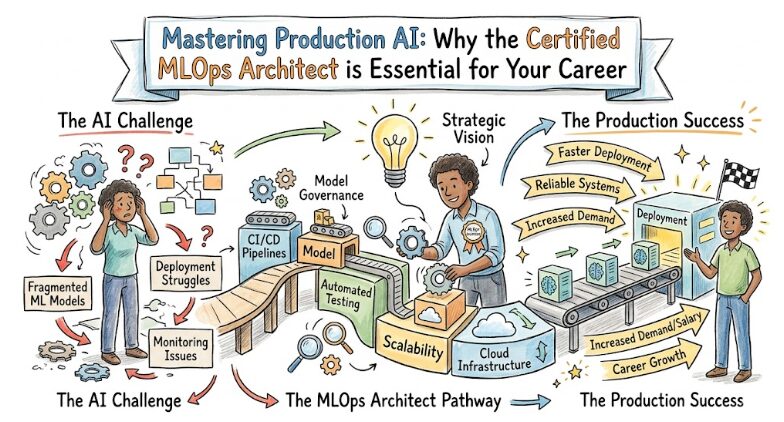
In the current landscape of enterprise technology, the transition from experimental machine learning to production-grade AI is the most significant challenge facing organizations. The Certified MLOps Architect designation is designed to bridge the gap between data science and operational excellence. This guide is crafted for engineers and technical leaders who recognize that a model is only as valuable as the system that supports it. By focusing on the intersection of DevOps, data engineering, and machine learning, this certification provides a structured path for professionals to master the complexities of automated model deployment and monitoring. Through AIOps School, learners gain the specific technical insights required to navigate the evolving demands of platform engineering and cloud-native architectures.
What is the Certified MLOps Architect?
The Certified MLOps Architect is a professional validation that signifies a deep understanding of the lifecycle management of machine learning models. Unlike traditional data science certifications that focus heavily on algorithms, this program emphasizes the infrastructure, automation, and reliability required to run ML at scale. It represents a shift toward “ML as a first-class citizen” in the software delivery pipeline, ensuring that models are reproducible, testable, and maintainable.
This certification exists because enterprises are struggling with “model rot” and manual deployment bottlenecks that prevent them from realizing ROI on AI investments. It aligns with modern engineering workflows by applying CI/CD principles to data and model code, creating a unified framework for cross-functional teams. By focusing on production-focused learning, the program prepares architects to design systems that handle data drift, manage feature stores, and ensure high availability for inference services in enterprise environments.
Who Should Pursue Certified MLOps Architect?
This certification is specifically tailored for professionals who sit at the crossroads of development and operations. Software engineers looking to specialize in AI infrastructure, and DevOps or SRE professionals aiming to broaden their scope into the data domain, will find this curriculum highly relevant. Cloud architects and platform engineers who are tasked with building the foundation for data science teams will also benefit significantly from the architectural patterns covered in the program.
Beyond individual contributors, technical leaders and engineering managers should pursue this certification to better understand the resource requirements and operational risks associated with ML projects. Beginners with a strong foundation in Linux and Python can use this as a roadmap to enter the high-growth field of AI operations. For professionals in India and globally, this credential serves as a signal to employers that the candidate can handle the unique challenges of model governance and scalable cloud infrastructure.
Why Certified MLOps Architect is Valuable in the Current Era and Beyond
As the initial hype around AI matures into a demand for tangible business results, the need for robust operational frameworks has never been higher. The Certified MLOps Architect credential remains valuable because it focuses on core principles that transcend specific tools, such as reproducibility and automated testing. Organizations are rapidly moving away from “laptop-based” data science toward centralized platforms, making the skills of an MLOps architect essential for long-term project viability.
Investing time in this certification provides a high return on effort by positioning professionals in a niche that is currently underserved by the traditional workforce. As enterprise adoption of AI increases, the complexity of managing thousands of models simultaneously will require a standardized approach to automation and security. This certification ensures that an engineer stays relevant even as individual libraries evolve, by mastering the fundamental architecture of the ML lifecycle.
Certified MLOps Architect Certification Overview
The Certified MLOps Architect program is a comprehensive curriculum delivered through the official platform hosted on the AIOps School website. The program is structured to provide a logical progression from foundational concepts to advanced architectural design, ensuring a holistic understanding of the field. It utilizes a mix of theoretical assessments and practical, project-based evaluations to validate that a candidate can apply their knowledge to real-world engineering scenarios.
Ownership of the certification lies with industry-recognized experts who ensure the content reflects the latest shifts in cloud-native technologies and data privacy regulations. The structure is designed to be flexible, allowing working professionals to learn at their own pace while maintaining a rigorous standard for certification. Rather than focusing on a single vendor, the program emphasizes a tool-agnostic approach that can be applied across AWS, Azure, Google Cloud, or on-premises environments.
Certified MLOps Architect Certification Tracks & Levels
The certification is divided into three distinct levels: Foundation, Professional, and Advanced. The Foundation level introduces the core vocabulary of MLOps, focusing on the differences between standard DevOps and ML-specific requirements. The Professional level dives deep into implementation details, such as building automated pipelines and managing model registries. The Advanced level is geared toward architectural leadership, covering topics like multi-cloud strategies, cost optimization, and large-scale governance.
Specialization tracks are also available for those coming from specific backgrounds such as SRE or FinOps. For instance, an SRE-focused track might emphasize model observability and latency management, while a FinOps track would focus on the economic impact of GPU utilization and storage costs. This tiered approach allows professionals to map their learning journey to their current career stage and their long-term professional aspirations.
Complete Certified MLOps Architect Certification Table
| Track | Level | Who it’s for | Prerequisites | Skills Covered | Recommended Order |
| Core MLOps | Foundation | Beginners, PMs | Basic Linux, IT Fundamentals | CI/CD Basics, ML Lifecycle | 1 |
| Implementation | Professional | DevOps/Data Engineers | Python, Containerization | Pipeline Automation, Registry | 2 |
| Architecture | Advanced | Senior Engineers, Leads | Cloud Architecture Exp | Scaling, Governance, Security | 3 |
| Reliability | SRE Specialization | Site Reliability Engineers | Infrastructure as Code | Monitoring, Drift Detection | 4 |
| Economics | FinOps Specialization | Cloud Architects | Cloud Billing Knowledge | Cost Management, Resource Ops | 5 |
Detailed Guide for Each Certified MLOps Architect Certification
Certified MLOps Architect – Foundation
What it is
This entry-level certification validates a professional’s understanding of the basic concepts, terminology, and workflows that define the MLOps discipline. It establishes a common language for cross-functional teams working on machine learning projects.
Who should take it
It is ideal for junior engineers, project managers, and business analysts who need to understand how machine learning models move from development to a production environment.
Skills you’ll gain
- Understanding the ML development lifecycle.
- Basic principles of version control for data and models.
- Awareness of the differences between DevOps and MLOps.
- Knowledge of standard model deployment patterns.
Real-world projects you should be able to do
- Setting up a basic Git repository for a machine learning project.
- Documenting a model’s deployment requirements for operations teams.
- Identifying bottlenecks in a manual model deployment process.
Preparation plan
- 7–14 days: Review official documentation and foundational whitepapers on MLOps principles.
- 30 days: Complete introductory online modules and participate in community study groups.
- 60 days: Not typically required for Foundation level unless transitioning from a non-technical role.
Common mistakes
- Focusing too much on specific machine learning algorithms instead of the operational process.
- Ignoring the importance of data versioning in the early stages of a project.
Best next certification after this
- Same-track option: Certified MLOps Architect – Professional.
- Cross-track option: Certified DataOps Associate.
- Leadership option: Project Management Professional (PMP) with AI focus.
Certified MLOps Architect – Professional
What it is
The Professional level validates the technical ability to implement and manage automated machine learning pipelines. It focuses on the “how” of MLOps, ensuring that candidates can build and maintain the systems that support model development.
Who should take it
This is designed for DevOps engineers, data engineers, and software developers who are responsible for building and maintaining ML infrastructure and automation.
Skills you’ll gain
- Building CI/CD pipelines specifically for machine learning.
- Implementing model registries and feature stores.
- Automating testing for data quality and model performance.
- Containerizing machine learning applications using Docker and Kubernetes.
Real-world projects you should be able to do
- Creating an automated pipeline that triggers a model retrain when new data is available.
- Setting up a centralized model registry to track versions and metadata.
- Implementing an automated testing suite for checking data drift before deployment.
Preparation plan
- 7–14 days: Intensive review of pipeline tools and containerization strategies for ML.
- 30 days: Hands-on lab work building end-to-end pipelines and troubleshooting common failures.
- 60 days: In-depth study of specialized tools and integration patterns across different cloud providers.
Common mistakes
- Treating model code exactly like application code without accounting for data dependencies.
- Failing to implement automated rollback procedures for failed model deployments.
Best next certification after this
- Same-track option: Certified MLOps Architect – Advanced.
- Cross-track option: Certified SRE Practitioner.
- Leadership option: Technical Lead / Architect Certification.
Certified MLOps Architect – Advanced
What it is
The Advanced certification is the highest level of validation, focusing on the strategic design and governance of large-scale MLOps platforms. It ensures the candidate can lead the architectural vision for an entire organization.
Who should take it
Senior architects, principal engineers, and technical directors who oversee multiple ML teams and high-stakes production environments should pursue this.
Skills you’ll gain
- Designing multi-tenant MLOps platforms for enterprise scale.
- Implementing robust governance, security, and compliance frameworks for AI.
- Optimizing infrastructure costs for large-scale model training and inference.
- Strategy for model monitoring and proactive incident response in AI systems.
Real-world projects you should be able to do
- Designing a global model deployment strategy that complies with local data residency laws.
- Auditing an existing AI platform for security vulnerabilities and cost inefficiencies.
- Creating a long-term roadmap for migrating legacy ML workflows to a modern MLOps architecture.
Preparation plan
- 7–14 days: High-level review of enterprise architecture patterns and regulatory compliance.
- 30 days: Case study analysis of large-scale ML failures and successful architectural transformations.
- 60 days: Comprehensive design of a hypothetical enterprise MLOps platform including cost and security projections.
Common mistakes
- Over-engineering the platform for small teams that do not yet have scale requirements.
- Neglecting the cultural shift required to align data science and engineering teams.
Best next certification after this
- Same-track option: Specialist certifications in Generative AI Ops.
- Cross-track option: Certified FinOps Professional.
- Leadership option: CTO or VP of Engineering executive programs.
Choose Your Learning Path
DevOps Path
The DevOps path focuses on extending existing software delivery expertise to the machine learning domain. Professionals on this path will learn how to adapt standard CI/CD tools to handle the non-deterministic nature of AI models. It emphasizes the “automation of everything,” ensuring that model training and deployment are as seamless as a standard microservice update. This path is perfect for those who want to build the underlying engines of AI-driven companies.
DevSecOps Path
The DevSecOps path integrates security into every stage of the machine learning lifecycle. It covers critical topics like adversarial attacks on models, securing data pipelines, and managing access to sensitive training datasets. Architects on this path focus on “shifting left” for AI security, ensuring that models are not only performant but also resilient to tampering and data leakage. This is a high-demand path for regulated industries like finance and healthcare.
SRE Path
The SRE path for MLOps architects prioritizes the reliability and observability of machine learning systems. It involves defining and measuring Service Level Objectives (SLOs) for model inference and building automated systems for detecting model drift or performance degradation. Engineers on this path focus on creating self-healing systems that can revert to previous model versions if the current production model fails to meet reliability standards.
AIOps Path
The AIOps path focuses on using artificial intelligence to improve general IT operations. While related to MLOps, it specifically targets the application of machine learning to log analysis, anomaly detection, and automated incident response. Architects in this path build the systems that help modern enterprises manage the overwhelming volume of operational data. It bridges the gap between infrastructure management and predictive maintenance for complex cloud environments.
MLOps Path
The dedicated MLOps path is a pure-play focus on the infrastructure required for machine learning. It covers the full spectrum from data ingestion and feature engineering to model deployment and monitoring. This path is ideal for those who want to be the primary architects of a company’s AI platform. It emphasizes the unique challenges of “Data + Code + Model” and how to synchronize these three variables for reliable output.
DataOps Path
The DataOps path focuses on the “Data” part of MLOps, ensuring that high-quality data is consistently available for model training. It applies agile and DevOps principles to data pipelines, focusing on reducing the cycle time of data delivery. Architects on this path work on data versioning, data quality automation, and the orchestration of complex data engineering workflows that feed into the ML lifecycle.
FinOps Path
The FinOps path addresses the massive costs associated with modern machine learning, particularly GPU and high-performance computing resources. Architects on this path learn how to track, manage, and optimize the cloud spend related to model training and inference. It combines technical architectural decisions with financial accountability, ensuring that AI projects remain economically viable as they scale to millions of users.
Role → Recommended Certified MLOps Architect Certifications
| Role | Recommended Certifications |
| DevOps Engineer | Certified MLOps Architect – Professional |
| SRE | Certified MLOps Architect – Professional + SRE Specialization |
| Platform Engineer | Certified MLOps Architect – Advanced |
| Cloud Engineer | Certified MLOps Architect – Foundation + Professional |
| Security Engineer | Certified MLOps Architect – Professional (Security Focus) |
| Data Engineer | Certified MLOps Architect – Professional + DataOps Focus |
| FinOps Practitioner | Certified MLOps Architect – Foundation + FinOps Track |
| Engineering Manager | Certified MLOps Architect – Foundation + Advanced (Leadership) |
Next Certifications to Take After Certified MLOps Architect
Same Track Progression
Once you have mastered the architectural basics, the next step is deep specialization in specific ML paradigms. This might include pursuing certifications in LLM-Ops (Large Language Model Operations) or specialized Edge AI deployment. Deepening your expertise in specific cloud-provider ML services like Amazon SageMaker or Google Vertex AI can also complement the tool-agnostic knowledge gained through the architect program.
Cross-Track Expansion
To become a truly versatile engineer, expanding into adjacent fields like DataOps or FinOps is highly recommended. Understanding the nuances of high-scale data engineering through DataOps allows an architect to build more resilient upstream systems. Similarly, gaining FinOps certification helps the architect justify their technical decisions by showing clear cost-benefit analyses to business stakeholders, which is crucial for senior roles.
Leadership & Management Track
For those looking to move into management, the technical foundation of an MLOps architect provides a perfect springboard. Transitioning toward executive leadership certifications or technical management programs can help you lead larger teams and define the AI strategy for an entire organization. This path focuses less on the code and more on team structure, budget management, and the ethical implications of AI deployment in the enterprise.
Training & Certification Support Providers for Certified MLOps Architect
DevOpsSchool
DevOpsSchool has established itself as a premier destination for technical training in India and abroad, focusing on the practical application of modern engineering tools. Their approach to MLOps training involves intensive, instructor-led sessions that cover the entire ecosystem from Git to Kubernetes. Students benefit from a massive library of resources and a community of experts who provide real-world insights into production challenges. They emphasize a hands-on learning model where participants build and break systems to understand the underlying architecture. This provider is particularly well-suited for those who prefer structured classroom environments and direct mentorship from industry veterans who have spent years in the field.
Cotocus
Cotocus is known for its specialized consulting and training services that cater to the specific needs of modern enterprises. Their training programs are often updated to reflect the latest trends in the cloud-native space, ensuring that learners are not just following old manuals. When it comes to MLOps, Cotocus focuses on the integration of various open-source tools to create a cohesive platform. Their curriculum is designed for professionals who need to solve immediate business problems using advanced automation. By providing a mix of theoretical knowledge and practical labs, they ensure that their graduates can immediately contribute to high-stakes projects in the corporate world.
Scmgalaxy
Scmgalaxy serves as a comprehensive knowledge hub and community for professionals in the software configuration and DevOps space. They provide an extensive array of tutorials, articles, and training programs that help engineers stay updated with the fast-moving tech landscape. Their focus on the Certified MLOps Architect path is deeply rooted in the history of software delivery, providing context that many newer programs lack. They offer a wealth of self-study materials and community-driven support that makes them a great resource for independent learners. For those who want to dive deep into the documentation and history of automation tools, this provider offers unparalleled depth.
BestDevOps
BestDevOps focuses on providing high-quality, curated training experiences that prioritize career transformation and skill mastery. Their programs are designed to be accessible yet rigorous, making them a popular choice for engineers looking to level up their current roles. In the realm of MLOps, they provide clear roadmaps that guide students through the complex web of technologies involved in AI operations. Their training often includes career coaching and resume support, ensuring that the technical skills gained translate into real-world professional growth. They are a strong choice for individuals who want a personalized touch and a focus on long-term career success in the tech industry.
devsecopsschool.com
DevSecOpsSchool is a specialized provider focusing on the critical intersection of security and operations. As machine learning models become more integral to business, the security of these systems becomes paramount, and this school addresses that gap perfectly. Their training for MLOps architects includes deep dives into vulnerability scanning, compliance as code, and securing data at rest and in transit. They provide a security-first perspective that is essential for architects working in the government, financial, or healthcare sectors. By emphasizing the “Security” in the pipeline, they prepare professionals to build systems that are as safe as they are efficient.
sreschool.com
SRESchool focuses on the art and science of reliability engineering, a crucial component for any production machine learning system. Their curriculum for MLOps professionals centers on monitoring, alerting, and incident management for AI models. They teach students how to manage the uncertainty of ML outputs and how to build resilient systems that can withstand data drift and infrastructure failures. The school’s approach is highly practical, focusing on the metrics and tools that keep high-traffic systems running smoothly. For an MLOps architect, the skills learned here are the difference between an experimental prototype and a reliable enterprise service that can be trusted.
aiopsschool.com
AIOpsSchool is the primary authority for certifications that combine artificial intelligence with IT operations. They provide a dedicated platform for the Certified MLOps Architect program, ensuring that the curriculum is always at the cutting edge of the industry. Their focus is purely on the application of AI to solve operational challenges and the management of AI systems themselves. This specialization allows them to offer a level of detail and nuance that broader providers might miss. Their training programs are designed by practitioners who are currently working on high-scale AI platforms, providing students with the most current and relevant information available.
dataopsschool.com
DataOpsSchool addresses the foundational layer of any AI initiative: the data itself. Their training programs focus on the principles of DataOps, which are essential for any MLOps architect to understand. They teach how to build automated, high-quality data pipelines that serve as the fuel for machine learning models. By applying DevOps concepts to data management, they help engineers reduce data errors and improve the speed of data delivery. For professionals who want to master the entire stack from data ingestion to model inference, this provider offers the essential knowledge required to manage the data lifecycle effectively.
finopsschool.com
FinOpsSchool is the leading provider for training in cloud financial management, an increasingly important topic for MLOps architects. As AI projects can quickly become expensive due to the high cost of specialized hardware, understanding cloud economics is vital. This school teaches architects how to design systems that are not only technically sound but also cost-efficient. They cover topics like rightsizing resources, optimizing spot instances for model training, and building transparent cost reporting for AI initiatives. Graduates from this program are equipped to handle the business side of technology, making them invaluable to organizations concerned with the bottom line.
Frequently Asked Questions (General)
- What is the typical difficulty level of these certifications?
The difficulty varies by level. Foundation is accessible to most IT professionals, while Professional and Advanced require significant hands-on experience and a deep understanding of architectural patterns. - How long does it take to get certified?
A dedicated professional can achieve the Foundation level in a few weeks. The Professional and Advanced levels typically require 2-4 months of study and practical experience to master. - Are there any mandatory prerequisites?
While there are no strict gatekeepers for the lower levels, a strong understanding of Python, Linux, and basic cloud infrastructure is highly recommended before starting the Professional track. - What is the return on investment for an MLOps certification?
Professionals with these skills often see significant salary increases and access to more senior roles, as the demand for architects who can operationalize AI currently far exceeds the supply. - Should I learn DevOps before MLOps?
It is highly beneficial to have a foundation in standard DevOps (CI/CD, containerization) before moving into MLOps, as the latter builds upon these core engineering principles. - Is this certification recognized globally?
Yes, the principles and tools covered are industry standards used by major tech companies and enterprises worldwide, making the certification relevant in any geographic market. - Do I need to be a data scientist to be an MLOps architect?
No, you do not need to be a data scientist. You need to understand the data science workflow, but your primary role is engineering, infrastructure, and automation. - How often should I renew my certification?
Due to the rapid pace of change in the AI field, it is recommended to refresh your knowledge or pursue a higher level of certification every two years to stay current. - Can this certification help me move into a management role?
Yes, the Advanced level specifically covers governance and strategy, which are key components of technical leadership and engineering management roles. - What tools are covered in the training?
The programs are generally tool-agnostic but include hands-on experience with popular tools like Kubernetes, Docker, MLflow, Kubeflow, and various cloud-native AI services. - Is there a community for certified professionals?
Yes, most providers offer access to alumni networks and community forums where professionals can share insights, find job opportunities, and collaborate on projects. - Are the exams proctored?
Yes, to maintain the integrity of the certification, exams for the Professional and Advanced levels are typically proctored and require the successful completion of practical labs.
FAQs on Certified MLOps Architect
- How does this certification differ from a standard Cloud Architect role?
A Cloud Architect focuses on general infrastructure, while an MLOps Architect focuses on the specific data pipelines and model lifecycles that make AI work at scale. - Is there a focus on Generative AI and LLMs?
The core principles apply to all models, but recent updates to the curriculum include specific architectural patterns for managing and deploying Large Language Models (LLMs). - Does the program cover data privacy and ethics?
Yes, the Advanced level includes significant modules on model governance, ensuring that AI systems are compliant with regulations like GDPR and are built ethically. - What programming languages are most important for this path?
Python is the primary language used in the curriculum, though understanding YAML for configuration and Bash for scripting is also essential for the automation components. - Can I pass this exam using only theoretical knowledge?
It is very unlikely. The Professional and Advanced levels are designed to test your ability to solve real-world problems through practical, hands-on lab exercises. - How does MLOps handle “Model Drift”?
The certification teaches you how to build automated monitoring systems that detect when a model’s performance drops and trigger automated retraining or alerts for human intervention. - Is this certification useful for small startups?
Absolutely. While the scale is smaller, the principles of reproducibility and automation are even more critical for small teams who need to move fast without breaking systems. - What is the focus of the Advanced architectural track?
The focus is on enterprise-grade challenges: multi-cloud deployments, high-security environments, and managing the total cost of ownership for massive AI platforms.
Final Thoughts: Is Certified MLOps Architect Worth It?
From the perspective of a mentor who has seen the industry move from physical servers to the cloud and now to AI, I can tell you that the Certified MLOps Architect is one of the most strategic investments you can make. The world has enough people who can build a model in a notebook; it does not have enough people who can build a system that keeps that model running reliably for a million users. This certification doesn’t just teach you a tool; it teaches you a mindset of reliability and scalability that is rare and highly valued.
If you are an engineer who enjoys solving complex, multi-dimensional problems, this path is for you. It requires patience and a willingness to constantly learn, but the career stability and the opportunity to work on the frontier of technology are well worth the effort. My advice is to start with the foundations, get your hands dirty with the professional-level tools, and always keep the end-user and the business value in mind. This isn’t about the hype; it’s about building the future of enterprise engineering.