Introduction
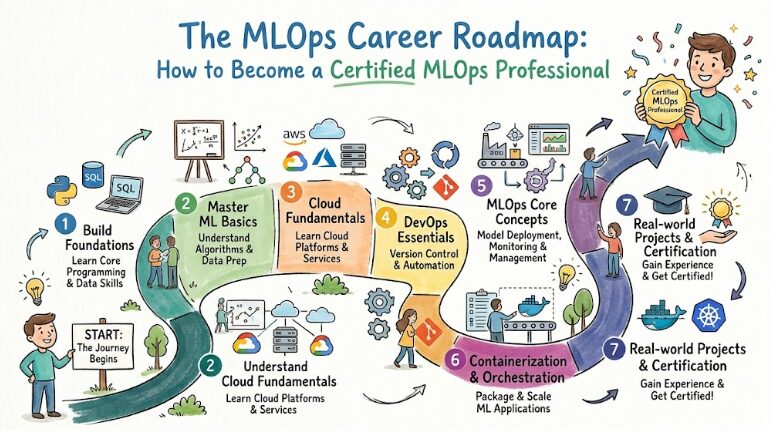
The transition from experimental machine learning to production-grade artificial intelligence is one of the most significant challenges facing modern enterprises. While data scientists excel at building models, the operationalization of those models requires a rigorous engineering approach known as MLOps. This guide explores the Certified MLOps Professional designation, a curriculum designed to bridge the gap between data science and IT operations. This roadmap is intended for engineers, architects, and technical leaders who aim to master the lifecycle of machine learning systems within cloud-native environments.
Navigating the landscape of DevOps, SRE, and platform engineering now requires a deep understanding of how data and models integrate into standard software delivery pipelines. The AIOps School provides a structured framework for professionals to validate their expertise in automating model deployment, monitoring, and governance. By following this guide, professionals can make informed decisions about their career trajectory and understand how to apply MLOps principles to solve real-world scalability and reliability issues in the enterprise.
What is the Certified MLOps Professional?
The Certified MLOps Professional program represents a standardized benchmark for engineers who need to manage the complexities of machine learning in production. Unlike theoretical courses that focus solely on model architecture, this certification emphasizes the “Ops” in MLOps, focusing on the infrastructure, automation, and monitoring necessary for sustainable AI. It exists to provide a clear, competency-based framework for professionals to prove they can handle the unique challenges of data versioning, model drift, and automated retraining.
This certification aligns with modern engineering workflows by treating machine learning assets as first-class citizens in the DevOps pipeline. It emphasizes enterprise practices such as CI/CD for ML, infrastructure as code for GPU clusters, and rigorous testing for both code and data. By focusing on production-grade outcomes, the program ensures that practitioners are prepared to move models from a researcher’s notebook into a scalable, resilient, and observable production environment that meets business requirements.
Who Should Pursue Certified MLOps Professional?
This certification is designed for a broad spectrum of technical professionals who sit at the intersection of development and operations. Software engineers looking to specialize in the high-growth field of AI infrastructure will find the curriculum particularly beneficial. Site Reliability Engineers (SREs) and Cloud Architects who are tasked with maintaining the uptime and performance of ML-driven applications will gain the specific specialized knowledge required to manage non-deterministic systems and heavy compute workloads.
The program also caters to data engineers who need to build robust pipelines and security professionals who must audit ML systems for compliance and vulnerability. For engineering managers and technical leaders in India and across the global market, this certification provides the conceptual foundation needed to lead cross-functional teams effectively. Whether you are a beginner looking to enter the field or an experienced professional aiming to formalize your skills, this certification offers a path toward mastering the operational side of artificial intelligence.
Why Certified MLOps Professional is Valuable Today and Beyond
In the current technological landscape, the demand for MLOps expertise is outpacing the supply of qualified engineers. As enterprises move beyond basic AI experimentation, they require professionals who can ensure that models remain accurate, secure, and cost-effective over time. The Certified MLOps Professional program provides the longevity needed for a career in this space by teaching fundamental principles that remain relevant even as specific tools and frameworks evolve.
The value of this certification lies in its focus on the return on time and career investment. By mastering the ability to automate the ML lifecycle, professionals can significantly reduce the “technical debt” often associated with manual model deployments. This expertise ensures that an individual remains a critical asset to any organization seeking to implement AI at scale. As enterprise adoption of AI continues to grow, having a validated skill set in MLOps will be a key differentiator in the competitive global job market.
Certified MLOps Professional Certification Overview
The program is delivered via the official portal at Certified MLOps Professional and is hosted on the AIOps School platform. This certification is structured to provide a comprehensive evaluation of a candidate’s ability to design, implement, and manage MLOps workflows. The assessment approach is practical, often involving hands-on scenarios that reflect the actual challenges faced by MLOps teams in industry settings.
Ownership of the certification rests with a body of experts who ensure the content is updated to reflect the latest industry trends and best practices. The structure is broken down into modular components, covering everything from data engineering and model training automation to deployment strategies and post-deployment monitoring. This practical orientation ensures that the certification is not just a theoretical credential but a reflection of an engineer’s ability to deliver tangible results in a production environment.
Certified MLOps Professional Certification Tracks & Levels
The certification is organized into three distinct levels to accommodate various stages of professional growth. The Foundation level focuses on the core concepts of MLOps, introducing candidates to the vocabulary, basic tools, and the overarching philosophy of combining data science with DevOps. This level is ideal for those new to the field or managers who need a high-level understanding of the ML lifecycle without getting bogged down in implementation details.
The Professional level is where the technical deep dive occurs, focusing on implementation, pipeline construction, and automation. This level is targeted at active practitioners who are responsible for building and maintaining MLOps systems. Finally, the Advanced level focuses on architecture, strategy, and complex problem-solving at the enterprise scale. These levels are designed to align with a natural career progression, allowing a professional to grow from a foundational contributor to a senior architect or technical lead.
Complete Certified MLOps Professional Certification Table
| Track | Level | Who it’s for | Prerequisites | Skills Covered | Recommended Order |
| MLOps Core | Foundation | Beginners, Managers | Basic IT knowledge | MLOps Lifecycle, Tools | First |
| MLOps Engineering | Professional | DevOps, Data Engineers | Linux, Python, CI/CD | Pipeline Automation, Monitoring | Second |
| MLOps Architecture | Advanced | Senior Engineers, Leads | Professional Cert | Scaling, Governance, Strategy | Third |
| Specialized DataOps | Professional | Data Engineers | Data SQL, ETL | Data Versioning, Feature Stores | Optional |
| Specialized AIOps | Professional | SREs, IT Ops | Monitoring knowledge | AI for IT Operations, Analytics | Optional |
Detailed Guide for Each Certified MLOps Professional Certification
Certified MLOps Professional – Foundation
What it is
This certification validates a candidate’s understanding of the fundamental principles of MLOps. It confirms that the individual understands the differences between traditional DevOps and MLOps and can identify the core components of a machine learning pipeline.
Who should take it
This is suitable for junior engineers, product managers, and data scientists who want to understand how their models are deployed. It is also an excellent entry point for IT professionals transitioning from traditional software backgrounds.
Skills you’ll gain
- Understanding the MLOps maturity model.
- Identifying key roles and responsibilities in an MLOps team.
- Familiarity with common MLOps tools and cloud services.
- Knowledge of the end-to-end ML lifecycle from data ingestion to monitoring.
Real-world projects you should be able to do
- Create a conceptual design for a basic ML pipeline.
- Document the requirements for an MLOps environment.
- Conduct a gap analysis of an existing ML workflow.
Preparation plan
- 7–14 days: Review the official glossary and watch introductory videos on MLOps concepts.
- 30 days: Complete the foundational modules on the platform and take practice quizzes.
- 60 days: Deeply study the integration points between data science and operations through case studies.
Common mistakes
- Focusing too much on specific machine learning algorithms instead of the operational workflow.
- Underestimating the importance of data management in the MLOps process.
Best next certification after this
- Same-track option: Certified MLOps Professional – Professional Level
- Cross-track option: Cloud Practitioner or DevOps Foundation
- Leadership option: Project Management Professional (PMP)
Certified MLOps Professional – Professional
What it is
This certification validates the technical ability to implement and manage MLOps pipelines. It covers the hands-on aspects of automation, containerization, and orchestration specifically tailored for machine learning workloads.
Who should take it
This is intended for DevOps engineers, data engineers, and SREs who are actively working on or moving into MLOps roles. A working knowledge of Python and container technologies like Docker is highly recommended.
Skills you’ll gain
- Building CI/CD pipelines for machine learning models.
- Implementing model versioning and data lineage.
- Deploying models using Kubernetes and serverless architectures.
- Setting up automated monitoring for model performance and data drift.
Real-world projects you should be able to do
- Automate the retraining of a model based on performance triggers.
- Build a scalable feature store for high-throughput model inference.
- Implement an A/B testing framework for model deployment in production.
Preparation plan
- 7–14 days: Set up a lab environment with Docker and a CI/CD tool like Jenkins or GitLab.
- 30 days: Complete hands-on labs focusing on model deployment and monitoring tools.
- 60 days: Build a full end-to-end pipeline using a cloud provider (AWS, Azure, or GCP).
Common mistakes
- Ignoring security practices during the model deployment phase.
- Failing to implement robust logging and observability for ML components.
Best next certification after this
- Same-track option: Certified MLOps Professional – Advanced Level
- Cross-track option: Certified Kubernetes Administrator (CKA)
- Leadership option: Technical Lead or Architect training
Choose Your Learning Path
DevOps Path
The DevOps path focuses on integrating machine learning into existing software delivery frameworks. Engineers on this path will learn how to extend traditional CI/CD pipelines to handle model artifacts and data dependencies. The goal is to treat ML as just another part of the software ecosystem while respecting its unique requirements for compute and data. This path is ideal for those who want to bridge the gap between application development and data science production.
DevSecOps Path
The DevSecOps path emphasizes the security and compliance aspects of machine learning operations. It involves learning how to secure data pipelines, protect model endpoints from adversarial attacks, and ensure data privacy throughout the lifecycle. Professionals will focus on automating security scans for ML code and auditing the provenance of training data. This path is critical for highly regulated industries such as finance and healthcare where model integrity is paramount.
SRE Path
The SRE path for MLOps centers on the reliability and scalability of machine learning systems. It applies Site Reliability Engineering principles—such as Error Budgets and Service Level Objectives—to the specific world of AI. Engineers learn how to manage the infrastructure that supports large-scale model inference and how to automate the recovery of failed ML services. This path is suited for those who enjoy troubleshooting complex distributed systems and optimizing performance.
AIOps Path
The AIOps path focuses on using artificial intelligence and machine learning to improve IT operations themselves. Professionals on this track learn how to implement algorithms that detect anomalies in system logs, predict outages before they occur, and automate the resolution of common IT tickets. This is a distinct field from MLOps, as it uses AI as a tool for the operations team rather than focusing on the deployment of business models. It is highly valuable for large-scale enterprise infrastructure management.
MLOps Path
The MLOps path is the primary technical route for those dedicated to the machine learning lifecycle. It covers the technical depths of model orchestration, experiment tracking, and automated model governance. Engineers focus on tools like Kubeflow, MLflow, and specialized feature stores to create a seamless flow from the data scientist’s workspace to the production environment. This path provides the most comprehensive coverage of the Certified MLOps Professional curriculum.
DataOps Path
The DataOps path concentrates on the health and flow of data that feeds machine learning models. Without high-quality, reliable data, MLOps cannot succeed. This path teaches engineers how to apply DevOps principles to data pipelines, focusing on data quality testing, versioning, and automated ETL processes. It is the perfect path for data engineers who want to ensure that the foundation of their ML systems is robust and scalable.
FinOps Path
The FinOps path focuses on the financial management and optimization of machine learning workloads. Because ML can consume vast amounts of expensive GPU and TPU resources, managing costs is a vital skill. Professionals learn how to attribute costs to specific models, optimize resource utilization, and implement automated scaling to keep cloud bills under control. This path is essential for organizations looking to scale their AI initiatives sustainably and profitably.
Role → Recommended Certified MLOps Professional Certifications
| Role | Recommended Certifications |
| DevOps Engineer | Certified MLOps Professional (Professional), CKA |
| SRE | Certified MLOps Professional (Professional), SRE Foundation |
| Platform Engineer | Certified MLOps Professional (Advanced), Terraform Associate |
| Cloud Engineer | Certified MLOps Professional (Professional), Cloud Architect |
| Security Engineer | Certified MLOps Professional (Foundation), DevSecOps Professional |
| Data Engineer | Certified MLOps Professional (Professional), DataOps Professional |
| FinOps Practitioner | Certified MLOps Professional (Foundation), FinOps Certified |
| Engineering Manager | Certified MLOps Professional (Foundation), Leadership Training |
Next Certifications to Take After Certified MLOps Professional
Same Track Progression
Once you have achieved the professional level of the Certified MLOps Professional, the natural progression is toward the Advanced or Expert levels. This involves deep specialization in niche areas such as distributed training at scale or specialized hardware acceleration. Staying within the track allows you to become a recognized subject matter expert in the field, making you a prime candidate for principal engineering or architectural roles within large-scale AI organizations.
Cross-Track Expansion
For those looking to broaden their skill set, expanding into adjacent tracks like DataOps or DevSecOps is highly recommended. Understanding the security implications of ML or the intricacies of data pipeline management makes you a more versatile and valuable engineer. This cross-pollination of skills allows you to handle a wider variety of project challenges and effectively communicate across different technical teams, which is essential for senior-level career growth.
Leadership & Management Track
If you are interested in moving into leadership, transitioning toward management certifications or strategic architecture programs is the logical step. A leader with a Certified MLOps Professional background is uniquely positioned to guide organizations through the complexities of AI transformation. This path focuses on team building, budget management, and aligning technical AI capabilities with business goals, ensuring that the technology delivers actual value to the enterprise.
Training & Certification Support Providers for Certified MLOps Professional
DevOpsSchool is a leading platform that provides comprehensive training programs for a wide range of engineering certifications. They offer hands-on labs and instructor-led sessions that help professionals master the technical requirements of the Certified MLOps Professional program. Their curriculum is designed by industry experts who bring real-world scenarios into the classroom, ensuring that students gain practical knowledge that can be applied immediately in their jobs. They have a strong presence in the Indian market and offer flexible learning schedules.
Cotocus specializes in high-end technical training and consulting, focusing on cloud-native technologies and MLOps. They provide personalized mentoring and intensive bootcamps designed to help engineers clear professional certifications. Their approach emphasizes deep technical understanding and the ability to solve complex architectural problems. For those pursuing the Certified MLOps Professional, Cotocus offers specialized modules that cover advanced automation and infrastructure management, making them a preferred choice for senior professionals seeking to upgrade their skills.
Scmgalaxy is a community-driven platform that offers an extensive library of resources, tutorials, and training for DevOps and MLOps. They focus on the practical implementation of tools like Git, Jenkins, and Kubernetes within the machine learning lifecycle. For candidates of the Certified MLOps Professional, Scmgalaxy provides a wealth of community support and practice materials that are invaluable for exam preparation. Their content is known for being straightforward and highly relevant to the daily tasks of an automation engineer.
BestDevOps provides targeted training for professionals looking to excel in the operations space. They offer structured courses that guide students through the complexities of modern software delivery and machine learning operations. Their training methodology for the Certified MLOps Professional focuses on the integration of various tools into a cohesive pipeline. They provide a supportive learning environment with access to experienced mentors who help clarify difficult concepts and provide career guidance for those entering the MLOps field.
devsecopsschool.com is the go-to resource for engineers who want to integrate security into their MLOps workflows. They offer specialized training that aligns with the Certified MLOps Professional program, with a heavy emphasis on the DevSecOps path. Their courses cover essential topics like model security, data privacy compliance, and automated security testing. For professionals who want to ensure their machine learning systems are not only efficient but also secure, this platform provides the specialized knowledge required to achieve that goal.
sreschool.com focuses on the principles of reliability and performance, which are critical for successful MLOps implementation. They provide training that helps engineers apply SRE practices to machine learning systems, ensuring high availability and optimal resource usage. Their curriculum supports the Certified MLOps Professional by teaching candidates how to manage large-scale ML infrastructure and automate incident response. This is an excellent resource for SREs looking to pivot into the world of AI operations.
aiopsschool.com is the primary hosting and delivery partner for the Certified MLOps Professional program. They offer the most direct and comprehensive path to achieving the certification, with a curriculum that is specifically designed to meet the program’s requirements. Their platform provides a seamless learning experience, from foundational courses to advanced architectural modules. By training directly with the hosting site, professionals can ensure they are getting the most up-to-date and relevant information for their certification journey.
dataopsschool.com provides specialized training for data engineers and professionals focused on the data lifecycle within MLOps. Their courses emphasize the importance of data quality, versioning, and pipeline automation. For those pursuing the Certified MLOps Professional, dataopsschool.com offers the deep dive into data management that is often missing from more general courses. Their training ensures that the data feeding the machine learning models is reliable, clean, and well-governed, which is the foundation of any successful ML project.
finopsschool.com addresses the critical need for cost management in cloud-based machine learning operations. They provide training on how to optimize GPU spend and manage the financial impact of large-scale AI initiatives. Their curriculum is highly relevant for professionals taking the Certified MLOps Professional who need to demonstrate fiscal responsibility and resource efficiency. By learning FinOps principles, engineers can ensure that their MLOps strategies are not only technically sound but also financially sustainable for their organizations.
Frequently Asked Questions (General)
- What is the typical difficulty level of the Certified MLOps Professional exam?
The exam is considered moderate to challenging because it requires both a conceptual understanding of MLOps and practical knowledge of engineering tools like Docker, Kubernetes, and CI/CD platforms. - How much time does it usually take to prepare for this certification?
For an experienced DevOps engineer, 30 to 45 days of focused study is usually sufficient. Beginners or those transitioning from other fields may require 60 to 90 days to master the prerequisites and core concepts. - Are there any mandatory prerequisites before taking the Professional level exam?
While there are no strict official prerequisites, it is highly recommended to have a basic understanding of Python, Linux command line, and general DevOps principles before attempting the Professional level. - What is the return on investment for the Certified MLOps Professional?
The ROI is significant, as MLOps professionals often command higher salaries than general DevOps engineers. It also opens doors to specialized roles in high-growth companies building AI products. - In what order should I take the certifications if I want to be an architect?
The recommended order is Foundation, followed by Professional, then a specialization like DataOps, and finally the Advanced MLOps Architecture level. - Does this certification focus on a specific cloud provider like AWS or Azure?
The certification is designed to be cloud-agnostic, focusing on principles and tools that can be applied across any major cloud provider or on-premises environment. - How long is the certification valid for?
The certification is typically valid for two to three years, after which professionals are encouraged to recertify to stay updated with the latest industry changes and tool versions. - Is there a hands-on component to the assessment?
Yes, the Professional and Advanced levels often include practical scenarios or lab-based assessments to ensure candidates can apply their knowledge in real-world situations. - Can a data scientist benefit from this certification?
Absolutely. It helps data scientists understand the operational constraints of their models, leading to better collaboration with engineering teams and more successful deployments. - Are there group discounts available for corporate teams?
Many training providers associated with the program offer corporate packages and group discounts for teams looking to upskill their entire engineering department. - Does the certification cover the ethical aspects of AI and machine learning?
Yes, the curriculum includes modules on model governance, bias detection, and ethical considerations, which are increasingly important for enterprise compliance. - How does this certification compare to general DevOps certifications?
While general DevOps certs focus on application lifecycles, this certification specifically addresses the unique challenges of data versioning, model retraining, and non-deterministic software behavior.
FAQs on Certified MLOps Professional
- Why is the Certified MLOps Professional important for engineers in India?
India is a global hub for IT services and product development. As more global companies move their AI operations to India, having a recognized MLOps credential becomes a vital competitive advantage for local engineers. - Does this program cover specific MLOps tools like Kubeflow or MLflow?
Yes, the curriculum introduces these industry-standard tools and explains how they fit into the broader MLOps ecosystem for experiment tracking and model orchestration. - How much coding is required to pass the Professional level?
A proficient understanding of Python is necessary, particularly for writing automation scripts, managing data pipelines, and interacting with various MLOps tool APIs. - Can I take the exam online, or do I need to go to a testing center?
The certification is designed to be accessible globally, with online proctored exam options available through the official hosting platform. - Does the certification teach you how to build machine learning models?
The focus is on the operationalization of models rather than model development. While you will learn the basics of the ML process, the emphasis is on deployment, monitoring, and scaling. - Is there a focus on large language models (LLMs) in this certification?
The newer modules of the program address the specific operational challenges of LLMs, such as fine-tuning pipelines and managing vector databases. - What kind of career support is provided after certification?
Many of the associated training providers offer job assistance, resume building, and access to a network of hiring partners looking for MLOps talent. - How often is the Certified MLOps Professional curriculum updated?
The curriculum is reviewed annually by a panel of industry experts to ensure it reflects the most current practices and tools used in production environments.
Final Thoughts: Is Certified MLOps Professional Worth It?
As a mentor who has seen the evolution of the industry from physical servers to cloud-native AI, my advice is straightforward: MLOps is not a trend; it is the inevitable maturity of the software engineering discipline. The Certified MLOps Professional program provides a structured and credible way to gain the skills that the market is currently desperate for. It moves you beyond the hype of AI and gives you the tools to build systems that actually work, scale, and provide value over the long term.
If you are an engineer looking to future-proof your career, this is a solid investment. It requires effort and a willingness to learn both the data and the operations side of the house, but the career impact is undeniable. There is no sales pitch here—just the reality that as AI becomes integrated into every piece of software, the people who know how to keep those systems running reliably will be the most valuable people in the room. This certification is a practical step toward becoming one of those professionals.