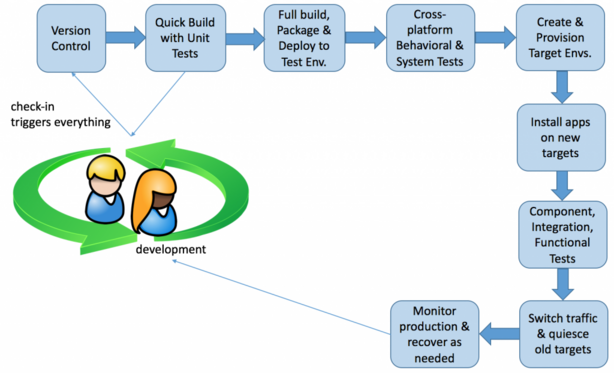
What Is Continuous Delivery?
Continuous Delivery (CD) is a software engineering discipline in which teams produce software in short cycles, ensuring that code can be reliably released at any time. The core idea is to replace the traditional, phase-gated release process — where code travels through isolated stages of development, testing, staging, and production over weeks or months — with an automated pipeline that moves changes toward production continuously and safely.
In a mature CD practice, every commit that passes automated tests is a candidate for release. Deployment becomes a low-risk, routine activity rather than a high-stakes event. The business benefit is faster delivery of value to users and quicker feedback loops for development teams.
Why Mainframes Are a Special Case
Mainframe systems — IBM z/OS environments being the most prevalent — power mission-critical workloads in banking, insurance, retail, and government. These platforms process enormous transaction volumes and are held to extremely high availability and auditability standards. That context shapes every decision about how software is developed and released on them.
The tooling, languages (COBOL, PL/I, Assembler, CICS, JCL), and operational models on mainframes evolved decades before Agile and DevOps became mainstream. As a result, several structural differences make applying standard CD practices non-trivial:
- Different version control conventions. Mainframe source code has historically lived in Partitioned Data Sets (PDS) rather than Git repositories, making integration with modern SCM tools a first hurdle.
- Compiled artifacts and load modules. Mainframe programs must be compiled and link-edited into load modules before they can run. Managing these binary artifacts through a pipeline requires tooling that understands z/OS object formats.
- Heavyweight change management. Regulated industries operating mainframes often require manual change advisory board (CAB) approvals, audit trails, and separation of duties — processes that must be encoded into, rather than bypassed by, a CD pipeline.
- Shared environments. Mainframe LPAR (Logical Partition) environments are expensive, so development, test, and pre-production stages often share resources. This complicates environment isolation strategies common in CD.
- Skill gaps. COBOL and JCL expertise is concentrated in experienced staff; DevOps and pipeline engineering skills are concentrated in younger teams. Bridging that knowledge gap is an organisational as much as a technical challenge.
Core Principles of CD Applied to Mainframes
Despite those differences, the fundamental CD principles still apply and can deliver measurable value on the mainframe:
1. Version Everything in a Modern SCM
Migrating mainframe source into Git (or another modern VCS) is the foundation. Tools and plugins exist to synchronise z/OS data sets with Git repositories, allowing mainframe code to participate in the same branching, pull-request, and code-review workflows used for distributed systems. This single change dramatically improves traceability and collaboration.
2. Automate the Build
Compile, link-edit, and package steps that were previously triggered manually via JCL jobs can be automated and invoked from a CI server such as Jenkins or Azure DevOps. Successful builds should produce versioned, immutable artifacts stored in an artifact repository — treating load modules the same way a Java pipeline treats a JAR file.
3. Shift Testing Left
Unit testing frameworks for COBOL (such as IBM’s zUnit/CBLTDAST or the open-source COBOL Check project) allow developers to write automated tests that run as part of the pipeline. Integration and regression test suites that previously ran only late in the cycle can be parallelised and triggered automatically on every commit.
4. Automate Deployment with Auditability
Deployment automation on z/OS typically involves IBM’s Software Delivery Pipeline tooling, Broadcom’s Compuware or ISPW, or open standards such as Ansible for z/OS. The goal is repeatable, scripted deployment that generates an auditable record — satisfying compliance requirements without manual steps that introduce delay and error.
5. Pipeline Visibility Across Platforms
Many organisations run hybrid applications where a mainframe back-end services distributed or cloud-based front-ends. A holistic CD pipeline should surface the status of mainframe builds and deployments in the same dashboard used for other components, giving teams a single view of system health before any release proceeds.
Organisational and Cultural Challenges
Technical tooling is only part of the story. Organisations pursuing mainframe CD typically encounter several cultural obstacles:
- Siloed teams. Mainframe and distributed development teams rarely share practices, stand-ups, or pipelines. Breaking down those silos requires deliberate organisational change as well as tooling integration.
- Risk aversion. The consequences of a production outage on a mainframe processing millions of financial transactions per hour are severe. CD adoption on mainframes must be incremental and demonstrate reliability improvements, not just speed.
- Knowledge transfer. As experienced mainframe engineers retire, capturing their implicit knowledge of system behaviour into automated tests and documented runbooks becomes urgent.
The Business Case
Organisations that successfully implement CD on mainframes report benefits consistent with those seen on distributed platforms: fewer defects reaching production, shorter lead times from code commit to deployment, and reduced toil for operations teams. In regulated industries where change windows are constrained, the ability to deploy smaller, better-tested changes more frequently also reduces the risk associated with each individual release.
The mainframe is not going away. An estimated proportion of the world’s commercial transaction volume still runs on IBM Z hardware, and organisations that treat mainframe delivery as a second-class concern relative to their cloud-native work create operational and competitive risk. Extending CD principles to the mainframe is no longer an exotic project — it is a mainstream DevOps priority.
Getting Started
A pragmatic starting point for teams new to mainframe CD:
- Audit current source code management practices and identify the gap between PDS-based workflows and Git.
- Select a pilot application — ideally one with a well-understood test suite and moderate change frequency.
- Automate the build and a basic smoke-test suite, integrating with your existing CI server.
- Instrument the deployment process to generate an audit log, and get sign-off from compliance stakeholders that the log satisfies their requirements.
- Expand coverage iteratively, measuring lead time and defect escape rate as lagging indicators of progress.
Mainframe CD is a long journey, but each incremental step towards automation, visibility, and repeatability delivers value — and reduces the risk of the next release.