This article is based on a briefing originally published by the House of Commons Library, authored by Claire Mills, Senior Library Clerk specialising in the armed forces and defence.
Background: Operation Banner and the Scale of the Conflict
Over 250,000 military personnel served in Northern Ireland during Operation Banner — the longest continuous deployment of troops in British military history, running from August 1969 to July 2007. During that period, 1,441 military personnel died as a result of operations, with 722 killed in paramilitary attacks. The British military were responsible for the deaths of 301 people over the same span, more than half of whom were civilians. In total, approximately 3,520 people were killed during the Troubles.
Military Law and the Rules of Engagement
Military personnel are subject to both service law and civilian law wherever they serve. For every operation, personnel are issued rules of engagement that establish the circumstances and limitations under which they may use armed force. These rules are tailored to the specific operation and are intended to help commanders and soldiers remain within the law and any applicable political constraints. Importantly, the rules themselves carry no independent legal force.
For personnel serving in Northern Ireland between 1969 and 2007, the rules of engagement were contained in what became known as the yellow card. The original version had 21 rules, but was considered too detailed and complex. It was amended in 1980 to just six rules, which included the directive that only the minimum force necessary should be used and that firearms were to be deployed only as a last resort. The card’s wording was revised again in 1994.
How Were Personnel Prosecuted During the Troubles?
All fatalities involving the armed forces were investigated by the Royal Ulster Constabulary (RUC). In most cases, the central legal question was whether the soldier had the right to open fire given the specific circumstances at the time.
This process resulted in a number of convictions. However, in the majority of cases the Director of Public Prosecutions for Northern Ireland either directed that there was no case to answer, or defendants were acquitted at trial.
The Good Friday Agreement and the “On the Runs” Scheme
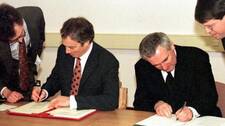
The 1998 Good Friday Agreement made no specific provision for the investigation or prosecution of former members of the armed forces. It focused instead on the early release of prisoners affiliated with paramilitary organisations. Crucially, it did not provide a blanket amnesty for crimes for which individuals had not yet been prosecuted.
From 2000 to 2014, the UK government operated an administrative scheme under which individuals suspected of terrorism crimes in Northern Ireland who were not in custody — known as On the Runs — were issued letters of assurance stating they were not of interest to the prosecuting authorities.
The scheme was thrown into sharp relief in 2014 when a trial against John Downey — suspected in connection with the 1982 Hyde Park bombing — collapsed because he had previously received one of these assurance letters. A subsequent judge-led review criticised the scheme for systematic failings and made clear that such “letters of comfort” did not constitute an amnesty or legal immunity from prosecution.
The Historical Enquiries Team (HET)
In 2006, the government established the Historical Enquiries Team (HET) within the Police Service of Northern Ireland (PSNI). The HET examined all deaths attributable to the security situation in Northern Ireland between 1968 and the Good Friday Agreement, working through cases largely in chronological order.
The HET was created partly in response to European Court of Human Rights (ECHR) judgments concerning the investigation of deaths with alleged state involvement. Those judgments identified breaches of Article 2 of the European Convention on Human Rights — the right to life.
In 2012, the Minister of Justice for Northern Ireland commissioned Her Majesty’s Inspectorate of Constabulary (HMIC) to inspect the HET’s role and function. The resulting report was highly critical. In 2013, the PSNI announced it would review all military cases from 1968 through to the signing of the Good Friday Agreement, in order to ensure reviews met the required standard.
The Legacy Investigations Branch (LIB)
Due to budget cuts to the PSNI, the HET was disbanded in September 2014. A much smaller Legacy Investigations Branch (LIB) was formed in its place. The LIB continues to review murder cases linked to the Troubles, prioritising cases based on forensic opportunities, available witnesses, and other investigative material rather than strict chronological order.
Any LIB decision to prosecute is referred to the Director of Public Prosecutions for Northern Ireland. The Ministry of Defence and the British government are entirely independent of this process.
The LIB and its predecessor have attracted significant criticism from multiple sides. Key concerns include:
- The credibility and reliability of evidence that is 40 or more years old
- The re-opening of investigations that had already formally concluded
- A widespread perception that investigations have disproportionately focused on the actions of the armed forces and former police officers — who account for approximately 30% of the LIB’s workload, despite being responsible for roughly 10% of overall Troubles-related deaths
Recent Prosecutions
The Director of Public Prosecutions for Northern Ireland has brought prosecutions against several former army personnel in recent years, which has reinforced perceptions among some that investigators are disproportionately targeting cases involving military personnel.
The Public Prosecution Service for Northern Ireland has stated that of the 26 prosecution cases brought since 2011, 21 involved republican and loyalist paramilitaries, with five cases ongoing at the time of the original briefing. To date, six military personnel have been charged with offences related to the Troubles, including one former soldier referred to publicly as Soldier F, who is being prosecuted in connection with the events of Bloody Sunday.
Summary
The legal framework governing armed forces conduct in Northern Ireland involved overlapping layers of service law, civilian law, and operational rules of engagement. Investigations and prosecutions have evolved significantly — from RUC-led inquiries during the Troubles, through the HET, to the current LIB. The process remains contested and politically sensitive, with ongoing debate about the balance between accountability, historical justice, and fairness to veterans.
The issues covered here are examined in depth in the House of Commons Library research briefing: Investigation of Former Armed Forces Personnel Who Served in Northern Ireland.