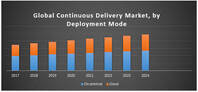
Source: marketresearchpioneer.com (original report summary, 2019)
Overview of the Global Continuous Delivery Market
The global Continuous Delivery (CD) market has attracted significant analyst attention as organizations across every major industry vertical accelerate their software release cycles. Market research covering the 2019–2024 period highlights growing adoption of CD pipelines driven by the need for faster time-to-market, reduced deployment risk, and tighter integration between development and operations teams.
Research reports in this space typically examine market dynamics, competitive positioning, regional growth patterns, and segment-level revenue distribution. Key metrics tracked include compound annual growth rate (CAGR), market share by vendor, revenue and volume trends, gross margins, and pricing trajectories. The sections below summarize the major dimensions of this market as reported in the 2019 research landscape.
Major Market Players
The Continuous Delivery vendor ecosystem is broad, spanning large enterprise software companies, specialist DevOps tooling vendors, and cloud platform providers. Companies identified as key participants in the 2019–2024 market include:
- Atlassian – Bitbucket Pipelines and integrations with Jira for end-to-end delivery tracking
- IBM – UrbanCode Deploy and broader IBM DevOps portfolio
- XebiaLabs (now Digital.ai) – Release orchestration and pipeline automation
- CA Technologies (acquired by Broadcom) – Release Automation tooling
- Electric Cloud (now CloudBees CD) – Enterprise-grade pipeline orchestration
- Puppet Enterprise – Infrastructure automation feeding CD workflows
- Chef Software – Configuration management and compliance automation
- CloudBees – Jenkins-based and cloud-native CD platforms
- Microsoft – Azure DevOps (formerly VSTS), GitHub Actions
- Flexagon – FlexDeploy for Oracle and hybrid environments
- Micro Focus – ALM and release management tooling
- Clarive – DevOps and release management platform
- Accenture, Wipro – Systems integrators delivering CD transformation services
- VMware – Tanzu portfolio and pipeline tooling
- Red Hat – OpenShift Pipelines and Tekton-based CD
- CircleCI, Shippable – Cloud-native CI/CD services
- Heroku – PaaS with integrated deployment pipelines
- JetBrains – TeamCity CI/CD server
- Bitrise – Mobile-focused CI/CD
- AppVeyor – Windows and .NET CI/CD service
- Infostretch, Kainos, Applariat, Spirent – Niche and specialist delivery tooling
Market Segmentation
By Deployment Mode
- On-premises – Preferred by regulated industries and organizations with strict data sovereignty requirements
- Cloud – Increasingly dominant, offering lower operational overhead and faster onboarding for CD toolchains
By Organization Size
- Small and Medium-sized Enterprises (SMEs) – Typically favor SaaS-based CD tools with low upfront cost and managed infrastructure
- Large Enterprises – Require enterprise-grade orchestration, compliance controls, audit trails, and integration with legacy systems
By Industry Vertical
Continuous Delivery adoption cuts across nearly every sector, though maturity and use-case drivers vary considerably:
- Banking, Financial Services, and Insurance (BFSI) – High compliance demands drive investment in auditable, automated pipelines
- Telecommunications – Rapid feature deployment for customer-facing applications and network functions
- Media and Entertainment – Continuous updates to streaming platforms and content delivery systems
- Retail and eCommerce – Frequent releases tied to seasonal campaigns and personalization features
- Healthcare – Growing adoption balanced against strict regulatory validation requirements
- Manufacturing – Integration of CD into IoT and operational technology software pipelines
- Education – Accelerating delivery of digital learning platforms
- Government, Transport, Logistics, Energy and Utilities – Emerging adoption, often constrained by legacy infrastructure
Geographic Segments
Market research in this period covered four primary geographic regions:
- North America (United States, Canada) – The largest market by revenue, driven by mature DevOps practices and a high concentration of technology firms
- Europe (Germany, France, Italy, and rest of Europe) – Strong growth in BFSI and manufacturing verticals; GDPR compliance is a key CD pipeline consideration
- Asia-Pacific (China, Japan, India, South Korea) – Fastest-growing region, fueled by digital transformation investment and expanding technology talent pools
- LAMEA (Brazil, Turkey, Saudi Arabia, South Africa) – Emerging market with increasing cloud adoption and government-led digitization programs
Key Market Trends Driving CD Adoption (2019–2024)
Several structural trends were identified as the primary forces shaping the Continuous Delivery market across this period:
- Microservices and containerization – Kubernetes and Docker adoption created demand for pipelines capable of managing dozens or hundreds of independently deployable services
- Shift-left security (DevSecOps) – Security scanning, secrets management, and policy enforcement integrated directly into CD pipelines
- GitOps – Git repositories becoming the single source of truth for both application code and infrastructure configuration, with CD tooling watching for changes and triggering deployments automatically
- AI/ML-assisted pipelines – Early exploration of anomaly detection in deployment metrics and intelligent rollback triggers
- Multi-cloud and hybrid deployment targets – CD platforms expanding to orchestrate deployments across on-premises, public cloud, and edge environments simultaneously
- Platform engineering – Internal developer platforms (IDPs) abstracting CD complexity and providing self-service deployment workflows to product teams
What This Market Data Means for DevOps Teams
For engineering and DevOps leaders evaluating CD tooling or building a business case for investment, the market segmentation above is useful context in several ways:
- Vendor longevity risk – The large number of specialist vendors means consolidation is likely. Several vendors listed above have already been acquired or merged (e.g., Electric Cloud into CloudBees, XebiaLabs into Digital.ai, Shippable into JFrog). Evaluating vendor roadmap and financial stability is important.
- Vertical-specific requirements – Healthcare and BFSI organizations should look for CD platforms with built-in compliance reporting, change approval workflows, and full audit logs.
- Cloud vs. on-premises decision – For most SMEs, cloud-hosted CD (GitHub Actions, CircleCI, GitLab CI) offers the fastest path to value. Large enterprises with regulated workloads often maintain on-premises runners even when using cloud-hosted orchestration layers.
- Regional procurement – Data residency regulations in Europe and Asia-Pacific increasingly influence where CD pipeline infrastructure can run, affecting SaaS tool selection.
Summary
The 2019–2024 Continuous Delivery market report landscape reflected a rapidly maturing ecosystem. The core story is one of expanding adoption across all organization sizes and geographies, driven by microservices architectures, cloud-native platforms, and organizational pressure to ship software faster without sacrificing quality or compliance. The vendor landscape has since consolidated somewhat, but the structural trends identified in this period—GitOps, DevSecOps, platform engineering, and multi-cloud orchestration—remain the dominant forces shaping CD tool investment decisions today.
This article summarizes the structure and key segments of Continuous Delivery market research published around 2019. Specific revenue figures, CAGR percentages, and market size numbers from the original report have not been reproduced here, as they could not be independently verified.