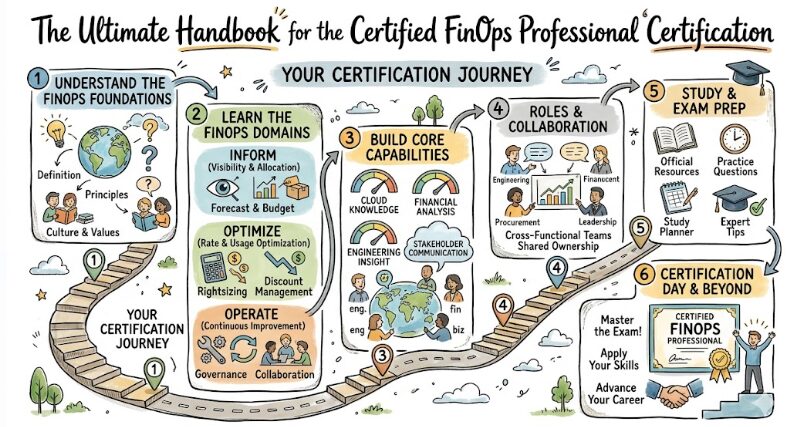
Cloud computing has shifted the way organizations build and scale, but it has also fundamentally changed how they spend money. The Certified FinOps Professional is a critical credential for engineers, managers, and financial stakeholders who need to master the art of cloud financial management. This guide serves as a strategic roadmap for professionals within the DevOps, SRE, and platform engineering domains who are looking to bridge the gap between technical operations and financial accountability. By following this curriculum hosted at finopsschool, individuals can transition from simply managing infrastructure to driving high-level business value through cost optimization and unit economics.
What is the Certified FinOps Professional?
The Certified FinOps Professional represents the highest standard of excellence in the cloud financial management discipline. It is a validation of an individual’s ability to implement the FinOps framework—Inform, Optimize, and Operate—within complex, enterprise-scale environments. Unlike theoretical certifications, this program focuses on the practical application of cost-saving strategies and the cultural shift required to make engineers accountable for their cloud spend.
This certification exists because cloud waste has become a multi-billion dollar problem. It aligns with modern engineering workflows by treating “cost” as a first-class metric, similar to performance or security. For organizations running cloud-native applications, having a certified professional ensures that every dollar spent on cloud resources is mapped to a specific business outcome, reducing friction between finance and engineering teams.
Who Should Pursue Certified FinOps Professional?
This certification is designed for a broad spectrum of professionals involved in the cloud lifecycle. For DevOps engineers and Site Reliability Engineers (SREs), it provides the financial context needed to make better architectural decisions. Cloud architects and platform engineers benefit by learning how to build cost-aware automated systems that scale efficiently without ballooning the budget.
Beyond the technical roles, engineering managers and technical leaders find this certification invaluable for reporting ROI to executive leadership. In the Indian market and globally, there is a massive demand for professionals who can navigate the nuances of multi-cloud billing. Even security and data professionals are increasingly pursuing this path, as data transfer costs and security tool expenses often represent a significant portion of the modern cloud bill.
Why Certified FinOps Professional is Valuable and Beyond
The demand for cloud financial management expertise is growing faster than the supply of qualified practitioners. As enterprises move past the initial migration phase and into the optimization phase of their cloud journey, they require experts who can sustain efficiency. The Certified FinOps Professional provides longevity because it teaches principles that are agnostic of the specific cloud provider, whether an organization uses AWS, Azure, or Google Cloud.
Staying relevant in the industry requires more than just knowing how to spin up a Kubernetes cluster; it requires knowing if that cluster is cost-effective. This certification offers a high return on investment for one’s career by positioning the holder as a strategic asset rather than just a technical resource. As companies tighten their budgets, the ability to demonstrate and deliver cloud savings becomes a primary factor in career advancement and job security.
Certified FinOps Professional Certification Overview
The program is delivered via the official certification portal and is hosted on the finopsschool.com platform. The certification structure is designed to move a candidate from basic terminology to advanced architectural optimization. It uses a performance-based assessment approach, meaning candidates must demonstrate they can solve real-world financial friction points within a cloud environment.
Ownership of the FinOps lifecycle is a central theme of the program. The structure covers the fundamental principles of the FinOps Foundation, the various personas involved in the process, and the specific capabilities required to achieve “Run” stage maturity. It is not just about passing a test; it is about proving one can lead a cultural transformation where finance, engineering, and business teams speak the same language.
Certified FinOps Professional Certification Tracks & Levels
The certification path is divided into logical tiers to support continuous professional development. The Foundation Level introduces the core vocabulary and the three phases of the FinOps lifecycle. It is the entry point for anyone touching the cloud, ensuring a baseline of financial literacy across the entire organization.
The Professional Level—the core of this guide—dives deep into advanced topics like commitment-based discounts, shared cost allocation, and unit economics. Finally, the Advanced/Specialist Tracks allow professionals to focus on specific domains such as FinOps for Containers or FinOps for Big Data. This progression ensures that as a professional grows in their career, their certification status reflects their ability to handle increasingly complex financial governance tasks.
Complete Certified FinOps Professional Certification Table
| Track | Level | Who it’s for | Prerequisites | Skills Covered | Recommended Order |
| Cloud Finance | Foundation | Beginners, Managers, Sales | None | Terminology, Lifecycle phases, Personas | 1 |
| Engineering | Professional | SREs, DevOps, Architects | Foundation Level | Cost Allocation, Optimization, Tagging | 2 |
| Governance | Professional | Finance, Procurement | Foundation Level | Forecasting, Budgeting, Reporting | 2 |
| Advanced | Specialist | Lead Practitioners | Professional Level | Unit Economics, Cultural Change | 3 |
Detailed Guide for Each Certified FinOps Professional Certification
Certified FinOps Professional – Foundation
What it is
The Foundation certification validates a basic understanding of FinOps and its fundamental principles. it ensures that all stakeholders have a common language for cloud financial management.
Who should take it
This is suitable for junior engineers, finance associates, and business leaders who need to understand why cloud billing is different from traditional data center accounting.
Skills you’ll gain
- Understanding the 6 Principles of FinOps.
- Identifying the Inform, Optimize, and Operate phases.
- Recognizing the roles of different personas like the Practitioner and Executive.
Real-world projects you should be able to do
- Map cloud bills to specific business units using basic tagging strategies.
- Identify obvious “zombie” resources and orphaned disks for immediate cost removal.
Preparation plan
- 7 Days: Focus on the official practitioner guide and glossary terms.
- 30 Days: Practice identifying cost anomalies in a sandbox cloud account.
- 60 Days: Deeply study the cultural aspects of FinOps and how to break down silos.
Common mistakes
- Treating cloud cost management as a one-time project rather than a continuous cycle.
- Focusing only on the technical “Optimize” phase while ignoring the “Inform” and reporting phase.
Best next certification after this
- Same-track option: Certified FinOps Professional (Professional Level).
- Cross-track option: Cloud Digital Leader or Practitioner.
- Leadership option: Engineering Management Foundation.
Certified FinOps Professional – Professional Level
What it is
This is the core certification that validates an individual’s ability to manage large-scale cloud budgets and drive engineering teams toward cost-efficient architectures.
Who should take it
Experienced DevOps engineers, SREs, and Platform leads who are responsible for production environments and cloud governance.
Skills you’ll gain
- Implementing advanced allocation strategies for shared costs (e.g., Support, Data Transfer).
- Managing Reserved Instances (RI) and Savings Plans across multiple accounts.
- Developing automated “right-sizing” scripts and governance policies.
Real-world projects you should be able to do
- Build a real-time dashboard that tracks “Cost per Transaction” for a microservices application.
- Implement a gamified “Cost Dashboard” that encourages engineering teams to reduce waste.
Preparation plan
- 7 Days: Review complex billing scenarios and discount logic (RIs/Savings Plans).
- 30 Days: Work with specialized FinOps tools or cloud-native cost explorers to analyze trends.
- 60 Days: Conduct a mock “Cloud Financial Audit” for a simulated enterprise environment.
Common mistakes
- Ignoring the “Unit Economics” aspect and only focusing on the total bill amount.
- Failing to automate the reporting process, leading to stale data and manual errors.
Best next certification after this
- Same-track option: FinOps Specialist (Containers or Big Data).
- Cross-track option: Certified Kubernetes Administrator (CKA).
- Leadership option: ITIL Strategic Leader or MBA in Technology Management.
Choose Your Learning Path
DevOps Path
The DevOps learning path integrates financial accountability into the CI/CD pipeline. Professionals here focus on “Shift-Left FinOps,” where cost estimation is part of the code review process. By mastering the Certified FinOps Professional curriculum, DevOps engineers can ensure that their automation logic includes cost constraints, preventing accidental “infinite loops” of resource scaling that could drain a budget overnight.
DevSecOps Path
In this path, the focus is on the intersection of security, compliance, and cost. Security tools and log ingestion can be incredibly expensive. A DevSecOps professional with FinOps training learns how to optimize log retention policies and choose cost-effective security scanners. They ensure that the organization stays secure without overpaying for redundant data storage or inefficient traffic inspection.
SRE Path
Site Reliability Engineers use FinOps to balance reliability with cost. Every increase in “nines” of availability comes with a price tag. The SRE path involves using FinOps data to define Service Level Objectives (SLOs) that are economically viable. They learn to treat “Cost” as a performance metric, ensuring that a system is not only fast and reliable but also fiscally sustainable.
AIOps Path
As organizations adopt Artificial Intelligence for IT operations, the cost of running large-scale telemetry and predictive models becomes a concern. The AIOps path focuses on using machine learning to predict cloud spend and identify anomalies. Professionals learn to apply FinOps principles to the infrastructure that powers AI, ensuring that the automated operations themselves remain profitable.
MLOps Path
Machine Learning operations involve massive compute costs for model training and inference. The MLOps path specifically targets the optimization of GPU and TPU usage. By applying FinOps, MLOps engineers can decide when to use spot instances for training and when to invest in reserved capacity for high-priority production inference, drastically reducing the cost of AI innovation.
DataOps Path
Data pipelines are notorious for hidden costs related to data transfer (egress) and storage. The DataOps path involves mastering the cost dynamics of data lakes and warehouses. Professionals in this track learn how to architect data movement to minimize inter-region costs and how to implement lifecycle policies that move aging data to cheaper storage tiers automatically.
FinOps Path
This is the dedicated specialist path for those who want to lead the FinOps department. It focuses heavily on the “Operate” phase and cultural change management. Practitioners in this path act as the bridge between the CFO’s office and the CTO’s office. They are responsible for the entire organizational cloud strategy, from procurement negotiations to developer education and reporting.
Role → Recommended Certified FinOps Professional Certifications
| Role | Recommended Certifications |
| DevOps Engineer | FinOps Foundation + FinOps Professional |
| SRE | FinOps Professional + Cloud Architect |
| Platform Engineer | FinOps Professional + FinOps for Containers |
| Cloud Engineer | FinOps Foundation + Cloud Provider Specific Cost certs |
| Security Engineer | FinOps Foundation + DevSecOps certs |
| Data Engineer | FinOps Foundation + FinOps for Big Data |
| FinOps Practitioner | FinOps Foundation + Professional + Specialist Tracks |
| Engineering Manager | FinOps Foundation + Leadership Management certs |
Next Certifications to Take After Certified FinOps Professional
Same Track Progression
Once the core professional certification is achieved, the natural next step is deep specialization. This involves mastering specific infrastructure types, such as Kubernetes or Serverless environments. Specialized certifications in FinOps for Containers or FinOps for SaaS provide the granular knowledge needed to manage modern, abstracted cloud architectures where traditional cost-tracking methods often fail.
Cross-Track Expansion
To be a truly effective cloud leader, one must understand the underlying technology as well as the cost. Expanding into technical certifications like the Certified Kubernetes Administrator (CKA) or Professional Cloud Architect allows a FinOps professional to speak the same language as the developers. This technical depth makes optimization recommendations much more credible and easier for engineering teams to implement.
Leadership & Management Track
For those looking to move into executive roles like Head of Cloud or VP of Engineering, the focus shifts to organizational strategy. Certifications in ITIL, PMP, or even an executive MBA can complement the Certified FinOps Professional background. This track prepares individuals to handle multi-million dollar contracts, vendor negotiations, and the long-term financial health of the entire technology organization.
Training & Certification Support Providers for Certified FinOps Professional
DevOpsSchool
DevOpsSchool provides a robust ecosystem for professionals seeking to master cloud financial management. Their curriculum is designed by industry veterans who understand the practical challenges of implementing FinOps in a DevOps environment. They offer extensive hands-on labs and real-world scenarios that go beyond the standard certification syllabus. Students benefit from personalized mentorship and a community-driven learning approach. The school focuses on bridging the gap between theoretical cloud concepts and the actual execution of cost-saving strategies. This ensures that learners are not just prepared for the exam but are ready to deliver immediate value to their organizations through optimized infrastructure and clear financial reporting.
Cotocus
Cotocus stands out as a specialized provider for enterprise-grade technical training, with a strong focus on cloud governance and FinOps. They provide highly customized training modules that cater to both technical teams and financial stakeholders within a company. Their methodology emphasizes “learning by doing,” which is crucial for a discipline like FinOps that requires constant adjustment and monitoring. Cotocus instructors bring years of experience in managing large-scale cloud migrations and cost-optimization projects. By choosing Cotocus, professionals gain access to proprietary tools and templates that simplify the process of cost allocation and forecasting. Their training is designed to foster collaboration between departments, which is the cornerstone of any successful FinOps initiative.
Scmgalaxy
Scmgalaxy is a well-known name in the DevOps community, providing a wealth of resources for those looking to advance their careers. Their approach to FinOps training is deeply rooted in the software configuration management and automation culture. They offer a variety of webinars, workshops, and comprehensive courses that cover every aspect of the FinOps lifecycle. Scmgalaxy excels at providing up-to-date content that reflects the latest trends in cloud billing and toolsets. Their training programs are particularly beneficial for those who want to integrate FinOps directly into their existing CI/CD pipelines. With a focus on practical implementation, Scmgalaxy helps engineers turn abstract financial goals into actionable automation scripts and governance policies.
BestDevOps
BestDevOps offers a streamlined and highly effective training path for the Certified FinOps Professional designation. They pride themselves on a curriculum that is both intensive and accessible, making it ideal for busy professionals. Their training modules are structured to provide a clear understanding of cloud unit economics and how to drive cultural change within an organization. BestDevOps focuses on the most high-impact areas of cloud spend, teaching students how to identify and eliminate waste quickly. Their instructors provide direct feedback and support, ensuring that every learner masters the complexities of commitment-based discounts and shared cost modeling. This makes BestDevOps a preferred choice for individuals looking to accelerate their career in cloud financial management.
devsecopsschool.com
DevSecOpsSchool is a specialized platform that integrates security and financial management into the modern engineering workflow. Their FinOps training is unique because it examines cost through the lens of security and compliance. They teach professionals how to manage the expenses associated with security tooling, log management, and threat detection. The curriculum emphasizes the importance of making cost-aware security decisions that do not compromise the safety of the application. By providing a holistic view of the cloud lifecycle, devsecopsschool.com prepares engineers to handle the complex trade-offs between speed, security, and spend. This training is essential for anyone working in highly regulated industries where every cloud resource must be accounted for and secured.
sreschool.com
SRESchool focuses on the intersection of site reliability and cloud financial management. Their training is built around the idea that “Cost is a proxy for efficiency.” They teach Site Reliability Engineers how to use FinOps data to improve system performance and reduce latency by optimizing resource utilization. The curriculum includes advanced topics like defining “Error Budgets” that incorporate financial constraints. Learners at SRESchool gain the skills needed to build resilient systems that are also cost-effective. The school’s focus on automation and observability ensures that SREs can monitor their cloud spend with the same precision they use for monitoring uptime and latency, leading to a more sustainable and predictable cloud environment.
aiopsschool.com
AIOpsSchool is at the forefront of the next generation of IT operations, where artificial intelligence meets cloud management. Their FinOps curriculum is tailored for professionals who are using AI to manage complex, dynamic cloud environments. They teach how to leverage machine learning algorithms for predictive billing and automated anomaly detection. This training is critical for organizations that have outgrown manual cost-management techniques and need to implement intelligent, self-healing financial governance. AIOpsSchool provides the tools and knowledge needed to manage the costs of the AI infrastructure itself, ensuring that the move toward automation remains a profitable venture for the business.
dataopsschool.com
DataOpsSchool addresses the specific and often hidden costs associated with large-scale data engineering. Their FinOps training focuses on the unique challenges of data egress, storage tiers, and database performance tuning. They teach data professionals how to architect data pipelines that are inherently cost-efficient. The school provides practical guidance on managing the costs of cloud-native data warehouses and big data platforms like Spark and Snowflake. By completing this training, data engineers and architects can provide clear visibility into the cost of data-driven insights. DataOpsSchool is the go-to resource for anyone looking to master the financial aspects of modern data platforms and ensure their data strategy is economically sound.
finopsschool.com
FinOpsSchool is the primary authority and hosting site for the Certified FinOps Professional program. As the dedicated home for this discipline, they provide the most comprehensive and authoritative training materials available. Their curriculum is designed to evolve alongside the cloud industry, ensuring that certified professionals are always at the cutting edge of best practices. FinOpsSchool offers a deep dive into the cultural and organizational aspects of FinOps, which are often the most difficult to master. Their platform provides a central hub for practitioners to share knowledge, access tools, and stay connected with the global FinOps community. Choosing FinOpsSchool ensures that your certification carries the maximum weight and recognition in the industry.
Frequently Asked Questions (General)
- What is the primary goal of the Certified FinOps Professional program?
The goal is to equip professionals with the framework and skills to manage cloud spend effectively while maintaining engineering velocity and business agility. - Is there a prerequisite for the professional level certification?
Yes, candidates are generally expected to have completed the Foundation level or have significant real-world experience in cloud financial management. - How long does it typically take to prepare for the exam?
Most professionals spend between 30 and 60 days preparing, depending on their existing familiarity with cloud billing and architectural optimization. - Is the certification recognized globally?
Absolutely. It is the industry standard for cloud financial management and is recognized by major enterprises and cloud providers worldwide. - How does FinOps differ from traditional IT cost management?
FinOps is a continuous, collaborative culture focused on real-time optimization and accountability, whereas traditional management is often a periodic, centralized accounting task. - Do I need to be a developer to pass the Certified FinOps Professional?
While you don’t need to be a full-stack developer, a solid understanding of cloud infrastructure, APIs, and basic scripting is highly beneficial for the technical sections. - What is the ROI of getting this certification?
Certified professionals often see higher salaries and are frequently tapped for leadership roles in cloud governance, as they can directly impact a company’s bottom line. - Are there any hands-on components to the assessment?
Yes, the professional level assessment often involves practical scenarios where you must analyze billing data and recommend specific optimization strategies. - How often do I need to recertify?
Recertification is typically required every two years to ensure that your skills remain current with the rapidly changing cloud landscape and new provider features. - Can finance professionals take this certification?
Yes, it is highly recommended for finance and procurement professionals who work closely with engineering teams to manage cloud contracts and budgets. - Does the certification cover all major cloud providers?
Yes, the principles taught are cloud-agnostic and apply to AWS, Microsoft Azure, Google Cloud Platform, and even private or hybrid cloud environments. - Where is the official certification hosted?
The official program and exams are hosted on the finopsschool.com platform.
FAQs on Certified FinOps Professional
- What are the three phases of the FinOps lifecycle?
The three phases are Inform (visibility and allocation), Optimize (identifying savings and right-sizing), and Operate (continuous improvement and cultural alignment). - What is unit economics in the context of FinOps?
Unit economics involves measuring the cost of cloud services against a business metric, such as cost per customer, cost per transaction, or cost per active user. - How does the program handle multi-cloud billing complexities?
The certification teaches common normalization techniques and tools that allow practitioners to consolidate and analyze data from multiple cloud vendors in a single view. - What is the importance of tagging in FinOps?
Tagging is the foundational “Inform” mechanism that allows organizations to attribute costs to specific teams, projects, or applications for accurate reporting. - What is the “Run” stage of FinOps maturity?
The Run stage indicates an organization has automated most of its FinOps processes and has a culture where engineers proactively manage their own costs. - Are commitment-based discounts like RIs and Savings Plans covered?
Yes, a significant part of the professional track involves mastering the strategy of when and how to purchase these discounts to maximize savings. - How does FinOps support the DevOps culture?
FinOps breaks down the silo between finance and engineering, encouraging collaborative decision-making and empowering engineers to take ownership of their resource costs. - Can this certification help with vendor contract negotiations?
Yes, by understanding the organizational usage patterns and forecasting needs, a certified professional can provide the data required for better enterprise discount agreements.
Final Thoughts: Is Certified FinOps Professional Worth It?
If you are looking to advance your career in the cloud-native era, the answer is a resounding yes. We have reached a point where building in the cloud is easy, but building efficiently is difficult. Companies no longer want engineers who just know how to “turn things on”; they want professionals who can balance performance with fiscal responsibility. The Certified FinOps Professional is not just another badge for your profile; it is a fundamental shift in how you approach engineering. It empowers you to have meaningful conversations with the CFO, lead complex architectural changes, and ultimately ensure that technology is a driver of profit rather than just a cost center. For any serious DevOps, SRE, or manager, this is the most practical and high-impact path to take right now.