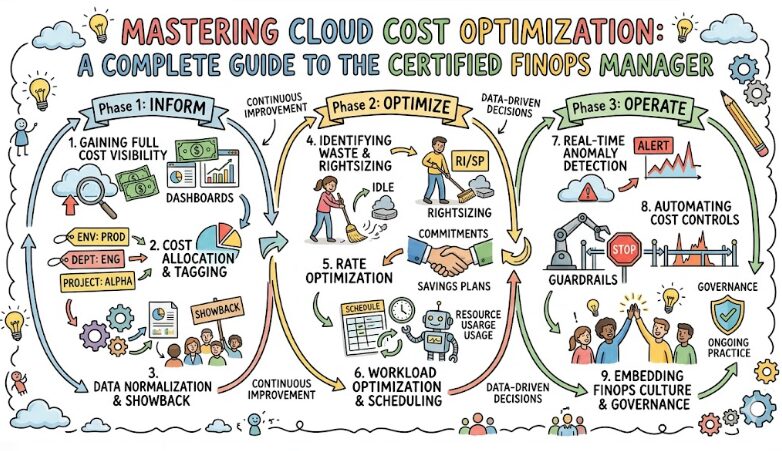
As cloud infrastructure scales across global enterprises, the gap between engineering decisions and financial accountability has become a critical bottleneck. The Certified FinOps Manager framework addresses this by building leaders who can optimize cloud spend without slowing down deployment velocity. This guide is designed for engineers, platform architects, and managers who want to master the financial operations of modern technical environments. By aligning cloud investment with business value, this certification track empowers you to make strategic career moves and lead cross-functional infrastructure teams. You can find the foundational learning resources at finopsschool, with the official curriculum detailed on the Certified FinOps Manager page.
What is the Certified FinOps Manager?
The Certified FinOps Manager is an advanced credential that validates a professional’s ability to govern, manage, and optimize enterprise cloud spending. It exists to bridge the historic divide between engineering teams, who provision resources, and finance teams, who pay the bills. The focus is entirely on real-world, production-focused cost management rather than abstract financial theory.
This certification aligns directly with modern DevOps and SRE workflows, ensuring that cost becomes a primary metric alongside performance and reliability. It covers cost allocation, anomaly detection, rate optimization, and the cultural shift required to make engineering teams cost-aware. By mastering these areas, professionals learn to implement chargeback models and automated governance policies that keep cloud environments financially sustainable.
Who Should Pursue Certified FinOps Manager?
Software engineers, site reliability engineers, and cloud architects who want to elevate their careers into strategic leadership roles are prime candidates. It provides the financial vocabulary and governance frameworks needed to justify infrastructure choices to executive leadership. Engineering managers and directors will also find it essential for managing departmental budgets and demonstrating return on investment.
Professionals in security, data engineering, and platform roles benefit heavily as well, given the massive computing costs associated with large-scale data pipelines and security logging. This certification is highly relevant for both the global tech market and the rapidly expanding enterprise ecosystem in India. Beginners can use foundational levels to break into cloud administration, while experienced veterans use the management tier to transition into enterprise architecture.
Why Certified FinOps Manager is Valuable Today and Beyond
As organizations migrate vast amounts of legacy infrastructure to cloud-native platforms, untracked and wasted cloud spending has become a major enterprise liability. The demand for professionals who can implement rigorous FinOps practices is surging globally, making this a highly resilient career path. Understanding the financial mechanics of the cloud ensures you remain valuable regardless of which specific vendor or deployment tool your company uses.
Enterprise adoption of FinOps frameworks is accelerating, moving from a niche specialty to a mandatory operational standard. Earning the Certified FinOps Manager credential demonstrates that you can protect the company’s bottom line while maintaining high engineering standards. The return on the time invested in this learning path is substantial, often leading to roles with higher strategic influence and increased compensation.
Certified FinOps Manager Certification Overview
The program is delivered via the official track at Certified FinOps Manager and hosted on the finopsschool.com portal. The certification levels are designed to take a practitioner from foundational knowledge to advanced strategic management. The assessment approach heavily favors practical scenario-based problem solving over rote memorization.
The structure of the certification ecosystem ensures that candidates prove their ability to use real cost-optimization tooling and methodologies. The curriculum is consistently updated to reflect the latest pricing models and discount mechanisms offered by major cloud providers. This ensures that the credential maintains strict alignment with the actual challenges faced by modern platform engineering teams.
Certified FinOps Manager Certification Tracks & Levels
The certification journey is divided into clear progression levels: foundation, professional, and advanced management. The foundation level introduces the core vocabulary, principles, and phases of the FinOps lifecycle, ensuring a baseline understanding. It is the perfect starting point for engineers transitioning into cost-aware roles.
The professional level dives deeply into technical implementation, focusing on tagging strategies, automated reporting, and right-sizing infrastructure. Finally, the advanced management track focuses on organizational culture, cross-departmental alignment, and enterprise-wide governance. These levels logically align with career progression, taking a professional from an individual contributor to an organizational leader.
Complete Certified FinOps Manager Certification Table
| Track | Level | Who it’s for | Prerequisites | Skills Covered | Recommended Order |
| Core FinOps | Foundation | Junior Engineers, Analysts | Basic Cloud Knowledge | Cost allocation, FinOps lifecycle, Tagging basics | 1 |
| Technical FinOps | Practitioner | Cloud Engineers, SREs | Foundation Cert | Right-sizing, Spot instances, Anomaly detection | 2 |
| Strategic FinOps | Manager | Platform Managers, Architects | Practitioner Cert | Forecasting, Chargeback models, Team enablement | 3 |
| Specialized | DataOps Cost | Data Engineers | Practitioner Cert | Pipeline optimization, Storage lifecycle policies | Optional |
| Specialized | SRE Cost Mgmt | Site Reliability Engineers | Practitioner Cert | Cost-reliability balancing, Observability costs | Optional |
Detailed Guide for Each Certified FinOps Manager Certification
Certified FinOps Manager – Foundation
What it is
This entry-level certification validates a fundamental understanding of cloud financial management principles. It ensures the candidate comprehends the inform, optimize, and operate phases of the FinOps lifecycle.
Who should take it
Junior cloud engineers, financial analysts transitioning to tech, and project managers should begin here. It requires minimal prior experience and focuses heavily on establishing a shared vocabulary.
Skills you’ll gain
- Understanding basic cloud pricing models and billing structures.
- Implementing elementary resource tagging and categorization.
- Reading and analyzing basic cloud cost and usage reports.
- Communicating cost drivers to non-technical stakeholders.
Real-world projects you should be able to do
- Map orphaned cloud resources back to their owning teams.
- Create a basic dashboard showing monthly spend by environment.
- Identify low-hanging fruit for immediate cost reduction.
Preparation plan
For a 7-14 day plan, focus intensely on the official glossary and core principles. A 30-day strategy should include exploring the billing consoles of major cloud providers. The 60-day plan allows for deploying small lab environments to see how usage translates to billing over time.
Common mistakes
Candidates often memorize definitions without understanding how they apply to real billing consoles. Many also underestimate the importance of the cultural aspect of FinOps compared to the technical tooling.
Best next certification after this
- Same-track option: Certified FinOps Practitioner.
- Cross-track option: AWS Cloud Practitioner or Azure Fundamentals.
- Leadership option: ITIL Foundation for broader service management context.
Certified FinOps Manager – Practitioner
What it is
The professional tier certification validates hands-on ability to reduce cloud waste and optimize architecture. It proves that the candidate can implement technical solutions to enforce financial boundaries.
Who should take it
Active DevOps engineers, SREs, and cloud architects working in production environments are the ideal audience. It assumes you already know how to provision infrastructure and are now learning to optimize it.
Skills you’ll gain
- Engineering automated shutdown schedules for non-production environments.
- Negotiating and applying committed use discounts and reserved instances.
- Implementing container-level cost allocation in Kubernetes.
- Designing automated anomaly detection alerts for sudden spend spikes.
Real-world projects you should be able to do
- Refactor a monolithic application to use cost-effective serverless components.
- Build a programmatic cost-alerting integration for Slack or Microsoft Teams.
- Execute a massive right-sizing initiative across a fleet of virtual machines.
Preparation plan
A 14-day sprint requires prior deep experience with cloud billing APIs. A 30-day plan should balance API exploration with studying advanced discounting mechanics. The 60-day path is ideal for practicing cost allocation inside complex Kubernetes clusters.
Common mistakes
Failing to understand the exact mathematical breakpoints of reserved instances versus on-demand pricing. Candidates also struggle with the complexities of multi-tenant cost allocation.
Best next certification after this
- Same-track option: Certified FinOps Manager (Advanced).
- Cross-track option: Certified Kubernetes Administrator (CKA).
- Leadership option: Agile Project Management credentials.
Certified FinOps Manager – Advanced
What it is
This pinnacle certification proves your capability to lead enterprise-wide cloud financial strategies. It validates executive-level decision-making, forecasting, and organizational change management skills.
Who should take it
Engineering directors, principal architects, and dedicated FinOps team leads should target this level. It requires deep technical background combined with strong business and financial acumen.
Skills you’ll gain
- Establishing accurate cloud cost forecasting and budget variance analysis.
- Designing completely automated chargeback and showback financial models.
- Driving cultural shifts to make distributed engineering teams cost-accountable.
- Aligning cloud unit economics with overarching business profitability metrics.
Real-world projects you should be able to do
- Present a comprehensive quarterly cost strategy to the C-suite.
- Design a gamified cost-optimization program for internal engineering teams.
- Architect a multi-cloud financial governance framework from scratch.
Preparation plan
A 14-day review is only viable for current platform directors. The 30-day approach should focus on financial modeling and organizational psychology. A 60-day deep dive allows time to practice building comprehensive enterprise strategy documents and executive presentations.
Common mistakes
Focusing too much on technical CLI commands rather than executive communication. Overlooking the importance of unit economics and tying cloud spend directly to business revenue.
Best next certification after this
- Same-track option: Specialized vendor-specific architecture professional certs.
- Cross-track option: Certified Information Systems Security Professional (CISSP).
- Leadership option: Executive MBA or advanced leadership training.
Choose Your Learning Path
DevOps Path
The DevOps path integrates cost optimization directly into the CI/CD pipeline. Professionals learn to evaluate the financial impact of infrastructure-as-code before it is deployed. This path ensures that automated testing and rapid deployment do not lead to runaway resource consumption. Focus is heavily placed on shifting cost accountability left to the developers.
DevSecOps Path
Integrating security and cost management, this path evaluates the financial overhead of compliance tools. Professionals analyze the spend associated with continuous vulnerability scanning and massive centralized logging. The goal is to design robust security architectures that do not unnecessarily inflate cloud bills. It balances risk mitigation with financial sustainability.
SRE Path
Site Reliability Engineers on this path focus on the relationship between system reliability and cost. You will learn to calculate the exact financial cost of achieving higher “nines” of availability. This path teaches how to justify or reject architectural redundancy based on business value. It is critical for balancing service level objectives with strict departmental budgets.
AIOps Path
This path focuses on utilizing artificial intelligence to automate complex operational workflows and reduce human overhead. Professionals learn how to evaluate the computing costs associated with running AI-driven observability platforms. The goal is to ensure the predictive maintenance tools save more money than they cost to operate. It emphasizes using intelligent automation to drive down operational expenditure.
MLOps Path
The MLOps path is dedicated specifically to the immense costs of training and serving machine learning models. Professionals master the deployment of GPU resources, spot instance orchestration, and model optimization to reduce compute time. This is vital for data science teams whose cloud bills can spiral out of control during model training phases. It teaches strict resource lifecycle management for intensive computational workloads.
DataOps Path
Data engineering environments are notorious for massive storage and data transfer costs. This path teaches professionals how to optimize data warehouse queries, manage cold storage lifecycles, and reduce egress fees. You will learn to govern the financial impact of continuous data ingestion and transformation pipelines. It brings rigorous financial oversight to large-scale big data architectures.
FinOps Path
The dedicated FinOps path focuses entirely on the strategic orchestration of cloud financial management. This path is for those who will own the centralized FinOps practice within an enterprise. It covers advanced forecasting, vendor negotiation, and cross-functional team leadership. Professionals here become the bridge between the Chief Technology Officer and the Chief Financial Officer.
Role → Recommended Certified FinOps Manager Certifications
| Role | Recommended Certifications |
| DevOps Engineer | Foundation, Practitioner |
| SRE | Practitioner, SRE Cost Mgmt Specialization |
| Platform Engineer | Practitioner, Manager |
| Cloud Engineer | Foundation, Practitioner |
| Security Engineer | Foundation, DevSecOps Integration Module |
| Data Engineer | Practitioner, DataOps Cost Specialization |
| FinOps Practitioner | Foundation, Practitioner, Manager |
| Engineering Manager | Foundation, Manager |
Next Certifications to Take After Certified FinOps Manager
Same Track Progression
Advancing within the same track involves pursuing highly granular, vendor-specific cost optimization credentials. After mastering agnostic FinOps principles, professionals should target deep specializations like the AWS Certified Advanced Networking or Google Cloud Professional Cloud Architect. These advanced engineering credentials allow you to apply strategic financial principles to the deepest technical layers of specific public clouds.
Cross-Track Expansion
Expanding your skills means moving into adjacent disciplines that heavily impact cloud environments. Pursuing Kubernetes (CKA/CKS) or Terraform associate certifications gives you the exact technical leverage to implement FinOps automation. Understanding how container orchestration and infrastructure-as-code function makes your financial governance strategies far more effective and easier to deploy automatically.
Leadership & Management Track
For those leaving individual contributor roles, the next step involves broader management and enterprise frameworks. Certifications in ITIL 4, TOGAF enterprise architecture, or Agile program management are highly recommended. These frameworks help you integrate cloud financial operations into the overarching corporate strategy and governance models required by modern enterprise boards.
Training & Certification Support Providers for Certified FinOps Manager
DevOpsSchool
This organization operates as a premier global platform dedicated to transforming enterprise engineering teams through rigorous, real-world training. They focus intensely on bridging the gap between theoretical knowledge and production-grade implementation in DevOps and cloud infrastructure. Their curriculum is highly respected for its hands-on labs and project-based approach, ensuring that candidates do not just pass exams but truly understand the mechanics of continuous integration, deployment, and cost governance. By fostering a deep understanding of infrastructure-as-code and automated pipelines, they provide the exact foundational skills necessary for any engineer aiming to master advanced financial operations in cloud-native environments.
Cotocus
A highly specialized consulting and training provider, this organization excels in cloud cost optimization, system architecture, and operational efficiency. They bring deep industry experience to their training modules, focusing on the complex challenges enterprises face when scaling multi-cloud environments. Their approach to training is heavily influenced by their consulting background, meaning candidates are exposed to real-world case studies, billing anomalies, and actual cost-saving architectural refactors. They are instrumental for teams who need to urgently rein in cloud spend while simultaneously upskilling their workforce to maintain those financial controls over the long term.
Scmgalaxy
As a long-standing community and training hub, this platform has deep roots in software configuration management, build automation, and release engineering. They provide extensive resources, forums, and structured courses that help engineers master the lifecycle of software delivery. Understanding configuration management is a critical prerequisite for advanced cloud operations, and this provider ensures professionals have those baseline concepts mastered. Their practical approach helps teams standardize their environments, which is an absolute necessity before any effective cloud financial governance or optimization strategy can be successfully implemented across an organization.
BestDevOps
This platform focuses on curating and delivering the absolute best practices in modern software delivery and reliability engineering. They cater to a global audience, providing high-quality insights, tutorials, and structured learning paths that align with current industry standards. Their focus on the cultural aspects of team collaboration, alongside technical tooling, makes them a valuable resource for engineers transitioning into leadership roles. By emphasizing clean architecture and efficient deployment strategies, they help professionals build the operational maturity required to support complex financial governance and optimization initiatives in large-scale environments.
devsecopsschool.com
Dedicated entirely to the intersection of security and operations, this provider teaches engineers how to weave compliance and vulnerability management directly into automated pipelines. They address the critical reality that security tools often introduce immense computing overhead and cloud costs if not implemented correctly. Their training ensures that professionals can architect secure systems that remain financially viable and operationally efficient. By mastering the principles taught here, engineers can defend their infrastructure against threats while simultaneously defending their enterprise against the hidden financial bloat often associated with rigorous compliance logging and active monitoring.
sreschool.com
This specialized training provider focuses on the discipline of Site Reliability Engineering, teaching professionals how to build, maintain, and scale ultra-reliable software systems. Their curriculum dives deep into service level objectives, error budgets, and incident response, always balancing system uptime with engineering velocity. They emphasize that every incremental gain in reliability comes with an associated infrastructure cost. Therefore, their training is highly complementary to financial operations, as it teaches engineers how to mathematically justify redundancy and high-availability architecture based on actual business requirements rather than over-provisioning infrastructure by default.
aiopsschool.com
Operating at the cutting edge of IT operations, this institution trains professionals in the deployment and management of artificial intelligence and machine learning within operational workflows. They teach engineers how to build automated, self-healing infrastructure that can predict failures before they happen. Their training covers the heavy computational demands required to run intelligent observability platforms. Learning how to properly manage and optimize the massive data processing requirements of operational AI ensures that enterprises can achieve intelligent automation without accidentally creating massive, uncontrolled spikes in their monthly cloud computing and storage bills.
dataopsschool.com
This provider is entirely focused on the modern data engineering lifecycle, teaching professionals how to build robust, scalable, and efficient data pipelines. They cover everything from stream processing and data warehousing to big data analytics infrastructure. Because data movement, storage, and processing represent some of the highest costs in any cloud environment, their training is vital. They teach engineers how to structure data architectures efficiently, optimize complex query performance, and manage data lifecycles effectively, all of which directly translate to massive financial savings for enterprise cloud environments.
finopsschool.com
This is the ultimate, dedicated hub for mastering the financial operations of modern cloud infrastructure. They provide the definitive curriculum, resources, and certification paths for professionals seeking to align engineering velocity with strict financial accountability. Their comprehensive approach covers everything from executive chargeback models and forecasting to granular Kubernetes cost allocation and spot instance orchestration. By focusing exclusively on the intersection of business value and cloud engineering, they equip professionals and enterprise teams with the exact frameworks needed to eliminate cloud waste, optimize vendor contracts, and build a culture of financial responsibility.
Frequently Asked Questions (General)
1. What exactly does a professional in this field do on a daily basis?
They analyze cloud billing reports, track down engineering teams responsible for unexpected spend spikes, and configure automated scripts to shut down unused resources. They also design dashboards that translate complex technical usage into clear financial metrics for executive leadership.
2. Do I need a background in finance or accounting to be successful here?
No, a background in software engineering, system administration, or DevOps is far more valuable. It is much easier to teach an engineer basic financial principles than it is to teach an accountant how Kubernetes cluster provisioning works.
3. How difficult are the certification exams?
The foundational level requires solid study but is accessible to beginners. The practitioner and manager levels are quite difficult and require extensive hands-on experience navigating the billing APIs and cost management consoles of major cloud providers.
4. How long does it realistically take to prepare for the exams?
Most working professionals need about two to four weeks of evening study for the foundation level. The advanced levels typically require two to three months of rigorous preparation, lab work, and practical application.
5. Which cloud provider is this certification focused on?
The principles taught are inherently vendor-agnostic and apply universally. However, you will learn how to adapt these frameworks specifically to the unique billing mechanics of AWS, Google Cloud Platform, and Microsoft Azure.
6. Will earning this credential increase my salary?
Yes, professionals who can demonstrably save a company hundreds of thousands of dollars in cloud waste are highly compensated. It often provides the leverage needed to negotiate higher salaries or transition into senior management roles.
7. Do I need to know how to write code to pass?
Deep programming knowledge is not strictly required, but it is highly beneficial. You must be comfortable with infrastructure-as-code concepts, basic scripting (like Python or Bash), and reading JSON/YAML configuration files.
8. Should I take this before or after my cloud architect certifications?
It is generally recommended to get a baseline cloud architect certification first to understand how resources are provisioned. Once you know how to build cloud environments, you can then learn how to optimize their costs.
9. Is this certification recognized globally?
Yes, enterprise organizations worldwide are adopting these frameworks to combat rising infrastructure costs. The skills are universally applicable, making the credential highly respected across global tech hubs.
10. How often do I need to renew or update my credential?
Because cloud pricing models and discount mechanisms change rapidly, professionals must continually update their knowledge. Continuous learning and periodic recertification ensure your skills remain relevant to the current market.
11. Can this help me transition from an individual contributor to a manager?
Absolutely, it is one of the best transition pathways available. It forces you to look at engineering output from a business perspective, which is exactly how directors and vice presidents evaluate technical teams.
12. What is the biggest challenge when implementing these practices?
The technical implementation is usually straightforward; the real challenge is cultural. Convincing fast-moving engineering teams to care about the cost of their deployments requires significant soft skills and leadership capability.
FAQs on Certified FinOps Manager
1. What is the core objective of the Certified FinOps Manager credential?
The primary objective is to validate a professional’s ability to drive financial accountability within technical teams without stifling innovation. It proves you can design and implement strategies that maximize the business value of every dollar spent in the cloud. You learn to break down silos between procurement, finance, and engineering, establishing a common language and shared metrics that ensure cloud investments directly align with the overarching strategic goals and profitability targets of the entire enterprise.
2. How does this differ from traditional IT procurement?
Traditional IT procurement relies on fixed, capital-expenditure budgets for physical hardware purchased on multi-year cycles. Cloud spending is highly variable, decentralized, and operates on an operational-expenditure model where resources are provisioned instantly by engineers. This credential teaches you how to govern this high-velocity, decentralized spending model dynamically. It shifts the focus from negotiating slow, static vendor contracts to managing real-time, automated cost optimizations and continuous unit-economic tracking within rapidly changing software environments.
3. What role does automation play in this certification?
Automation is absolutely central to modern cloud financial management. Human oversight cannot keep up with the scale and speed of automated CI/CD pipelines provisioning thousands of resources daily. This certification covers how to implement automated guardrails, scripted resource scheduling, and machine-driven anomaly detection. You must demonstrate the ability to use code to enforce budget limits, automatically tag new resources, and programmatically shut down orphaned infrastructure before it generates significant unnecessary billing charges.
4. Why is tagging so critical in the curriculum?
Tagging is the foundational metadata mechanism that allows enterprises to track cloud spending back to specific products, teams, or business units. Without a rigorous, universally enforced tagging strategy, cloud bills become an opaque black box. The certification emphasizes designing comprehensive tagging taxonomies and implementing automated policies to ensure 100% compliance. Mastering this ensures that finance teams can accurately execute chargebacks and understand exactly which software features are driving the highest operational costs.
5. How does this certification approach multi-cloud environments?
Multi-cloud architectures introduce immense financial complexity due to disparate billing formats, differing discount mechanics, and complex data egress fees. The curriculum teaches you how to normalize billing data across AWS, Azure, and GCP into a single, cohesive pane of glass. You will learn to architect cross-cloud cost allocation strategies and evaluate the hidden financial penalties of moving data between different cloud providers, ensuring robust governance over the most complex enterprise network designs.
6. Is container optimization covered in the training?
Yes, optimizing containerized environments, specifically Kubernetes, is a major component of the advanced tracks. Because Kubernetes abstracts the underlying virtual machines, traditional billing reports cannot accurately attribute costs to specific microservices. The training covers specialized tooling and methodologies required to allocate memory and CPU usage financially down to the pod and namespace level, ensuring granular cost visibility within massive, multi-tenant container clusters.
7. How does this framework impact software architecture choices?
By integrating financial visibility into the engineering process, architects learn to treat cost as a non-functional requirement alongside security and scalability. The curriculum trains you to mathematically evaluate whether a workload should be run on serverless functions, spot instances, or reserved virtual machines. You learn to calculate the long-term unit economics of architectural decisions, ensuring that the systems being built today do not become financially unsustainable as user traffic scales.
8. How do you convince engineering teams to adopt these practices?
A significant portion of the management-tier certification focuses on organizational psychology and cultural change. You learn to implement “showback” models that create visibility, gamify cost optimization to foster healthy competition among engineering squads, and integrate cost metrics directly into developer dashboards. By removing friction and automating the reporting process, you learn to make cost-awareness a natural, painless part of the engineering lifecycle rather than a burdensome bureaucratic mandate.
Final Thoughts: Is Certified FinOps Manager Worth It?
For any professional operating in cloud-native environments, mastering the financial mechanics of infrastructure is no longer optional; it is a necessity. The Certified FinOps Manager path provides an immediate, tangible return on investment by equipping you with the skills to align technical architecture with business profitability. It forces you to step outside the narrow scope of pure engineering and adopt an executive mindset, making you an indispensable asset to corporate leadership. If you want to future-proof your career, influence enterprise strategy, and lead high-performing teams, committing to this learning path is one of the most pragmatic and high-impact decisions you can make.