Introduction
In the current landscape of information technology, there is perhaps no career path as dynamic, rewarding, and challenging as DevOps. You see the job postings everywhere, with high salaries and the promise of working with cutting-edge technology. However, for many students and professionals looking to transition, the path is clouded by confusing jargon, an endless list of tools, and a feeling that they are already behind before they even begin.
When you decide you want to start learning DevOps step by step, you are not just learning a specific software tool; you are learning a methodology of how to build and deliver software efficiently. The reason beginners feel overwhelmed is that they often start by trying to learn Kubernetes before they understand Linux, or they jump into AWS without grasping basic networking. This is like trying to build a roof before laying the foundation.
Structured learning is the only way to navigate this field successfully. You need a path that respects your current skill level and builds your confidence incrementally. This is where the guidance at DevOpsSchool proves invaluable, offering the necessary structured environment to turn confusion into professional competence. In this guide, we will break down the entire process, ensuring you have the patience and the roadmap required to build a sustainable career.
What Is DevOps?
DevOps is not a single tool, a plugin, or a certificate. At its core, DevOps is a cultural and professional movement that encourages better collaboration between software developers (Dev) and IT operations teams (Ops).
In a traditional setup, developers would write code and then throw it over the fence to the operations team, who would then struggle to deploy and maintain it. DevOps breaks down this wall. It promotes a culture where teams are responsible for the entire lifecycle of an application, from design and development to production support.
When you learn DevOps, you are learning to automate the “hand-offs” between these teams. You are learning to ensure that code is tested automatically, deployed consistently, and monitored effectively. It is about creating a factory-like pipeline that delivers value to customers faster and more reliably.
Why DevOps Feels Difficult for Beginners
If you feel overwhelmed, you are not alone. There are several reasons why this field feels like a steep mountain to climb.
- Too Many Tools: The DevOps landscape is crowded with hundreds of tools, from Jenkins and Terraform to Docker and Kubernetes. Beginners often try to learn them all at once.
- The Cloud Complexity: Transitioning from local machines to cloud environments like AWS or Azure adds layers of complexity regarding security, billing, and architecture.
- Linux Anxiety: For many developers coming from a Windows background, the Linux command line feels like learning a foreign language.
- Abstract Concepts: CI/CD and orchestration are abstract concepts. You cannot “see” a container or a pipeline in the same way you can see a web page, which makes visualization difficult.
The key to overcoming this is to stop looking at the entire landscape and start looking at the individual building blocks.
DevOps Learning Mindset Before You Start
Before we dive into the technical steps, you must adopt the right mindset.
- Learn Step by Step: Do not rush. Master Linux before you touch Docker. Master Git before you try to implement CI/CD.
- Focus on Fundamentals: Tools change, but the fundamentals of networking, security, and OS management remain constant. If you learn the principles, you can learn any tool.
- Hands-on Over Theory: Watching videos is not learning. You must build. If you read about a command, type it. If you learn about a pipeline, build a broken one and fix it.
- Accept Failure: In DevOps, things will break. Your server will crash, your deployment will fail, and your code will have bugs. This is not failure; this is the learning process.
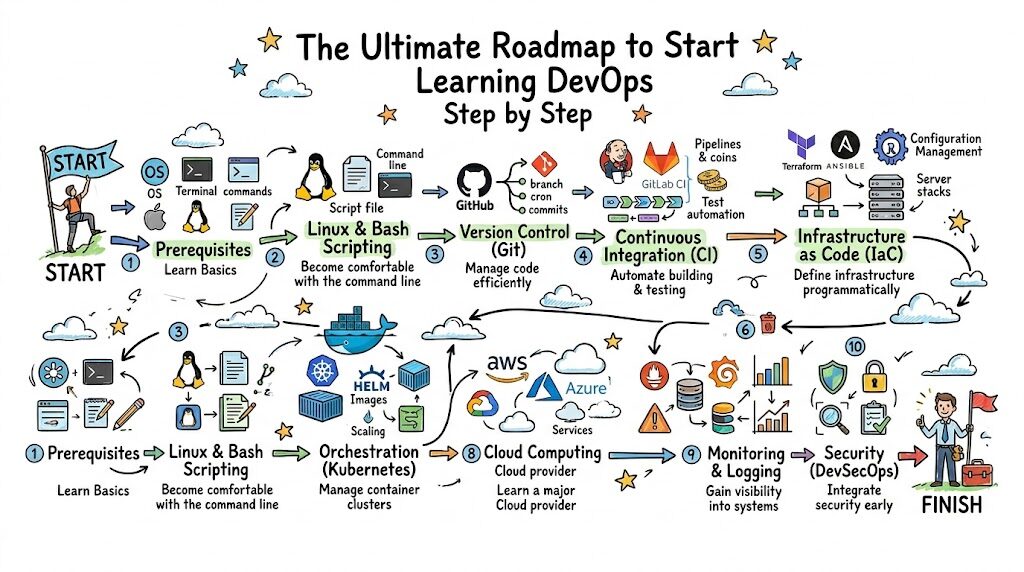
Step-by-Step DevOps Learning Roadmap
The following roadmap is designed to guide you through the transition from a complete beginner to a junior DevOps professional.
| Step | Skill Area | Goal |
| 1 | Linux Skills | Master the Command Line Interface (CLI) |
| 2 | Networking | Understand how machines talk to each other |
| 3 | Git | Learn version control and collaborative coding |
| 4 | Scripting | Automate simple tasks using Bash |
| 5 | CI/CD | Automate code integration and deployment |
| 6 | Containers | Package applications using Docker |
| 7 | Kubernetes | Manage container orchestration |
| 8 | Cloud Basics | Provision infrastructure on AWS/Azure/GCP |
| 9 | IaC | Provision infrastructure using Terraform |
| 10 | Monitoring | Track system health and logs |
| 11 | Projects | Build end-to-end DevOps workflows |
| 12 | Portfolio | Document and showcase your work |
Step 1: Learn Basic Linux Skills
Linux is the backbone of the internet and the foundation of DevOps. You must be comfortable working in a terminal without a graphical user interface.
- Key Concepts: File management, user permissions, process management, text editors (Vi/Vim), and package management.
- Example: Practice creating a user, assigning them to a group, and restricting their access to a specific folder.
Step 2: Understand Networking Basics
You cannot manage servers if you do not understand how they communicate.
- Key Concepts: IP addresses, DNS, subnets, ports, firewalls, and the OSI model.
- Example: Learn how to use ‘ping’, ‘curl’, and ‘netstat’ to diagnose why a website is not loading.
Step 3: Learn Git and Version Control
Git is how teams collaborate on code. It is mandatory for any developer or operations professional.
- Key Concepts: Repositories, cloning, branching, merging, pull requests, and resolving merge conflicts.
- Example: Create a repository on GitHub, create a feature branch, make a change, and merge it back to the main branch.
Step 4: Learn Basic Scripting
Automation is the heart of DevOps. If you do it manually more than once, you should script it.
- Key Concepts: Variables, loops, conditional statements (if/else), and functions.
- Example: Write a script that checks if a server has enough disk space and sends an alert if it is running low.
Step 5: Understand CI/CD Concepts
CI/CD (Continuous Integration and Continuous Delivery) is about automating the release process.
- Key Concepts: Pipeline stages, build steps, automated testing, and deployment strategies.
- Example: Use a tool like Jenkins or GitHub Actions to automatically deploy a simple HTML page whenever you push code to your repository.
Step 6: Learn Containers and Docker
Containers allow you to package an application with all its dependencies so it runs the same way on any machine.
- Key Concepts: Dockerfiles, images, containers, and Docker Hub.
- Example: Dockerize a simple Python web application and run it as a container on your local machine.
Step 7: Learn Kubernetes Fundamentals
Kubernetes is the standard for managing hundreds or thousands of containers.
- Key Concepts: Pods, deployments, services, clusters, and namespaces.
- Example: Deploy a containerized application to a local Kubernetes cluster (like Minikube).
Step 8: Learn Cloud Basics
The cloud is where your infrastructure lives.
- Key Concepts: Compute (EC2), Storage (S3), Databases (RDS), and IAM (Identity and Access Management).
- Example: Launch a virtual machine (EC2 instance) on AWS and host a simple web server on it.
Step 9: Learn Infrastructure as Code (IaC)
Stop creating infrastructure manually. Use code to define it.
- Key Concepts: Terraform, providers, resources, and state files.
- Example: Use Terraform to spin up a virtual machine instead of using the AWS console.
Step 10: Learn Monitoring and Observability
You cannot fix what you cannot see.
- Key Concepts: Metrics, logs, alerts, and dashboards.
- Example: Set up Prometheus to collect metrics from your server and visualize them in Grafana.
Step 11: Build Small DevOps Projects
Combine the skills.
- Idea: Create a pipeline that builds a Docker image, pushes it to a registry, and deploys it to a server automatically.
Step 12: Build a DevOps Portfolio
You need to prove you have done the work.
- Example: Document your projects in a GitHub README file, explaining what problem you solved and how you did it.
Beginner-Friendly DevOps Learning Timeline
This timeline is a guide. Some may learn faster, others slower. Do not compare your journey to others.
| Learning Stage | Focus Area | Expected Progress |
| Months 1-2 | Linux & Networking | Comfort in CLI, basic server management |
| Months 3-4 | Git & Scripting | Automating simple system tasks |
| Months 5-6 | CI/CD & Docker | Building basic deployment pipelines |
| Months 7-9 | Cloud & IaC | Managing cloud infrastructure via code |
| Months 10+ | Kubernetes & Monitoring | Handling complex, scalable environments |
Real-World Example: Beginner Learning DevOps the Wrong Way
“Student A” decides to start DevOps. They hear Kubernetes is popular and immediately start a complex K8s tutorial. They do not know Linux commands, they do not understand how networking works, and they have never used Git. They spend three weeks trying to configure a cluster, fail, get frustrated, and quit because they think “DevOps is too hard.”
Lesson Learned: Do not jump into advanced orchestration tools without understanding the underlying OS and networking.
Real-World Example: Beginner Learning DevOps Step by Step
“Student B” starts by mastering the Linux command line. They spend two weeks getting comfortable with terminal navigation. Next, they learn Git and manage their own code projects. Once they are confident, they move to basic scripting, automating their own file backups. By the time they reach Docker and Kubernetes, they understand the “why” behind the tools. They face issues, but they have the fundamental knowledge to debug them.
Lesson Learned: Structured growth leads to competence and confidence.
Common Beginner Mistakes
- Skipping Linux: Thinking you can bypass the command line. You cannot.
- Tool Hopping: Learning a little bit of Jenkins, then switching to GitLab, then to CircleCI. Pick one, master it, then switch if needed.
- Passive Learning: Only watching videos. If you don’t type the code, you don’t learn it.
- Ignoring Fundamentals: Trying to learn advanced cloud architecture without knowing basic networking.
- Lack of Documentation: Not writing down what you did. You will forget.
Best Practices for Learning DevOps Successfully
- Practice Daily: Consistency is better than intensity. One hour a day is better than ten hours on Saturday.
- Build Real Projects: Build a website, host it, monitor it, and automate its deployment.
- Learn to Debug: Don’t just look for the answer. Read the error message. Use Google, use documentation, use community forums.
- Join Communities: Find study groups or online forums.
- Use Documentation: Read the “official documentation” of the tool (e.g., Docker docs, Terraform docs) instead of just relying on third-party tutorials.
Role of DevOpsSchool in DevOps Learning
DevOpsSchool provides a path that cuts through the noise of the industry. Many beginners struggle because they lack a structured environment that prioritizes hands-on experience over theoretical lecturing. By focusing on practical application, they ensure that learners get exposure to the tools they will actually use in the workforce. Their curriculum is designed to help students build the CI/CD pipelines and cloud infrastructure they need to master, moving from beginner concepts to advanced deployment strategies.
Career Opportunities After Learning DevOps
The job market for DevOps professionals remains strong across the globe. Once you have built your skills, you can target roles such as:
- Junior DevOps Engineer: Focusing on CI/CD pipelines and automation.
- Cloud Engineer: Managing cloud infrastructure on platforms like AWS, Azure, or GCP.
- SRE (Site Reliability Engineer): Focusing on the availability, latency, and performance of systems.
- Platform Engineer: Building internal tools that help other developers deploy code faster.
- Automation Engineer: Specializing in writing scripts to reduce manual work.
Skills needed for these roles include strong Linux proficiency, experience with cloud services, a deep understanding of CI/CD, and the ability to monitor and manage distributed systems.
Industries Hiring DevOps Professionals
DevOps is no longer limited to tech startups. Every modern company is a software company.
- SaaS Platforms: Need 24/7 uptime and rapid release cycles.
- Banking & Finance: Need strict compliance, security, and automated auditing.
- Healthcare: Require secure, reliable, and scalable infrastructure to manage patient data.
- E-Commerce: Need to handle massive spikes in traffic during sales.
- Telecom: Moving legacy systems to the cloud, requiring migration experts.
Future of DevOps Learning
The future of DevOps is moving toward Platform Engineering, where teams provide “internal developer platforms” (IDP) that make it easier for developers to deploy. We are also seeing a massive rise in DevSecOps, where security is integrated into every step of the pipeline. Additionally, AI-assisted DevOps is becoming real, with AI tools helping to write scripts, detect anomalies, and even fix broken code. The fundamentals, however, will remain the same. The better you understand how a server works, the better you will be able to leverage AI to manage it.
FAQs
- How do I start learning DevOps?Start with Linux basics, then networking, then Git. Build a solid foundation before moving to tools like Docker or Kubernetes.
- Is DevOps hard for beginners?It can be challenging because of the breadth of tools. However, by breaking it down into a step-by-step roadmap, it becomes manageable.
- Should I learn Linux first?Yes, absolutely. It is the most critical prerequisite.
- Do I need coding skills?You do not need to be a software engineer, but you need to know how to read and write basic scripts in languages like Bash or Python.
- How long does it take to learn DevOps?A solid foundation can be built in 6 to 12 months with consistent daily practice.
- Can freshers learn DevOps?Yes, many freshers enter the industry through internships or by building a strong portfolio of projects.
- Which cloud should I learn first?AWS is the most widely used, so it is a good place to start, but the concepts transfer to Azure and GCP.
- Is Kubernetes mandatory?For modern DevOps roles, yes, it is increasingly becoming a standard skill.
- Do I need a degree to get a DevOps job?While a degree helps, practical skills and a solid portfolio of work often matter more to employers.
- What is the difference between SRE and DevOps?DevOps is the culture/methodology; SRE is a specific engineering approach to implementing that culture with a focus on reliability.
- How much coding do I actually do?It varies by role, but you will spend a lot of time writing scripts for automation and configuration files (like YAML for Kubernetes).
- Can I learn DevOps by myself?Yes, but it is often faster and less frustrating to follow a structured roadmap or a course.
- Is it better to learn one tool or many?Master one tool in a category (e.g., learn Terraform for IaC) rather than learning a little bit of five different tools.
- What is a “Pipeline”?A pipeline is a series of automated steps that code goes through, from the moment it is written to the moment it is running in production.
- How do I show my skills to recruiters?Maintain an active GitHub profile with documentation and clear examples of projects you have built.
Final Thoughts
Starting to learn DevOps is a significant commitment, but it is one of the most rewarding paths you can take in the technology sector. It requires patience, a relentless drive to solve problems, and a commitment to continuous learning. Remember that you do not need to know everything on day one. You only need to know the next step.
Start with your Linux fundamentals. Set up a simple project. Build a script that does something useful, even if it is small. Celebrate those small wins. Over time, those small wins will compound into the deep, practical expertise that defines a senior DevOps professional. Stay focused, stay consistent, and keep building.