Introduction
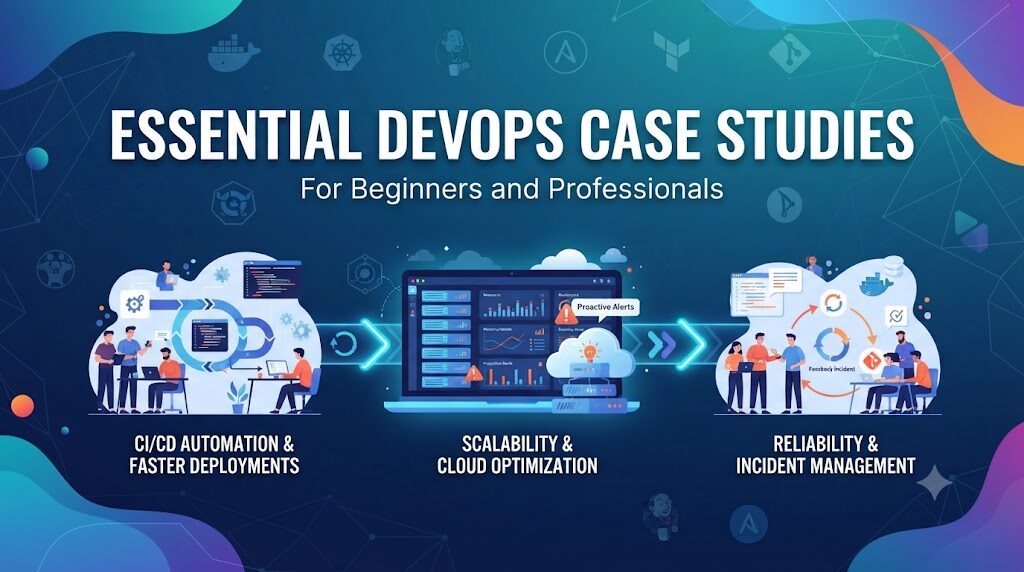
The transition from understanding theoretical DevOps concepts to applying them in a high-pressure production environment is often the most challenging hurdle for learners. Many professionals spend months mastering syntax for tools like Kubernetes or Terraform, yet struggle when asked to integrate them into a cohesive, business-driven workflow. This is where DevOpsCase Studies to Learn Practical Skills become invaluable.
Theoretical knowledge provides the “what,” but case studies provide the “why” and the “how.” By examining real-world challenges—such as scaling a legacy monolithic application or implementing automated security gates—learners can observe the decision-making processes of seasoned engineers. At DevOpsSchool, we emphasize that true proficiency comes not from memorizing command-line arguments, but from understanding how technical choices directly impact business reliability and efficiency. Whether you are a career changer or an experienced engineer looking to transition into Platform Engineering, analyzing documented implementations is the fastest route to bridge the gap between theory and execution.
Why Case Studies Are Powerful Learning Tools
Case studies move beyond simple documentation by offering context. In a textbook, you learn how to install an agent; in a case study, you learn why that specific agent was chosen over an open-source alternative, how it affected network latency, and the trade-offs made during the configuration phase.
- Context-based learning: You see how infrastructure components interact within a real business ecosystem.
- Problem-solving simulation: You are forced to think through the “what-ifs” before seeing the solution.
- Decision-making clarity: You understand the constraints (budget, time, legacy debt) that influence engineering choices.
- Business alignment: You learn to speak the language of stakeholders, linking technical uptime to revenue protection.
DevOps Learning Through Case Studies Framework
To get the most out of any case study, adopt a structured analytical approach. Use this framework to dissect every project you encounter:
- Business Requirement: What was the specific pain point? (e.g., slow releases).
- Technical Challenge: What were the constraints? (e.g., on-premise hardware).
- Assessment: What tools or methodologies were considered?
- Solution Design: The architecture chosen to resolve the conflict.
- Implementation: The step-by-step technical execution.
- Monitoring: How was success measured post-deployment?
- Optimization: What adjustments were made after gathering data?
- Lessons Learned: What would be done differently in retrospect?
Core Skills Learners Develop Through Case Studies
| Skill Area | Practical Benefit | Career Value |
| CI/CD | Faster, safer code deployment cycles. | High demand in all cloud-native teams. |
| Cloud Computing | Leveraging elastic resources effectively. | Critical for cost-efficient architecture. |
| Infrastructure as Code | Eliminating configuration drift. | Standard for modern systems engineering. |
| Monitoring | Gaining actionable system insights. | Essential for SRE and reliability roles. |
| Security | Integrating guardrails without friction. | Highly prioritized in current enterprise IT. |
| Automation | Reducing manual toil and human error. | Core requirement for platform engineers. |
Case Study #1: CI/CD Pipeline Modernization
Scenario: A mid-sized fintech company faced a “deployment bottleneck.” Developers were merging code, but the manual testing phase took 48 hours, delaying releases.
- Initial Challenges: Manual QA, frequent integration conflicts, and lack of automated rollback.
- Pipeline Design: Implemented a GitOps workflow using Jenkins for orchestration and ArgoCD for deployment.
- Automation: Introduced automated unit and integration testing blocks in the pipeline.
- Outcomes: Lead time for changes dropped from two days to 30 minutes.
- Skills Learned: Managing pipeline dependencies, understanding gated promotions, and master/slave architecture.
Case Study #2: Infrastructure as Code (IaC) Adoption
Scenario: A retail startup suffered from “snowflake servers,” where each production environment was configured differently, leading to unpredictable outages.
- Issues: Inconsistent environments between Development, Staging, and Production.
- IaC Implementation: Migrated all resource provisioning to Terraform.
- Consistency: Used modular templates to ensure 100% environment parity.
- Operational Improvements: Rebuilt the entire environment from scratch in minutes after a configuration error.
- Lessons Learned: The importance of state file management and preventing manual overrides.
Case Study #3: Cloud Migration Project
Scenario: A media company needed to migrate its legacy database and application layer to AWS to handle fluctuating traffic loads during major events.
- Challenges: High latency, database locking, and strict data compliance.
- Migration Strategy: A “Re-platforming” approach, moving to managed services like RDS and EKS.
- Cloud Automation: Used Ansible for configuration management across the new cloud nodes.
- Cost Optimization: Implemented Auto Scaling Groups and Spot Instances for non-critical workloads.
- Skills Gained: Understanding cloud security groups, VPC peering, and elastic resource management.
Case Study #4: Monitoring and Observability Enhancement
Scenario: An e-commerce platform experienced frequent downtime with no clear indication of the root cause until customers reported it.
- Visibility Challenges: Siloed logs and a lack of correlation between infrastructure metrics and application performance.
- Implementation: Deployed the Prometheus and Grafana stack with centralized logging using the ELK stack.
- Alerting Improvements: Created “Service Level Objectives” (SLOs) and actionable alerts.
- Outcomes: Reduced Mean Time to Recovery (MTTR) by 60%.
- Learning Outcomes: Understanding metrics vs. logs vs. traces and how to set meaningful thresholds.
Case Study #5: DevSecOps Integration
Scenario: A healthcare provider faced compliance audits, finding that security vulnerabilities were being introduced in early development cycles.
- Security Bottlenecks: Security scans occurred only at the end of the release cycle.
- Security Automation: Integrated SonarQube for static analysis and Trivy for container image scanning directly into the CI pipeline.
- Compliance: Automated policy-as-code checks to ensure all deployments met HIPAA standards.
- Lessons Learned: Security is a shared responsibility, not a final phase; automation prevents human oversight.
Measuring Success in DevOps Projects
| Metric | Why It Matters | Learning Value |
| Deployment Frequency | Measures team velocity. | Teaches pipeline efficiency. |
| Lead Time | Measures total delivery speed. | Highlights process bottlenecks. |
| MTTR | Indicates resilience. | Teaches effective debugging/monitoring. |
| Change Failure Rate | Measures deployment safety. | Teaches testing strategies. |
| Cost Efficiency | Validates infrastructure design. | Teaches cloud financial management. |
| Automation Coverage | Reduces manual toil. | Teaches scripting/tool proficiency. |
Common Learning Mistakes
| Mistake | Impact | Recommended Solution |
| Tool Obsession | You learn the “how,” but not the strategy. | Focus on architecture over specific tools. |
| Ignoring Context | Solutions fail in real production environments. | Study the business problem first. |
| Skipping Documentation | Knowledge is lost quickly. | Maintain a project logbook. |
| Avoiding Troubleshooting | You never learn to handle failure. | Intentionally break your test environments. |
| Neglecting Security | You create insecure pipelines. | Adopt a “security-first” mindset. |
| Not Measuring | You cannot prove the value of your work. | Implement KPI tracking from Day 1. |
Best Practices for Learning Through Case Studies
- Analyze business goals: Every project must solve a real-world problem.
- Understand technical decisions: Ask “Why did they pick this tool?” rather than “How do I install this?”
- Review outcomes: Look at the data provided in the case study—did it actually work?
- Document findings: Write summaries or blog posts about what you analyzed.
- Build similar projects: Use the architecture described as a blueprint for your own lab.
- Reflect on lessons learned: Understand the mistakes the team made during the project.
Building Your Own Practice Case Studies
Don’t just read—reproduce. Take the architecture diagrams from a case study and try to rebuild them in your own home lab or cloud sandbox. Create a public repository where you track your progress, write README files explaining your decisions, and document the challenges you faced during implementation. This becomes the basis of your professional portfolio, proving to employers that you understand the end-to-end lifecycle of a DevOps project.
Real-World Learning Roadmap
- Beginner: Start by deploying a simple web application using basic automation scripts.
- Intermediate: Transition to containerization (Docker) and basic orchestrations (Kubernetes).
- Advanced: Implement full CI/CD pipelines with monitoring, logging, and automated testing.
- Specialization: Focus on specific domains like cloud-native security, FinOps, or Platform Engineering.
- Professional Portfolio: Curate your projects into a narrative that showcases problem-solving skills.
Future of DevOps Learning
The landscape is shifting toward AI-assisted development and Platform Engineering. Future learning will rely on interactive simulations where you can troubleshoot “live” broken environments. As DevOps matures, the focus is moving away from manual pipeline creation toward creating self-service internal developer platforms (IDPs). Continuous learning is no longer optional; it is the core of the profession.
Certifications & Learning Paths
| Certification Area | Best For | Skill Level | Practical Relevance |
| Linux | Foundation building | Fundamental | Essential for all server management |
| Cloud (AWS/Azure) | Infrastructure scaling | Intermediate | Critical for modern deployments |
| Docker | Containerization | Fundamental | Base requirement for microservices |
| Kubernetes | Orchestration | Advanced | The standard for modern scale |
| Terraform | IaC | Intermediate | Essential for repeatable environments |
| DevOps | Process integration | Professional | Comprehensive industry alignment |
DevOps Case Study Learning Checklist
- Define the business problem clearly.
- Map out the required technical components.
- Review existing architecture patterns for similar solutions.
- Implement a proof-of-concept (PoC) in a sandbox environment.
- Integrate monitoring to track performance metrics.
- Write a retrospective summary of your technical decisions.
- Push your code to a portfolio repository.
FAQs (15 Questions)
- Why are case studies important for DevOps learning? They provide the “real-world” context that tutorials often miss.
- How many case studies should I review? Start with three, then move to building your own projects based on those patterns.
- Can beginners learn from advanced projects? Yes, by focusing on the “what” and “why” rather than the complex implementation details.
- How do case studies improve job readiness? They help you talk through architectural decisions in technical interviews.
- What skills are most important? Automation, networking fundamentals, and monitoring.
- Should I build similar projects? Absolutely; building is the only way to solidify the knowledge.
- How do I document learning? Keep a technical blog or a well-structured GitHub README.
- What should I focus on first? Start with Linux and basic automation scripting.
- Are tools more important than processes? No; tools change, but the DevOps philosophy remains the same.
- How do I measure success in my lab? Use KPIs like deployment time and system uptime.
- Do I need expensive hardware? No; cloud free-tiers are sufficient for most learning projects.
- Is DevOps only about automation? No; it is about culture, collaboration, and continuous improvement.
- How do I handle failures in my projects? Treat them as learning opportunities to improve your debugging skills.
- How do I keep up with new trends? Follow industry blogs and contribute to open-source communities.
- Does every project need a case study? Not every project, but every significant learning milestone should be documented as one.
Final Thoughts
DevOps is not a destination; it is a cycle of constant refinement. By using case studies to learn practical skills, you are doing more than just building a resume—you are training your brain to think like an engineer. Focus on solving the underlying business problem, maintain a relentless pursuit of measurement, and never shy away from the complexities of a real production environment. Your ability to troubleshoot and adapt is what will set you apart.