Ever since Patrick Debois coined the term “DevOps” in 2009, it has become one of the most discussed — and most misunderstood — concepts in software engineering. A closely related source of confusion is CI/CD. Many developers use the two terms interchangeably, yet they describe fundamentally different things. This article untangles the two concepts so you can use them precisely and apply them effectively in your organisation.
What Is DevOps?
DevOps is a cultural and organisational movement — a combination of practices, ideas, tools, and processes designed to break down the traditional silos between software development and IT operations teams. Its core goal is to enable organisations to build, test, and release software faster, more reliably, and with higher quality.
In Patrick Debois’s own framing, DevOps represents “a movement of people who think it’s time for a change in the IT industry — time to stop wasting money, time to start delivering great software, and building systems that scale and last.”
Key attributes of a DevOps culture include:
- Shared ownership — development and operations teams are jointly responsible for product quality and uptime.
- Continuous feedback loops — teams monitor production systems and feed insights back into the development process.
- Automation-first thinking — repetitive manual tasks (provisioning, testing, deployment) are automated wherever practical.
- Incremental delivery — software is shipped in small, frequent batches rather than large, infrequent releases.
- Collaborative tooling — teams share dashboards, on-call rotations, and post-mortems instead of working in isolation.
DevOps is not a specific tool, a job title, or a pipeline. It is a way of working — a cultural shift that must be adopted at the team and organisational level before any tooling decisions are made.
Why DevOps Exists: The Historical Context
Historically, development teams wrote code and then “threw it over the wall” to operations teams who were responsible for deploying and running it. This handoff model created conflict, slow feedback, finger-pointing during outages, and long release cycles. DevOps emerged as a direct response to these friction points, encouraging the two groups to collaborate throughout the entire software lifecycle rather than only at handoff moments.
DevOps in Practice: A Real-World Example
Facebook is a widely cited example of DevOps practices at scale. Its engineering approach has long emphasised code ownership, automation, incremental changes, and continuous improvement — all hallmarks of DevOps thinking. The company reportedly completed a migration of its infrastructure and back-end services to the Chef configuration management platform around 2015, allowing it to manage thousands of servers and push multiple code updates daily. Some of those Chef cookbooks were also made publicly available.
This example illustrates that DevOps is not a single tool or pipeline — it is a philosophy that shapes how an entire engineering organisation operates.
What Is CI/CD?
CI/CD stands for Continuous Integration / Continuous Delivery (and sometimes Continuous Deployment). It is a concrete set of engineering practices and automated workflows — often implemented as a “pipeline” — that enable teams to integrate, test, and release code changes frequently and reliably.
Where DevOps is the culture, CI/CD is one of the most important technical implementations of that culture. Think of DevOps as the philosophy and CI/CD as a key part of the machinery that puts that philosophy into practice.
Continuous Integration (CI)
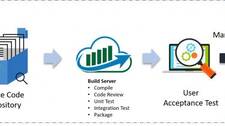
Continuous Integration is the practice of developers merging their code changes into a shared repository frequently — ideally multiple times per day. Each merge triggers an automated build and a suite of automated tests. The goals are:
- Catch integration bugs early, before they compound.
- Keep the main branch in a consistently deployable state.
- Give developers rapid feedback on whether their change broke anything.
In their book Continuous Delivery, Jez Humble and David Farley recommend that developers check in to the main branch at least a couple of times a day. The longer a branch lives in isolation, the harder — and riskier — the eventual merge becomes.
Continuous Delivery (CD)
Continuous Delivery extends CI by ensuring that every change that passes automated tests is also automatically prepared for release to production. Critically, the final push to production still requires a human decision. A staging or pre-production environment is typically used for user acceptance testing (UAT) or manual review before deployment is approved.
The key benefit of Continuous Delivery is that releases become low-risk, routine events rather than high-stakes, infrequent ordeals. Because the software is always in a releasable state, the business can choose when to ship based on business needs rather than technical readiness.
Continuous Deployment (also CD)
Continuous Deployment goes one step further: every change that passes all automated test stages is automatically pushed to production without any manual approval step. This requires a high level of confidence in the automated test suite, because there is no human gate before the change reaches users.
Continuous Deployment is not appropriate for every organisation or every product. Regulated industries, for example, may require manual sign-off before production releases. However, for mature teams with comprehensive test coverage, it can dramatically accelerate the feedback loop between developers and end users.
Summary: The Scope of Automation in Each Practice
| Practice | Automated Build & Test | Automated Release Prep | Automated Production Deploy |
|---|---|---|---|
| Continuous Integration | ✅ | ❌ | ❌ |
| Continuous Delivery | ✅ | ✅ | ❌ (manual approval) |
| Continuous Deployment | ✅ | ✅ | ✅ |
CI/CD in Practice: A Real-World Example
The ReactJS framework maintained by Facebook (now Meta) is a publicly visible example of CI/CD in action. The project’s GitHub repository includes status badges — such as CircleCI build status and code coverage reports via Coveralls — that reflect the results of their automated pipeline on every pull request. Clicking through those badges shows the individual steps of their CI process and how the pipeline is configured. This transparency also serves as a useful learning resource for teams building their own pipelines.
CI/CD vs. DevOps: The Core Distinction
The confusion between CI/CD and DevOps is understandable — both aim to speed up and improve software delivery, and CI/CD is almost always present in a healthy DevOps organisation. But they operate at different levels:
- DevOps is the culture and strategy. It defines how teams are structured, how they communicate, and what values guide their work. You cannot buy DevOps as a product or install it as a tool.
- CI/CD is a set of technical practices and automated pipelines. It is one of the most powerful enablers of a DevOps culture, but it is possible to run a CI/CD pipeline without having a genuine DevOps culture — and conversely, a DevOps culture encompasses much more than just CI/CD (including monitoring, incident management, infrastructure as code, and organisational design).
A useful analogy: DevOps is to CI/CD what Agile is to Scrum. Agile is a set of values and principles; Scrum is a specific framework that implements many of those principles. Similarly, DevOps is the broader cultural philosophy, and CI/CD is one of the most important concrete frameworks for living it out.
Why the Distinction Matters
Getting this distinction right has practical consequences:
- Tooling decisions: Choosing a CI/CD tool (Jenkins, GitHub Actions, GitLab CI, CircleCI, etc.) is a technical decision. Adopting DevOps requires leadership buy-in, team restructuring, and cultural change — no tool alone delivers it.
- Diagnosing problems: If your deployments are still slow and painful despite having a CI/CD pipeline, the root cause may be cultural — siloed teams, poor communication, lack of shared ownership — not a pipeline configuration problem.
- Setting expectations: Promising stakeholders that “we’re adopting DevOps” when you mean “we’re setting up a Jenkins pipeline” sets up a gap between expectation and reality that can undermine confidence in the initiative.
Key Takeaways
- DevOps is a cultural and organisational philosophy that bridges the gap between development and operations to enable faster, higher-quality software delivery.
- CI/CD is a set of engineering practices and automated pipelines — Continuous Integration, Continuous Delivery, and Continuous Deployment — that automate the building, testing, and releasing of software.
- CI/CD is one of the most important technical pillars of a DevOps culture, but the two terms are not synonymous.
- You can implement CI/CD without a full DevOps transformation, but you cannot achieve a true DevOps culture without some form of CI/CD automation.
- The key differentiator among CI, Continuous Delivery, and Continuous Deployment is the degree of automation applied — particularly whether the final production deployment requires human approval.