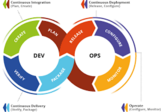
This article is based on analysis originally published on Security Boulevard. It covers how modern application development teams can integrate DevOps security tools such as IAST into CI/CD pipelines to maintain both speed and security.
The Shift from Monolithic to Modern Applications
Software developers building modern applications have broadly adopted agile development practices, DevOps toolchains, and continuous integration and continuous delivery (CI/CD) pipelines. This shift has been driven by a fundamental change in how software is consumed: consumers and enterprises increasingly rely on web and mobile apps that must be updated frequently rather than delivered in large, infrequent releases.
Traditional monolithic applications were released on cycles of six to twenty-four months, with presentation, business logic, and data tier layers all shipped together in a single “big bang” deployment. That model cannot meet the demands of modern software, which must scale to potentially millions of concurrent users worldwide, handle massive data volumes, and process requests with near-zero latency. As a result, teams have decomposed codebases into discrete modules—proprietary code, open source libraries, microservices, and APIs—each independently deployable.
This architectural shift has a direct security implication: no single developer can hold a complete mental model of the entire codebase anymore, and the attack surface has grown proportionally. Security must evolve at the same pace as development.
DevOps Security Tools: Why Point Solutions Matter
A common but mistaken assumption is that simply migrating a monolithic application to a cloud infrastructure-as-a-service (IaaS) platform—such as Amazon Web Services (AWS)—automatically addresses security requirements. Modern applications built around microservices and APIs require security tooling that matches their architecture, not generic platform-level protections.
In its Critical Capabilities Report for Application Security Testing, Gartner noted that buyers often seek a single-vendor platform covering static application security testing (SAST), dynamic application security testing (DAST), and other AST techniques. However, Gartner cautioned that while this approach may be adequate for conventional web application testing, modern applications and DevOps workflows frequently require targeted point solutions—particularly for API security testing.
The key categories of application security testing tools relevant to DevOps environments include:
- SAST (Static Application Security Testing): Analyzes source code, bytecode, or binaries for vulnerabilities without executing the application. Integrates early in the SDLC.
- DAST (Dynamic Application Security Testing): Tests a running application from the outside, simulating attacker behavior against exposed endpoints.
- IAST (Interactive Application Security Testing): Instruments the application at runtime using agents or sensors, identifying vulnerabilities during normal test execution—combining the depth of SAST with the runtime accuracy of DAST.
- SCA (Software Composition Analysis): Identifies known vulnerabilities in open source and third-party components within the codebase.
- API Security Testing: Specifically targets the APIs that modern applications rely on for inter-service communication and external integrations.
Modern Applications Move Fast—Security Must Keep Up
Under DevOps and CI/CD models, development teams may commit code multiple times per day. This pace of “continuous innovation” creates tension with traditional security practices, which were often bolt-on steps performed at the end of the development cycle. Waiting until a release candidate is ready to run security scans introduces costly delays and can create a backlog of vulnerabilities that are expensive to fix late in the SDLC.
The solution is to shift security left—embedding automated security testing directly into the CI/CD pipeline so that every code commit, build, and deployment triggers relevant security checks. Gartner’s analysis of the DevOps and modern applications use case emphasizes that effective security tools in this context must:
- Integrate tightly with the existing DevOps toolchain (IDEs, source control, build systems, orchestration platforms)
- Support full automation with minimal manual intervention
- Minimize test execution time to avoid blocking pipeline throughput
- Provide actionable, developer-friendly vulnerability reports that link findings to specific lines of code
- Support bug-tracking integrations (such as Jira or similar systems) for seamless remediation workflows
The goal is not to slow development—it is to make security a natural, low-friction part of the development workflow so that teams can deliver secure software at DevOps speed.
IAST and Its Role in CI/CD Pipelines
Interactive Application Security Testing (IAST) is particularly well-suited to modern application development and CI/CD environments. Unlike SAST tools that require access to source code and can produce false positives, or DAST tools that require a fully deployed application and can miss server-side logic flaws, IAST instruments the application at runtime—typically via a language agent—and observes actual code execution paths during automated test runs.
This approach offers several advantages in a DevOps context:
- Low friction: IAST runs passively during existing automated tests (unit, integration, end-to-end), requiring no separate test execution phase.
- High accuracy: Because findings are tied to observed runtime behavior, IAST typically generates fewer false positives than SAST alone.
- Continuous feedback: Results are available immediately after each test run, giving developers real-time security feedback within the pipeline.
- Broad coverage: IAST is effective at identifying vulnerabilities in applications that rely heavily on open source components, APIs, client-side code, and JavaScript frameworks.
According to the Gartner Critical Capabilities report, the modern applications use case concentrates on API security testing, software composition analysis (SCA), automation and turnaround speed, SDLC integration, and IAST—with SAST and DAST treated as secondary considerations for this specific use case.
Embedding Security Across the Full SDLC
Regardless of deployment model—whether fully cloud-native microservices, legacy on-premises monoliths, or hybrid architectures—security cannot be an afterthought. The most effective approach is to treat security as a continuous practice that runs in parallel with development and testing throughout the entire software development life cycle.
Gartner recommends that security and risk management leaders responsible for application security embed AST into the SDLC by selecting solutions that:
- Work effectively within integrated development environments (IDEs)
- Provide native bug-tracking and issue management integrations
- Support quality assurance workflows
- Integrate with other application development and testing systems through plugins and full API enablement
When DevOps security tools are automated within the CI/CD pipeline, potential security risks can be identified and remediated before code reaches production—dramatically reducing the cost and complexity of fixing vulnerabilities and reducing exposure windows.
Key Takeaways for DevOps Teams
- Shift security left: Integrate automated security testing at every stage of the CI/CD pipeline, not just pre-release.
- Choose tools designed for DevOps: Prioritize solutions that support automation, pipeline integration, and fast feedback over tools that require manual setup or separate test cycles.
- Address the full component landscape: Modern applications depend on open source libraries, third-party APIs, and microservices—your security tooling must cover all of these, not just proprietary code.
- Consider IAST for runtime coverage: For applications where runtime behavior is critical to accurate vulnerability detection, IAST complements SAST and DAST effectively.
- Use SCA for open source risk: Software composition analysis is essential for identifying known vulnerabilities in the open source dependencies that make up a significant portion of most modern codebases.
- Treat API security as a first-class concern: APIs are primary attack vectors in microservices architectures and require dedicated security testing beyond what general-purpose AST tools provide.
Teams that integrate the right mix of SAST, DAST, IAST, SCA, and API security testing tools into their DevOps workflows—and automate those tools within CI/CD pipelines—are best positioned to deliver secure, high-quality software at the pace modern application development demands.