Introduction
Austria has quietly become one of the most desirable destinations for professionals seeking a change of pace, a high standard of living, and access to the heart of Europe. From the artistic streets of Vienna to the majestic landscapes of the Alps, the country offers more than just beauty—it offers a stable, secure, and thriving professional ecosystem.
But navigating the path to Austrian residency can feel complex. You might be wondering: “Do I qualify?” or “How can I improve my chances?” This is where the Austria PR Points Calculator comes into play. It is your foundational tool for assessing whether you meet the requirements for the Red-White-Red Card, the gateway to living and working in Austria.
In this guide, we strip away the bureaucracy. Whether you are an IT specialist, a healthcare worker, or a recent graduate looking for your first big opportunity, we will help you understand how your skills, education, and language abilities translate into the points that determine your eligibility. Let’s prepare your path to Austria together.
What Is an Austria PR Points Calculator?
At its core, the Austria PR Points Calculator is a self-assessment tool. Austria operates on a point-based immigration system, specifically for the Red-White-Red (RWR) Card. Unlike some countries that use a lottery or a purely employer-driven visa, Austria uses a transparent, criteria-based system to select skilled talent that the local labor market needs.
The Purpose
The calculator allows you to tally your qualifications against the Austrian government’s specific criteria. It turns subjective concepts—like “having enough experience”—into an objective score.
How It Works
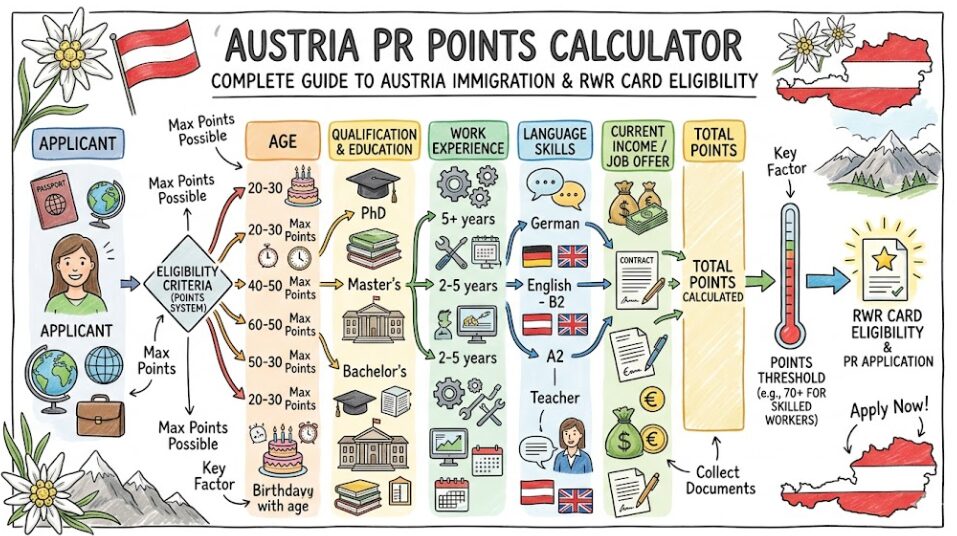
The government assigns a specific number of points to factors like your age, your educational degree, your proficiency in German or English, and the nature of your work experience. You need to reach a specific “cut-off” score to be eligible for the application process.
Who Should Use It?
- IT Professionals and Engineers: If you work in a sector facing skill shortages.
- Healthcare Workers: Who are highly sought after by Austrian hospitals.
- Recent Graduates: Who want to understand how their degree fits into the Austrian labor market.
- Skilled Workers: Looking for a structured pathway to long-term residency.
Understanding the Difference: Eligibility Score vs. Visa Approval
It is vital to understand that the calculator provides an eligibility assessment, not a guarantee. Reaching the minimum points required allows you to submit a valid application. The final approval rests with the Austrian authorities, who verify your documents and ensure your job offer meets the salary thresholds for the specific region and industry.
How Austria Immigration Points System Works
The points system is designed to reward candidates who fill specific gaps in the Austrian economy. Here is how the scoring breakdown generally functions.
Age Points
Austria values a mix of youthful energy and established experience. Points for age are typically highest in the earlier stages of a career and gradually adjust as you progress into more senior roles. The goal is to ensure a long-term contribution to the Austrian pension and social system.
Education Points
Your academic background is a primary driver of your score.
- Diploma: Recognized vocational or technical training.
- Bachelor’s Degree: Standard university education.
- Master’s Degree: Advanced specialization.
- PhD: For researchers, academics, and highly specialized experts, this category often carries the highest weight.
Language Skills
While you can often survive in professional circles with English, Austria is a German-speaking country.
- German Language: High proficiency (B2/C1 levels) earns significant bonus points.
- English Proficiency: While useful, it is often treated as a supplementary skill unless your specific job profile (e.g., international software development) allows for English-only communication.
Work Experience
The system looks at the relevance of your experience.
- Local Experience: Work performed within Austria counts heavily.
- International Experience: Professional roles held outside Austria are measured by their complexity and relevance to the “shortage occupation” lists.
Salary & Job Offer
A binding job offer from an Austrian employer is the “golden ticket.” The salary offered must meet the minimum thresholds set by the Austrian authorities. If your offer exceeds the standard wage for your role, you may earn additional points.
Adaptability Factors
These are “bonus” points that account for other factors, such as:
- Prior studies in Austria.
- Research achievements or publications.
- Accompanying family member’s qualifications (in some specific visa sub-types).
Austria Red-White-Red Card Explained
The Red-White-Red Card is a combined work and residence permit. It essentially tells the government, “I have a job, I am skilled, and I have the right to live here.”
Types of Pathways
- Very Highly Qualified Workers: For those with exceptional academic and professional achievements. This is a points-based system that does not require a job offer to start the application process (you can enter to seek work).
- Skilled Workers in Shortage Occupations: For professionals in fields like engineering, IT, and nursing where Austria cannot find enough local workers.
- Other Key Workers: For those who don’t fit the shortage list but have a high-salary job offer.
- Graduates from Austrian Universities: A pathway designed for those who have already completed a degree in Austria and wish to transition into the labor market.
- Self-Employed Key Workers: For entrepreneurs who can prove their business brings significant economic benefit to Austria.
Visa Validity
Typically, the RWR Card is issued for 24 months. After this, if you are still employed and meet the requirements, you can transition to a Red-White-Red Card Plus, which offers unrestricted access to the labor market and is a precursor to Permanent Residency.
Austria PR Points Calculator Breakdown
Use this table as a reference for your self-assessment. (Note: Points can vary slightly depending on the specific immigration stream).
| Factor | Description | Potential Impact |
| Age | Based on your current age bracket. | Medium |
| Education | Level of degree (Bachelor/Master/PhD). | High |
| Language | Proficiency in German (ÖSD/Goethe). | High |
| Experience | Relevant years of professional work. | High |
| Job Offer | Validated contract from an Austrian employer. | Critical |
- Pro Tip: Always have your degrees officially translated and, if necessary, verified by the ENIC NARIC Austria office.
Step-by-Step Example of Austria PR Score Calculation
To make this practical, let’s look at three hypothetical profiles.
Example 1: Software Engineer
- Age: 28 (High points)
- Education: Master’s in Computer Science (Very High points)
- Language: English (Fluent), German (Basic/A1)
- Experience: 5 years in backend development (High points)
- Job Offer: Yes, at a Vienna-based startup
- Final Score: Likely to qualify comfortably due to the “Shortage Occupation” status of IT professionals.
Example 2: Nurse/Healthcare Worker
- Age: 35
- Education: Bachelor’s in Nursing
- Language: German (B2 level—this is crucial for healthcare)
- Experience: 7 years in clinical settings
- Job Offer: Yes
- Final Score: Highly competitive. The language skill pushes this candidate into the safe zone.
Example 3: Student Transitioning to Work
- Age: 24
- Education: Austrian University Graduate
- Language: German (B2/C1 attained during studies)
- Experience: Internships during studies
- Job Offer: Junior Data Analyst
- Outcome: Graduates from Austrian universities often benefit from specific streamlined processes that bypass some of the standard points requirements.
Austria PR Eligibility Requirements
To be eligible, you must generally satisfy the following:
- Educational Qualifications: Your degree must be recognized in Austria. If it’s from a non-EU country, you may need to apply for recognition.
- Skilled Occupation: Your job title must fall under the national shortage list or be classified as a “key” position.
- Language Proficiency: German is rarely “optional” for long-term integration. Start learning early.
- Financial Proof: You need to show that you have the means to support yourself during the initial move.
- Work Contract: A formal, signed contract that complies with the minimum salary thresholds determined by the Austrian government.
Benefits of Using an Austria PR Points Calculator
- Fast Eligibility Checking: Save time by identifying your weak spots before you apply.
- Better Immigration Planning: If you know you are 5 points short, you know exactly what you need to focus on (e.g., getting a German certification).
- Reduced Rejection Risk: Applying only when you meet the criteria saves you the cost and stress of a denied application.
- Choosing the Right Stream: It helps you distinguish between applying as a “Very Highly Qualified” worker versus a “Shortage Occupation” worker.
Step-by-Step Guide to Calculate Austria PR Points
- Gather Documents: Collect your degree certificates, job letters, and language certifications.
- Check Language Proficiency: Take a recognized exam (like Goethe or ÖSD) if you claim points for German.
- Calculate Work Experience: Ensure your CV clearly highlights the duties that relate to your target job in Austria.
- Verify Job Offer: Check if your employer is ready to sponsor your visa.
- Calculate Bonus Points: Look for extra points for research, publications, or family members’ skills.
- Check Final Eligibility: Compare your total to the official government cutoff for your specific visa type.
How to Increase Austria PR Score
If you fall short of the required points, do not panic. Use these strategies:
- Learn German: This is the most impactful way to boost your score. A B2 certification is often a game-changer.
- Upskill: If your points are low, consider a specialized certification in your field (e.g., Cloud Architect, advanced project management).
- Target Shortage Occupations: Ensure your resume highlights skills that are explicitly on the Austrian shortage list.
- Refine Your CV: Ensure your work experience is described in a way that aligns with the Austrian understanding of your professional role.
Common Mistakes to Avoid
- Wrong Score Calculation: Counting years of experience that are not “relevant” to the job.
- Ignoring German: Assuming English will be enough in every sector.
- Using Outdated Criteria: Austria updates its shortage lists annually. Always check the latest government portals.
- Missing Documents: Incomplete files are the fastest way to get a rejection.
- Choosing the Wrong Category: Applying for the wrong stream can lead to disqualification.
Real-Life Case Studies
1. Young IT Professional Moving to Austria
- Initial Profile: High experience but no German language skills.
- Weaknesses: Language barrier.
- Improvements: Took an intensive German course for 6 months.
- Outcome: Secured the points necessary for the Shortage Occupation RWR card.
2. Married Couple Improving Eligibility
- Initial Profile: Principal applicant met the criteria, but the spouse had low qualifications.
- Weaknesses: Low overall family points.
- Improvements: Spouse completed a certification in a demand-driven field.
- Outcome: Improved the overall “Adaptability” profile and secured the visa.
3. Healthcare Worker Getting Selected
- Initial Profile: Degree not initially recognized.
- Weaknesses: Document verification delay.
- Improvements: Applied for official recognition of the nursing degree early in the process.
- Outcome: With the recognized degree, the points score jumped, leading to successful selection.
FAQs
- What is the Austria PR points calculator?It is a tool that helps you estimate your eligibility for an Austrian residence permit by assigning values to your age, education, and skills.
- How many points are needed for Austria PR?The requirement varies depending on the specific Red-White-Red Card category you apply for. Always check the official government threshold for the current year.
- What is the Red-White-Red Card?It is a combined residence and work permit that allows qualified third-country nationals to live and work in Austria.
- Is German language mandatory?While some high-level IT roles may accept English, German is crucial for most jobs and essential for long-term integration.
- Can I move to Austria without a job offer?Only if you apply as a “Very Highly Qualified Worker” and meet the strict point requirements for that category.
- Does age affect eligibility?Yes, age is a factor, with points awarded for being in an active, prime-working-age bracket.
- Can students settle permanently in Austria?Yes, after graduating from an Austrian university, students have pathways to transition to work permits and eventually residency.
- How accurate are online calculators?They are good for estimation, but always verify your specific scenario against official government documentation.
- What if I don’t have a degree?You may still qualify if you have extensive experience in a shortage occupation, though the points calculation will differ.
- Does my family come with me?Yes, once you secure your RWR card, your family members can generally join you under the family reunification visa rules.
- How long does the process take?It varies, but typically ranges from several weeks to a few months depending on the consulate and your background.
- What if my job isn’t on the shortage list?You can still apply as a “Key Worker,” but you will need to meet the specific salary thresholds for your role.
Conclusion
Austria offers a pathway to a life that balances professional ambition with an unparalleled quality of life. Using the Austria PR Points Calculator is your first proactive step. It moves you from the realm of “wishing” to “planning.” By understanding where you stand, improving your language skills, and targeting the right visa streams, you turn the complex immigration process into a manageable, step-by-step project. Start your documentation, evaluate your score, and begin your journey to the heart of Europe.