This article is based on analysis originally published by TVTechnology and commentary from Pebble, a broadcast playout technology vendor.
What Do We Actually Mean by Microservices?
“Microservices” has become one of the most overused terms in enterprise software. Before applying it to a broadcast context, it is worth pinning down what the term really means.
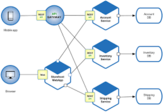
A microservices architecture decomposes an application into a collection of small, independently deployable services. Each service is focused on a single business function, runs in its own process, and communicates with other services over a well-defined API—typically HTTP/REST or a message queue. Because each service is self-contained, teams can build, test, deploy, and scale individual services without recompiling or redeploying the entire application.
The contrast is with a monolithic application: a system that may be internally modular but is packaged and deployed as a single executable or container. A monolith is not inherently poorly designed; it simply has a different operational profile.
One persistent industry debate is how small a service must be before it earns the “micro” label. There is no universally agreed threshold. This ambiguity matters in practice because vendors can claim microservices compliance without delivering the operational benefits the architecture is supposed to provide.
The Real Benefits of Microservices—and Their Costs
Microservices offer genuine advantages in the right contexts:
- Independent scalability: If one function is under load—say, a transcoding queue—you can spin up more instances of that specific service without scaling the entire application.
- Fault isolation: A failure in one service does not necessarily bring down the whole system. A new instance can be restarted quickly.
- Independent deployment: Teams can release updates to one service on its own schedule without coordinating a full application release.
- Technology flexibility: Different services can use different programming languages or runtimes where appropriate.
However, these benefits come with real costs that are easy to underestimate:
- Operational complexity: Orchestrating dozens of services requires tooling—container schedulers such as Kubernetes, service meshes, distributed tracing, and centralised logging. Each layer adds operational overhead.
- Network latency: Inter-process communication over a network is slower and less reliable than in-process function calls. For latency-sensitive workloads, this matters.
- Infrastructure requirements: Dynamic scaling requires elastic compute capacity. In a fixed on-premises hardware environment, the scaling benefit largely disappears.
- Budgeting complexity: Consumption-based pricing for cloud compute can make costs harder to predict than a fixed licensed appliance.
Why Playout Is a Special Case
Broadcast playout has characteristics that make a pure microservices decomposition genuinely difficult—not just a matter of engineering preference.
The Video Processing Engine Is Not “Micro”
At the centre of any playout solution is a real-time video processing engine. This component must ingest, decode, mix, key, process, and output video continuously—24 hours a day, 7 days a week—with no tolerance for the kind of cold-start latency that is acceptable in a web API. Processing 4K video at high data rates is computationally intensive. Splitting this pipeline into multiple fine-grained services that communicate over a network introduces latency and synchronisation challenges that can degrade or break real-time output.
Load Patterns Are More Predictable Than in Web Applications
One of the strongest arguments for microservices is elastic scaling in response to unpredictable demand spikes. A Media Asset Management (MAM) system processing workflow tasks is a good fit: queue depth can vary enormously, and spinning up additional worker instances to drain a large queue is exactly the kind of problem microservices solve well.
Playout is different. The peak load is relatively predictable—it is driven by schedule, not by external user traffic. A channel playing out at midnight carries a known number of streams. The dynamic scaling argument is therefore weaker for playout than for many other broadcast software categories.
Hardware Acceleration Complicates Pure Containerisation
Professional playout often relies on dedicated video processing hardware—cards that handle SDI I/O, hardware keyers, or GPU-accelerated processing—to meet real-time performance requirements with manageable CPU overhead. Containerised microservices running on commodity compute may not have direct access to this hardware, or the abstraction layer required to share it adds its own complexity and potential points of failure.
A More Useful Framework: Match Architecture to Function
Rather than asking “is this system microservices-based?” as a binary quality check, broadcasters should ask which parts of the system benefit from decomposition and which do not.
A practical heuristic, as articulated by Pebble in the original analysis: the closer a module is to performing actual playout, the larger and more self-contained the service should be. The closer a module is to management, automation, and workflow logic, the more it benefits from lightweight, independently deployable services.
| System Layer | Characteristics | Recommended Architecture |
|---|---|---|
| Real-time video processing | Latency-critical, continuous, hardware-dependent | Monolithic or tightly coupled modular |
| Channel control & playout logic | Stateful, reliability-critical, moderate complexity | Modular with strong internal APIs |
| Automation & scheduling | Event-driven, scalable, tolerant of short delays | Microservices or service-oriented |
| Workflow & MAM integration | Variable load, long-running jobs, loosely coupled | Microservices or serverless functions |
| Monitoring & management UI | Low throughput, stateless queries | Microservices or lightweight APIs |
What Good Architecture Actually Delivers for Playout
Regardless of the architectural label, the properties a broadcaster actually needs from a playout system are:
- Resilience and self-healing: The system should detect failures and recover automatically without operator intervention.
- Central monitoring: Operators need a unified view of system health across all components.
- Open APIs: Third-party integration—automation systems, MAM, traffic and billing—requires well-documented, versioned APIs.
- Proper versioning and deployment practices: Components should be upgradeable independently without requiring full system downtime.
- Modularity at the right granularity: Modules should be sized for the job they do, not shrunk to satisfy an architectural ideology.
A system that delivers all of these properties using a hybrid of modular, service-oriented, and—where appropriate—monolithic components is more valuable than a system that claims a pure microservices pedigree but compromises real-time reliability to achieve it.
Looking Further Ahead: Serverless and Its Trade-Offs
Beyond microservices, serverless (Functions-as-a-Service) takes decomposition further still. In a serverless model, individual functions—such as a playlist import or a validation check—are invoked on demand and billed per execution. The broadcaster pays only for compute actually consumed, and the cloud provider manages all underlying infrastructure.
For suitable workloads—infrequent, short-duration, stateless tasks—serverless can be highly cost-effective. Running thousands of lightweight validation calls costs a fraction of maintaining a dedicated server. However, the model introduces its own concerns for broadcasters:
- Cost unpredictability: Variable execution costs are harder to budget than fixed licence or infrastructure fees, particularly for finance teams accustomed to capital expenditure models.
- Cold-start latency: Serverless functions may have a startup delay when first invoked after a period of inactivity—unacceptable for anything in the real-time playout path.
- Vendor lock-in risk: Major public cloud providers implement serverless with proprietary interfaces. Migrating a serverless workload between cloud providers can require significant rework.
- Suitability for real-time video: Serverless is fundamentally event-driven and stateless. Continuous, stateful, real-time video processing does not fit this model.
Questions Broadcasters Should Ask Vendors
When a vendor claims their playout system is “microservices-based,” these questions cut through the marketing:
- Which components are implemented as microservices, and which are not? Why?
- How does your architecture handle the real-time video processing path? What is the deployment unit for that component?
- How do you orchestrate and monitor individual services in production?
- What is your upgrade path? Can services be updated independently without taking the channel off-air?
- What are your API versioning policies for third-party integrations?
- If cloud-based, which cloud providers do you support, and are there proprietary dependencies that create lock-in?
- What are the minimum and maximum hardware requirements for your architecture at our channel count?
Summary
Microservices architecture delivers real benefits—elastic scalability, fault isolation, independent deployment—but those benefits are not evenly distributed across a broadcast playout system. The parts of playout closest to real-time video processing are poor candidates for fine-grained decomposition. The parts furthest from the video path—workflow orchestration, automation, management APIs—are better candidates.
The most useful question is not “is this system microservices-based?” but “does this system deliver the resilience, scalability, and operational efficiency I need for my specific workflow?” The answer may involve microservices, modular services, monolithic components, or—most likely—an appropriate mix of all three.
Architectural labels are a means to an end. The end is reliable, efficient, maintainable broadcast output.