Canada is one of the most preferred immigration destinations for skilled workers, students, healthcare professionals, IT experts, engineers, and families. People choose Canada because it offers strong career opportunities, better salaries, public healthcare, quality education, family safety, and a clear pathway toward permanent residency and citizenship.
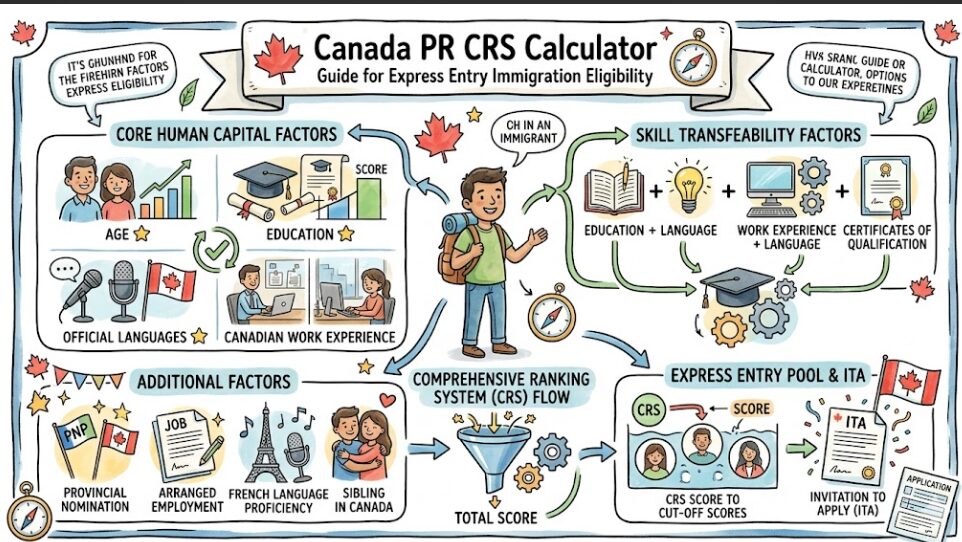
The Canada PR CRS Calculator helps applicants understand their possible score before entering the Express Entry pool. CRS stands for Comprehensive Ranking System, which is the points-based system used to rank Express Entry candidates. Officially, IRCC uses CRS to assess skills, education, language ability, work experience, and other profile factors.
A good CRS score does not automatically mean final PR approval. It means your profile may rank well enough to receive an Invitation to Apply. After that, IRCC still checks your documents, eligibility, medical exam, police clearance, and admissibility.
What Is a Canada PR CRS Calculator?
A Canada PR CRS Calculator is an online scoring tool that estimates your Express Entry CRS score. It helps you understand where you stand before applying.
It usually checks:
| Factor | Why It Matters |
|---|---|
| Age | Younger applicants usually score higher |
| Education | Higher education can improve CRS |
| Language score | IELTS, CELPIP, or French scores are very important |
| Work experience | Skilled work experience supports eligibility |
| Canadian experience | Adds strong value to the profile |
| Spouse factors | Can improve or reduce total profile strength |
| Provincial nomination | Can add a major CRS boost |
The calculator is useful for software engineers, nurses, student graduates, mechanical engineers, IT professionals, finance professionals, and skilled trades workers.
Eligibility Score vs Final PR Approval
| Point | Meaning |
|---|---|
| CRS score | Used to rank your Express Entry profile |
| Invitation to Apply | Given when your score meets the draw requirement |
| Final PR approval | Depends on verified documents, medicals, police checks, and admissibility |
Express Entry candidates are invited through rounds, and IRCC chooses candidates based on CRS ranking, program-specific rounds, or category-based rounds.
How Canada CRS Points System Works
The CRS score is built from multiple factors.
Age Points
Age affects CRS because Canada gives preference to applicants who can contribute to the workforce for a longer period. Applicants in their prime working years usually get stronger age points.
Example:
| Applicant | Age | CRS Impact |
|---|---|---|
| Applicant A | Mid-20s | Strong age score |
| Applicant B | Mid-30s | Moderate age score |
| Applicant C | Over 40 | Lower age score |
Education Points
Education plays a major role in the Canada immigration points calculator.
| Education Level | CRS Value |
|---|---|
| Diploma | Helpful for eligibility |
| Bachelor’s degree | Strong profile base |
| Master’s degree | Higher CRS advantage |
| PhD | Strongest academic profile |
Applicants with foreign education usually need an Educational Credential Assessment if they want to claim points for education obtained outside Canada.
Language Skills
Language is one of the most powerful CRS factors. Strong IELTS or CELPIP scores can improve your CRS score significantly. French can also provide an advantage, especially in category-based selection and bilingual profiles.
Important language areas:
| Skill | Test Area |
|---|---|
| Reading | IELTS/CELPIP |
| Writing | IELTS/CELPIP |
| Listening | IELTS/CELPIP |
| Speaking | IELTS/CELPIP |
Work Experience
Work experience supports your eligibility and profile strength.
It may include:
| Experience Type | Importance |
|---|---|
| International skilled experience | Useful for FSWP and CRS transferability |
| Canadian work experience | Strong CRS benefit |
| TEER skilled jobs | Important for Express Entry eligibility |
Job Offer and Provincial Nomination
A provincial nomination remains one of the strongest CRS boosters. However, IRCC states that CRS points for job offers were removed from March 25, 2025, although job offers may still matter for eligibility under some programs.
| Factor | CRS Impact |
|---|---|
| Provincial nomination | Very strong CRS boost |
| Job offer | May support eligibility, but no CRS job-offer points currently |
| LMIA-supported offer | Still useful in some immigration contexts |
Canada Express Entry System Explained
Express Entry is Canada’s online application management system for skilled immigration. IRCC says Express Entry manages applications for three main programs: Canadian Experience Class, Federal Skilled Worker Program, and Federal Skilled Trades Program.
Federal Skilled Worker Program
Best for skilled workers with foreign or Canadian skilled experience.
Common requirements include:
| Requirement | Details |
|---|---|
| Skilled work experience | Required |
| Language test | Required |
| Education | Usually required |
| Proof of funds | Usually required unless exempt |
| Job offer | Not always required |
Canadian Experience Class
Best for people who already have eligible Canadian skilled work experience. It is commonly used by international graduates and workers who move from a work permit to PR.
Federal Skilled Trades Program
Best for skilled trades workers. The program is for applicants qualified in a skilled trade and may require a valid job offer or certificate of qualification.
Provincial Nominee Program
PNP allows Canadian provinces and territories to nominate candidates based on local labor market needs. A nomination can make a profile much more competitive in Express Entry.
Canada PR CRS Calculator Breakdown
| Factor | Maximum Points |
|---|---|
| Core human capital factors without spouse | 500 |
| Core human capital factors with spouse | 460 |
| Spouse factors | 40 |
| Skill transferability | 100 |
| Additional points | 600 |
| Total CRS score | 1200 |
Official CRS criteria include age, education, language ability, Canadian work experience, spouse factors, skill transferability, and additional points.
Step-by-Step Example of Canada CRS Score Calculation
Example 1: Software Engineer
| Profile Factor | Details |
|---|---|
| Age | 29 |
| Education | Bachelor’s degree |
| Work experience | 5 years international |
| IELTS | Strong CLB level |
| Job offer | No |
| Canadian experience | No |
| Estimated result | Competitive, but may need stronger IELTS or PNP |
This applicant can improve by increasing language score, adding French, or applying for a suitable PNP stream.
Example 2: Nurse / Healthcare Worker
| Profile Factor | Details |
|---|---|
| Age | 31 |
| Education | Bachelor’s in nursing |
| Experience | 6 years |
| IELTS | Good score |
| Occupation | Healthcare |
| Estimated result | Strong profile for category-based or provincial opportunities |
Healthcare workers should also check licensing requirements because Canadian PR eligibility and professional licensing are separate matters.
Example 3: International Student Transitioning to PR
| Profile Factor | Details |
|---|---|
| Canadian education | Yes |
| PGWP pathway | Possible after eligible study |
| Canadian work experience | Can improve CRS |
| Language score | Still important |
| PR path | Often CEC or PNP |
A student can move from study permit to PGWP, gain Canadian work experience, and then apply through Express Entry or PNP.
Canada PR Eligibility Requirements
Basic Canada PR requirements may include:
| Requirement | Why It Matters |
|---|---|
| Valid passport | Identity and travel document |
| Language test | Required for Express Entry |
| Education documents | Used for CRS and eligibility |
| ECA report | Needed for many foreign degrees |
| Work experience letters | Prove skilled employment |
| Proof of funds | Shows settlement ability |
| Police certificate | Security/background check |
| Medical exam | Health admissibility |
IRCC lists passport, language test results, education proof/ECA, job offer if applicable, work experience proof, proof of funds, police certificates, and provincial nomination if applicable as key Express Entry documents.
Proof of funds must generally be available, legally accessible, and supported by official bank letters. IRCC also specifies settlement fund amounts by family size.
Benefits of Using a Canada PR CRS Calculator
A CRS calculator helps you:
| Benefit | Explanation |
|---|---|
| Check eligibility faster | You understand your estimated score early |
| Plan better | You know which areas need improvement |
| Reduce rejection risk | You avoid weak or incomplete applications |
| Save money | You avoid applying without preparation |
| Improve strategy | You can target IELTS, French, PNP, or education |
| Track progress | You can recalculate after improvements |
Step-by-Step Guide to Calculate Canada PR CRS Points
Step 1 – Gather Educational Documents
Collect degrees, diplomas, transcripts, and ECA reports if your education is outside Canada.
Step 2 – Calculate IELTS/CELPIP Score
Convert your language score into CLB level. Higher CLB levels can strongly improve CRS.
Step 3 – Calculate Work Experience
Check whether your work experience is skilled and matches eligible TEER categories.
Step 4 – Check Job Offer Eligibility
A job offer may still support eligibility for some programs, even though CRS job-offer points are currently removed.
Step 5 – Add Spouse and Bonus Points
Include spouse education, language score, and Canadian experience if applicable.
Step 6 – Check Final CRS Score
Compare your score with recent Express Entry draw trends and plan improvements.
How to Increase Canada CRS Score
| Strategy | How It Helps |
|---|---|
| Improve IELTS/CELPIP | One of the fastest ways to increase CRS |
| Learn French | Adds language strength and category advantage |
| Gain more experience | Improves profile depth |
| Get higher education | Can improve education and transferability points |
| Apply for PNP | Strong CRS boost |
| Gain Canadian experience | Very valuable for CEC candidates |
| Improve spouse profile | Adds points through spouse factors |
Common Mistakes to Avoid
Avoid these mistakes:
| Mistake | Why It Hurts |
|---|---|
| Wrong CRS calculation | Creates false confidence |
| Ignoring language score | IELTS/CELPIP can change the result |
| Using outdated criteria | Immigration rules can change |
| Missing documents | Delays or refusal risk |
| Wrong immigration stream | Weakens the strategy |
| Overestimating eligibility | Leads to poor planning |
| Weak profile planning | Reduces chances of invitation |
Real-Life Case Studies
Case Study 1: Young IT Professional Moving to Canada
A young software developer had good education and work experience but an average IELTS score. His CRS score was not strong enough for competitive draws.
He improved IELTS, prepared proper work reference letters, and explored tech-focused provincial options. His profile became stronger because he focused on the weakest area first: language.
Case Study 2: Married Couple Improving CRS Score
A married applicant had a decent CRS score, but the spouse had no language test. After the spouse completed a language test and education documents were reviewed properly, the total profile improved.
The couple also checked PNP options instead of depending only on general Express Entry draws.
Case Study 3: Healthcare Worker Getting Canada PR
A nurse had strong work experience but needed better documentation and licensing awareness. She improved her language score, collected detailed employment letters, and checked healthcare-focused immigration options.
Her final plan became stronger because she treated PR and professional licensing as two separate but connected goals.
FAQs
1. What is the Canada PR CRS Calculator?
It is a tool that estimates your Express Entry CRS score based on age, education, language, work experience, spouse factors, and bonus points.
2. What is a good CRS score for Canada PR?
A good score depends on the draw type. General, program-specific, PNP, and category-based draws can have different cut-offs.
3. What is Express Entry?
Express Entry is Canada’s online system for managing skilled immigration applications for major economic immigration programs.
4. Is IELTS mandatory for Canada PR?
For Express Entry, an approved language test is required. IELTS and CELPIP are common English options.
5. Can I move to Canada without a job offer?
Yes, many Express Entry candidates apply without a job offer, but they still need to meet eligibility and CRS requirements.
6. Does age affect CRS score?
Yes. Age is an important CRS factor, and younger skilled applicants usually receive stronger age points.
7. Can students settle permanently in Canada?
Yes. Many students study in Canada, apply for a PGWP, gain Canadian work experience, and later apply through CEC or PNP.
8. How accurate are online CRS calculators?
They are useful for estimates, but final eligibility depends on official criteria, correct documents, and IRCC assessment.
9. Is Canada PR easy to get?
It depends on your CRS score, occupation, documents, language score, and immigration pathway.
10. What jobs are in demand in Canada?
Demand changes by province and program. IT, healthcare, skilled trades, engineering, and essential services often have strong opportunities.
11. Can family members join me?
Yes. Spouse or common-law partner and dependent children may be included, depending on the application situation.
12. How long does Canada PR take?
Processing time can vary by program, application quality, document completeness, and IRCC workload.
Conclusion
The Canada PR CRS Calculator is one of the most useful starting points for anyone planning Canada immigration. It helps you understand your Express Entry CRS score, identify weak areas, and plan improvements before submitting your profile. A strong PR journey is not only about getting a high score; it is also about choosing the right pathway, preparing accurate documents, improving language results, checking PNP options, and staying updated with Express Entry draws. Start early, calculate honestly, improve step by step, and build a profile that is both competitive and well-documented.