Introduction
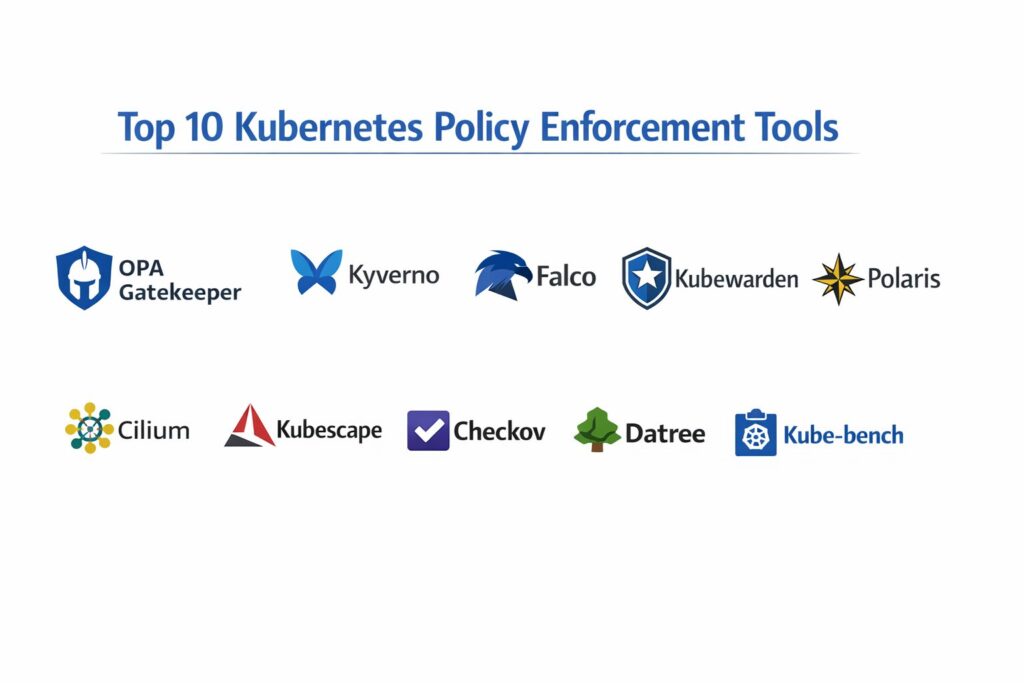
Kubernetes policy enforcement has evolved from a niche security requirement into a fundamental operational necessity for modern cloud-native infrastructure. As organizations scale their containerized environments, the complexity of managing thousands of microservices across multiple clusters introduces significant risks, ranging from privilege escalation to insecure network configurations. Policy enforcement tools act as automated guardrails, ensuring that every resource deployed into a cluster adheres to a predefined set of security, operational, and compliance standards. These platforms primarily function by intercepting requests to the Kubernetes API server, evaluating them against specific rules, and either allowing, denying, or modifying the request before it is persisted in the system.
The strategic importance of these tools lies in their ability to provide “Policy as Code,” allowing platform teams to manage governance with the same rigor as application code. By codifying compliance, organizations can eliminate manual audits and drastically reduce the human error associated with complex YAML configurations. In a high-velocity DevOps pipeline, these tools shift security to the left, catching misconfigurations at the pull-request stage rather than at runtime. When evaluating a policy engine, technical leaders must consider the trade-off between the expressive power of the policy language and the ease of adoption for development teams. A robust solution should offer broad visibility, support for both validation and mutation, and the ability to scale across a global fleet of clusters without introducing significant latency.
Best for: Platform engineers, DevSecOps teams, and enterprise organizations that require strict governance, automated compliance (such as SOC 2 or HIPAA), and a scalable way to manage security guardrails across multi-tenant clusters.
Not ideal for: Very small, single-node developmental environments or legacy monolithic applications that do not utilize container orchestration. For teams with zero internal security overhead, basic built-in Kubernetes Role-Based Access Control may suffice until scaling begins.
Key Trends in Kubernetes Policy Enforcement
One of the most significant shifts in the industry is the move toward WebAssembly (Wasm) for policy execution, which allows developers to write security rules in their preferred programming languages while ensuring high-performance, sandboxed execution. We are also seeing a rapid convergence of policy enforcement and AI-driven automation. Modern engines are increasingly utilizing machine learning to analyze historical deployment patterns and suggest adaptive policies that react to emerging threats in real-time.
Furthermore, the “Policy everywhere” trend is gaining momentum, where a single policy language is used to govern not just Kubernetes, but also cloud infrastructure, CI/CD pipelines, and application-level authorization. Distributed policy enforcement is also becoming a standard for edge computing, where lightweight agents enforce rules locally on resource-constrained devices. Finally, the integration of eBPF technology is enabling deeper runtime enforcement, allowing tools to block malicious system calls and network traffic with minimal overhead, providing a more comprehensive defense-in-depth strategy.
How We Selected These Tools
The selection of these top ten platforms was based on an extensive analysis of technical maturity, community adoption, and integration capabilities within the CNCF ecosystem. We prioritized tools that have achieved “Graduated” or “Incubating” status, as these signals indicate a high level of production readiness and professional governance. Market adoption was a critical metric, as tools with larger user bases benefit from more extensive pre-built policy libraries and better third-party integrations.
We evaluated each tool based on its ability to handle complex logic, its performance impact on the Kubernetes API server, and the clarity of its documentation. Security and compliance were non-negotiable; we sought out platforms that offer out-of-the-box support for industry-standard benchmarks like the CIS Kubernetes Benchmark. Additionally, we looked for versatility—specifically, the ability to perform validation, mutation (changing a request on the fly), and generation (automatically creating new resources like NetworkPolicies). Finally, the ease of integration into modern GitOps workflows was a decisive factor in our final scoring.
1. OPA Gatekeeper
OPA Gatekeeper is the heavyweight champion of the policy world, utilizing the Open Policy Agent (OPA) as its core engine. It uses a specialized declarative language called Rego to define policies. It is designed for enterprise-scale environments where highly complex, cross-platform policy logic is a requirement.
Key Features
The tool utilizes a constraint-based framework that separates the logic of a policy from the specific parameters of a cluster. It supports both admission control (blocking bad requests) and audit mode (scanning existing resources for violations). Its high-performance engine is capable of processing thousands of decisions per second across diverse tech stacks. It also features a robust template system that allows technical teams to create reusable policy skeletons for different departments.
Pros
It is the industry standard with the most powerful and flexible policy language available. Its ability to work across non-Kubernetes platforms allows for a unified governance strategy.
Cons
The learning curve for the Rego language is exceptionally steep. The initial setup and management of constraint templates can be more complex compared to YAML-native tools.
Platforms and Deployment
Windows, macOS, and Linux. Deployed as a set of controllers within the Kubernetes cluster.
Security and Compliance
As a CNCF Graduated project, it adheres to the highest security standards and is used by the world’s most regulated organizations for SOC 2 and PCI compliance.
Integrations and Ecosystem
Extensive ecosystem with integrations for almost every CI/CD tool, cloud provider, and service mesh.
Support and Community
Massive global community and professional enterprise support available through various third-party vendors.
2. Kyverno
Kyverno is a Kubernetes-native policy engine that allows users to manage policies as standard Kubernetes resources. Unlike OPA, it does not require learning a new language; instead, policies are written in familiar YAML. This makes it a favorite among DevOps teams who value simplicity and speed.
Key Features
The platform excels at validation, mutation, and the automatic generation of resources. It features a unique “policy reporter” that provides a visual dashboard of compliance across the cluster. It can verify container image signatures using Cosign and look up data from external registries. Its ability to generate new resources—such as automatically creating a NetworkPolicy for every new namespace—drastically reduces manual configuration.
Pros
Extremely easy for Kubernetes users to adopt since it uses native YAML. It offers superior resource generation and mutation capabilities compared to most other engines.
Cons
While powerful, the logic can become difficult to manage in YAML for extremely complex, nested conditional rules that Rego handles with ease.
Platforms and Deployment
Windows, macOS, and Linux. Installed via Helm or YAML manifests as a standard admission controller.
Security and Compliance
Actively maintained CNCF project with built-in support for Best Practices and CIS Benchmarks.
Integrations and Ecosystem
Strong integrations with GitOps tools like Argo CD and Flux, as well as vulnerability scanners.
Support and Community
Rapidly growing community with excellent documentation and active developer engagement.
3. Falco
Falco is the gold standard for runtime security and policy enforcement. Rather than checking resources at the gate, it monitors the actual behavior of running containers by tapping into the Linux kernel via eBPF.
Key Features
The system uses a powerful rules engine to detect anomalous activity, such as unexpected shell execution, unauthorized file access, or outbound network connections to malicious IPs. It provides real-time alerts through multiple channels including Slack, PagerDuty, and SIEM platforms. Its deep kernel visibility allows it to see exactly what is happening inside a container without requiring sidecar proxies.
Pros
Provides the most granular visibility into runtime behavior. Essential for detecting zero-day exploits and post-compromise activity that admission controllers miss.
Cons
Primarily focused on detection; blocking activity requires integration with additional tools (like Falco Sidekick). Managing false positives requires constant tuning of the ruleset.
Platforms and Deployment
Linux-only (requires kernel access). Typically deployed as a DaemonSet across all nodes.
Security and Compliance
CNCF Graduated project. It is a critical component for achieving high-level threat detection compliance.
Integrations and Ecosystem
Integrates with almost all major logging and alerting stacks, as well as the Cilium service mesh.
Support and Community
Extensive community-maintained rule library for common applications like NGINX, Redis, and etcd.
4. Kubewarden
Kubewarden is a modern policy engine that leverages WebAssembly (Wasm) to provide a flexible and high-performance policy environment. It allows policies to be written in languages like Go, Rust, or Swift and then compiled into secure, portable Wasm modules.
Key Features
The platform treats policies as artifacts that can be stored and distributed using standard container registries (OCI). It provides a secure, sandboxed execution environment that protects the host from malicious policy code. Because it uses Wasm, policies are incredibly fast and have a minimal memory footprint. It also features a “policy-server” that can manage multiple policy modules efficiently.
Pros
Allows developers to use familiar programming languages to write complex logic. The use of OCI registries for distribution makes policy management feel just like application management.
Cons
The ecosystem of pre-built Wasm policies is smaller than the library available for OPA or Kyverno.
Platforms and Deployment
Windows, macOS, and Linux. Distributed as a set of Kubernetes controllers and a dedicated policy server.
Security and Compliance
Wasm provides native isolation, making it one of the most secure ways to execute custom policy code.
Integrations and Ecosystem
Integrates with standard OCI-compliant registries and is gaining traction in the SUSE/Rancher ecosystem.
Support and Community
Supported by a growing community of developers interested in the future of Wasm and cloud-native security.
5. Polaris
Polaris is a specialized tool focused on cluster health and configuration best practices. It acts as both an admission controller and a dashboard that identifies misconfigurations that could lead to reliability or security issues.
Key Features
The tool provides a comprehensive “score” for your cluster based on how well it follows best practices. It includes a built-in library of over 30 checks for things like missing resource limits, insecure host path mounts, and improper liveness probes. It can run in three modes: as a dashboard, a CLI tool for CI/CD, or a validating webhook.
Pros
The visual dashboard is excellent for providing stakeholders with a high-level view of cluster health. It is very easy to set up for teams that want to start with “low-hanging fruit” misconfigurations.
Cons
It lacks the deep, custom logic capabilities of OPA or the resource generation features of Kyverno.
Platforms and Deployment
Windows, macOS, and Linux. Can be run as a local CLI or an in-cluster dashboard.
Security and Compliance
Focuses heavily on the “Reliability” and “Security” pillars of the Kubernetes Well-Architected Framework.
Integrations and Ecosystem
Commonly used in development pipelines to block non-compliant code before it reaches production.
Support and Community
Maintained by Fairwinds, with a strong focus on open-source community contributions.
6. Cilium
Cilium is primarily a networking and observability tool, but its eBPF-powered network policy engine is the industry standard for enforcing security at the network and API level.
Key Features
The platform enables “identity-aware” security, where policies are based on Kubernetes labels rather than unstable IP addresses. It provides Layer 7 visibility, allowing you to enforce policies on specific HTTP methods or URL paths. With its Tetragon component, it also provides deep runtime enforcement, including the ability to kill malicious processes instantly at the kernel level.
Pros
Offers the highest performance for network policy enforcement. The combination of networking, observability, and security in one tool simplifies the stack.
Cons
The full feature set requires a modern Linux kernel with eBPF support. It can be complex to configure for those who are only looking for simple admission control.
Platforms and Deployment
Linux-only for nodes. Replaces or augments the standard CNI (Container Network Interface).
Security and Compliance
A CNCF Graduated project that provides the foundation for Zero Trust architectures in Kubernetes.
Integrations and Ecosystem
Integrates deeply with Hubble for visualization and most major cloud provider managed Kubernetes services.
Support and Community
Massive community and enterprise support available through companies like Isovalent (Cisco).
7. Kubescape
Kubescape is a multi-purpose security platform that was the first to offer a comprehensive “Kubernetes Security Posture Management” (KSPM) tool based on the NSA-CISA hardening guidance.
Key Features
The tool scans clusters, YAML files, and Helm charts to detect misconfigurations and vulnerabilities. It provides a prioritized list of risks mapped to the MITRE ATT&CK framework. It includes a robust policy engine that can enforce compliance across diverse environments. One of its unique features is the ability to determine “runtime reachability,” showing which vulnerabilities are actually exploitable in your specific configuration.
Pros
Provides the most comprehensive “out-of-the-box” compliance reports for major frameworks (SOC 2, ISO). The runtime context significantly reduces alert fatigue by filtering out unreachable vulnerabilities.
Cons
The breadth of the platform can be overwhelming for teams that only need a simple, targeted admission controller.
Platforms and Deployment
Windows, macOS, and Linux. Can be used as a CLI tool or installed as a cluster agent.
Security and Compliance
CNCF Incubating project with a heavy focus on government and industry security standards.
Integrations and Ecosystem
Integrates with Lens IDE, VS Code, and major CI/CD pipelines.
Support and Community
Supported by ARMO, with a very active community and frequent updates to security benchmarks.
8. Checkov
Checkov is a static analysis tool that specializes in “shifting security left” by enforcing policies on Infrastructure as Code (IaC) before it is ever deployed to a cluster.
Key Features
The platform includes over 1,000 pre-built policies for Kubernetes, Terraform, Helm, and CloudFormation. It identifies misconfigurations in YAML files and provides clear remediation instructions directly in the developer’s CLI or pull request. It uses a graph-based engine to understand the relationships between different resources, ensuring that complex dependencies are properly secured.
Pros
Extremely effective at preventing issues from ever reaching the production cluster. Supports a wide variety of IaC formats beyond just Kubernetes.
Cons
Since it is a static analysis tool, it cannot enforce policies on resources created dynamically or manually changed within a running cluster.
Platforms and Deployment
Windows, macOS, and Linux. Primarily used as a CLI or a GitHub Action.
Security and Compliance
Maintained by Prisma Cloud (Palo Alto Networks), ensuring it stays up to date with the latest security research.
Integrations and Ecosystem
Deeply integrated with Bridgecrew and the broader Prisma Cloud ecosystem.
Support and Community
Very popular among developers, with a large library of community-contributed policies.
9. Datree
Datree is a developer-centric tool that focuses on preventing Kubernetes misconfigurations by integrating directly into the development workflow. It is designed to be the “unit test” for your Kubernetes manifests.
Key Features
The tool offers a centralized policy management dashboard where admins can define rules that are then enforced across all developer machines. It checks for best practices, security vulnerabilities, and even YAML schema validity. It includes a built-in “policy as code” mode that allows you to version control your governance rules. Its lightweight CLI is designed to be lightning-fast, providing immediate feedback during the coding process.
Pros
The best user experience for developers, with clear, actionable error messages. The centralized dashboard makes it easy to maintain a consistent security posture across a large organization.
Cons
Requires developers to adopt the CLI or for the tool to be integrated into the CI pipeline; it is not a standalone runtime enforcement engine.
Platforms and Deployment
Windows, macOS, and Linux. Distributed as a CLI and a centralized web dashboard.
Security and Compliance
Focuses on internal governance and adherence to organizational “Gold Standards.”
Integrations and Ecosystem
Excellent integrations with Helm, Kustomize, and all major CI/CD providers.
Support and Community
Active community with a strong focus on “shifting left” and developer education.
10. Kube-bench
Kube-bench is a specialized tool that has one primary purpose: checking whether your Kubernetes cluster is configured according to the CIS Kubernetes Benchmark.
Key Features
The tool runs a series of tests against the master and worker nodes to verify settings for the API server, etcd, scheduler, and kubelet. It provides a clear “Pass/Fail” report for each benchmark item along with remediation steps for any failures. It can be run as a container inside the cluster or as a standalone binary on the host machine.
Pros
The most trusted tool for verifying CIS compliance. It is lightweight and provides very specific, actionable configuration advice for cluster hardening.
Cons
It is a point-in-time auditing tool, not a continuous enforcement engine. It does not monitor or block requests to the API server.
Platforms and Deployment
Linux-only (for node scanning). Deployed as a Kubernetes Job or a standalone binary.
Security and Compliance
The industry standard for CIS Benchmark verification.
Integrations and Ecosystem
Often used as a fundamental building block in larger security platforms like Kubescape or Aqua Security.
Support and Community
Maintained by Aqua Security, it is widely considered a mandatory tool for any secure Kubernetes deployment.
Comparison Table
| Tool Name | Best For | Platform(s) Supported | Deployment | Standout Feature | Public Rating |
|---|---|---|---|---|---|
| 1. OPA Gatekeeper | Enterprise Governance | Win, Mac, Linux | Controller | Rego Policy Language | 4.8/5 |
| 2. Kyverno | DevOps Simplicity | Win, Mac, Linux | Controller | YAML-native Logic | 4.9/5 |
| 3. Falco | Runtime Threat Detect | Linux | DaemonSet | eBPF Kernel Visibility | 4.7/5 |
| 4. Kubewarden | Multilingual Policy | Win, Mac, Linux | Wasm | Wasm Sandboxing | 4.5/5 |
| 5. Polaris | Best Practices Audit | Win, Mac, Linux | Dashboard | Health Scoring System | 4.4/5 |
| 6. Cilium | Network Security | Linux | CNI/Agent | Identity-aware L7 | 4.8/5 |
| 7. Kubescape | Full Posture/KSPM | Win, Mac, Linux | Agent/CLI | MITRE ATT&CK Mapping | 4.6/5 |
| 8. Checkov | Shift-Left IaC | Win, Mac, Linux | CLI/Action | 1000+ Built-in Rules | 4.7/5 |
| 9. Datree | Dev Configuration | Win, Mac, Linux | CLI | Developer UX focus | 4.5/5 |
| 10. Kube-bench | CIS Hardening | Linux | Job/Binary | CIS Benchmark Focus | 4.8/5 |
Evaluation & Scoring of Kubernetes Policy Enforcement Tools
The scoring below is a comparative model intended to help shortlisting. Each criterion is scored from 1–10, then a weighted total from 0–10 is calculated using the weights listed. These are analyst estimates based on typical fit and common workflow requirements, not public ratings.
Weights:
- Core features – 25%
- Ease of use – 15%
- Integrations & ecosystem – 15%
- Security & compliance – 10%
- Performance & reliability – 10%
- Support & community – 10%
- Price / value – 15%
| Tool Name | Core (25%) | Ease (15%) | Integrations (15%) | Security (10%) | Performance (10%) | Support (10%) | Value (15%) | Weighted Total |
|---|---|---|---|---|---|---|---|---|
| 1. OPA Gatekeeper | 10 | 4 | 10 | 10 | 9 | 10 | 9 | 8.80 |
| 2. Kyverno | 9 | 10 | 9 | 9 | 9 | 9 | 10 | 9.30 |
| 3. Falco | 9 | 5 | 8 | 10 | 10 | 9 | 9 | 8.65 |
| 4. Kubewarden | 8 | 7 | 7 | 9 | 10 | 8 | 8 | 8.05 |
| 5. Polaris | 6 | 9 | 8 | 7 | 9 | 8 | 8 | 7.45 |
| 6. Cilium | 10 | 6 | 9 | 10 | 10 | 10 | 8 | 9.05 |
| 7. Kubescape | 9 | 8 | 9 | 9 | 8 | 9 | 9 | 8.85 |
| 8. Checkov | 8 | 9 | 10 | 8 | 9 | 9 | 9 | 8.85 |
| 9. Datree | 6 | 10 | 9 | 7 | 10 | 8 | 8 | 8.00 |
| 10. Kube-bench | 7 | 8 | 7 | 10 | 10 | 9 | 9 | 8.25 |
How to interpret the scores:
- Use the weighted total to shortlist candidates, then validate with a pilot.
- A lower score can mean specialization, not weakness.
- Security and compliance scores reflect controllability and governance fit, because certifications are often not publicly stated.
- Actual outcomes vary with assembly size, team skills, templates, and process maturity.
Which Kubernetes Policy Enforcement Tool Is Right for You?
Solo / Freelancer
For individuals managing small clusters, Kyverno is the undisputed winner. Its YAML-based configuration means you don’t have to learn a complex new language to secure your workloads, and its ability to automatically generate resources saves a significant amount of time.
SMB
Small to medium businesses should look at a combination of Kyverno for admission control and Polaris or Datree for maintaining general best practices. This provides a strong security baseline with minimal operational overhead.
Mid-Market
Mid-market organizations often require more robust runtime visibility. Adding Falco or the security components of Cilium to their stack ensures that they are protected not just at deployment time, but also against active threats during production.
Enterprise
Large enterprises with multi-platform needs and strict compliance requirements almost always land on OPA Gatekeeper. Its ability to enforce a single policy language across their entire tech stack (cloud, CI/CD, and K8s) provides the unified governance that large-scale operations demand.
Budget vs Premium
Since most of these tools are open-source, the real “cost” is in engineering time. Kyverno and Datree are high-value because they reduce the time needed for onboarding, while OPA is a “premium” choice in terms of the technical expertise required to wield it effectively.
Feature Depth vs Ease of Use
If you need the deepest possible technical control, OPA Gatekeeper and Cilium are your best bets. If you prioritize ease of use and getting your team up to speed quickly, Kyverno and Polaris are the superior choices.
Integrations & Scalability
Scale is where OPA and Cilium shine, as they are designed for the most demanding high-volume environments in the world. For organizations heavily invested in GitOps, Kyverno and Checkov offer the best integration patterns.
Security & Compliance Needs
For meeting specific compliance frameworks like SOC 2 or HIPAA, Kubescape and Kube-bench are essential. They provide the automated reports and auditing evidence that are necessary for passing professional security audits.
Frequently Asked Questions (FAQs)
1. What is an admission controller?
An admission controller is a piece of code that intercepts requests to the Kubernetes API server prior to persistence of the object, but after the request is authenticated and authorized. It can either validate the request or mutate it to meet organizational standards.
2. Can I run OPA Gatekeeper and Kyverno in the same cluster?
Technically, yes, you can. However, this is generally not recommended as it creates a “split brain” for your policy logic, making it much harder to troubleshoot why a specific request was denied or modified.
3. Does policy enforcement slow down my cluster?
When configured correctly, the impact is negligible (usually just a few milliseconds). However, complex policies that require external data lookups can introduce latency into the API server response time.
4. What is the difference between validation and mutation?
Validation is a “Yes/No” check that either allows or blocks a request. Mutation is the process of automatically modifying a request—for example, adding a default label or a sidecar container if they are missing from the original YAML.
5. How do I prevent policies from breaking my existing applications?
Most professional policy engines offer an “Audit” or “Dry Run” mode. This allows you to deploy a policy and see which existing resources would fail without actually blocking them, giving you time to remediate issues before turning on enforcement.
6. What is “Shift-Left” security?
Shift-left refers to moving security checks earlier in the development lifecycle. Instead of finding a misconfiguration when the pod fails to start in production, tools like Checkov and Datree find it while the developer is still writing the code in their IDE.
7. Do I still need RBAC if I have a policy engine?
Yes. RBAC (Role-Based Access Control) determines who can do something, while a policy engine determines what they can do. Both are required for a comprehensive security strategy.
8. Is eBPF better than traditional network policies?
eBPF-based tools like Cilium are more efficient because they process traffic at the kernel level rather than using iptables. They also provide much deeper visibility and can enforce policies at the application layer (Layer 7).
9. How do I manage policies across multiple clusters?
Most organizations use a GitOps approach, storing their policies in a central Git repository and using tools like Argo CD or Flux to sync those policies across their entire fleet of clusters automatically.
10. Can I write custom policies in these tools?
Yes, all of these tools allow for custom policies. OPA uses Rego, Kyverno uses YAML, and Kubewarden uses any language that compiles to WebAssembly, giving you full control over your organization’s specific rules.
Conclusion
As Kubernetes matures, the ability to enforce consistent, automated policies has become the defining characteristic of a professional platform team. Moving beyond basic manual checks to a “Policy as Code” model is no longer optional for organizations that value security and reliability at scale. The current ecosystem offers a diverse range of tools tailored to different organizational needs—from the developer-friendly simplicity of Kyverno to the enterprise-grade power of OPA Gatekeeper and the deep kernel-level visibility of Cilium and Falco. Success in this domain is not about choosing the “best” tool in a vacuum, but rather about selecting the solution that best fits your team’s technical skill set and your organization’s long-term governance strategy. By implementing a layered defense that combines static analysis, admission control, and runtime monitoring, you can build a Kubernetes environment that is both secure by default and resilient to change.