Introduction
If you are just starting your journey in the world of technology, you have likely heard the term DevOps tossed around in almost every job description. It is a common point of confusion for beginners, students, and even experienced professionals. Many people search for “what is a DevOps engineer,” thinking it is a single job title that requires knowing everything under the sun.
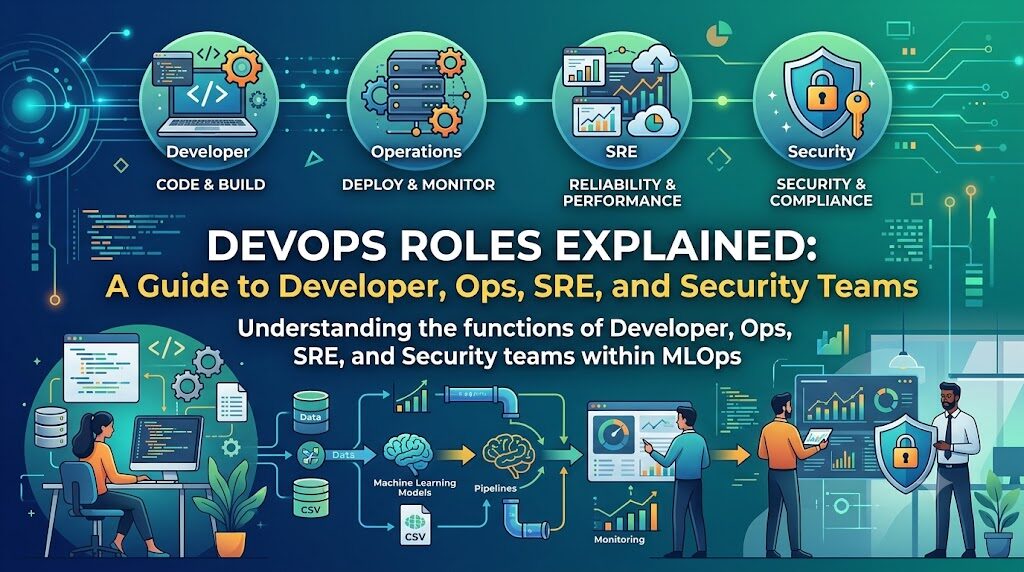
The truth is that DevOps is not one single role. Instead, it is a cultural and professional approach to building software. It involves a diverse group of talented individuals—developers, operations engineers, site reliability engineers (SREs), and security professionals—all working together toward the same goal: delivering software that is fast, reliable, and secure.
If you are looking to build a career in this field, DevOpsSchool provides excellent resources and roadmaps to help you navigate these different paths. Understanding how these roles overlap and support each other is the first step toward becoming a successful engineer. Think of it like a movie production; you have directors, camera operators, editors, and sound engineers. They all have unique tasks, but without them coordinating perfectly, you would never see a finished film on the big screen. In this guide, we will break down exactly how these professionals interact in the modern workplace.
What Are DevOps Roles?
At its simplest, DevOps roles are a collection of specialized positions that focus on bridging the gap between writing code and keeping that code running smoothly in the real world.
Think of it like a professional kitchen. The developers are the chefs who create the recipes and prepare the dishes. The operations engineers are the ones who manage the kitchen infrastructure, ensuring the ovens work and the supplies are stocked. The SREs are like the quality control managers who make sure every plate sent out meets a high standard of consistency, and the security team ensures the food is safe for everyone. When these roles function as one unit, the service is seamless.
Why DevOps Is a Team Effort
DevOps is not about one person doing everything. It is about shared responsibility. In a traditional setup, developers would “throw code over the wall” to operations, and if something broke, they would blame each other.
In a modern DevOps team, this wall is removed. Everyone shares the goal of keeping the application healthy. If a feature fails to deploy, the developer and the operations engineer work together to fix it because the success of the software is a team effort. This results in faster releases, fewer bugs, and a more stable experience for the end user.
Understanding the Main DevOps Roles
| Role | Primary Focus |
| Developer | Writing, testing, and building the application features. |
| Operations Engineer | Managing the servers, cloud platforms, and infrastructure. |
| Site Reliability Engineer (SRE) | Ensuring system uptime, performance, and automation. |
| Security Engineer | Protecting the code and infrastructure from vulnerabilities. |
Developer Role in DevOps
Developers are the creators. Their main focus is turning business requirements into functional software. In a DevOps environment, developers do more than just write code; they also ensure their code is “deployable.”
- Key Responsibilities: Writing clean code, running unit tests, and configuring deployment pipelines.
- Tools: Git (for version control), Jenkins (for automation), and Docker (for containerizing their apps).
- Workplace Example: A developer finishes writing a new feature. Instead of just sending it to the team, they use a tool like Git to submit their code, which automatically triggers a test sequence. If the test passes, the code is ready for the operations team to deploy.
Operations Engineer Role in DevOps
Operations engineers, often called SysAdmins or Cloud Engineers, are the keepers of the environment. They ensure the platform where the application lives is healthy, scalable, and responsive.
- Key Responsibilities: Managing cloud infrastructure, setting up monitoring alerts, and handling server updates.
- Tools: Linux (the foundation of most servers), Kubernetes (for managing containers), and Terraform (for infrastructure automation).
- Workplace Example: An operations engineer uses Terraform to spin up new servers when traffic to the website spikes, ensuring the application stays online for every user.
Site Reliability Engineer (SRE) Role
SREs are essentially software engineers who look at operations problems from a code-based perspective. They love automation and hate repetitive manual tasks.
- Key Responsibilities: Reducing manual toil, managing incidents, and setting SLOs (Service Level Objectives).
- Tools: Prometheus and Grafana (for monitoring), PagerDuty (for incident alerts).
- Workplace Example: If a system crashes, the SRE doesn’t just reboot the server. They investigate the root cause, write a script to fix it automatically in the future, and document the process to improve overall system reliability.
Security Role in DevOps (DevSecOps)
Security is no longer a final check at the end of a project. It is integrated into every stage of development. Security engineers help teams build “secure by design” software.
- Key Responsibilities: Scanning for vulnerabilities, managing access controls, and ensuring compliance.
- Tools: SonarQube (for code quality), Snyk (for dependency scanning), and Trivy (for container security).
- Workplace Example: A security engineer sets up automated checks that scan the developer’s code for security flaws every time they save their work, catching potential hacks before the code ever reaches the production server.
How These Roles Work Together
Imagine a new mobile banking feature being released:
- Developer: Writes the code and pushes it to a shared repository.
- Security Engineer: The automated security tool they configured scans the code for weak points.
- Operations Engineer: Provides the pre-configured environment (the “home” for the code) using automation scripts.
- SRE: Watches the release in real-time, monitoring performance metrics to ensure the system handles the user traffic without lagging.
Because these teams communicate constantly, the software is released faster and is much safer than in a siloed environment.
DevOps Role Comparison Table
| Role | Primary Skills | Key Tools | Goal |
| Developer | Coding, Debugging | Git, Java/Python | Feature Delivery |
| Ops | Networking, Linux | Kubernetes, Terraform | Platform Stability |
| SRE | Automation, Systems | Prometheus, Go | System Reliability |
| Security | Compliance, Scanning | SonarQube, Snyk | Risk Mitigation |
Common Misunderstandings About DevOps Roles
- DevOps is a Job Title: While companies hire for “DevOps Engineers,” DevOps is primarily a philosophy of collaboration, not just a label for one person.
- SRE and DevOps are Identical: SRE is a specific way of implementing DevOps principles. Think of DevOps as the strategy and SRE as the tactical execution.
- Security is a Separate Island: Security is everyone’s responsibility. It is built into the workflow, not added at the end.
Skills Needed for Different DevOps Careers
- For Developers: Mastery of version control (Git), understanding API development, and basic knowledge of containers.
- For Operations: Deep Linux proficiency, cloud platforms (AWS/Azure/GCP), and infrastructure as code (Terraform).
- For SREs: Strong programming skills, understanding of system architecture, and incident management experience.
- For Security: Knowledge of network security, vulnerability assessment, and compliance standards.
Real-World Example: Team Without Role Clarity
In a disorganized team, a developer writes a feature, but it fails in production because the operations environment was different from the developer’s local machine. The operations team blames the code; the developer blames the server. The SRE is stuck manually restarting servers at 2:00 AM because nobody implemented automated monitoring. This leads to burnout, slow releases, and unhappy customers.
Real-World Example: Team With Strong DevOps Collaboration
In a collaborative team, the developer and operations engineer use the same automated environment configurations. When a minor issue occurs, the SRE’s automated monitoring alerts the team before users even notice. The security tools catch a potential flaw during development, saving the company from a costly data breach. The release goes smoothly, and the team maintains a healthy work-life balance.
Role of DevOpsSchool in Learning DevOps Career Paths
If you find yourself wondering how to gain these skills, DevOpsSchool is a great place to start. They offer structured pathways that break down complex technologies into manageable learning modules. By focusing on hands-on tools like CI/CD, cloud infrastructure, and automation, you can move from a beginner level to a professional role with a clear roadmap.
Career Opportunities in DevOps
- DevOps Engineer: Focuses on bridging the gap between Dev and Ops.
- SRE Engineer: Focuses on the scale and stability of large systems.
- Cloud Engineer: Focuses specifically on managing cloud resources.
- Platform Engineer: Builds internal tools that make life easier for other developers.
- Security Engineer: Focuses on keeping systems hardened against threats.
- Automation Engineer: Focuses on writing scripts to eliminate manual tasks.
Industries Hiring DevOps Professionals
- SaaS Companies: High-frequency updates require strong DevOps teams.
- Banking & Finance: Security and reliability are non-negotiable here.
- Healthcare: Compliance and uptime are critical for patient safety.
- E-Commerce: Scalability is key for handling millions of shoppers.
- Telecom: Managing massive network infrastructure requires heavy automation.
- Enterprise IT: Traditional companies are moving to the cloud and need DevOps transformation.
Future of DevOps Roles
The future of DevOps is moving toward Platform Engineering, where teams build internal platforms to make development even more self-service. We are also seeing a massive increase in AI-assisted operations, where machine learning helps identify and fix issues before they become outages. Security-first DevOps will continue to grow as cyber threats become more sophisticated.
FAQs
- Is DevOps one job role? No, it is a cultural movement involving many different roles.
- What is the difference between DevOps and SRE? DevOps is the philosophy; SRE is a specific way to apply that philosophy focused on reliability.
- Do developers need DevOps skills? Yes, understanding how their code runs in production makes them much more effective.
- Is security part of DevOps? Absolutely, through the concept of DevSecOps.
- Which role is best for beginners? Typically, a developer or system administrator role is the best foundation.
- Are Linux skills important? Linux is the backbone of the internet; it is essential for almost all DevOps roles.
- Can beginners become SREs? It usually requires some experience in development or operations first, but it is a great long-term goal.
- Which DevOps role pays more? Salaries vary based on experience, but SRE and Cloud Architecture roles are often highly compensated.
- Do I need to know coding for all these roles? Yes, automation is at the heart of all DevOps-related careers.
- What is a CI/CD pipeline? It is an automated process that takes code from a developer’s computer to the production environment.
- Is cloud computing required? Almost all modern DevOps work happens in the cloud.
- Can I learn DevOps without a degree? Yes, hands-on experience and certifications are often more valued than formal degrees.
- How do I start my DevOps career? Focus on learning Git, Linux, and a cloud provider like AWS.
- Is DevOps only for big companies? No, even startups benefit from DevOps practices to move fast.
- Does DevOpsSchool offer certifications? Yes, they provide various training programs for professional growth.
Final Thoughts
DevOps is ultimately about people. The most successful teams are the ones where developers, operations, SREs, and security professionals talk to each other daily. By understanding the responsibilities of each role, you can find the path that best fits your interests and strengths. Focus on learning the fundamentals, practice your skills on real projects, and keep an open mind toward continuous learning. Success in this field comes from consistent effort and a commitment to working together.