Introduction
Federated Learning (FL) platforms represent a transformative shift in the field of artificial intelligence, moving away from centralized data processing toward a decentralized, privacy-preserving model. In a traditional machine learning environment, data must be aggregated into a single location to train a model, which often creates significant security risks and compliance hurdles. Federated Learning solves this by allowing models to be trained on local data sources—such as mobile devices, edge servers, or isolated hospital databases—while only the model updates are shared with a central server. This approach ensures that sensitive raw data never leaves its original environment, making it an essential technology for industries governed by strict data sovereignty laws.
The emergence of these platforms is driven by the growing tension between the need for high-quality AI and the mandate for individual privacy. As global regulations like GDPR and HIPAA become more stringent, organizations can no longer easily share data across borders or between departments. Federated Learning platforms provide the orchestration layer necessary to manage thousands of remote training clients, aggregate their local updates, and synthesize a global model that is smarter than any individual local instance. For the modern enterprise, these platforms are critical for unlocking “siloed” data, enabling collaborative AI research without the legal and technical liabilities of data centralization.
Best for: Data scientists, security architects, and healthcare researchers who need to train high-performance AI models on decentralized, sensitive data sets across multiple organizations or edge devices.
Not ideal for: Simple projects where data is already centralized and non-sensitive, or small-scale applications where the computational overhead of decentralized coordination outweighs the privacy benefits.
Key Trends in Federated Learning Platforms
The integration of Differential Privacy has become a standard requirement, providing a mathematical guarantee that individual data points cannot be reconstructed from the model updates shared during the federated process. We are also seeing a significant move toward Vertical Federated Learning, which allows organizations with different types of data about the same individuals—such as a bank and a retail chain—to collaborate on a single model without seeing each other’s raw information. This is opening new frontiers in personalized finance and predictive healthcare.
Hardware-accelerated “Trusted Execution Environments” (TEEs) are being utilized to further secure the aggregation phase, ensuring that even the central server cannot inspect the model weights during the merge. There is a marked shift toward “Asynchronous Federated Optimization,” which allows the global model to progress even if some remote devices are offline or have slow connections, significantly improving the scalability of edge-based AI. Furthermore, the rise of “Federated Analytics” is allowing companies to gain insights into population-level trends without ever accessing individual user records, bridging the gap between big data and total privacy.
How We Selected These Tools
Our selection process involved a rigorous assessment of architectural flexibility and the strength of the underlying security protocols. We prioritized platforms that support a wide range of machine learning frameworks, ensuring that data scientists can use familiar tools like PyTorch or TensorFlow within a federated environment. A key criterion was the “orchestration capability,” evaluating how well each platform manages the lifecycle of decentralized training, from client discovery and task distribution to secure aggregation and model deployment.
Interoperability across heterogeneous environments was also a major factor; we selected tools that can operate seamlessly across cloud providers, on-premises servers, and resource-constrained edge devices. We looked for platforms that have been battle-tested in high-stakes sectors like medical imaging and financial fraud detection. Security features such as Secure Multi-Party Computation (SMPC) and homomorphic encryption were scrutinized to ensure they meet the highest standards of data protection. Finally, we assessed the maturity of the developer ecosystem and the availability of clear documentation to ensure that teams can move from a prototype to a production-grade federated deployment.
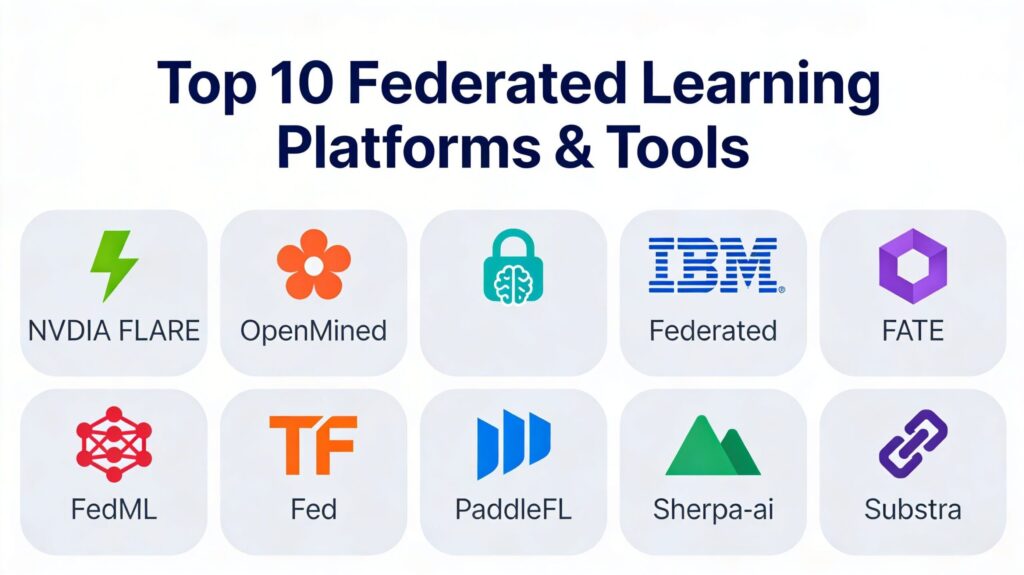
1. NVIDIA Flare (NVFlare)
NVIDIA Flare is an enterprise-grade, open-source framework designed for collaborative and federated computing. It is built to allow researchers and developers to easily transition their existing machine learning workflows into a federated environment with minimal code changes.
Key Features
The platform features a flexible “Controller-Worker” architecture that supports various patterns, including peer-to-peer and cyclic weight transfer. It includes built-in support for “Site Provisioning,” which simplifies the process of securely connecting remote data sites. The system offers a robust “FL Simulator” that allows developers to test federated logic on a single machine before deploying to a distributed network. It features advanced security protocols like SSL/TLS for communication and support for hardware-based trusted execution. Additionally, it integrates natively with the broader NVIDIA AI ecosystem for optimized GPU performance.
Pros
The framework is highly modular, allowing developers to customize the aggregation logic to fit specific use cases. It offers excellent performance when utilized on NVIDIA hardware clusters.
Cons
The setup process can be complex for teams without significant experience in distributed systems. It requires a solid understanding of Python and networking protocols.
Platforms and Deployment
Linux-based servers and edge devices. It supports Cloud, On-premises, and Hybrid deployments.
Security and Compliance
Features robust identity management and supports secure aggregation through differential privacy and encryption.
Integrations and Ecosystem
Seamlessly integrates with PyTorch, TensorFlow, and MONAI for healthcare-specific AI applications.
Support and Community
Maintains an active GitHub repository and comprehensive technical documentation for enterprise developers.
2. Flower (Flwr)
Flower is an extremely user-friendly and scalable federated learning framework that emphasizes simplicity and compatibility. It is designed to work with any machine learning framework and can scale to millions of devices, making it a favorite for mobile and IoT applications.
Key Features
The platform features a “Framework-Agnostic” design, meaning it can be used with PyTorch, TensorFlow, JAX, or even Scikit-learn. It includes a robust “Flower Server” that manages the aggregation of model updates from thousands of concurrent clients. The system offers a “Virtual Client Engine” that allows for the simulation of massive federated networks on a single server. It features specialized support for mobile deployments on Android and iOS. It also provides a wide range of pre-built “Strategies” for common federated optimization tasks like FedAvg and FedProx.
Pros
The API is remarkably simple, allowing developers to turn a centralized training script into a federated one in just a few lines of code. It is highly efficient for edge-device training.
Cons
While highly flexible, it may lack some of the deep, pre-built enterprise “management” consoles found in more heavy-weight platforms. Advanced security features often require manual configuration.
Platforms and Deployment
Windows, macOS, Linux, Android, and iOS. Cloud and Edge deployments.
Security and Compliance
Supports the implementation of SSL, Differential Privacy, and Secure Aggregation through its extensible strategy API.
Integrations and Ecosystem
Highly compatible with almost all Python-based machine learning libraries and mobile development environments.
Support and Community
Boasts a vibrant community and a wealth of tutorials, making it accessible for both academics and industry professionals.
3. OpenMined PySyft
PySyft is a pioneering library for secure and private deep learning. It focuses on “Remote Data Science,” allowing researchers to perform computations on data they cannot see, using federated learning as a core component of its architecture.
Key Features
The platform features a “Data Owner and Data Scientist” separation, ensuring that the researcher never has direct access to raw information. It includes built-in support for “Differential Privacy” to prevent data leakage from model updates. The system offers “Pointer Tensors,” which allow researchers to manipulate remote data as if it were on their local machine. It features advanced cryptographic protocols like Secure Multi-Party Computation (SMPC). It also provides a “Domain” server architecture for managing organizational data silos.
Pros
It offers the most comprehensive set of privacy-preserving technologies in a single library. The philosophy of the platform is built entirely around data sovereignty and ethics.
Cons
The performance overhead of cryptographic protocols like SMPC can be significant. It is a rapidly evolving library, which can sometimes lead to breaking changes between versions.
Platforms and Deployment
Linux and macOS. Primarily Cloud and Hybrid deployments.
Security and Compliance
Specializes in privacy-enhancing technologies (PETs) including SMPC and Differential Privacy.
Integrations and Ecosystem
Deeply integrated with PyTorch and extensible to other frameworks like TensorFlow via the PyGrid ecosystem.
Support and Community
Supported by a massive global community of “Privacy Tech” enthusiasts and researchers.
4. Duality Tech: Secure Federated Learning Beyond Standard FL
While many federated learning platforms focus primarily on keeping raw datasets distributed, Duality Tech’s secure FL takes a deeper security approach by protecting the training process itself.
Its platform integrates encrypted aggregation, privacy-preserving analytics, and enterprise governance controls that help organizations collaborate on machine learning initiatives without exposing intermediate model parameters or sensitive operational data.
This added security layer makes Duality a strong fit for enterprise AI teams operating in sectors where privacy, compliance, and data sovereignty are critical requirements.
5. FATE (Federated AI Technology Enabler)
FATE is a comprehensive, industrial-grade federated learning framework that focuses on providing a holistic solution for collaborative data ecosystems. It is particularly strong in the “Vertical Federated Learning” space.
Key Features
The platform features a high-performance “Federated Computing” core that supports various decentralized algorithms. It includes a robust “FATE-Board” for visualizing the entire training process and pipeline execution. The system offers “Vertical Federated Learning” modules that allow organizations to collaborate on overlapping user sets. It features an integrated “Secret Sharing” protocol for secure model aggregation. It also provides a “FATE-Flow” engine for managing complex end-to-end federated pipelines.
Pros
It is the most advanced platform for Vertical Federated Learning, which is essential for B2B collaborations. It provides an “out-of-the-box” industrial solution with a full suite of management tools.
Cons
The platform is very heavy and has a complex installation process. The documentation can sometimes be challenging for developers outside of its primary regional ecosystem.
Platforms and Deployment
Linux systems. Primarily On-premises and Hybrid deployments.
Security and Compliance
Implements multiple layers of security including homomorphic encryption and secure multi-party computation.
Integrations and Ecosystem
Highly compatible with various big data tools and supports major deep learning frameworks.
Support and Community
Managed by the WeBank research team with a strong focus on industrial and financial use cases.
6. FedML
FedML is a high-level federated learning platform that bridges the gap between research and production. It offers a “Full-Stack” solution that includes a library, a mobile SDK, and a cloud-based management console.
Key Features
The platform features “FedML Nexus AI,” a cloud-based dashboard for managing and monitoring federated training jobs. It includes an “MLOps” style workflow for federated models, covering everything from deployment to monitoring. The system offers a specialized “Mobile SDK” for high-performance training on edge devices. It features support for “Cross-Silo” and “Cross-Device” federated learning patterns. It also provides a library of state-of-the-art federated optimization algorithms.
Pros
The cloud management console significantly reduces the operational overhead of managing a federated network. It offers a very modern “developer-first” experience.
Cons
The “Nexus AI” management layer is a premium service, which may not fit all budgets. It is a newer entrant to the market compared to some established research libraries.
Platforms and Deployment
Linux, macOS, Android, and iOS. Cloud-Native and Edge deployments.
Security and Compliance
Provides standard encryption and supports the implementation of custom privacy-preserving protocols.
Integrations and Ecosystem
Strong integrations with major cloud providers and various edge-computing platforms.
Support and Community
Rapidly growing community with an active developer forum and professional support options.
7. TensorFlow Federated (TFF)
TensorFlow Federated is an open-source framework for machine learning and other computations on decentralized data. Developed by Google, it is the platform used to power federated learning in some of the world’s most widely used mobile applications.
Key Features
The platform features a “Functional Programming” model that allows for precise control over decentralized computations. It includes “Federated Learning (FL) API,” which provides high-level interfaces for training existing Keras models. The system offers “Federated Core (FC) API,” a lower-level environment for designing new federated algorithms. It features a robust simulation environment for testing large-scale decentralization. It also provides deep integration with TensorFlow’s broader set of privacy tools.
Pros
It is backed by Google’s extensive research and experience in large-scale mobile federated learning. It offers the most granular control over the aggregation process.
Cons
The functional programming paradigm can be difficult for developers used to imperative Python code. It is strictly tied to the TensorFlow ecosystem.
Platforms and Deployment
Linux and macOS for development. Primarily targeted at Android and Edge deployments.
Security and Compliance
Integrates with TensorFlow Privacy and supports advanced differential privacy configurations.
Integrations and Ecosystem
Seamlessly integrated with the entire TensorFlow ecosystem, including Keras and TFLite.
Support and Community
Extensive documentation and a large community of TensorFlow developers and researchers.
8. PaddleFL
PaddleFL is an open-source federated learning framework based on the PaddlePaddle deep learning platform. It is designed to provide a rich set of federated learning strategies for various industrial applications.
Key Features
The platform features a comprehensive “Strategy Library” that includes various aggregation and optimization methods. It includes support for “Multi-Task” federated learning, allowing multiple objectives to be optimized simultaneously. The system offers specialized “Privacy Protection” modules including differential privacy and secret sharing. It features a “Compile-time” optimization engine that improves the efficiency of distributed training. It also provides a clear set of industrial examples for finance and medical research.
Pros
It is highly optimized for performance and provides a wide range of industrial-grade strategies. It is particularly effective for large-scale deployments in the Asian market.
Cons
The primary documentation is often focused on the PaddlePaddle ecosystem, which may be less familiar to PyTorch or TensorFlow users. The global community is smaller than that of TFF.
Platforms and Deployment
Linux systems. Cloud and On-premises deployments.
Security and Compliance
Provides robust implementations of differential privacy and secure multi-party computation.
Integrations and Ecosystem
Deeply integrated with the PaddlePaddle platform and its associated tools.
Support and Community
Supported by the Baidu research team and a strong regional developer community.
9. Sherpa.ai Federated Learning
Sherpa.ai offers a high-performance federated learning platform designed to make decentralized AI accessible to the enterprise. It focuses on providing a secure, “plug-and-play” experience for organizations in highly regulated sectors.
Key Features
The platform features a “Universal Framework” that supports multiple machine learning libraries. It includes a specialized “Security Layer” that automates the deployment of differential privacy and homomorphic encryption. The system offers an intuitive “Management Console” for defining and monitoring federated tasks. It features “Adaptive Aggregation” that adjusts to the quality and availability of remote data nodes. It also provides pre-built templates for common use cases like fraud detection and churn prediction.
Pros
It focuses heavily on the “Enterprise UX,” making it easier for business teams to oversee federated projects. The security features are very accessible and easy to configure.
Cons
As a commercial-led platform, it may offer less flexibility for “low-level” research compared to purely open-source libraries. Licensing costs can be a factor for smaller organizations.
Platforms and Deployment
Linux and Cloud-based environments. Hybrid and On-premises deployments.
Security and Compliance
Prioritizes GDPR compliance and features advanced cryptographic data protection.
Integrations and Ecosystem
Integrates with standard enterprise data stacks and major cloud providers.
Support and Community
Provides dedicated professional support and consulting for enterprise implementation.
10. Substra
Substra is an open-source framework for “Trustworthy Federated Learning.” It is specifically designed for high-stakes collaborative research, particularly in the healthcare and life sciences industries.
Key Features
The platform features a “Traceability” engine that records every action on a distributed ledger to ensure auditability. It includes “Permissioned Access” controls that allow data owners to define exactly who can train on their data. The system offers a “Task-Based” workflow where researchers submit training code to remote data nodes. It features a robust “Backend Agnostic” design that works with any ML library. It also provides a clean web interface for managing multi-partner collaborations.
Pros
The focus on auditability and governance makes it ideal for medical consortia and highly regulated research. It excels at managing the “trust” between different organizations.
Cons
The administrative overhead of managing permissions and audit trails can be high. It is more focused on “Cross-Silo” collaboration than massive “Cross-Device” edge training.
Platforms and Deployment
Linux-based systems. Primarily Hybrid and Multi-Cloud deployments.
Security and Compliance
Prioritizes data sovereignty and features extensive audit logs for compliance with medical data regulations.
Integrations and Ecosystem
Works well with Docker and Kubernetes for managing distributed training nodes.
Support and Community
Supported by the Owkin research team and a dedicated community of healthcare and AI researchers.
Comparison Table
| Tool Name | Best For | Platform(s) Supported | Deployment | Standout Feature | Public Rating |
| 1. NVIDIA Flare | Enterprise / Healthcare | Linux | Hybrid | Site Provisioning | 4.7/5 |
| 2. Flower | Scalable Edge / Mobile | Win, Mac, Linux, Mob | Cloud/Edge | Framework Agnostic | 4.8/5 |
| 3. OpenMined | Privacy Research | Linux, Mac | Cloud/Hybrid | Pointer Tensors | 4.5/5 |
| 4. IBM Federated | Corporate Reliability | Linux | On-Prem/Cloud | Low-Code Fusion | 4.2/5 |
| 5. FATE | Vertical B2B Collab | Linux | On-Prem/Hybrid | FATE-Board UI | 4.6/5 |
| 6. FedML | Full-Stack MLOps | Linux, Mac, Mob | Cloud-Native | Nexus AI Console | 4.7/5 |
| 7. TensorFlow Fed | Google Ecosystem | Linux, Mac, Android | Edge/Android | Functional Core API | 4.3/5 |
| 8. PaddleFL | Industrial Scale | Linux | Cloud/On-Prem | Compile-time Opt | 4.4/5 |
| 9. Sherpa.ai | Enterprise UX | Linux, Cloud | Hybrid | Security Automation | 4.5/5 |
| 10. Substra | Medical Consortia | Linux | Multi-Cloud | Audit Traceability | 4.6/5 |
Evaluation & Scoring of Federated Learning Platforms
The scoring below is a comparative model intended to help shortlisting. Each criterion is scored from 1–10, then a weighted total from 0–10 is calculated using the weights listed. These are analyst estimates based on typical fit and common workflow requirements, not public ratings.
Weights:
- Core features – 25%
- Ease of use – 15%
- Integrations & ecosystem – 15%
- Security & compliance – 10%
- Performance & reliability – 10%
- Support & community – 10%
- Price / value – 15%
| Tool Name | Core (25%) | Ease (15%) | Integrations (15%) | Security (10%) | Performance (10%) | Support (10%) | Value (15%) | Weighted Total |
| 1. NVIDIA Flare | 10 | 5 | 9 | 9 | 10 | 9 | 7 | 8.65 |
| 2. Flower | 8 | 10 | 10 | 8 | 9 | 9 | 10 | 9.05 |
| 3. OpenMined | 9 | 6 | 8 | 10 | 7 | 8 | 9 | 8.25 |
| 4. IBM Federated | 8 | 7 | 8 | 9 | 8 | 8 | 7 | 7.75 |
| 5. FATE | 10 | 4 | 7 | 10 | 9 | 7 | 8 | 8.10 |
| 6. FedML | 9 | 8 | 9 | 8 | 9 | 9 | 8 | 8.65 |
| 7. TensorFlow Fed | 9 | 4 | 9 | 9 | 9 | 8 | 8 | 8.05 |
| 8. PaddleFL | 8 | 6 | 7 | 9 | 9 | 7 | 8 | 7.65 |
| 9. Sherpa.ai | 7 | 9 | 8 | 9 | 8 | 8 | 7 | 7.95 |
| 10. Substra | 8 | 7 | 7 | 10 | 8 | 9 | 8 | 8.10 |
How to interpret the scores:
- Use the weighted total to shortlist candidates, then validate with a pilot.
- A lower score can mean specialization, not weakness.
- Security and compliance scores reflect controllability and governance fit, because certifications are often not publicly stated.
- Actual outcomes vary with assembly size, team skills, templates, and process maturity.
Which Federated Learning Platform Tool Is Right for You?
Solo / Freelancer
If you are an individual developer or a founder building a privacy-first startup, you need a tool that allows for rapid prototyping and has a low barrier to entry. A platform that is framework-agnostic and features a simple Python API will allow you to test your federated hypotheses quickly without getting bogged down in complex infrastructure management.
SMB
For smaller organizations or research groups, a tool that offers robust simulation capabilities is essential. This allows you to develop and refine your decentralized models on a single workstation before attempting to coordinate with external data partners. Look for a platform with a strong community and plenty of open-source examples to guide your implementation.
Mid-Market
Organizations in the mid-market segment should prioritize ease of deployment and “site management.” As you begin to connect multiple data silos, the ability to securely provision remote training sites and monitor them through a centralized dashboard becomes a vital operational requirement for maintaining model quality.
Enterprise
For large-scale, multi-national enterprises, security and industrial-grade reliability are the top priorities. You need a platform that supports complex vertical and horizontal federated patterns and can integrate with your existing corporate security stack. The ability to perform high-performance GPU aggregation and maintain a clear audit trail of all model updates is non-negotiable.
Budget vs Premium
If budget is the primary concern, open-source research libraries provide state-of-the-art capabilities for zero licensing fees, though they may require more technical “heavy lifting.” Premium, managed platforms provide a “SaaS-like” experience for federated learning, reducing operational complexity in exchange for a subscription or usage fee.
Feature Depth vs Ease of Use
Some platforms offer “functional core” environments that provide infinite mathematical control but have a very steep learning curve. Others offer “plug-and-play” strategies that are easy to use but may not allow for the deep customization required for highly specialized research tasks.
Integrations & Scalability
Your federated learning platform must play well with your existing data science stack. Ensure the tool supports your preferred ML frameworks and can scale from a few high-performance servers (Cross-Silo) to millions of resource-constrained mobile devices (Cross-Device) depending on your specific use case.
Security & Compliance Needs
If you are handling medical, financial, or government data, your platform choice is a security decision as much as a technical one. You must ensure the platform provides robust implementations of differential privacy and secure aggregation, and can provide the necessary audit logs to satisfy regulatory requirements.
Frequently Asked Questions (FAQs)
1. What is the main difference between Horizontal and Vertical Federated Learning?
Horizontal Federated Learning is used when data sets share the same feature space but differ in samples (e.g., two different hospitals with different patients). Vertical Federated Learning is used when data sets share the same samples but differ in feature space (e.g., a bank and a utility company with the same customers).
2. Does federated learning eliminate the need for data cleaning?
No, data cleaning is actually more challenging in a federated environment because you cannot see the raw data. Organizations must agree on a standardized data schema and preprocessing pipeline before the training begins to ensure that local updates are compatible.
3. How does federated learning handle “Stragglers”?
“Stragglers” are remote devices that are slow to return their model updates. Modern platforms use asynchronous aggregation techniques or specific “timeouts” to ensure that the global training process can continue even if some nodes are delayed.
4. Is raw data ever shared in a federated learning process?
No, the fundamental rule of federated learning is that raw data stays on the local device. Only model weights or gradients (mathematical updates) are shared with the central aggregator, and these are often further protected by encryption or differential privacy.
5. What is “Non-IID” data and why is it a problem?
Non-IID data refers to situations where the data on different remote devices is distributed differently (e.g., one hospital sees only rare diseases while another sees common ones). This can make it difficult for the global model to converge, requiring specialized optimization algorithms.
6. Can federated learning be used for unsupervised tasks?
Yes, federated learning can be applied to clustering, anomaly detection, and generative modeling. The core decentralized architecture remains the same; only the local training objective and the aggregation logic change.
7. Do I need specialized hardware for federated learning?
While not strictly necessary for all tasks, NVIDIA GPUs can significantly speed up local training on servers. For edge devices, frameworks like TensorFlow Lite and Flower are optimized to run on standard mobile and IoT processors.
8. What is Secure Multi-Party Computation (SMPC)?
SMPC is a cryptographic technique that allows multiple parties to jointly compute a function over their inputs while keeping those inputs private. In federated learning, it is often used to ensure the aggregator can’t see individual model updates.
9. How do you evaluate a model you can’t see the training data for?
Evaluation is typically done on a held-out, centralized validation set or by performing “federated evaluation,” where the global model is sent back to local devices to be tested on their private local data, with the results aggregated centrally.
10. Is federated learning the same as “Edge AI”?
They are related but different. Edge AI refers to running or training models on local devices. Federated Learning is a specific method of training models across multiple edge devices to create a single, shared global intelligence.
Conclusion
Federated Learning represents the next frontier of artificial intelligence, providing a scalable path for innovation in an increasingly privacy-conscious world. By decoupling model training from data centralization, these platforms empower organizations to unlock the value of their most sensitive data silos without compromising on security or legal compliance. Whether you are building a collaborative medical research network or optimizing on-device intelligence for millions of users, the selection of a robust federated infrastructure is critical. The ideal platform is one that provides a seamless bridge between local data sovereignty and global model performance, ensuring that your AI remains both powerful and trustworthy.