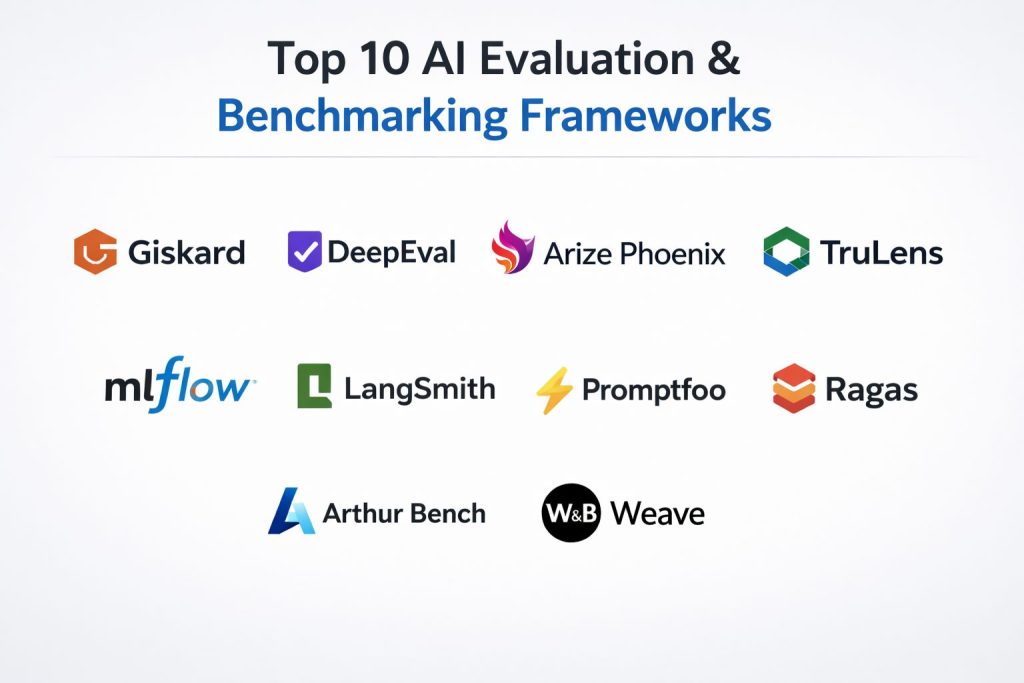
Introduction
AI evaluation and benchmarking frameworks represent the critical infrastructure required to move Large Language Models (LLMs) and generative agents from experimental prototypes to reliable production assets. As these systems grow in complexity, relying on subjective “vibe checks” is no longer a viable engineering strategy. These frameworks provide a structured methodology for quantifying model performance using automated scorers, algorithmic judges, and standardized datasets. By implementing these tools, organizations can systematically detect hallucinations, measure response faithfulness, and ensure that AI outputs remain within the safety and policy boundaries defined by the business.
In a professional development lifecycle, evaluation frameworks act as the quality assurance gate that prevents regressions when prompts are updated or models are swapped. They allow engineering teams to run thousands of test cases in minutes, simulating real-world user interactions and adversarial attacks. This rigor is essential for maintaining trust in highly regulated sectors such as finance, healthcare, and legal services. When choosing a framework, practitioners must evaluate the breadth of built-in metrics, the ease of integration into existing CI/CD pipelines, the ability to handle multi-turn conversations, and the robustness of the “LLM-as-a-Judge” implementation, which uses one model to grade the performance of another.
Best for: Machine Learning engineers, AI product managers, and DevSecOps teams who need to validate model accuracy, security, and cost-efficiency before and after deployment.
Not ideal for: Basic static data analysis, simple automation scripts that do not involve probabilistic outputs, or hobbyist projects where manual spot-checking is sufficient for the intended use case.
Key Trends in AI Evaluation Frameworks
The industry is rapidly shifting toward “LLM-as-a-Judge” patterns, where sophisticated models are utilized to evaluate the nuance of natural language that traditional deterministic metrics cannot capture. There is also a significant rise in synthetic data generation, allowing teams to create massive, diverse test sets even when they lack large volumes of real-world user data. Real-time evaluation is another growing trend, where frameworks are increasingly integrated into production monitoring to flag quality drift as it happens rather than waiting for offline batch processing.
Red-teaming automation is becoming a standard feature, with frameworks now including pre-built suites to test for prompt injections, PII leakage, and toxic content generation. We are also seeing a move toward open-source standards for tracing and instrumentation, such as OpenTelemetry, which allows evaluation data to flow seamlessly between different observability and testing tools. Finally, there is a renewed focus on multi-modal evaluation, as frameworks evolve to score not just text, but also images, audio, and structured code execution for advanced agentic workflows.
How We Selected These Tools
Our selection process for these benchmarking frameworks involved a rigorous assessment of their technical maturity and industry adoption. We prioritized tools that offer a wide array of research-backed metrics, such as G-Eval and RAGAS scores, which have become the industry gold standard for assessing Retrieval Augmented Generation systems. Integration capability was a major factor; we looked for frameworks that connect natively with popular orchestration libraries like LangChain and LlamaIndex to ensure they fit into modern AI stacks.
Performance at scale was also evaluated, specifically looking at how these frameworks handle high-concurrency testing and large-scale dataset processing. We scrutinized the transparency of the scoring algorithms to ensure that the evaluation results are explainable and actionable for developers. Security features, including local execution options for data privacy and support for enterprise compliance standards, played a decisive role. Lastly, we considered the strength of the community and the frequency of updates, ensuring that these tools are capable of keeping pace with the near-daily advancements in foundation models.
1. Giskard
Giskard is a comprehensive open-source testing framework specifically designed to detect vulnerabilities in LLM agents and RAG systems. It excels at identifying “black-box” risks, such as hallucinations, misinformation, and security flaws, by automatically generating adversarial test cases based on the model’s specific business context.
Key Features
The platform features an automated “scan” that detects quality and security risks without requiring manual test writing. It provides a robust suite for collaborative human-in-the-loop evaluation, allowing domain experts to grade model responses easily. The framework supports the creation of “golden datasets” that are continuously enriched with new edge cases discovered during testing. It also includes specialized detectors for prompt injection and sensitive information disclosure. Furthermore, it generates detailed compliance reports that are ready for audit by risk and legal teams.
Pros
It is one of the few tools that combines security red-teaming with functional quality testing in a single interface. The automated scan feature drastically reduces the time needed to find initial model weaknesses.
Cons
The deep technical focus on security can make the initial configuration more complex for non-technical product owners. Some of the most advanced collaboration features are restricted to their enterprise hub.
Platforms and Deployment
Windows, macOS, and Linux via Python SDK. It can be deployed as a local instance or accessed through a managed cloud hub.
Security and Compliance
Offers robust data privacy features by allowing all scans to run locally on your infrastructure. It is designed to assist with EU AI Act and NIST risk management compliance.
Integrations and Ecosystem
Integrates deeply with CI/CD tools like GitHub Actions and supports all major LLM providers including OpenAI, Hugging Face, and Anthropic.
Support and Community
Active open-source community on GitHub and Discord, with professional enterprise support available for large-scale deployments.
2. DeepEval
DeepEval is an open-source framework that brings unit-testing principles to the world of LLMs. It is built to feel familiar to software engineers by mirroring the logic of Pytest, making it exceptionally easy to integrate into existing automated testing pipelines for AI applications.
Key Features
The framework includes over 50 research-backed metrics covering everything from RAG faithfulness to agentic tool-calling correctness. It allows for the creation of custom “G-Eval” metrics where users can define their own criteria in natural language. DeepEval provides a native multi-modal testing suite that can evaluate text, images, and audio outputs. It also features a built-in synthetic data generator that creates test cases from your existing documents. Additionally, it offers a real-time observability decorator that tracks performance directly from your production code.
Pros
Its integration with Pytest makes it the most developer-friendly option for teams that want to treat AI evaluation as a standard part of their software engineering process. The variety of built-in metrics is among the highest in the market.
Cons
Running high volumes of LLM-based evaluations can lead to significant API costs if not managed carefully. The sheer number of metrics can sometimes lead to “metric fatigue” if teams don’t prioritize which ones matter most.
Platforms and Deployment
Cross-platform via Python SDK. Results can be synced to the Confident AI cloud platform for team collaboration.
Security and Compliance
Supports local execution of metrics using open-weight models to ensure data does not leave the corporate perimeter.
Integrations and Ecosystem
Native support for LangChain, LlamaIndex, and major CI/CD providers. It easily connects with various cloud-hosted and local LLM backends.
Support and Community
Maintained by a dedicated team with a highly responsive Discord community and extensive technical documentation.
3. Arize Phoenix
Arize Phoenix is a specialized open-source platform for AI observability and evaluation, built on the foundations of OpenTelemetry. It provides a highly visual and interactive environment for tracing complex agentic workflows and troubleshooting where exactly a model’s reasoning or retrieval failed.
Key Features
The platform utilizes a powerful trace-based evaluation system that can pinpoint failures at any step of a multi-stage AI chain. It includes advanced embedding visualization tools that allow users to identify “clusters” of poor performance in their data. Phoenix provides high-speed, local evaluation templates for common tasks like relevance and toxicity. It also supports human annotation directly in the UI, allowing teams to build ground-truth datasets from production traces. The system tracks token usage and costs across all tracked applications in real-time.
Pros
It offers unparalleled visibility into the “inner workings” of agents, making it the best tool for debugging complex multi-step processes. Being built on OpenTelemetry ensures long-term flexibility and no vendor lock-in.
Cons
The platform focuses more on observability than on “off-the-shelf” academic benchmarking. The interface can be overwhelming for users who only need a simple pass/fail evaluation.
Platforms and Deployment
Docker-based or Python-based deployment on Windows, macOS, and Linux.
Security and Compliance
Enterprise versions offer SOC 2 Type II compliance and role-based access controls for secure data management.
Integrations and Ecosystem
Strongest integration with LangGraph and other agentic frameworks. It works seamlessly with any tool that emits OTLP-compliant traces.
Support and Community
Backed by a major enterprise AI company with a large, professional community and regular technical workshops.
4. TruLens
TruLens, developed by the TruEra team, is a focused evaluation framework designed to help developers move “from vibes to metrics.” It is particularly well-known for its “RAG Triad” approach, which evaluates the relationships between the query, the retrieved context, and the final answer.
Key Features
The framework provides a set of core feedback functions that measure groundedness, context relevance, and answer relevance. It allows for rapid comparison between different model versions and prompt configurations through a dedicated dashboard. TruLens emits OpenTelemetry traces, making it interoperable with broader observability stacks. It supports “chain-of-thought” evaluations that explain why a certain score was given. Additionally, it features specific tools for evaluating the performance of multi-agent systems and their internal tool-calling logic.
Pros
The “RAG Triad” methodology is one of the most effective ways to troubleshoot retrieval-heavy applications. The dashboard is clean and makes it very easy to explain performance regressions to non-technical stakeholders.
Cons
Setting up complex custom feedback functions can require more initial coding effort compared to “one-click” alternatives. Its acquisition has led to some changes in its integration path within broader cloud suites.
Platforms and Deployment
Windows, macOS, and Linux. It is primarily used as a Python library with a local dashboard.
Security and Compliance
Adheres to standard professional data handling practices, with flexibility for local model execution for privacy.
Integrations and Ecosystem
Excellent support for LlamaIndex and LangChain. It is frequently used in conjunction with MLflow for lifecycle management.
Support and Community
Widely used in the academic and professional AI research communities, with a solid base of community-contributed feedback functions.
5. Ragas
Ragas is the most specialized framework for evaluating Retrieval Augmented Generation (RAG) pipelines. It is designed to evaluate these systems without requiring expensive and time-consuming human-annotated ground truth data, using the concept of “reference-free” evaluation.
Key Features
The core of Ragas is its set of specialized metrics: faithfulness, answer relevance, context precision, and context recall. It features a unique “knowledge graph” based synthetic data generator that can create complex, multi-hop questions from your documents. The framework can evaluate citation accuracy, ensuring that models are correctly attributing information to their sources. It supports a wide range of LLMs as judges, allowing users to choose the most cost-effective model for the evaluation task. It also provides tools for analyzing the “intent” behind user queries to better categorize performance.
Pros
It is the gold standard for RAG evaluation, offering specific insights into whether the “Retriever” or the “Generator” is the cause of a failure. Its ability to work without ground truth data makes it ideal for rapid prototyping.
Cons
Its focus is narrower than general-purpose frameworks; it is not the best choice for evaluating non-RAG applications like creative writing or code generation. It lacks a built-in production monitoring dashboard of its own.
Platforms and Deployment
Python-based SDK that runs on all major operating systems.
Security and Compliance
Standard open-source security model where the user controls data flow and model access.
Integrations and Ecosystem
Almost every other major AI observability platform (like DeepEval and LangSmith) integrates Ragas metrics natively into their systems.
Support and Community
Thriving developer community with frequent updates that incorporate the latest research in RAG evaluation.
6. MLflow
MLflow is the industry-standard platform for managing the entire machine learning lifecycle, and it has recently added robust features for LLM evaluation. It provides a centralized repository for tracking experiments, comparing model versions, and monitoring the quality of AI applications from development to production.
Key Features
The evaluation module includes over 50 built-in metrics and support for custom “LLM-as-a-Judge” scorers. It features a unified “AI Gateway” that allows teams to route requests and manage rate limits across multiple LLM providers. MLflow Tracing captures detailed execution data, including latency and token usage, for every step of an agentic workflow. It also provides a systematic way to manage evaluation datasets and collect human feedback from domain experts. The platform’s “Evaluation-Driven Development” workflow helps teams catch regressions before they reach the user.
Pros
It is part of a mature ecosystem that handles everything from experiment tracking to model deployment, making it the best choice for teams already using MLflow for traditional machine learning. Its enterprise-grade stability is a significant advantage.
Cons
The interface can feel more like a traditional data science tool than a modern “AI-first” developer platform. The setup can be heavy for teams only interested in a simple evaluation library.
Platforms and Deployment
Windows, macOS, and Linux. Can be self-hosted or used as a managed service on major cloud platforms like Databricks.
Security and Compliance
Built for the enterprise, offering single sign-on (SSO), role-based access control (RBAC), and detailed audit logs.
Integrations and Ecosystem
One of the largest integration ecosystems in the world, connecting with virtually every major AI framework and data source.
Support and Community
Backed by the Linux Foundation and major tech companies, offering world-class documentation and global community support.
7. LangSmith
LangSmith is the evaluation and observability platform built by the creators of LangChain. It is designed to provide deep visibility into the behavior of LLM applications, offering a highly polished suite of tools for debugging, testing, and optimizing complex reasoning paths.
Key Features
The platform features an exceptionally detailed tracing UI that visualizes every step of a LangChain sequence, including prompt inputs, model outputs, and tool executions. It supports dataset-driven testing with built-in evaluators for accuracy, relevance, and coherence. LangSmith allows developers to quickly turn a production trace into a test case with a single click. It includes a collaborative “Playground” for testing and versioning prompts before they go into production. The system also tracks drift and performance trends over time through integrated monitoring dashboards.
Pros
The user experience is widely considered the best in the industry, specifically for teams already using the LangChain library. The “Trace-to-Test” workflow is a massive time-saver for creating realistic evaluation datasets.
Cons
While it supports other frameworks, its best features are tightly coupled with the LangChain ecosystem. Self-hosting is generally limited to high-tier enterprise contracts.
Platforms and Deployment
Primarily a SaaS platform with enterprise options for on-premises or VPC deployment.
Security and Compliance
Provides SOC 2 compliance and enterprise-level data protection, though users must be aware of data flowing to a managed service.
Integrations and Ecosystem
Unmatched integration with the LangChain and LangGraph ecosystem, but also supports independent Python and JavaScript applications.
Support and Community
Excellent professional support and a massive community of LangChain developers providing a wealth of shared knowledge and templates.
8. Promptfoo
Promptfoo is a CLI-first, developer-centric tool focused on test-driven prompt engineering. It is designed to be fast, local-first, and easily integrated into automated pipelines to compare prompts and models against a set of predefined requirements.
Key Features
The tool produces a “matrix view” that compares multiple prompts and model outputs side-by-side based on custom assertions. It includes built-in scorers for common tasks like factuality, toxicity, and semantic similarity. Promptfoo features a powerful red-teaming module that automatically scans for vulnerabilities like jailbreaks and prompt injections. It uses a simple, declarative YAML format to define test cases, making it language-agnostic. The system also includes caching and concurrency features to maximize evaluation speed.
Pros
It is incredibly fast and respects developer workflows by staying primarily in the terminal. The matrix comparison view is the clearest way to see how different model versions handle the same set of edge cases.
Cons
It lacks the persistent production monitoring and visual tracing features found in platforms like Arize Phoenix or LangSmith. It is more of a development-time tool than a full-lifecycle platform.
Platforms and Deployment
Runs locally on Windows, macOS, and Linux via Node.js or Python.
Security and Compliance
Completely local-first; evaluations run on your machine and talk directly to your LLM providers, ensuring maximum data privacy.
Integrations and Ecosystem
Supports dozens of LLM providers and is designed to work as a standalone CLI or as part of a CI/CD pipeline like GitHub Actions or GitLab CI.
Support and Community
Growing open-source community with a strong focus on security and prompt engineering best practices.
9. Arthur Bench
Arthur Bench is an open-source evaluation product focused on model selection and real-world performance validation. It is designed to help companies translate academic benchmarks into metrics that actually matter for their specific business use cases.
Key Features
The platform provides a suite of scoring metrics for summarization quality, hallucination detection, and question-answering accuracy. It features an intuitive UI for visualizing and comparing test runs across different LLM providers. Arthur Bench allows for the creation of customized benchmarks tailored to unique industry requirements. It provides tools for budget and privacy optimization, helping teams find the least expensive model that still meets their quality thresholds. The framework is designed to be consistently applied across local and cloud environments.
Pros
The focus on “real-world translation” makes it very useful for business stakeholders who need to understand the ROI of switching model providers. The open-source nature ensures it can be extended easily.
Cons
The suite of built-in metrics is currently smaller than some of the older, more established frameworks like DeepEval. It lacks deep agentic tracing capabilities.
Platforms and Deployment
Available as a GitHub repository for local installation or as a cloud-based SaaS offering.
Security and Compliance
Designed with privacy in mind, allowing organizations to keep sensitive evaluation data in-house through local deployment.
Integrations and Ecosystem
Connects with major LLM APIs and is built to integrate with the broader Arthur AI observability platform.
Support and Community
Backed by an established AI monitoring company, providing professional guidance and a growing open-source contributor base.
10. Weights & Biases (Weave)
Weights & Biases has introduced “Weave” to its platform to provide a unified developer system for building and evaluating agentic AI. It bridges the gap between traditional model training and the modern world of LLM orchestration and evaluation.
Key Features
Weave provides systematic tools for iterating on prompts, datasets, and models in a single environment. It includes a tracing and monitoring system that captures LLM calls and application logic for debugging production systems. The evaluation dashboard visualizes performance across key metrics and supports human-in-the-loop feedback. It features direct prompt editing and message retrying from within the trace view to speed up the iteration cycle. It also provides specialized support for evaluating multi-step agent workflows.
Pros
For teams already using Weights & Biases for model training, Weave offers a perfectly integrated experience. It is exceptionally strong at visualizing how changes in “fine-tuning” impact “inference” performance.
Cons
The platform is primarily a managed service, which may not fit teams with strict “local-only” requirements. Its focus on the broader AI lifecycle can make it complex for those only needing a simple eval library.
Platforms and Deployment
SaaS (multi-tenant or single-tenant) and private cloud deployment (VPC).
Security and Compliance
Enterprise-ready with SOC 2 compliance, encryption at rest, and support for deployment within customer-controlled cloud environments.
Integrations and Ecosystem
Integrates natively with Amazon Bedrock, LangChain, and other major cloud AI services, benefiting from the massive W&B integration library.
Support and Community
Provides top-tier enterprise support and is used by many of the world’s leading AI research labs and corporations.
Comparison Table
| Tool Name | Best For | Platform(s) Supported | Deployment | Standout Feature | Public Rating |
| 1. Giskard | AI Security & Quality | Win, Mac, Linux | Local/Hub | Automated Risk Scan | 4.7/5 |
| 2. DeepEval | Unit-testing for LLMs | Win, Mac, Linux | Local/Cloud | 50+ Research Metrics | 4.8/5 |
| 3. Arize Phoenix | Tracing & Debugging | Win, Mac, Linux | Local/Docker | OTel-native Tracing | 4.6/5 |
| 4. TruLens | RAG Troubleshooting | Win, Mac, Linux | Local/Python | The RAG Triad Scorer | 4.5/5 |
| 5. Ragas | Reference-free RAG | Win, Mac, Linux | Python SDK | KG Synthetic Data | 4.9/5 |
| 6. MLflow | Enterprise Lifecycle | Win, Mac, Linux | Hybrid/Cloud | Integrated AI Gateway | 4.4/5 |
| 7. LangSmith | LangChain Teams | Win, Mac, Linux | SaaS/VPC | Trace-to-Test Workflow | 4.8/5 |
| 8. Promptfoo | CLI/Prompt Testing | Win, Mac, Linux | Local/CLI | Matrix Comparison View | 4.7/5 |
| 9. Arthur Bench | Model ROI Selection | Win, Mac, Linux | Local/SaaS | Real-world Translation | 4.2/5 |
| 10. Weights & Biases | Training & Inference | Win, Mac, Linux | SaaS/VPC | Unified Dev/Eval Suite | 4.6/5 |
Evaluation & Scoring of AI Benchmarking Frameworks
The scoring below is a comparative model intended to help shortlisting. Each criterion is scored from 1–10, then a weighted total from 0–10 is calculated using the weights listed. These are analyst estimates based on typical fit and common workflow requirements, not public ratings.
Weights:
- Core features – 25%
- Ease of use – 15%
- Integrations & ecosystem – 15%
- Security & compliance – 10%
- Performance & reliability – 10%
- Support & community – 10%
- Price / value – 15%
| Tool Name | Core (25%) | Ease (15%) | Integrations (15%) | Security (10%) | Performance (10%) | Support (10%) | Value (15%) | Weighted Total |
| 1. Giskard | 9 | 7 | 8 | 10 | 8 | 9 | 9 | 8.55 |
| 2. DeepEval | 10 | 9 | 9 | 8 | 9 | 9 | 10 | 9.35 |
| 3. Arize Phoenix | 8 | 7 | 10 | 9 | 9 | 10 | 8 | 8.55 |
| 4. TruLens | 8 | 8 | 9 | 7 | 8 | 8 | 8 | 8.05 |
| 5. Ragas | 10 | 8 | 10 | 7 | 8 | 9 | 9 | 8.90 |
| 6. MLflow | 8 | 6 | 10 | 10 | 8 | 10 | 7 | 8.15 |
| 7. LangSmith | 9 | 10 | 10 | 8 | 9 | 10 | 8 | 9.15 |
| 8. Promptfoo | 9 | 9 | 8 | 10 | 10 | 8 | 10 | 9.25 |
| 9. Arthur Bench | 7 | 8 | 7 | 8 | 7 | 8 | 8 | 7.45 |
| 10. W&B Weave | 9 | 7 | 9 | 9 | 9 | 10 | 7 | 8.50 |
How to interpret the scores:
- Use the weighted total to shortlist candidates, then validate with a pilot.
- A lower score can mean specialization, not weakness.
- Security and compliance scores reflect controllability and governance fit, because certifications are often not publicly stated.
- Actual outcomes vary with assembly size, team skills, templates, and process maturity.
Which AI Evaluation Tool Is Right for You?
Solo / Freelancer
Individuals building smaller apps should prioritize tools that are free to use and easy to set up. A CLI-based tool that works locally without requiring a subscription is ideal for rapid experimentation and prompt refinement.
SMB
Small teams need frameworks that provide the most “out-of-the-box” metrics so they can focus on building features rather than writing evaluation logic. A tool that integrates with their existing CI/CD pipeline ensures that quality is maintained even with a small staff.
Mid-Market
For growing companies, the ability to collaborate and share evaluation reports is vital. Platforms that offer a shared cloud dashboard where developers and product managers can review results together will yield the best results.
Enterprise
Enterprise organizations must prioritize security, data governance, and scalability. They require tools that can be deployed within their own virtual private clouds and that offer detailed audit trails for regulatory compliance.
Budget vs Premium
Open-source tools offer incredible power for zero licensing cost, though they may require more manual infrastructure management. Premium SaaS platforms provide a “hands-off” experience with high-quality support, which can be more cost-effective for teams with high developer rates.
Feature Depth vs Ease of Use
Some frameworks offer hundreds of advanced metrics but require deep ML knowledge to configure correctly. Others are designed for speed, allowing a developer to get their first evaluation run in minutes, though they may lack niche research metrics.
Integrations & Scalability
If your team is heavily invested in a specific library like LangChain, using the platform built specifically for that ecosystem is often the most efficient path. However, if you use a diverse set of tools, an OpenTelemetry-based framework is safer.
Security & Compliance Needs
Highly regulated industries should look for frameworks that support “local model” judges and local data storage. This ensures that sensitive customer data or internal company documents used for testing never leave the organization’s secure environment.
Frequently Asked Questions (FAQs)
1. What is an “LLM-as-a-Judge”?
This is an evaluation pattern where a highly capable model, like GPT-4 or Claude 3, is given a prompt and a response to grade based on specific criteria. It is used to evaluate qualitative aspects of language that traditional math-based metrics cannot handle.
2. Why do I need a specialized framework for RAG evaluation?
RAG systems have two failure points: the retrieval of the wrong documents and the generation of the wrong answer from the correct documents. Specialized frameworks like Ragas separate these two phases so you know exactly which part to fix.
3. Can I use these tools with open-source models like Llama 3?
Yes, most of these frameworks are model-agnostic. They can be configured to use local model providers like Ollama or vLLM to run evaluations, which is excellent for cost-saving and data privacy.
4. What is a “Golden Dataset”?
A golden dataset is a curated collection of inputs and “perfect” outputs that have been verified by humans. It serves as the ground-truth benchmark that your AI system must consistently match or exceed.
5. How does automated red-teaming work?
These tools use “attacker” models to send thousands of malicious prompts to your AI to see if it will leak data, ignore its safety instructions, or generate harmful content, allowing you to patch vulnerabilities before release.
6. Do I need to be a data scientist to use these frameworks?
While a background in ML helps, many of these tools are designed for software engineers. If you can write basic Python and understand the logic of unit testing, you can effectively use most AI evaluation frameworks.
7. Is manual human evaluation still necessary?
Yes. While automated tools can handle 90% of the volume, human review is still essential for defining the initial ground truth and for periodic audits to ensure the “AI Judge” isn’t suffering from its own biases.
8. How do these tools help with the EU AI Act?
They provide the systematic testing, risk assessment, and performance documentation required by the act, ensuring that your AI application is transparent, safe, and accountable.
9. What is “Faithfulness” in AI evaluation?
Faithfulness measures how much of the model’s answer is actually supported by the provided source documents. A low faithfulness score usually indicates that the model is “hallucinating” or making things up.
10. How much do these frameworks cost to run?
The software is often open-source, but you will pay for the “evaluation tokens” used by the judge models. Using smaller, cheaper models for simple tasks and high-end models only for complex reasoning can help manage these costs.
Conclusion
The transition from “AI as a curiosity” to “AI as critical infrastructure” requires a fundamental shift in how we approach quality and performance. AI evaluation and benchmarking frameworks are no longer optional accessories; they are the essential tools that allow engineers to build with confidence and organizations to deploy with safety. By adopting a systematic approach to testing—combining automated metrics, adversarial red-teaming, and human-in-the-loop oversight—teams can navigate the inherent uncertainty of probabilistic models. As the landscape continues to evolve toward more autonomous and agentic systems, the frameworks that prioritize transparency, scalability, and interoperability will become the definitive standards for the next generation of digital transformation.