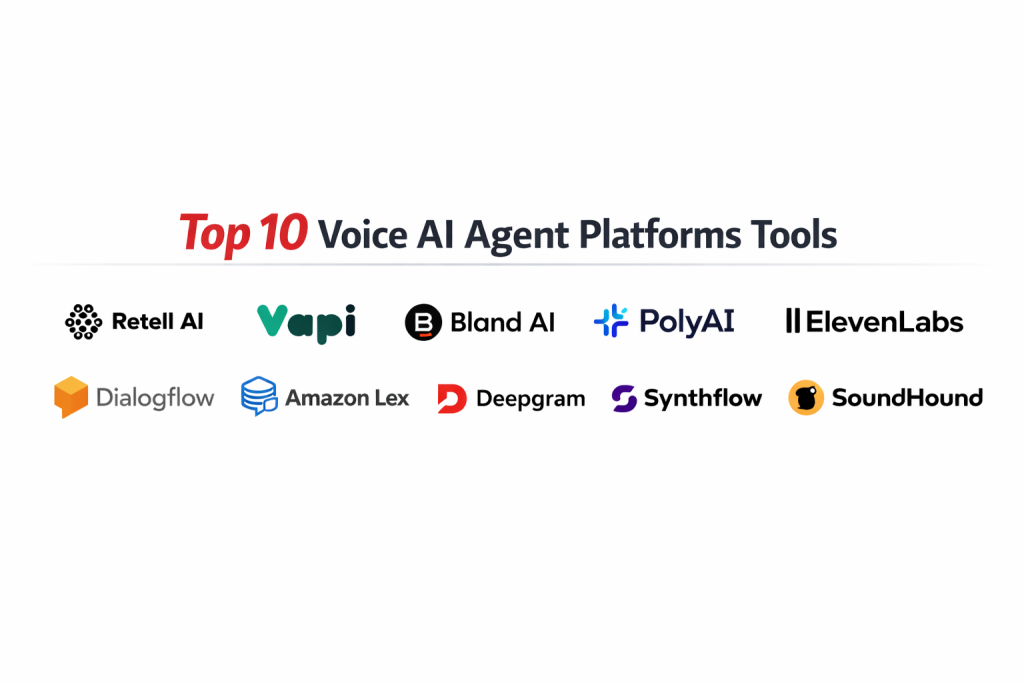
Introduction
Voice AI agent platforms represent the next evolution in conversational interfaces, moving beyond simple automated menus into the realm of natural, fluid, and goal-oriented verbal communication. These platforms utilize a sophisticated orchestration of three core technologies: Automatic Speech Recognition (ASR) to hear the user, Large Language Models (LLMs) to reason and generate responses, and Text-to-Speech (TTS) to deliver a human-like voice. Unlike traditional IVR systems, modern voice agents can handle interruptions, understand emotional nuances, and execute complex backend tasks like scheduling appointments or processing refunds in real time. For organizations, these tools are no longer just about cost-cutting through deflection; they are about providing 24/7 high-quality service that scales instantly without the overhead of a massive physical call center.
The strategic importance of voice AI lies in its ability to bridge the gap between digital efficiency and human empathy. In sectors like healthcare, finance, and logistics, the speed of resolution is often more critical than the channel of communication. Voice remains the most intuitive interface for humans, and by automating the high-volume, repetitive inquiries that typically clog phone lines, enterprises can free up their human specialists for high-stakes problem-solving. When evaluating these platforms, technical leaders must look past “shiny” voice demos and scrutinize latency—the delay between a user speaking and the AI responding—as well as the robustness of the telephony integration and the platform’s ability to maintain context over long, multi-turn conversations.
Best for: Global enterprise contact centers, high-volume outbound sales teams, healthcare providers requiring HIPAA-compliant automation, and e-commerce brands looking for 24/7 customer support.
Not ideal for: Low-volume businesses with highly unpredictable or deeply bespoke physical world problems that require manual human intervention, or scenarios where voice biometrics and identity verification are the only requirements without a need for conversation.
Key Trends in Voice AI Agent Platforms
The most significant trend is the move toward “Zero-Latency” architectures, where specialized processing pipelines reduce response delays to under 600 milliseconds, making conversations feel truly lifelike. We are also seeing a shift toward “Agentic” workflows, where the voice assistant is not just a talker but a doer, capable of navigating internal APIs to change a flight or update a medical record autonomously. Multilingual fluency has also matured, with agents now able to detect a caller’s language mid-sentence and switch dialects instantly to match the user.
Another major trend is the integration of “Emotion AI,” which allows agents to detect frustration or urgency in a caller’s voice and adjust their tone or escalate to a human supervisor accordingly. Industry-specific grounding is also becoming standard; instead of general-purpose bots, we see agents pre-trained on the specific vocabularies of insurance claims, technical support, or real estate. Finally, the “Human-in-the-Loop” model has been refined, allowing for “warm transfers” where the AI provides a full summary of the interaction to the human agent who takes over, ensuring the customer never has to repeat themselves.
How We Selected These Tools
Our selection process focused on platforms that demonstrate technical excellence in three critical areas: conversation quality, integration depth, and enterprise-grade reliability. We prioritized tools that offer low-latency performance, as high delays are the primary reason voice AI projects fail to gain user trust. We also evaluated the “Developer Experience,” looking for platforms that provide either powerful APIs for custom builds or intuitive visual builders that allow business units to deploy agents without a six-month engineering cycle.
Market provenness was another essential factor. The tools on this list are used by organizations to handle thousands of concurrent calls, demonstrating they can survive the “stress test” of real-world production. We also weighed compliance and security heavily, ensuring that the selected platforms meet the rigorous standards of HIPAA, SOC 2, and GDPR. Finally, we looked at the economic model of each tool, favoring those with transparent usage-based pricing that allows businesses to start small and scale based on actual performance and ROI.
1. Retell AI
Retell AI has quickly become a favorite for enterprises and startups alike due to its focus on ultra-low latency and human-like prosody. It provides a specialized “Voice-to-Voice” engine that bypasses many of the delays inherent in traditional stacks. The platform is designed for those who need a high-performance conversational layer that can be integrated into existing telephony or used as a standalone solution.
Key Features
The platform features an industry-leading response time that typically stays under 600 milliseconds. It offers a sophisticated visual builder for creating complex call flows without deep coding knowledge. Users can utilize a native “Knowledge Base” sync that allows the agent to ingest documents and websites to answer questions accurately. It supports advanced telephony features like IVR navigation, warm transfers, and branded caller ID. Additionally, it provides detailed post-call analytics, including automated sentiment scoring and data extraction.
Pros
The conversation quality is exceptionally natural, handling interruptions and background noise with high accuracy. The pricing model is highly transparent with no hidden platform fees.
Cons
While it offers high customization, teams without any technical resources may find the initial API setup for complex backend actions challenging.
Platforms and Deployment
Cloud-based API with support for web, mobile, and traditional PSTN/SIP telephony.
Security and Compliance
Fully compliant with HIPAA, SOC 2 Type 1 and 2, and GDPR across all tiers. It also includes automatic PII redaction for call transcripts.
Integrations and Ecosystem
Strong native connections to Hubspot, Salesforce, and Twilio. It also supports custom Webhook triggers for real-time data exchange with internal databases.
Support and Community
Offers dedicated onboarding and a very responsive technical support team, complemented by comprehensive developer documentation.
2. Vapi
Vapi is a developer-centric orchestration platform that allows engineering teams to build bespoke voice agents by picking and choosing their preferred LLM, STT, and TTS providers. It acts as the “glue” that holds the voice stack together, offering granular control over every aspect of the call experience.
Key Features
It provides a modular architecture where users can bring their own API keys for models like GPT-4 or ElevenLabs. The platform supports “Function Calling,” enabling the agent to perform real-time actions like booking a calendar slot during the call. It features a robust testing environment to simulate various network conditions and latencies. The dashboard provides real-time monitoring of active calls and detailed logs for debugging. It also supports specialized telephony options including SIP trunking and BYOT (Bring Your Own Telephony).
Pros
Offers the highest level of flexibility for developers who want to fine-tune every millisecond of the interaction. It is excellent for creating highly differentiated, custom-branded voice experiences.
Cons
The pricing can be complex as it involves orchestration fees plus the costs of the individual underlying providers. It requires a dedicated engineering team to maintain and optimize.
Platforms and Deployment
Primarily API-driven cloud deployment with extensive SDKs for various programming languages.
Security and Compliance
Supports SOC 2 Type 2; however, advanced compliance features like HIPAA often require a significant additional monthly fee or enterprise plan.
Integrations and Ecosystem
Extensive compatibility with almost any LLM and voice provider in the market. It integrates well with modern developer workflows and CI/CD pipelines.
Support and Community
Strong community-led support through Discord and GitHub, with enterprise-level SLAs available for high-volume users.
3. Bland AI
Bland AI is built for speed and scale, specifically targeting high-volume outbound and inbound use cases. It is known for its “Pathways” builder, which allows users to map out massive conversational trees that can handle thousands of concurrent calls for lead qualification or customer surveys.
Key Features
The “Pathways” system is a visual logic builder designed to handle complex decision-making during a call. It features built-in voice cloning that allows brands to create a unique, consistent voice with just a short audio sample. The platform is optimized for high-concurrency, allowing for millions of calls to be processed simultaneously. It includes an automated tool for “Batch Campaigns,” making it easy to upload a list of contacts and launch an outbound voice initiative. It also provides real-time transfer logic to move callers to human representatives when certain criteria are met.
Pros
Extremely efficient for outbound-heavy operations like sales and recruitment. The no-code builder is intuitive enough for non-technical marketing teams to use.
Cons
The base per-minute rates can be higher than competitors when operating at extreme scales. The focus on speed sometimes results in slightly less “emotional” voice quality compared to specialized providers.
Platforms and Deployment
Cloud-hosted platform with a focus on ease of deployment through a web-based interface.
Security and Compliance
Adheres to SOC 2 and GDPR standards. It offers specialized tools for maintaining compliance with telemarketing regulations like TCPA.
Integrations and Ecosystem
Direct integrations with major CRMs and lead management tools. It offers a simple API for pushing call data to external reporting dashboards.
Support and Community
Provides a robust knowledge base and active support for enterprise clients, with a focus on helping users optimize their call conversion rates.
4. PolyAI
PolyAI is an enterprise-grade platform that focuses on “Grandmaster” level conversational quality for large consumer brands. They specialize in high-stakes environments where the AI must behave as a true brand ambassador, handling complex accents, slang, and multi-turn inquiries without breaking character.
Key Features
The platform utilizes proprietary “Encoder” models that are specifically trained for spoken language rather than text. It supports over 35 languages and dialects with native-level fluency. Their agents are designed to be “interruption-friendly,” allowing users to change their minds or ask side-questions naturally. It features a “Unified Agent” model where the same logic can be applied across voice, web chat, and mobile apps. The system also includes advanced noise-suppression technology to handle calls from busy streets or public transport.
Pros
Delivers perhaps the most consistent and high-quality “human” experience in the industry. It is highly effective at “containment,” meaning it resolves the vast majority of calls without needing a human handoff.
Cons
This is an enterprise-first solution with a price point and implementation timeline that may be out of reach for smaller businesses. It is not a “plug-and-play” tool for weekend projects.
Platforms and Deployment
Managed cloud service with deep integration into enterprise contact center suites like Genesys and Five9.
Security and Compliance
Meets the highest global standards, including PCI-DSS for handling payments, HIPAA, and ISO 27001.
Integrations and Ecosystem
Deeply integrated with the world’s leading CCaaS (Contact Center as a Service) providers and enterprise ERP systems like SAP and Oracle.
Support and Community
Offers a fully managed service model where their own conversational designers help build and optimize the agents for the client.
5. ElevenLabs (Conversational AI)
ElevenLabs, originally famous for its world-class voice synthesis, has expanded into a full conversational AI platform. It allows users to combine their industry-leading voices with low-latency LLM orchestration to create agents that sound indistinguishable from humans.
Key Features
The standout feature is the vast library of high-fidelity, emotionally expressive voices that can convey subtle tones like empathy or excitement. Users can create a “Professional Voice Clone” that captures every nuance of a specific person’s speech. The platform offers a “Turn-based” API that is optimized for conversational stability. It includes a built-in “Knowledge Base” for RAG (Retrieval-Augmented Generation), allowing the agent to cite specific company facts. It also features a workspace for teams to collaborate on voice personas and conversational prompts.
Pros
The audio quality is the gold standard of the industry. It is the best choice for brands where the “aesthetic” and “vibe” of the voice are critical to the user experience.
Cons
It lacks some of the deep telephony features found in competitors, such as native SIP trunking or complex IVR navigation, often requiring an external telephony provider.
Platforms and Deployment
Available via web interface and a robust API. Can be integrated into apps, websites, and phone systems via third-party bridges.
Security and Compliance
SOC 2 Type 2 and GDPR compliant. They have pioneered “Voice Captcha” and safety features to prevent the unauthorized cloning of voices.
Integrations and Ecosystem
Strong developer ecosystem with hundreds of community-built integrations. It is frequently used as the TTS layer for other platforms on this list.
Support and Community
Very active and large community of creators and developers, with dedicated technical support for Pro and Enterprise users.
6. Google Dialogflow (CX)
Dialogflow CX is Google’s advanced conversational AI platform designed for large-scale, complex enterprise bot development. It uses a state-based approach to conversation design, making it ideal for managing long, winding interactions that involve many different possible outcomes.
Key Features
It utilizes a “Flow” based visual editor that allows for the modular design of different parts of a conversation. The platform is natively integrated with Google’s world-class Speech-to-Text and Text-to-Speech engines. It features “Deterministic NLU,” which gives developers precise control over how the AI interprets specific intents. It also includes “Omnichannel” support, allowing the same agent logic to run on a phone line, a website, and a Google Assistant device. The platform provides sophisticated versioning and environment management for safe deployment.
Pros
Unrivaled scalability and global reach, with support for more languages than almost any other platform. It integrates seamlessly with the broader Google Cloud ecosystem.
Cons
The “CX” version has a steep learning curve and can be complex to set up. It is designed for technical teams and lacks the “out-of-the-box” simplicity of some newer startups.
Platforms and Deployment
Native to Google Cloud Platform, with extensive options for integrating into any telephony or digital channel.
Security and Compliance
Benefits from the full range of Google Cloud’s security certifications, including HIPAA, SOC, and various government-level clearances.
Integrations and Ecosystem
Deep integration with Google BigQuery for analytics and Google Contact Center AI (CCAI). It is supported by a massive global network of certified partners.
Support and Community
Extensive documentation, training certifications, and enterprise-grade support plans provided by Google Cloud.
7. Amazon Lex
Amazon Lex provides the same deep learning technologies that power Alexa, allowing developers to build sophisticated voice and text chatbots. It is a key component of the AWS ecosystem, offering a “pay-as-you-go” model that is highly attractive for companies already running on Amazon’s infrastructure.
Key Features
The platform features “Streaming Conversations,” which allows the agent to process speech and respond in real-time without waiting for the user to finish a long sentence. It integrates natively with Amazon Connect, providing a complete “Contact Center in a Box” solution. It uses “Automated Chatbot Designer” tools to analyze existing transcripts and suggest the best conversational paths. The system supports multi-turn conversations with context management and slot-filling for data collection. It also allows for one-click deployment to multiple platforms.
Pros
Extremely cost-effective for businesses with fluctuating call volumes. The integration with Amazon Connect makes it the fastest way to set up a professional-grade call center from scratch.
Cons
The voice quality of the standard Lex voices, while good, may not feel as “magical” or “human” as specialized providers like ElevenLabs. The interface can be intimidating for non-AWS users.
Platforms and Deployment
Cloud-native on AWS. Best utilized in conjunction with Amazon Connect and AWS Lambda for backend logic.
Security and Compliance
Compliant with PCI-DSS, HIPAA, SOC, and FedRAMP. It provides robust encryption and identity management through AWS IAM.
Integrations and Ecosystem
Seamless integration with the entire AWS catalog. It has a massive marketplace of pre-built connectors for popular SaaS applications.
Support and Community
Backed by the massive AWS support organization and a global community of cloud architects and developers.
8. Deepgram (Voice Agent API)
Deepgram, originally known for having the fastest and most accurate speech-to-text on the market, has released an end-to-end Voice Agent API. It is designed for developers who need a high-performance, integrated solution that minimizes the “hops” between different pieces of the AI stack.
Key Features
The platform features a “Unified Pipeline” that combines ASR, LLM, and TTS into a single API call, significantly reducing latency. It offers “Instant Audio Fine-tuning,” which allows the agent to correctly recognize industry-specific jargon or product names. The voices are generated using neural models that prioritize clarity and speed. It supports “Single-Tenant” and on-premises deployment for organizations with extreme data privacy needs. It also includes a sophisticated “Voice Activity Detection” system to handle difficult acoustic environments.
Pros
The most performant choice for high-concurrency, production-scale infrastructure. Their bundled pricing model eliminates the “sticker shock” of separate API costs.
Cons
As a newer entry into the full “Agent” space, it has fewer pre-built “no-code” templates compared to platforms that have been focused on business users from day one.
Platforms and Deployment
Cloud, dedicated single-tenant, and on-premises deployment options available.
Security and Compliance
Fully HIPAA and GDPR compliant. It is the preferred choice for organizations that require complete control over where their data is processed.
Integrations and Ecosystem
Extensive API and WebSocket support. It is natively integrated into many of the world’s largest CCaaS platforms as the underlying engine.
Support and Community
Provides high-level technical support and a “developer-first” documentation style that is clear and comprehensive.
9. Synthflow
Synthflow is a no-code voice AI platform that prioritizes ease of use for small to medium-sized businesses. It allows users to go from a blank screen to a working voice agent that can book appointments or qualify leads in just a few minutes, without writing any code.
Key Features
It features a visual “Drag-and-Drop” agent builder that maps out the entire customer journey. The platform includes a native “Calendar Integration” that syncs directly with tools like Google Calendar and Calendly. It provides a “Sandbox” environment where users can test their agents over the phone before going live. The software includes “Multilingual” support, allowing agents to be deployed globally. It also features a “Lead Management” dashboard to view and export the data collected during calls.
Pros
The fastest time-to-value for businesses that don’t have an engineering team. The interface is clean and avoids the technical jargon found in developer-centric tools.
Cons
It offers less granular control over the underlying AI models compared to API-first platforms. The per-minute costs can be higher for very large-scale enterprise users.
Platforms and Deployment
Web-based platform with cloud hosting. No local installation or complex server setup is required.
Security and Compliance
Adheres to standard security practices and is suitable for most general business use cases.
Integrations and Ecosystem
Strong integrations via Zapier and Make, allowing it to connect to thousands of other apps. It also features native CRM sync for common platforms.
Support and Community
Offers excellent customer success support and a library of video tutorials specifically designed for business users.
10. SoundHound (Smart Desktop / Conversational AI)
SoundHound is an independent pioneer in voice AI, offering a platform that is not tied to the “Big Tech” ecosystems. They are known for their “Speech-to-Meaning” technology, which processes speech in real-time to understand intent before the user has even finished talking.
Key Features
The “Collective AI” architecture allows their agents to tap into a growing library of “domains” or skills, such as weather, flight info, or local business data. It features a proprietary voice synthesis engine that is highly optimized for automotive and restaurant environments. The platform supports “Multi-Modal” interactions, where a voice agent can push visual information to a screen simultaneously. It offers a “Private Cloud” option for brands that want to keep their user data completely separate from other companies. It also includes advanced tools for “Custom Wake Word” development.
Pros
Excellent for specialized hardware integrations like smart appliances or automotive systems. Being independent allows for more flexible data-sharing agreements than the major cloud providers.
Cons
The developer ecosystem, while robust, is smaller than that of Google or Amazon. It is more focused on “Product” integration than “Call Center” automation.
Platforms and Deployment
Supports a wide range of deployments from cloud to edge/on-device processing.
Security and Compliance
Enterprise-grade security with a strong focus on brand data sovereignty and user privacy.
Integrations and Ecosystem
Widely used in the automotive and hospitality industries. It offers a comprehensive developer portal for building custom “Voice Interfaces.”
Support and Community
Provides high-touch professional services for enterprise partners and a dedicated support portal for developers.
Comparison Table
| Tool Name | Best For | Platform(s) Supported | Deployment | Standout Feature | Public Rating |
| 1. Retell AI | Low-Latency / CX | Web, Phone, API | Cloud | 600ms Response Time | 4.8/5 |
| 2. Vapi | Custom Development | API, SDK | Cloud | Modular Architecture | 4.7/5 |
| 3. Bland AI | Outbound Scaling | Web, API | Cloud | Pathways Logic Builder | 4.6/5 |
| 4. PolyAI | Enterprise Brands | CCaaS, Cloud | Managed | Emotional Intelligence | 4.9/5 |
| 5. ElevenLabs | High-Fidelity Voice | Web, API | Cloud | Pro Voice Cloning | 4.8/5 |
| 6. Dialogflow CX | Global Scale | Google Cloud | Hybrid | State-based Logic | 4.5/5 |
| 7. Amazon Lex | AWS Integration | AWS, Connect | Cloud | Streaming Conversations | 4.4/5 |
| 8. Deepgram | High Concurrency | API, SDK | On-Prem/Cloud | Unified Agent Pipeline | 4.7/5 |
| 9. Synthflow | SMB / No-Code | Web | Cloud | One-Click Calendar Sync | 4.3/5 |
| 10. SoundHound | Specialized Hardware | Edge, Cloud | Hybrid | Speech-to-Meaning Tech | 4.5/5 |
Evaluation & Scoring of Voice AI Agent Platforms
The scoring below is a comparative model intended to help shortlisting. Each criterion is scored from 1–10, then a weighted total from 0–10 is calculated using the weights listed. These are analyst estimates based on typical fit and common workflow requirements, not public ratings.
Weights:
- Core features – 25%
- Ease of use – 15%
- Integrations & ecosystem – 15%
- Security & compliance – 10%
- Performance & reliability – 10%
- Support & community – 10%
- Price / value – 15%
| Tool Name | Core (25%) | Ease (15%) | Integrations (15%) | Security (10%) | Performance (10%) | Support (10%) | Value (15%) | Weighted Total |
| 1. Retell AI | 10 | 9 | 9 | 10 | 10 | 9 | 9 | 9.55 |
| 2. Vapi | 10 | 5 | 10 | 8 | 9 | 8 | 8 | 8.55 |
| 3. Bland AI | 8 | 8 | 8 | 8 | 9 | 8 | 9 | 8.25 |
| 4. PolyAI | 10 | 4 | 9 | 10 | 10 | 10 | 6 | 8.55 |
| 5. ElevenLabs | 10 | 8 | 7 | 9 | 9 | 8 | 8 | 8.55 |
| 6. Dialogflow | 9 | 4 | 10 | 10 | 9 | 9 | 7 | 8.25 |
| 7. Amazon Lex | 8 | 5 | 10 | 10 | 9 | 9 | 9 | 8.35 |
| 8. Deepgram | 9 | 6 | 9 | 10 | 10 | 8 | 9 | 8.70 |
| 9. Synthflow | 6 | 10 | 8 | 7 | 8 | 9 | 7 | 7.45 |
| 10. SoundHound | 9 | 5 | 8 | 9 | 9 | 8 | 7 | 8.00 |
How to interpret the scores:
- Use the weighted total to shortlist candidates, then validate with a pilot.
- A lower score can mean specialization, not weakness.
- Security and compliance scores reflect controllability and governance fit, because certifications are often not publicly stated.
- Actual outcomes vary with assembly size, team skills, templates, and process maturity.
Which Voice AI Agent Platform Tool Is Right for You?
Solo / Freelancer
For individuals building their own apps or automations, the focus should be on ease of use and low upfront costs. A platform that offers a generous free tier and a simple no-code builder allows a single person to deploy a professional-sounding agent without needing a team of engineers.
SMB
Small businesses need tools that solve specific problems—like missed call handling or appointment scheduling—with minimal setup time. Look for platforms with native integrations into common tools like Google Calendar or small-business CRMs to ensure the data flows smoothly into your existing workflows.
Mid-Market
As companies grow, the need for scalability and reliability increases. Mid-market firms should look for tools that offer a balance between developer flexibility and ease of use, ensuring that as their needs become more complex, the software can adapt without a complete rebuild.
Enterprise
For the enterprise, security, compliance, and global performance are the non-negotiables. Platforms that offer single-tenant deployments, multi-language support, and deep integrations into high-end contact center software are the only ones that can meet the rigorous demands of a large-scale organization.
Budget vs Premium
Budget-conscious users will find great value in pay-as-you-go models where you only pay for the minutes you actually use. Premium solutions, while they carry higher costs and implementation fees, provide the custom conversational design and high-touch support required for high-stakes brand interactions.
Feature Depth vs Ease of Use
If you have a team of developers, a platform with deep API access and modular controls will allow you to build something truly unique. If you are a business owner with no technical background, a visual, no-code platform will get you to market much faster.
Integrations & Scalability
A voice agent is only as good as the data it can access. Ensure the tool you choose can talk to your database or CRM in real-time. Also, verify that the platform can handle peak call volumes without increasing latency or dropping calls.
Security & Compliance Needs
In regulated industries, this is the most important factor. Always check for HIPAA, SOC 2, and GDPR compliance. For global companies, ensure the platform also complies with local telecommunications and data privacy laws in every region where you operate.
Frequently Asked Questions (FAQs)
1. What is the difference between an AI voice agent and a chatbot?
A chatbot communicates via text, whereas a voice agent uses speech recognition and synthesis to conduct verbal conversations. Voice agents must also manage “latency” and “prosody” (the rhythm of speech) to ensure the interaction feels natural.
2. Can these agents handle different accents?
Modern platforms use advanced neural models that are trained on millions of hours of diverse speech, allowing them to understand a wide range of accents and even regional slang with high accuracy.
3. Is it legal to use AI for outbound calls?
Laws vary by region, but generally, you must comply with telemarketing regulations such as the TCPA in the United States. This includes maintaining “Do Not Call” lists and ensuring you have the proper consent before placing automated calls.
4. How much does a voice AI agent cost?
Most platforms charge based on usage, typically ranging from $0.05 to $0.20 per minute. Enterprise-level solutions may also involve setup fees or monthly platform licenses for advanced security and support.
5. Can the AI agent transfer a call to a human?
Yes, most professional platforms support “warm transfers,” where the AI summarizes the conversation for the human representative before handing off the call, ensuring a seamless experience for the customer.
6. Do I need to provide my own phone numbers?
Some platforms provide phone numbers directly, while others require you to “bring your own” by integrating with a telephony provider like Twilio or using SIP trunking to connect your existing office lines.
7. How do I prevent the AI from “hallucinating” or giving wrong info?
By using a “Knowledge Base” or RAG (Retrieval-Augmented Generation) system, you can restrict the AI to only use information from your approved documents, significantly reducing the risk of incorrect answers.
8. What is “latency” and why does it matter?
Latency is the delay between when a user stops talking and when the AI starts. In voice, even a two-second delay feels awkward. Top-tier platforms aim for sub-second latency to make the conversation feel instantaneous.
9. Can I customize the voice to sound like a specific person?
Many platforms offer “Professional Voice Cloning,” where you can record a few minutes of a specific person’s voice to create a digital version that sounds exactly like them, provided you have their legal consent.
10. Do these platforms support languages other than English?
Yes, most of the top platforms support 30 or more languages, including major global languages like Spanish, French, Mandarin, and Hindi, often with the ability to detect and switch languages automatically.
Conclusion
The transition from traditional, frustrating automated phone systems to fluid Voice AI agents marks a significant milestone in how businesses interact with their customers. As we have seen, the current market offers a diverse range of tools, from developer-first APIs that allow for total customization to no-code platforms that democratize access to advanced automation. The “right” choice depends entirely on your organizational maturity, technical resources, and the specific complexity of your customer journeys. However, regardless of the platform chosen, the ultimate goal remains the same: to create a voice experience so seamless and helpful that the technology fades into the background, leaving only a satisfied customer. By prioritizing low latency, data security, and thoughtful conversational design, businesses can leverage these platforms to turn every phone call into an opportunity for brand loyalty and efficient resolution.
This guide on voice AI agents is super helpful and makes finding the right platform for us much easier.