Introduction
In the current landscape of software engineering, technical proficiency is the baseline expectation. If you know how to write code, configure servers, or manage cloud infrastructure, you have entered the game. However, many engineers find that their career trajectory plateaus despite having advanced technical knowledge. They master the tools but struggle to lead, innovate, or advance into senior roles. This is where the missing piece—DevOps culture—becomes critical.
Many professionals mistakenly view DevOps as a collection of tools like Jenkins, Kubernetes, or Docker. In reality, DevOps is a philosophy. It is a way of working that emphasizes communication, shared responsibility, and continuous improvement. Without understanding this culture, you are just performing tasks; with it, you are building systems and, more importantly, a lasting career.
The demand for professionals who understand this shift is rising rapidly. Companies are no longer looking for siloed experts. They need engineers who can bridge the gap between development and operations. By cultivating this mindset, you position yourself as a force multiplier within your organization.
For those looking to deepen their understanding of these practices, platforms like DevOpsSchool provide essential resources, training, and a community focus that helps bridge the gap between theoretical knowledge and real-world engineering culture. Developing this mindset is not just about company goals; it is about your own professional longevity.
What Is DevOps Culture?
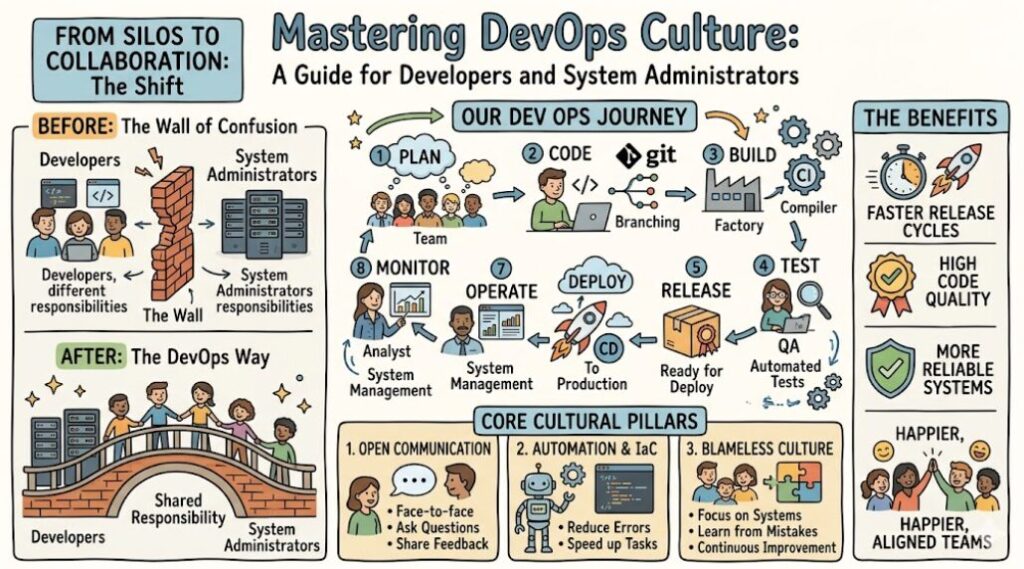
At its core, DevOps culture is the human side of software engineering. It is the practice of breaking down the traditional walls between the people who write code and the people who maintain it.
Think of it as a shift from “my job ends here” to “we succeed together.” It is a mindset that prioritizes empathy, transparency, and a relentless focus on the end-user. If a developer pushes code that breaks the production environment, a DevOps culture does not look for a scapegoat. Instead, it looks for the gap in the process that allowed the failure, fixes it, and ensures it does not happen again.
The Key Ingredients
- Collaboration: Actively seeking out different perspectives to solve problems.
- Shared Responsibility: Accepting that the health of the application is a team effort, not an individual burden.
- Continuous Improvement: Always looking for ways to make the process smoother, faster, and more reliable.
Why DevOps Culture Matters in Modern Engineering
Modern software engineering is fast-paced. Requirements change, cloud services evolve, and users demand instant reliability. If your team operates in silos—where developers throw code over a wall to an operations team—you will inevitably face bottlenecks.
DevOps culture matters because it creates a safety net for innovation. When teams collaborate, they identify security flaws earlier, catch bugs faster, and reduce the time it takes to get features into the hands of users. This is not just about efficiency; it is about building software that actually works and improves the lives of those using it.
Example in the Workplace
Consider a scenario where an application crashes during a high-traffic sale. In a traditional environment, the developers might blame the server config, while the operations team blames the code. In a DevOps culture, the team acts as one unit. They immediately look at the monitoring dashboards, correlate the crash with recent deployments, and work together to roll back or patch the issue within minutes. This speed is only possible when the culture is built on trust and shared data.
Core Principles of DevOps Culture
| Principle | Career Benefit |
| Collaboration | Builds strong cross-functional relationships and networking skills. |
| Automation | Frees up your time to focus on complex, high-value tasks. |
| Continuous Feedback | Sharpens your ability to learn from mistakes and improve. |
| Shared Ownership | Establishes your reputation as a reliable and accountable leader. |
| Learning Mindset | Keeps your skills relevant in a rapidly changing market. |
Collaboration
Collaboration is the bedrock of this culture. It is not just about meetings; it is about open communication channels. An engineer who talks to the QA team early in the design phase is far more valuable than one who hides behind a monitor.
Automation
Automation is the mechanism that allows for scale. If you are doing a task more than once, it should be automated. This requires you to move beyond manual intervention and toward building systems that manage themselves.
Continuous Feedback
This involves using metrics and monitoring to understand how your software performs in the real world. You are not guessing anymore; you are using data to drive your next move.
How DevOps Culture Impacts Your Career
If you want to move from an individual contributor to a lead, architect, or manager, you must embrace this culture. The impact on your career is tangible.
Faster Career Growth
Professionals who understand DevOps culture are viewed as problem solvers rather than ticket-closers. You start being involved in architectural discussions earlier because stakeholders trust your collaborative approach.
Cross-Functional Expertise
By working across teams—from security and development to operations—you gain a bird’s-eye view of the product lifecycle. This knowledge is invaluable for roles like SRE or Solutions Architect.
Leadership Opportunities
Leadership is not just about managing people; it is about influencing processes. By championing automation and collaboration, you naturally step into positions of influence, making you the person management turns to when they need to scale a team.
Collaboration Skills in DevOps Careers
Collaboration is often mistaken for just being “friendly.” In the context of engineering, it is a technical skill. It requires the ability to explain complex problems to non-technical stakeholders and the humility to accept feedback on your code.
Engineering Scenario
Imagine you are building a new deployment pipeline. Instead of building it in isolation, you reach out to the security team to understand their compliance requirements first. By doing this, you avoid having your pipeline rejected later. That is collaboration as a competitive advantage. It saves time and builds professional political capital.
Automation Mindset and Career Growth
The automation mindset is about looking at every manual task as a technical debt. If you are manually patching servers or copy-pasting configurations, you are not using your brain to its full potential.
Practical Productivity
When you automate a process, you are effectively creating a product. You are taking your expertise and embedding it into the system. This creates a legacy of your work that continues to provide value long after you have moved on to new projects. This is what separates an average engineer from a top-tier performer.
Ownership and Accountability in DevOps Culture
The mantra “you build it, you run it” is the ultimate test of ownership. When you are responsible for the code you deploy, you naturally write better, more maintainable, and more robust code.
Workplace Example
Think of the engineer who deploys a database migration and goes home immediately. Compare that to the engineer who stays online to ensure the metrics remain stable after the deployment. The latter displays a level of accountability that is immediately noticed by leadership. This accountability is the fastest way to earn trust.
Continuous Learning and DevOps Success
The landscape of technology changes every six months. If you rely on the knowledge you gained in college or your first job, you will become obsolete. DevOps culture fosters a “beginner’s mind,” where learning is not a chore but a daily habit.
Whether it is learning to secure a container, understanding cloud cost optimization, or mastering infrastructure-as-code, your value is tied to your ability to learn. This is why continuous improvement is not just a company goal—it is your personal insurance policy.
DevOps Culture vs Traditional IT Culture
| Area | Traditional IT | DevOps Culture |
| Collaboration | Siloed, team-specific knowledge. | Open, shared knowledge across teams. |
| Delivery Speed | Slow, prone to release friction. | Rapid, consistent, and automated. |
| Accountability | Blame-driven (“not my fault”). | Ownership-driven (“how do we fix this?”). |
| Learning | Stagnant, based on legacy processes. | Constant, based on feedback loops. |
| Feedback | Reactive (post-mortem only). | Proactive (real-time monitoring). |
Real-World Example: Engineer Without DevOps Culture
Consider Alex, a developer who is brilliant at writing code. Alex is fast, writes clean syntax, and never misses a deadline. However, Alex treats the operations team as an annoyance, views documentation as a waste of time, and ignores the security implications of his dependencies.
When a bug hits production, Alex is nowhere to be found, claiming, “I wrote the code; the ops team manages the server.” Over time, Alex’s code becomes brittle, team members avoid working with him, and his career stagnates because he has not learned how to scale himself or his work.
Real-World Example: Engineer With DevOps Culture
Now consider Sam. Sam writes good code but always documents the “why” behind his logic. When he builds a feature, he collaborates with the QA and SRE teams to ensure the release plan is solid. When a production issue happens, Sam is the first to open the logs and help the team diagnose the root cause, not to place blame, but to solve the issue.
Sam is known as a reliable partner. Because of this culture, Sam is offered leadership opportunities, asked to mentor juniors, and is often the first person considered for promotions. Sam understands that his success is tied to the success of the whole team.
Soft Skills That Matter in DevOps Culture
- Communication: Can you articulate the value of a technical change to a project manager?
- Teamwork: Do you elevate the performance of those around you?
- Problem-solving: Do you seek root causes or just symptom relief?
- Adaptability: Are you comfortable changing course when data suggests it?
- Ownership: Do you treat the company’s goals as your own?
Common Beginner Misunderstandings
- “DevOps is only tools.” False. Tools are the vehicle, not the destination.
- “Culture does not matter if I code well.” False. Technical skills get you hired; soft skills get you promoted.
- “Automation will replace me.” False. Automation allows you to work on higher-level, more rewarding problems.
- “Only DevOps Engineers need this.” False. Every developer and system admin needs this mindset to remain competitive.
Best Practices to Build a DevOps Mindset
- Ask Questions: Do not just execute tasks. Ask why the process exists.
- Practice Automation: Start by automating your smallest, most repetitive daily task.
- Build Relationships: Shadow someone from a different department (e.g., Security or QA) for a day.
- Share Knowledge: Write documentation for the things you learn.
- Stay Curious: Follow trends, read engineering blogs, and keep your toolset updated.
Role of Leadership in DevOps Culture
Leadership sets the tone. If managers value “firefighting” over “preventative engineering,” the team will never adopt a DevOps culture. Leaders must empower their teams by allowing them to fail fast in safe environments, providing the time for learning, and rewarding collaboration over individual heroics.
Role of DevOpsSchool in Building DevOps Skills and Culture
Building a career in this field requires more than reading articles; it requires structured guidance and practical application. DevOpsSchool supports this journey by offering environments where you can practice CI/CD, understand cloud infrastructure, and learn the collaborative practices that define this culture. By engaging with these resources, you transition from someone who just knows the theory to someone who has actually applied the engineering mindset in a real-world context.
Career Opportunities Influenced by DevOps Culture
- DevOps Engineer: Bridging development and operations.
- Cloud Engineer: Managing scalable infrastructure.
- SRE (Site Reliability Engineer): Focusing on uptime and reliability.
- Platform Engineer: Building internal tools for other developers.
- Automation Engineer: Specializing in process optimization.
- Engineering Leader: Managing teams and culture.
Industries Benefiting from DevOps Culture
- Banking & Finance: Where security and reliability are non-negotiable.
- Healthcare: Where data integrity and uptime save lives.
- SaaS Platforms: Where rapid feature delivery is a competitive advantage.
- E-Commerce: Where performance directly correlates to revenue.
- Telecom: Where massive scale and automation are essential.
Future of DevOps Culture
The future is shifting toward “Platform Engineering” and AI-assisted operations. The fundamental principle—collaboration and shared responsibility—remains unchanged. As AI begins to handle more of the manual tasks, the value of the human engineer will shift toward system architecture, strategic thinking, and fostering the cultural environment that allows technology to thrive.
FAQs
- What is DevOps culture exactly?It is a collaborative work style that removes silos between teams, focusing on shared responsibility and continuous improvement.
- Why does DevOps culture matter for my career?It accelerates your growth, makes you a more effective team player, and prepares you for leadership roles.
- Can beginners learn DevOps culture?Yes. It is a mindset that can be cultivated by anyone willing to prioritize collaboration and learning.
- Is DevOps only about automation tools?No, tools enable the culture, but the culture is about how people interact and work together.
- What skills matter most in this culture?Communication, adaptability, ownership, and a deep understanding of the entire product lifecycle.
- Does DevOps culture help career growth?Absolutely, as it builds the soft skills and architectural thinking required for senior and leadership positions.
- Is collaboration important in DevOps?It is the foundation. Without it, you are just working in a different, more technical silo.
- How can I develop a DevOps mindset?Start by automating small tasks, talking to other teams, and focusing on the “why” behind your work.
- Do developers need DevOps culture?Yes. It helps developers write code that is easier to deploy, monitor, and maintain.
- Does DevOps culture increase productivity?Yes, by removing friction, reducing manual errors, and speeding up feedback loops.
- Is it only for large enterprises?No, teams of any size benefit from shared ownership and automated processes.
- How do I handle team friction in a DevOps transition?Focus on empathy, clearly communicating the benefits, and leading by example.
- Is DevOps culture about SRE?SRE is a specific way to implement DevOps principles, but the culture itself is broader.
- What is the biggest challenge?Changing human behavior and overcoming the “this is how we have always done it” mentality.
- Where should I start my learning journey?Focus on mastering one domain, like cloud or CI/CD, while actively seeking collaboration opportunities at work.
Final Thoughts
Technical skills are your currency, but your cultural mindset is your investment strategy. You can spend your career focusing solely on the “next big framework,” or you can develop the habits, collaboration skills, and engineering maturity that define a true DevOps professional.
When you start taking ownership, automating the mundane, and looking for ways to support your teammates, you stop being just another engineer. You become the engineer that teams rely on, that leadership values, and that consistently moves forward. Culture is not just a company buzzword; it is the most reliable path to a successful and fulfilling career in modern technology. Start building that mindset today.