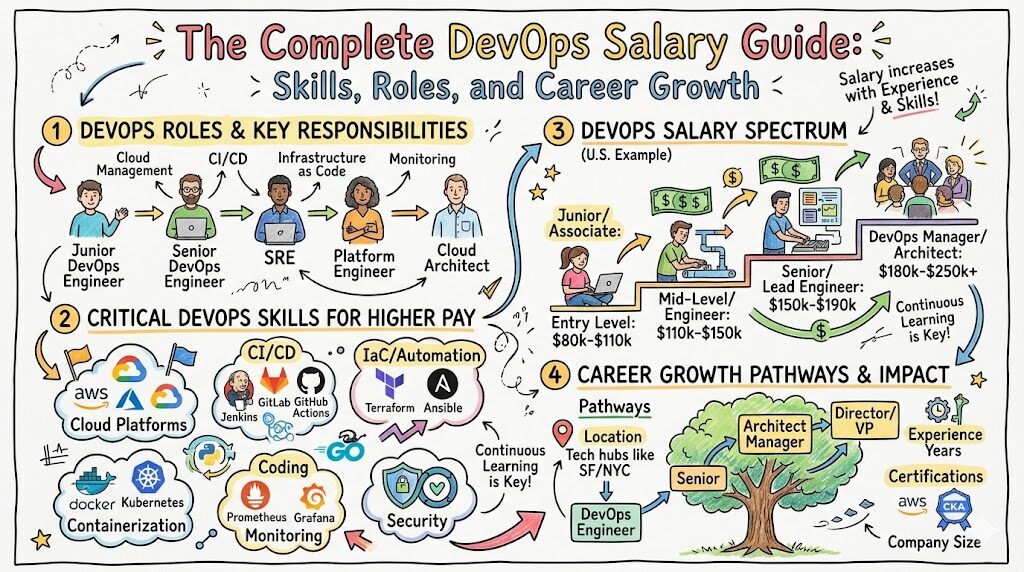
The landscape of modern IT has shifted, making DevOps salary growth a significant topic for professionals across the globe. As organizations increasingly rely on cloud infrastructure, automated delivery, and resilient systems, the value of professionals who can bridge the gap between development and operations has risen sharply. This isn’t just about market trends; it’s about the tangible business value generated by minimizing downtime, accelerating product delivery, and securing infrastructure.
DevOps salary potential is often tied to business risk. When your technical work directly impacts revenue, system uptime, and regulatory compliance, your compensation ceiling changes. Companies are now looking for more than just tool operators; they are seeking reliability engineers and platform architects who understand the full lifecycle of a service. This evolution in roles means that compensation is moving away from generic technical tasks and toward measurable outcomes like platform adoption, cost management, and system resilience.
Understanding where you fit in this ecosystem—and how to move toward higher-value roles—is essential. Whether you are a fresh entrant or a seasoned engineer looking to transition, navigating the DevOps salary landscape requires a focus on high-impact skills. This guide breaks down the data, clarifies role expectations, and provides a roadmap for those looking to scale their career and earnings in this competitive field.
Why DevOps Salaries Are High
The demand for high compensation in this field is driven by several critical factors that impact the bottom line of modern businesses:
- Cloud Adoption: As companies migrate to complex, multi-region cloud setups, the demand for experts who can manage landing zones, identity patterns, and infrastructure delivery has exploded.
- Automation Demand: Automation is the baseline. Organizations need professionals who can reduce toil, shrinking manual operational queues and creating self-service workflows.
- Reliability and SRE: The rise of Site Reliability Engineering (SRE) reflects a shift toward measuring success via Service Level Objectives (SLOs) and error budgets.
- Security Integration: The shift toward DevSecOps—integrating security controls and policy-as-code directly into the pipeline—creates a high premium for those who can enable security without slowing down development.
- FinOps and Cost Engineering: With cloud bills becoming a major enterprise expense, those who can optimize unit costs and capacity economics are increasingly valuable.
Who Should Read This Guide
This guide is designed for professionals looking to understand the mechanics behind DevOps salary growth, including:
- Freshers entering the field
- Developers moving into operations
- System administrators transitioning to cloud environments
- Automation engineers
- Site Reliability Engineers (SRE)
- Platform engineers
- DevSecOps professionals
DevOps Salary Overview
DevOps salary trends are currently fragmenting into three distinct market segments. Understanding these segments helps you align your career strategy with your earning goals:
- Product-Focused/Big Tech: These organizations often include equity-heavy compensation packages. Roles here are frequently mapped to software engineering ladders, emphasizing architecture and distributed systems.
- Enterprise/Regulated: These companies often provide bonus-heavy compensation structures. The focus is on governance, security, and stability.
- Services/Outsourcing: These environments are often rate-card driven, where operational efficiency and reliability are key indicators for career growth.
DevOps Salary by Experience Level
The table below outlines how experience impacts your professional progression and scope of work.
| Experience Level | Typical Roles | Skills Expected | Salary Growth Potential | Career Scope |
| Fresher | Junior Ops/Support | Task execution, basic scripting, monitoring | Baseline | Skill building |
| Mid-Level | DevOps Engineer | Independent pipeline/infra delivery | Moderate | System ownership |
| Senior | Senior Engineer | Design, mentorship, incident management | High | Architecture influence |
| Lead/Staff | Lead/Staff Engineer | Cross-team strategy, reliability design | Very High | Organizational direction |
| Architect | Platform Architect | Org-wide standards, platform product ownership | Highest | Technical authority |
Highest Paying DevOps Roles
Different designations carry different premiums based on the complexity and scope of the work.
| Role | Main Focus | Difficulty Level | Salary Potential |
| DevOps Engineer | CI/CD, Infra automation | Moderate | Baseline |
| SRE Engineer | SLOs, reliability, toil reduction | High | +0–15% |
| Platform Engineer | Internal platforms, developer experience | High | +5–20% |
| DevSecOps Engineer | Security policy, pipeline security | High | +10–30% |
| Security Platform Engineer | Scalable security controls | Very High | +15–35% |
| FinOps / Cost Engineer | Unit cost, capacity governance | Moderate/High | +5–25% |
DevOps Salary by Skills
Salary growth is not merely about accumulating tools; it is about applying them to business-critical outcomes. The following skill areas significantly influence potential:
- Platform Engineering: Moving from pipeline implementation to building internal developer platforms.
- Reliability Engineering: Utilizing SLOs, error budgets, and incident command processes.
- Security: Implementing policy-as-code and secrets management.
- Cost Engineering: Managing cloud unit costs and governance.
- Architecture: Designing distributed systems and multi-region infrastructure.
Note: Mastering these skills is more impactful than certification collection alone.
DevOps Salary by Country or Region
The following table provides a snapshot of base salary trends across select regions to illustrate market variance.
| Country | DevOps Engineer (Median) | SRE (Median) | Platform Engineer (Median) | DevSecOps (Median) |
| United States | $115,072 | $124,278 | $128,881 | $135,785 |
| Canada | $83,417 | $90,091 | $93,427 | $98,432 |
| France | €80,510 | €86,951 | €90,172 | €95,002 |
| India | $23,030 | $24,873 | $25,794 | $27,176 |
| Singapore | $89,149 | $96,281 | $99,847 | $105,196 |
DevOps Salary by Company Type
Where you work affects your DevOps salary growth trajectory:
- Startups: Offer rapid learning exposure and high equity potential, though they may have limited formal laddering.
- Product Companies: Often provide structured leveling and clear paths for senior individual contributors.
- MNCs/Enterprise: Tend to provide stability, competitive base pay, and clear promotional bands, often with a focus on governance.
- Cloud-Native Companies: These organizations usually treat the platform as a product, offering pay structures similar to software engineering.
Factors That Affect DevOps Salary
- Scope of Responsibility: Professionals who design systems with decision-making authority command higher pay than those who only execute tasks.
- Reliability Ownership: Tying work to SLOs, uptime, and incident response increases your value.
- Specialization: Niche skills like security platform engineering or cost governance are currently high-premium areas.
- Communication: The ability to lead incidents and communicate strategy across teams is a key differentiator for senior roles.
- Project Impact: Tangible outcomes, such as reduced cloud bills or increased platform adoption, are strong negotiation points.
Best Skills for High DevOps Salary
A structured approach to skill acquisition helps maximize growth:
- Foundational: Linux fundamentals, basic networking, and scripting (Shell/Python).
- Core Delivery: CI/CD pipeline implementation and infrastructure automation.
- Advanced Growth: Kubernetes architecture, GitOps workflows, and observability (telemetry/tracing).
- Specialized: DevSecOps (policy-as-code) and FinOps (cost governance).
Real-World Career Scenarios
- The Transitioning Developer: Developers who learn infrastructure and reliability engineering can pivot to Platform or SRE roles, often bypassing traditional ops entry-level salary tiers.
- The System Administrator: Focusing on cloud landing zones and automation allows sysadmins to evolve into Cloud or DevOps Engineers, shifting the focus from manual server management to scalable automation.
- The SRE Pivot: Moving from pure “alert response” to “reliability engineering” (SLOs and design reviews) is a proven way to increase compensation and influence.
Common Mistakes That Reduce Salary Growth
- Over-Indexing on Tools: Learning tools without understanding the underlying architectural patterns or reliability goals.
- Ignoring Cost/Security: Failing to understand how infrastructure choices impact the company’s cloud bill or security posture.
- Avoiding Platform Thinking: Viewing work as “ticket-based” tasks rather than “product-based” internal platform improvements.
- Lack of Communication: Neglecting the soft skills required to lead incidents or mentor team members.
Hands-On Projects to Increase Salary Opportunities
To demonstrate your value, build projects that mirror real-world business challenges:
- Platform Development: Build an internal self-service developer portal.
- Reliability Setup: Implement SLO monitoring and automated incident response triggers.
- Secure Pipelines: Create a pipeline that enforces security policies as code.
- Cost Optimization: Develop a system to track and optimize multi-cloud resource usage.
Career Roadmap for Better Salary Growth
- Phase 1 (Foundations): Focus on Linux, Git, and automated deployment basics.
- Phase 2 (Intermediate): Move into infrastructure automation (Terraform) and cloud fundamentals.
- Phase 3 (Advanced): Master Kubernetes, observability, and platform engineering principles.
- Phase 4 (Strategic): Focus on DevSecOps, cost engineering, and system design.
FAQs
Is DevOps a high-paying career?
Yes, it is highly competitive, especially when your skills move beyond basic maintenance into platform engineering, reliability, and security.
Which DevOps skill gives the highest salary?
Skills that directly reduce business risk or cost—such as Security Platform Engineering, FinOps, and SRE/reliability design—typically command the highest premiums.
Does certification increase salary?
Certifications are often treated as a baseline for eligibility. Your salary growth is primarily driven by your ability to deliver complex projects and demonstrate organizational impact.
How long does it take to become a high-earning DevOps engineer?
Growth depends on your ability to master operational complexity. The transition from task-based work to designing scalable systems is the primary catalyst for compensation increases.
Final Recommendation
To grow your career and your earnings, focus on real-world outcomes rather than just gathering tools or certifications. The most successful professionals are those who treat their infrastructure as a product, their reliability as a standard, and their cost-efficiency as a priority. Start by mastering the foundations, but continuously look for ways to tie your technical output to the business goals of reliability, security, and efficiency. Continual learning and a focus on solving high-value problems are the most reliable paths to long-term career growth.