Introduction
Recommendation system toolkits help teams build models that suggest products, content, people, or actions based on user behavior and item similarity. They matter because most digital products now compete on personalization, not just features. A good recommender improves conversion, watch time, retention, and customer satisfaction by reducing the effort users spend searching. Common use cases include product recommendations in e-commerce, movie or music suggestions, news feed ranking, job and candidate matching, learning content personalization, and next-best-action suggestions in customer support. When choosing a toolkit, evaluate algorithm coverage (collaborative filtering, ranking, deep learning), offline and online evaluation support, scalability, training speed, data pipeline compatibility, deployment options, interpretability, monitoring patterns, extensibility, community maturity, and how well it fits your existing ML stack.
Best for: data scientists, ML engineers, analytics teams, and product teams building personalization features for e-commerce, media, marketplaces, learning platforms, and SaaS products.
Not ideal for: very small apps that only need rule-based suggestions, or teams without enough interaction data to train meaningful models; in those cases, curated lists, search improvements, or simple heuristics may deliver better ROI.
Key Trends in Recommendation System Toolkits
- Increasing shift from pure collaborative filtering toward ranking and retrieval pipelines
- Two-stage recommenders becoming standard: candidate generation followed by re-ranking
- More use of embeddings and vector search for retrieval-based recommendations
- Wider adoption of deep learning and sequence-based models for session and next-item prediction
- Growing focus on responsible recommendations: bias, fairness, and explainability checks
- Better offline-to-online alignment using counterfactual evaluation ideas (implementation varies)
- More emphasis on monitoring drift, feedback loops, and real-time feature freshness
- Hybrid recommenders combining rules, content signals, and behavioral signals for robustness
- Toolkits integrating more tightly with modern data stacks and feature store patterns
- Scalable training and distributed inference becoming common even for mid-size teams
How We Selected These Tools (Methodology)
- Selected widely recognized toolkits used in research and real-world production settings
- Prioritized breadth of algorithms and the ability to build end-to-end recommender pipelines
- Considered maturity signals such as community adoption, maintenance, and documentation depth
- Looked for scalability options: GPU support, distributed training patterns, and efficient retrieval
- Evaluated extensibility: modular design, custom loss functions, and custom model support
- Included a balanced mix of deep learning frameworks, classic recommender libraries, and toolkit-style stacks
- Considered ease of prototyping versus production readiness across different team sizes
- Focused on tools that support evaluation workflows and repeatable experiments
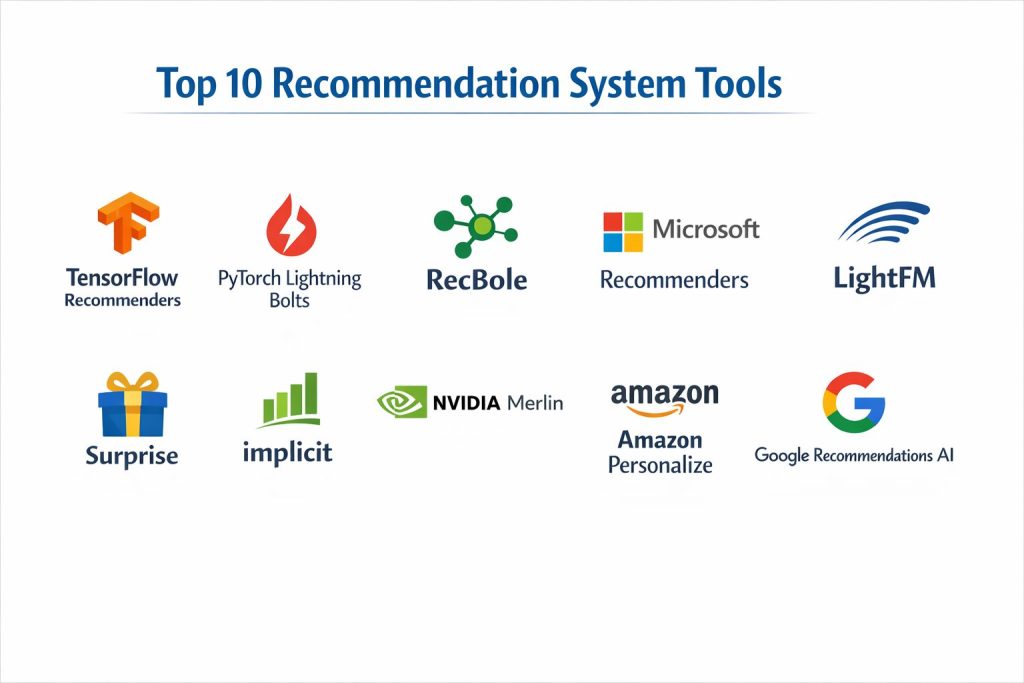
Top 10 Recommendation System Toolkits
1) TensorFlow Recommenders
A toolkit built for creating end-to-end recommendation models using a flexible deep learning workflow. Strong fit for teams building retrieval and ranking models within a TensorFlow-centric stack.
Key Features
- Supports retrieval and ranking workflows for common recommender patterns
- Modular model building for two-tower and ranking architectures
- Works well with embedding-based candidate generation approaches
- Flexible loss functions and training loops for experimentation
- Compatible with scalable training patterns when infrastructure supports it
- Helpful utilities for evaluation and model structuring
- Extensible for custom features and model components
Pros
- Strong for teams already using TensorFlow and embedding workflows
- Good structure for building two-stage recommenders
Cons
- Requires ML engineering comfort and thoughtful pipeline design
- Productionization depends heavily on your broader serving stack
Platforms / Deployment
- Web / Windows / macOS / Linux
- Self-hosted
Security & Compliance
- SSO/SAML, MFA, encryption, audit logs, RBAC: Varies / N/A
- SOC 2, ISO 27001, GDPR, HIPAA: Not publicly stated
Integrations & Ecosystem
Fits into TensorFlow pipelines and common data processing patterns for training and serving.
- Works with common data pipelines and feature workflows: Varies / N/A
- Integrates with broader TensorFlow ecosystem tooling
- Supports custom layers and model components
- Interoperability with other ML tools: Varies / N/A
Support & Community
Strong community support due to TensorFlow ecosystem; documentation quality is generally good, but production guidance varies by use case.
2) PyTorch Lightning Bolts
A collection of research-driven components and templates that can help prototype recommendation-style models quickly in a PyTorch-friendly workflow. Best for experimentation and rapid iteration.
Key Features
- Reusable training templates that accelerate prototyping
- Works well with GPU training patterns in PyTorch environments
- Helpful for testing new architectures and losses quickly
- Cleaner separation of training code and model code
- Supports modular experimentation across model variants
- Practical for research-to-prototype workflows
- Can be adapted to recommender pipelines with engineering effort
Pros
- Speeds up experiments for PyTorch-centric teams
- Good for prototyping new ideas and baselines
Cons
- Not a full recommendation platform or complete pipeline toolkit
- Production patterns depend on what your team builds around it
Platforms / Deployment
- Windows / macOS / Linux
- Self-hosted
Security & Compliance
- SSO/SAML, MFA, encryption, audit logs, RBAC: Varies / N/A
- SOC 2, ISO 27001, GDPR, HIPAA: Not publicly stated
Integrations & Ecosystem
Works best inside the PyTorch ecosystem and modern ML experiment workflows.
- Integrates with common tracking and logging tools: Varies / N/A
- Works with Python data tooling and GPU training stacks
- Extensible for custom data modules and model architectures
- Pipelines for serving: Varies / N/A
Support & Community
Community-driven support; documentation and stability vary by component, so teams should validate carefully.
3) RecBole
A research-friendly recommendation library with many algorithms and standardized evaluation. Strong fit for teams that want fast benchmarking and a consistent experiment structure.
Key Features
- Large collection of recommendation algorithms across families
- Standardized training and evaluation for fair comparison
- Config-driven experiments that reduce boilerplate code
- Useful support for sequential and session-based models (varies by setup)
- Built-in dataset handling patterns and evaluation routines
- Helpful baseline generation for new projects
- Extensible for custom models and losses
Pros
- Excellent for benchmarking and rapid iteration
- Strong structure for comparative experiments and reproducibility
Cons
- Production deployment patterns often require custom engineering
- Data pipeline integration may need adaptation for real systems
Platforms / Deployment
- Windows / macOS / Linux
- Self-hosted
Security & Compliance
- SSO/SAML, MFA, encryption, audit logs, RBAC: Varies / N/A
- SOC 2, ISO 27001, GDPR, HIPAA: Not publicly stated
Integrations & Ecosystem
Often used in research and internal evaluation pipelines, then exported into a production stack.
- Compatible with common Python ML tooling
- Config-based experiment management
- Model export and serving integration: Varies / N/A
- Extensible with custom modules
Support & Community
Active community in research circles; documentation is generally solid for experimentation workflows.
4) Microsoft Recommenders
A practical toolkit that provides best-practice examples, utilities, and reference implementations for building recommenders. Useful for teams that want proven patterns and structured guidance.
Key Features
- Reference implementations for common recommender approaches
- Evaluation utilities and metrics for offline testing
- Practical notebooks and workflow patterns for data teams
- Covers both classic and modern approaches (coverage varies by module)
- Helpful templates for data preparation and modeling steps
- Integrates well with common Python ML libraries
- Good starting point for teams building first recommender systems
Pros
- Practical guidance with reusable building blocks
- Good learning and implementation resource for teams new to recommenders
Cons
- Not a single unified framework; feels more like a toolkit collection
- Production readiness depends on how you package and serve models
Platforms / Deployment
- Windows / macOS / Linux
- Self-hosted
Security & Compliance
- SSO/SAML, MFA, encryption, audit logs, RBAC: Varies / N/A
- SOC 2, ISO 27001, GDPR, HIPAA: Not publicly stated
Integrations & Ecosystem
Pairs well with common Python ML stacks and standard experimentation tooling.
- Integrates with popular ML libraries and data processing tools
- Supports evaluation workflows and reproducible experiments
- Serving integrations depend on your stack: Varies / N/A
Support & Community
Strong community visibility; documentation is useful for practitioners, though depth varies across modules.
5) LightFM
A lightweight library for hybrid recommendation that can combine collaborative and content-based signals. Good for teams that need a practical baseline quickly.
Key Features
- Hybrid matrix factorization style recommenders
- Can incorporate item and user metadata features
- Efficient baseline building for common recommendation tasks
- Suitable for smaller-to-mid datasets in many cases
- Straightforward training workflow and evaluation patterns
- Useful when you need a fast, interpretable baseline
- Practical for cold-start improvements compared to pure CF
Pros
- Easy to use and fast to prototype
- Good hybrid baseline when metadata is available
Cons
- Limited compared to deep learning toolkits for complex ranking problems
- Scaling to very large datasets may require alternative approaches
Platforms / Deployment
- Windows / macOS / Linux
- Self-hosted
Security & Compliance
- SSO/SAML, MFA, encryption, audit logs, RBAC: Varies / N/A
- SOC 2, ISO 27001, GDPR, HIPAA: Not publicly stated
Integrations & Ecosystem
Works well in Python-based data pipelines and can be paired with simple serving patterns.
- Integrates with Python data stacks
- Exports predictions and embeddings for downstream usage
- Monitoring and online serving: Varies / N/A
Support & Community
Smaller community than major deep learning toolkits, but clear usage patterns and stable baseline value.
6) Surprise
A classic Python library focused on collaborative filtering and rating prediction. Great for teaching, experimentation, and building a baseline quickly.
Key Features
- Many classic CF algorithms for rating prediction
- Easy dataset handling and evaluation workflows
- Simple API for training and testing recommenders
- Useful baselines for matrix factorization approaches
- Strong for educational and proof-of-concept work
- Supports quick model comparisons within its algorithm family
- Lightweight and straightforward to run
Pros
- Very easy to start with for classic recommenders
- Useful for baseline comparisons and learning
Cons
- Not designed for modern large-scale ranking pipelines
- Limited support for deep learning and sequence recommenders
Platforms / Deployment
- Windows / macOS / Linux
- Self-hosted
Security & Compliance
- SSO/SAML, MFA, encryption, audit logs, RBAC: Varies / N/A
- SOC 2, ISO 27001, GDPR, HIPAA: Not publicly stated
Integrations & Ecosystem
Often used as a baseline library inside a broader analytics or ML workflow.
- Integrates with Python analytics stacks
- Works with common evaluation workflows
- Production serving: Varies / N/A
Support & Community
Well-known in learning contexts; community resources exist, but it is not a modern production-first toolkit.
7) implicit
A library optimized for implicit feedback recommendation using matrix factorization methods. Good for teams working with clicks, views, and purchases rather than explicit ratings.
Key Features
- Strong support for implicit feedback matrix factorization approaches
- Efficient training implementations suited for larger interaction datasets
- Useful for candidate generation workflows and baseline embedding models
- Works well for item-item similarity and factor models (workflow dependent)
- Simple APIs for fitting and retrieving recommendations
- Can serve as a fast first stage in a two-stage pipeline
- Practical performance for many real datasets
Pros
- Good performance for implicit feedback problems
- Useful for scalable baselines and candidate generation
Cons
- Not a complete end-to-end ranking toolkit
- Complex feature-rich ranking requires additional tools
Platforms / Deployment
- Windows / macOS / Linux
- Self-hosted
Security & Compliance
- SSO/SAML, MFA, encryption, audit logs, RBAC: Varies / N/A
- SOC 2, ISO 27001, GDPR, HIPAA: Not publicly stated
Integrations & Ecosystem
Often used to generate candidates or embeddings, then paired with a separate ranking model.
- Integrates with Python data pipelines
- Produces embeddings and similarity outputs for downstream ranking
- Online serving patterns: Varies / N/A
Support & Community
Solid practitioner community for implicit feedback use cases; documentation is practical but assumes ML knowledge.
8) NVIDIA Merlin
A toolkit for building large-scale recommendation systems with GPU acceleration. Best for teams dealing with large datasets and needing high throughput training and inference.
Key Features
- GPU-accelerated pipelines for training and inference (in supported environments)
- Supports scalable deep learning recommendation workflows
- Tools for data processing and feature handling patterns (workflow dependent)
- Designed for performance and throughput in production-like settings
- Useful for large-scale retrieval and ranking pipelines
- Helps reduce time-to-train for large interaction datasets
- Integrates into ML ops patterns with engineering effort
Pros
- Strong performance when GPU infrastructure is available
- Good fit for large-scale recommender workloads
Cons
- Heavier setup and infrastructure requirements
- Overkill for small datasets and lightweight recommendation needs
Platforms / Deployment
- Linux (others: Varies / N/A)
- Self-hosted
Security & Compliance
- SSO/SAML, MFA, encryption, audit logs, RBAC: Not publicly stated
- SOC 2, ISO 27001, GDPR, HIPAA: Not publicly stated
Integrations & Ecosystem
Designed to integrate with GPU and deep learning ecosystems for scalable recommender pipelines.
- Integrates with GPU data processing stacks: Varies / N/A
- Supports deep learning frameworks and feature pipelines: Varies / N/A
- Serving integration depends on stack: Varies / N/A
Support & Community
Strong vendor-backed ecosystem, but requires experienced ML engineering teams to use effectively.
9) Amazon Personalize
A managed recommendation service that helps teams build and deploy recommenders without maintaining the full modeling stack. Useful for teams that want speed-to-production with less infrastructure burden.
Key Features
- Managed training and deployment workflows for recommendations
- Handles common recommendation scenarios through templates (capability varies)
- Supports real-time style recommendation APIs (implementation dependent)
- Reduces the need to manage training infrastructure directly
- Built-in patterns for personalization and item ranking use cases
- Can speed up launch time for teams without deep ML ops resources
- Operational burden is lower compared to full self-built stacks
Pros
- Faster route to production for many teams
- Reduces infrastructure and operations complexity
Cons
- Less model transparency and tuning freedom than self-built toolkits
- Costs and performance depend on usage pattern and data volume
Platforms / Deployment
- Cloud
- Cloud
Security & Compliance
- SSO/SAML, MFA, encryption, audit logs, RBAC: Not publicly stated
- SOC 2, ISO 27001, GDPR, HIPAA: Not publicly stated
Integrations & Ecosystem
Often integrates through event ingestion and output APIs into product systems.
- Data ingestion integration: Varies / N/A
- Event tracking integration: Varies / N/A
- Downstream serving integration into apps: Varies / N/A
- Export and portability: Varies / N/A
Support & Community
Support depends on service plan; community resources exist but are more implementation-focused than algorithm-focused.
10) Google Recommendations AI
A managed recommendation service aimed at helping teams deploy personalization faster with less ML infrastructure. Often used when teams want a cloud-first approach with product integration patterns.
Key Features
- Managed recommendation workflows with service-driven deployment
- Supports common recommendation use cases (capability varies)
- Handles training and serving within the managed environment
- Helps teams launch personalization features with reduced ops burden
- Designed for integration into product experiences via APIs (workflow dependent)
- Often used for retail and content scenarios (use case dependent)
- Provides operational scaling through managed infrastructure
Pros
- Reduces infrastructure and operational overhead
- Can accelerate production rollout for suitable use cases
Cons
- Less control over modeling internals and tuning details
- Cost and fit depend on usage pattern and data readiness
Platforms / Deployment
- Cloud
- Cloud
Security & Compliance
- SSO/SAML, MFA, encryption, audit logs, RBAC: Not publicly stated
- SOC 2, ISO 27001, GDPR, HIPAA: Not publicly stated
Integrations & Ecosystem
Typically integrates through event ingestion, catalog feeds, and serving endpoints into product systems.
- Data ingestion and event pipelines: Varies / N/A
- Integration into web and app products: Varies / N/A
- Export and portability: Varies / N/A
- Monitoring and governance: Varies / N/A
Support & Community
Support depends on plan; adoption is common in cloud-first organizations, but guidance varies by use case.
Comparison Table (Top 10)
| Tool Name | Best For | Platform(s) Supported | Deployment (Cloud/Self-hosted/Hybrid) | Standout Feature | Public Rating |
|---|---|---|---|---|---|
| TensorFlow Recommenders | Deep learning recommenders in TensorFlow stacks | Web, Windows, macOS, Linux | Self-hosted | Retrieval and ranking workflows | N/A |
| PyTorch Lightning Bolts | Rapid prototyping in PyTorch environments | Windows, macOS, Linux | Self-hosted | Experiment templates and structure | N/A |
| RecBole | Benchmarking many recommender algorithms | Windows, macOS, Linux | Self-hosted | Config-driven evaluation and baselines | N/A |
| Microsoft Recommenders | Practical patterns and reference implementations | Windows, macOS, Linux | Self-hosted | Best-practice toolkit collection | N/A |
| LightFM | Hybrid recommenders with metadata signals | Windows, macOS, Linux | Self-hosted | Simple hybrid matrix models | N/A |
| Surprise | Classic collaborative filtering baselines | Windows, macOS, Linux | Self-hosted | Fast classic CF experimentation | N/A |
| implicit | Implicit feedback factorization and candidates | Windows, macOS, Linux | Self-hosted | Efficient implicit feedback training | N/A |
| NVIDIA Merlin | Large-scale GPU recommender pipelines | Linux (others: Varies / N/A) | Self-hosted | GPU acceleration at scale | N/A |
| Amazon Personalize | Managed recommendations with low ops burden | Cloud | Cloud | Faster path to production | N/A |
| Google Recommendations AI | Managed personalization in cloud-first setups | Cloud | Cloud | Managed training and serving | N/A |
Evaluation & Scoring of Recommendation System Toolkits
Weights: Core features 25%, Ease 15%, Integrations 15%, Security 10%, Performance 10%, Support 10%, Value 15%.
| Tool Name | Core (25%) | Ease (15%) | Integrations (15%) | Security (10%) | Performance (10%) | Support (10%) | Value (15%) | Weighted Total (0–10) |
|---|---|---|---|---|---|---|---|---|
| TensorFlow Recommenders | 8.8 | 7.2 | 8.0 | 6.0 | 8.2 | 7.5 | 7.5 | 7.82 |
| PyTorch Lightning Bolts | 7.2 | 7.5 | 7.0 | 5.5 | 7.5 | 6.8 | 8.0 | 7.19 |
| RecBole | 8.2 | 7.0 | 7.2 | 5.5 | 7.5 | 7.2 | 8.2 | 7.59 |
| Microsoft Recommenders | 7.8 | 7.2 | 7.5 | 5.8 | 7.2 | 7.0 | 8.0 | 7.48 |
| LightFM | 6.8 | 8.0 | 6.5 | 5.5 | 6.8 | 6.5 | 8.8 | 7.24 |
| Surprise | 6.5 | 8.5 | 6.2 | 5.5 | 6.5 | 6.8 | 9.0 | 7.23 |
| implicit | 7.5 | 7.5 | 6.8 | 5.5 | 8.0 | 6.8 | 8.0 | 7.39 |
| NVIDIA Merlin | 8.5 | 6.5 | 7.5 | 6.0 | 9.2 | 7.2 | 6.8 | 7.63 |
| Amazon Personalize | 7.5 | 8.2 | 7.8 | 6.5 | 7.8 | 7.2 | 6.8 | 7.50 |
| Google Recommendations AI | 7.3 | 8.0 | 7.8 | 6.5 | 7.5 | 7.0 | 6.8 | 7.36 |
How to interpret the scores:
- These numbers compare tools inside this list only, not the entire market.
- A higher total suggests broader fit across many scenarios, not a universal winner.
- Ease and value can beat deep features for small teams shipping quickly.
- Security scores are conservative because public disclosures vary widely.
- Always validate results with a pilot using your real data and KPIs.
Which Recommendation System Toolkit Is Right for You?
Solo / Freelancer
If you want to learn and prototype quickly, start with Surprise or LightFM to build intuition and ship a working baseline. If you already work in deep learning, TensorFlow Recommenders or RecBole can help you build stronger retrieval and ranking models. For portfolio projects, focus on clean evaluation, simple deployment, and clear documentation of trade-offs.
SMB
Most SMB teams benefit from fast baselines and controlled complexity. LightFM and implicit are practical for interaction-heavy datasets, while Microsoft Recommenders helps teams follow proven patterns and avoid common pitfalls. If you have ML engineers and want more lift, TensorFlow Recommenders or RecBole can support stronger modeling, but plan time for feature pipelines and monitoring.
Mid-Market
Mid-market teams often need a two-stage pipeline: candidate generation plus ranking. implicit can be a strong candidate generator baseline, while TensorFlow Recommenders or RecBole can cover ranking and more complex models. If training speed becomes a bottleneck, evaluate NVIDIA Merlin if you have GPU infrastructure and enough data volume to justify it.
Enterprise
Enterprises typically care most about scalability, governance, reliability, and operational burden. NVIDIA Merlin fits well when you need large-scale GPU pipelines and have experienced ML engineering teams. Managed services like Amazon Personalize and Google Recommendations AI can reduce ops burden, but you must accept trade-offs around model transparency and portability.
Budget vs Premium
Budget-first approaches usually start with open toolkits like Surprise, LightFM, implicit, and RecBole, then graduate to deeper stacks as data and requirements grow. Premium approaches often use managed services for speed-to-production or GPU stacks for performance, but you should validate long-term cost and flexibility.
Feature Depth vs Ease of Use
If you need quick wins, pick tools with simple workflows and strong baselines like LightFM, Surprise, or Microsoft Recommenders. If you need feature depth for ranking and retrieval, TensorFlow Recommenders and RecBole provide better structure for modern recommender pipelines, but require more engineering.
Integrations & Scalability
If your product needs real-time personalization, focus on data freshness, stable inference patterns, and pipeline automation. Managed services can reduce integration burden, while self-hosted toolkits provide more control but require stronger engineering. Validate ingestion, model updates, and monitoring early.
Security & Compliance Needs
For many teams, security depends more on how you store data, restrict access, and audit pipelines than on the toolkit itself. Where compliance details are not publicly stated, treat them as unknown and align with your internal security and governance processes.
Frequently Asked Questions (FAQs)
1. What data do recommendation toolkits usually need?
Most need user-item interaction logs such as views, clicks, purchases, ratings, and search events. You can also add item metadata and user attributes, but quality and consistency matter more than volume alone.
2. How do I measure recommendation quality offline?
Common metrics include precision and recall at K, ranking metrics, and coverage. Offline results are helpful, but you should validate with online experiments because offline metrics can mislead.
3. What is the most common mistake teams make?
Building a complex model before establishing a strong baseline and a clean evaluation process. Start simple, prove lift, then add complexity only when it pays for itself.
4. Do I need deep learning for good recommendations?
Not always. Matrix factorization and hybrid baselines can perform very well, especially when data is sparse and engineering resources are limited.
5. What is a two-stage recommender pipeline?
It usually means generating a small set of candidate items first, then re-ranking those candidates with a richer model that uses more features and signals.
6. How can I handle cold-start for new users or items?
Use metadata signals, popularity priors, content similarity, and onboarding questions. Hybrid models like LightFM can help when metadata is available.
7. Should I choose a managed service or build in-house?
Managed services can reduce operational effort and speed up launch, but may limit tuning and portability. In-house stacks provide control but require ML ops maturity.
8. How often should I retrain a recommender?
It depends on product dynamics and user behavior. Many teams retrain on a regular schedule and also monitor drift to adjust retraining frequency.
9. How do I avoid feedback loops and bias?
Track diversity and fairness metrics, add exploration strategies, and monitor whether recommendations overly reinforce narrow content patterns. Evaluate changes with careful experiments.
10. What is a practical way to start?
Pick one clear use case, build a baseline with clean offline evaluation, then run a small controlled online test. Focus on data quality, monitoring, and simple iteration.
Conclusion
Recommendation system toolkits help you move from generic experiences to personalized journeys that feel relevant and timely. However, the best toolkit depends on your team skills, your data maturity, and how quickly you must ship. If you want strong deep-learning workflows for retrieval and ranking, TensorFlow Recommenders and RecBole provide a solid foundation, while classic tools like LightFM, Surprise, and implicit can deliver strong baselines with less complexity. If operational speed matters most, managed services such as Amazon Personalize and Google Recommendations AI can reduce infrastructure work, but may limit tuning freedom. A smart next step is to shortlist two or three options, build one baseline pipeline, validate offline metrics, then run a small online experiment to confirm lift before scaling.