Introduction
Picture a mid-sized software company preparing for a major system update. The developers spend weeks writing application features in isolation, handing the finished code over a wall to the system administration team for deployment. Meanwhile, the network team handles connectivity separately, and a dedicated security group reviews the infrastructure for vulnerabilities right before production release. When something breaks in production—as it inevitably does—fingers point across departmental boundaries. Developers argue that the code works on their local machines, operations blames unstable code configurations, and everyone scrambles to restore service.
This scenario illustrates the friction points of traditional IT operating models. Organizations began looking toward more collaborative, automated approaches not because traditional methods were inherently broken, but because the speed of modern software delivery demands continuous integration, rapid feedback loops, and shared operational responsibility.
Understanding how DevOps vs traditional IT roles differ helps professionals, students, and leaders navigate career growth without falling for the trap of viewing one as entirely obsolete.
What Is Traditional IT?
Traditional IT refers to structured, siloed operating models that have powered enterprises for decades. In these environments, technology management is divided into specialized domains based on distinct functional boundaries.
Key areas of traditional IT environments include:
- System Administration: Managing individual physical servers, operating systems, user accounts, and local configurations.
- Network Administration: Configuring routers, switches, firewalls, and managing static physical connectivity.
- Database Administration: Tuning, backing up, and securing relational databases manually or through scheduled maintenance windows.
- IT Support & Infrastructure Management: Handling hardware lifecycle, endpoint support, and data center maintenance.
- Security Administration: Conducting periodic compliance audits and reviewing security checklists post-development.
- Release Management: Organizing infrequent, scheduled deployment windows managed by dedicated release coordinators.
Characteristics commonly associated with traditional IT include strict role-based responsibilities, manual execution of operational tasks, formalized change control boards, and separate reporting lines for development and operations teams. These structures vary significantly across organizations based on scale and industry regulation.
What Is DevOps?
DevOps is not a single job title, tool, or software product. Instead, it represents a cultural and technical movement that combines philosophies, practices, automation, and tooling to shorten the system development life cycle while delivering high software reliability.
Important DevOps principles and practices include:
- Collaboration: Breaking down organizational silos between development, QA, security, and operations teams.
- Continuous Integration and Continuous Delivery (CI/CD): Automating code integration, testing, and delivery pipelines.
- Infrastructure as Code (IaC): Provisioning and managing infrastructure using declarative code configurations rather than manual clicking.
- Observability: Combining metrics, logs, and traces to understand deep system behavior.
- Shared Responsibility: Shifting operational ownership closer to the teams writing code while maintaining high system reliability.
Traditional IT vs DevOps: Core Differences
| Area | Traditional IT | DevOps-Oriented Approach |
| Team Structure | Highly siloed, specialized departments | Cross-functional, collaborative units |
| Responsibilities | Hand-off based, strictly bounded by role | Shared ownership from development to production |
| Deployment | Infrequent, scheduled, highly manual | Frequent, automated, continuous pipelines |
| Automation | Script-based or manual execution | Comprehensive pipeline and infrastructure automation |
| Infrastructure | Manually configured servers and hardware | Cloud-native, version-controlled Infrastructure as Code |
| Monitoring | Reactive threshold alerting (CPU, memory) | Proactive observability (metrics, logs, traces) |
| Security | Gated security reviews at the end of cycles | Integrated DevSecOps practices within CI/CD |
| Feedback | Slow feedback loops, post-incident reviews | Rapid, automated feedback loops |
System Administrator vs DevOps Engineer
Traditional System Administrator
Traditional system administrators focus heavily on server maintenance, operating system patching, manual user access provisioning, localized configuration management, hardware troubleshooting, and executing routine system backups. Their world revolves around maintaining uptime for specific physical or virtual machines.
DevOps Engineer
DevOps engineers focus on building repeatable platforms and pipelines. Their responsibilities include designing CI/CD workflows, writing Infrastructure as Code, deploying containerized workloads, managing cloud resources, configuring automated monitoring, and improving platform reliability.
Crucially, system administration knowledge remains exceptionally valuable for DevOps professionals when troubleshooting low-level kernel issues, storage allocation, or networking bottlenecks.
Traditional Network Administrator vs DevOps/Cloud Role
Traditional network administrators configure physical routing tables, manage hardware firewalls, handle DNS entries, adjust physical load balancers, and troubleshoot cabling and WAN/LAN connectivity.
Modern DevOps and cloud environments shift these tasks toward software-defined networking (SDN), cloud virtual private clouds (VPCs), automated load balancer provisioning via code, and cloud security groups. Even in these automated environments, deep networking fundamentals—such as understanding TCP/IP stacks, routing protocols, and packet flows—remain critical for diagnosing complex cloud application failures.
Traditional Developer vs DevOps-Oriented Developer
Traditional developers focus primarily on writing application logic, building features, running local unit tests, and handing packaged binaries over to operations teams for deployment.
DevOps-oriented developers take a broader view of the software lifecycle. They understand how their code moves through CI/CD pipelines, how it behaves under production load, how to instrument application metrics, and how to write secure code. However, adopting a DevOps mindset does not mean developers must become full-time infrastructure engineers.
Traditional IT Operations vs DevOps Operations
Traditional IT operations teams manage infrastructure reactively through manual ticket queues, manual server provisioning, and scheduled maintenance windows.
DevOps operations transform this approach into automated, version-controlled, and observable infrastructure. Using tools for configuration management, continuous logging, distributed tracing, and automated recovery, modern operations focus on reliability engineering rather than routine manual firefighting.
Traditional Release Management vs CI/CD
| Traditional Release Process | DevOps-Oriented CI/CD |
| Scheduled, infrequent releases (monthly/quarterly) | Continuous, on-demand automated deployments |
| Manual handoffs between QA and operations | Automated testing and quality gates in pipelines |
| Extensive manual sign-offs and change windows | Automated validation and automated rollback strategies |
While regulated industries may still require formal approval stages, CI/CD streamlines the validation process to catch bugs early.
Traditional Infrastructure vs DevOps Infrastructure
Traditional infrastructure relies on pets-not-cattle methodology: servers are manually configured, hand-tuned, and carefully nursed when they fail.
DevOps infrastructure treats servers as immutable and ephemeral. Using Infrastructure as Code, environments can be spun up, tested, destroyed, and recreated identically in minutes. This automation improves consistency, but requires rigorous version control, security governance, and automated testing.
Traditional Monitoring vs DevOps Observability
Traditional monitoring focuses on basic system health indicators: CPU utilization, available disk space, memory usage, and ping availability.
Modern observability goes deeper by correlating metrics, structured logs, and distributed traces. Observability allows engineering teams to answer unknown-unknown questions about complex distributed microservices and understand why a system is behaving unexpectedly.
Traditional Security vs DevSecOps
Traditional security practices rely on perimeter defenses, periodic manual audits, and isolated security sign-offs right before release.
DevSecOps embeds security into every stage of the software delivery lifecycle. This includes automated static code analysis (SAST), software composition analysis for open-source dependencies, container vulnerability scanning, and secure secrets management within CI/CD pipelines. DevSecOps does not eliminate dedicated security professionals; rather, it empowers all engineers to practice secure development.
Traditional IT Roles and Their DevOps Evolution
- System Administrator $\rightarrow$ DevOps / Infrastructure Engineer
- Network Administrator $\rightarrow$ Cloud / Network Automation Engineer
- Release Manager $\rightarrow$ CI/CD / Release Automation Role
- Operations Engineer $\rightarrow$ DevOps / SRE Role
- Security Administrator $\rightarrow$ DevSecOps / Cloud Security Role
- Developer $\rightarrow$ DevOps-Aware / Platform-Aware Developer
- Database Administrator $\rightarrow$ Cloud Database / Data Reliability Role
Career transitions across these paths vary widely depending on organizational maturity and individual learning goals.
DevOps vs Traditional IT Skills
- Traditional IT Skills: Operating systems, hardware, local troubleshooting, system administration, manual backups, physical networking, IT support.
- DevOps Skills: Linux internals, Git version control, CI/CD pipelines, cloud platforms, containers, Kubernetes, Infrastructure as Code, scripting languages, monitoring, and observability.
Many traditional IT skills form the essential bedrock upon which advanced DevOps practices are built.
Why Traditional IT Skills Still Matter in DevOps
Jumping straight into advanced container orchestration tools without understanding underlying fundamentals often leads to brittle architectures. Core skills such as Linux administration, DNS troubleshooting, file systems, storage configuration, networking fundamentals, and operating system kernels remain indispensable. When complex production outages occur, automated tools often fail to explain the root cause, making deep traditional troubleshooting expertise invaluable.
DevOps Roles and Responsibilities
- DevOps Engineer: Focuses on bridging development and operations through automation, CI/CD, and cloud tooling.
- Cloud Engineer: Specializes in provisioning, scaling, and securing cloud infrastructure services.
- Platform Engineer: Builds internal developer platforms to streamline application deployment for development teams.
- Site Reliability Engineer (SRE): Applies software engineering principles to operations, focusing on uptime, latency, performance, and capacity planning.
- DevSecOps Engineer: Integrates security automation, vulnerability management, and compliance checks into pipelines.
- Infrastructure Engineer: Manages foundational server, storage, and networking layers via code.
- Automation Engineer: Writes scripts and tooling to eliminate manual toil across workflows.
What Does a DevOps Engineer Actually Do?
A typical day for a DevOps engineer involves far more than maintaining pipeline YAML files. A representative workflow includes:
- Reviewing failing CI/CD pipelines and assisting developers with build errors.
- Writing or refining Infrastructure as Code modules to provision staging environments.
- Investigating production alerts, analyzing logs, and participating in incident triage.
- Implementing security patches or updating container base images.
- Collaborating with product teams to design reliable deployment strategies.
How Collaboration Changes in DevOps
DevOps redefines cross-functional collaboration by establishing shared ownership of software systems. Instead of throwing code over organizational walls, development, QA, security, and operations teams participate in joint planning, shared retrospectives, and unified incident response. This eliminates the “us versus them” mentality often found in traditional IT environments.
Automation in DevOps
Automation is a primary engine of DevOps efficiency. By automating infrastructure provisioning, testing cycles, application builds, deployment sequences, configuration management, and security scans, organizations reduce human error and eliminate repetitive toil. However, poorly designed automation can propagate errors at scale, highlighting the need for rigorous testing and peer review of automation code.
Career Transition from Traditional IT to DevOps
For professionals looking to transition from traditional IT roles into modern DevOps positions, a structured roadmap provides clarity:
- Step 1 — Strengthen Linux: Master command-line operations, file permissions, and process management.
- Step 2 — Learn Networking: Understand TCP/IP, DNS, HTTP/HTTPS, and routing fundamentals.
- Step 3 — Learn Git: Master version control workflows, branching, and merging.
- Step 4 — Learn Scripting: Pick up Python or Bash for automation tasks.
- Step 5 — Learn CI/CD: Understand build automation principles and pipeline tools.
- Step 6 — Learn Cloud: Explore major cloud service providers (AWS, Azure, or GCP).
- Step 7 — Learn Containers: Understand Docker and containerization concepts.
- Step 8 — Learn Infrastructure as Code: Practice provisioning resources using declarative tools.
- Step 9 — Learn Monitoring: Study metrics, logging, and tracing configurations.
- Step 10 — Build Practical Projects: Deploy sample multi-tier applications using automated pipelines.
- Step 11 — Learn DevSecOps and Reliability Concepts: Understand security scanning and SRE principles.
Existing IT experience gives practitioners a major advantage during this transition because they already understand how operating systems and networks behave under pressure.
Common Misconceptions About DevOps
- Misconception: DevOps is just a job title.Correction: DevOps is a cultural and operational philosophy, not a title you can simply hire.
- Misconception: DevOps means developers do everything.Correction: Developers take on operational awareness, but specialized infrastructure and security roles remain vital.
- Misconception: Kubernetes is required for every environment.Correction: Many stable systems run successfully without container orchestration.
- Misconception: DevOps eliminates all IT operations work.Correction: Operational work evolves into platform engineering, reliability engineering, and system governance.
Advantages and Challenges of DevOps
Potential Advantages
- Faster feedback loops and shorter release cycles.
- Improved cross-functional team collaboration.
- Consistent, repeatable deployments through automation.
- Enhanced system visibility and faster incident recovery.
Potential Challenges
- Steep learning curve and tool complexity.
- Cultural resistance to organizational restructuring.
- Risk of brittle automation scripts without proper governance.
Traditional IT and DevOps Can Work Together
Organizations do not need to completely dismantle their existing IT structures overnight. Traditional IT expertise and DevOps practices complement each other seamlessly. System administrators bring deep infrastructure knowledge, network engineers secure cloud topologies, and database administrators ensure robust data reliability. DevOps serves as an evolution of collaboration rather than a destructive replacement.
Role of DevOpsSchool
Structured learning plays an essential role for IT professionals looking to navigate modern operational shifts. Programs offered by providers like DevOpsSchool help engineers master foundational and advanced concepts—ranging from Linux, Git, and CI/CD to Docker, Kubernetes, Infrastructure as Code, DevSecOps, and SRE principles—through structured, hands-on professional training.
Future of IT Roles
As cloud computing, platform engineering, AI-assisted operations, GitOps, and observability tools continue to evolve, specific job titles will undoubtedly shift. However, fundamental skills—such as systems thinking, rigorous troubleshooting, security awareness, and networking knowledge—will remain enduring assets for technology professionals.
Frequently Asked Questions
What is the difference between DevOps and traditional IT?
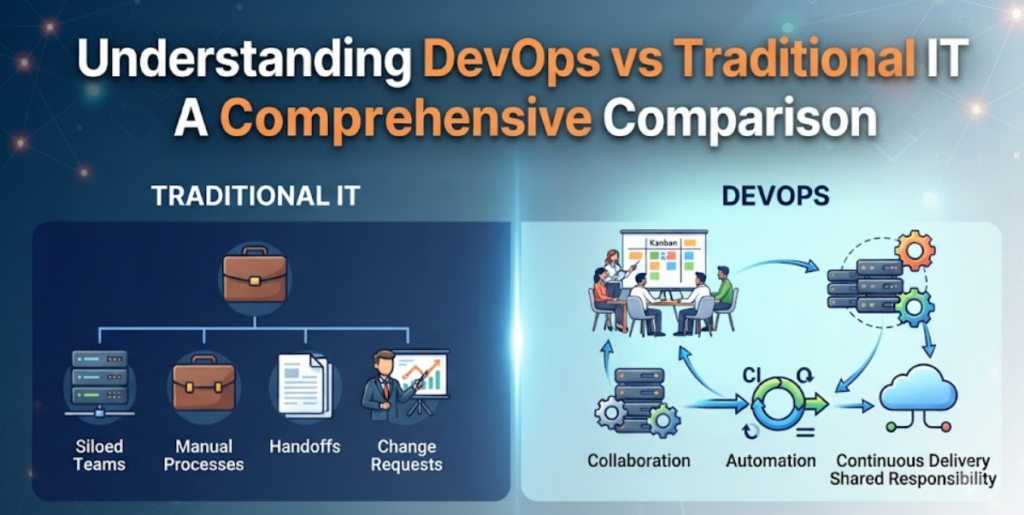
Traditional IT relies on siloed teams, manual processes, and infrequent release cycles. DevOps focuses on cross-functional collaboration, automation, continuous delivery, and shared operational responsibility.
Is DevOps replacing system administrators?
No. System administration knowledge forms the vital foundation of DevOps. System administrators transition into roles like DevOps engineers, site reliability engineers, and platform engineers.
Can a system administrator become a DevOps engineer?
Yes. System administrators make excellent DevOps engineers because they already understand operating systems, networking, and troubleshooting principles.
What skills are required to move from IT operations to DevOps?
Key skills include Linux proficiency, Git version control, scripting (Python/Bash), CI/CD fundamentals, cloud platforms, containers, and Infrastructure as Code.
Is DevOps only about automation?
No. While automation is essential, DevOps is fundamentally a cultural transformation centered around collaboration, feedback, and shared ownership.
What is the difference between a DevOps engineer and an IT operations engineer?
An IT operations engineer often focuses on maintaining existing infrastructure and handling manual ticket requests, whereas a DevOps engineer builds automated pipelines and platforms to scale software delivery.
Are traditional IT skills useful in DevOps?
Yes. Deep knowledge of Linux, networking, DNS, storage, and security is crucial for troubleshooting complex production issues in automated environments.
Which is better for a career: traditional IT or DevOps?
Neither is universally better. Traditional IT offers deep specialization in infrastructure domains, while DevOps offers broader exposure to software delivery pipelines, cloud architecture, and automation.
Final Thoughts
The evolution from traditional IT operating models toward DevOps is not about discarding established expertise or eliminating traditional IT roles. Instead, it is about applying collaboration, automation, feedback loops, and shared responsibility to improve how software is built, deployed, and operated. Whether you are a system administrator, developer, or IT manager, understanding both traditional foundations and modern DevOps practices provides a balanced, resilient path forward in the technology landscape.