Introduction
Mastering DevOps is an ongoing journey that requires far more than passive course completion; it demands a structured approach centered on hands-on application, troubleshooting, and architectural understanding. To navigate this complex landscape without losing momentum, you must move beyond collecting certifications and start measuring tangible progress through project outputs, skill matrices, and consistent self-assessment. By focusing on building real-world solutions rather than simply consuming content, you transform from a learner into a practitioner, ensuring your growth remains aligned with industry demands. For those seeking a guided path and professional mentorship to organize this journey, DevOpsSchool provides the foundational resources and structure needed to turn your aspirations into a successful, career-defining reality.
Why Tracking Your Progress Matters
In the world of technology, it is easy to fall into the “tutorial hell” trap. You finish a course, feel good for a day, and then realize you cannot build anything from scratch. Tracking your progress serves as a vital safeguard against this.
Staying Motivated
DevOps is a massive domain. Without a way to look back and see how far you have come, the complexity can feel overwhelming. A progress tracker acts as a visual representation of your growth. When you check off a milestone—like deploying your first multi-container application—it provides a dopamine hit that reinforces your discipline.
Identifying Strengths and Weaknesses
You might be excellent at writing Shell scripts but struggle with Kubernetes networking. If you do not track your progress, you might waste time repeating what you already know while ignoring your weak points. A formal tracking system forces you to confront these gaps and allocate your study time more efficiently.
Improving Learning Efficiency
Most professionals have limited time. By measuring your progress, you can determine which study methods work best for you. Are you learning faster by reading documentation or by doing hands-on labs? Tracking provides the data you need to optimize your study habits.
Preparing for Real-World Projects
Ultimately, your goal is to handle real-world scenarios. By tracking your progress, you are essentially creating a library of your own successes. When an interviewer asks about your experience, you will have a log of projects, challenges solved, and specific tools mastered, rather than just a list of courses attended.
Build a Personalized DevOps Learning Roadmap
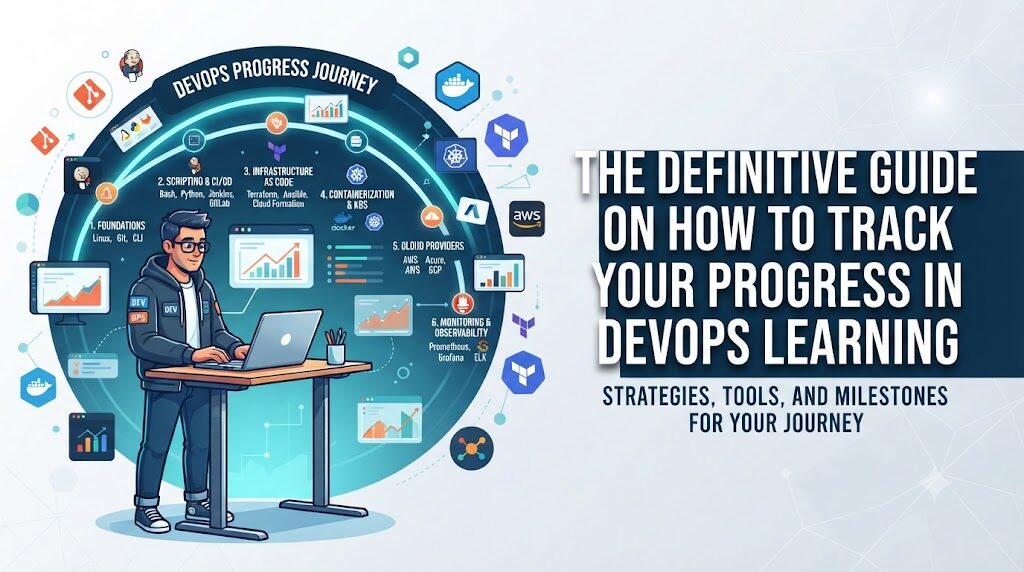
A roadmap is your navigation system. Without it, you will likely wander between unrelated tools. Follow this progression to ensure you build a strong foundation before jumping into advanced topics.
- Linux Fundamentals: Master the CLI, file systems, permissions, and process management.
- Networking Basics: Understand DNS, HTTP/HTTPS, TCP/IP, and load balancing.
- Git & Version Control: Learn branching strategies, pull requests, and code management.
- Shell Scripting: Focus on Bash/Python to automate repetitive tasks.
- Docker: Transition to containerization. Learn to write Dockerfiles and manage images.
- CI/CD: Understand the software development lifecycle (SDLC) and pipeline automation.
- Cloud Platforms: Choose one provider (AWS, Azure, or GCP) and master its core services.
- Terraform & Infrastructure as Code (IaC): Move from manual setup to automated provisioning.
- Kubernetes: Manage container orchestration at scale.
- Monitoring & Observability: Learn tools like Prometheus and Grafana to track system health.
- DevSecOps: Integrate security scanning and policy enforcement into your pipelines.
- Capstone Projects: Combine everything into a full-stack deployment.
- Career Readiness: Prepare your resume, portfolio, and interview skills.
Each stage is dependent on the previous one. Do not rush the fundamentals, as advanced topics like Kubernetes will be impossible to understand without a solid grasp of Linux and networking.
Set SMART Learning Goals
Goals must be actionable. Using the SMART framework (Specific, Measurable, Achievable, Relevant, Time-bound) ensures you are not just “learning DevOps,” but actually building competence.
- Specific: Instead of “Learn Docker,” aim for “Build a Dockerfile for a Python web application that runs in a container.”
- Measurable: Can you run the container without errors? Is the port mapped correctly?
- Achievable: Do you have the necessary environment set up?
- Relevant: Does this help you reach your ultimate goal of becoming a DevOps engineer?
- Time-bound: “Complete this project by Saturday, 5 PM.”
Example: “I will learn to deploy a simple 3-tier application using Kubernetes within the next 4 weeks by dedicating 10 hours per week.”
Technical Skills Progress Tracker
Use this table to audit your current standing. Be honest with yourself. Rate your comfort level on a scale of 1-5 (1 = Total Beginner, 5 = Ready for Production).
| Skill Area | What to Learn | Progress Indicator |
| Linux | Filesystem, Permissions, Bash | Can navigate the CLI without a GUI. |
| Networking | DNS, Subnetting, OSI Model | Can troubleshoot connectivity issues. |
| Git | Branching, Merging, Rebase | Can resolve complex merge conflicts. |
| Shell Scripting | Automation scripts, Variables | Can write scripts to automate server tasks. |
| Docker | Dockerfiles, Compose, Images | Can containerize a multi-tier app. |
| CI/CD | Jenkins, GitLab CI, GitHub Actions | Can build a pipeline that tests and deploys code. |
| Cloud | EC2, IAM, S3, VPC | Can design and deploy a secure architecture. |
| Terraform | Providers, State management, Modules | Can automate infrastructure creation. |
| Kubernetes | Pods, Deployments, Services, Ingress | Can troubleshoot a crash-looping pod. |
| Monitoring | Prometheus, Grafana, Logs | Can set up alerts for high CPU usage. |
| DevSecOps | Secret management, SAST/DAST | Can scan code for vulnerabilities. |
Track Hands-On Projects
Projects are the single most important metric for your progress. Certificates fade, but a well-documented project remains.
How to Monitor Your Work
- Home Lab Setup: Document your virtualization environment. Did you use VirtualBox? Proxmox? AWS Free Tier?
- Git Repositories: Keep your code clean. Use
README.mdfiles to explain what the project does and how to run it. - Dockerized Applications: Move from a single Dockerfile to using Docker Compose for orchestrating services.
- CI/CD Pipelines: Track how many manual steps you have successfully automated.
- Cloud Deployments: Record your infrastructure costs and architecture diagrams.
- Kubernetes Clusters: Track your ability to manage stateful vs. stateless applications.
- Monitoring Dashboards: Keep screenshots of your Grafana dashboards as a testament to your observability skills.
Projects are stronger indicators of success than certificates because they demonstrate that you can apply theory to solve real-world problems.
Measure Soft Skill Development
DevOps is a cultural movement as much as a technical one. Your soft skills will determine your ability to scale in a corporate environment.
- Communication: Can you explain complex technical concepts to a non-technical stakeholder?
- Collaboration: Are you comfortable working with developers to troubleshoot production issues?
- Documentation: Are your Readme files and architectural diagrams clear enough for someone else to use?
- Problem-solving: Do you approach errors methodically, or do you panic?
- Time Management: Can you balance learning new tools with delivering project tasks?
- Continuous Learning: Are you reading industry blogs and keeping up with new version releases?
Build a DevOps Portfolio
Your portfolio is your resume in action. It proves that you can do the work.
- GitHub Repositories: Ensure your best work is public (where appropriate). Use descriptive commit messages.
- Project Documentation: A repository without a Readme is useless. Explain the architecture, the tools, and the challenges you faced.
- Technical Blogs: Write about what you learn. Explaining a concept is the best way to master it.
- Architecture Diagrams: Use tools like Draw.io or Lucidchart to visualize your setups.
- Automation Scripts: Show off your ability to make systems efficient.
- Case Studies: Document a specific problem you faced, the steps you took to diagnose it, and the solution you implemented.
Certifications as Progress Milestones
Certifications are excellent milestones, but they should be used to validate your knowledge, not to acquire it. Use them to set deadlines for your learning.
| Certification | Best For | Skill Level | Focus Area |
| Linux+ / RHCSA | System Admin | Beginner | OS Deep Dive |
| AWS Certified Solutions Architect | Cloud | Intermediate | Cloud Infrastructure |
| CKA (Certified Kubernetes Administrator) | Kubernetes | Advanced | Container Orchestration |
| Terraform Associate | IaC | Intermediate | Automation |
| Certified DevSecOps Professional | Security | Advanced | Pipeline Security |
The DevOpsSchool ecosystem can assist you in preparing for these milestones by aligning your training with exam objectives and practical implementation.
Measuring Career Readiness
When you are ready to apply for jobs, use these KPIs (Key Performance Indicators) to assess your readiness:
| Metric | Why It Matters | Career Benefit |
| Labs completed | Demonstrates grit and practice. | Shows practical experience. |
| GitHub activity | Proof of consistent coding. | Demonstrates passion and skill. |
| Projects delivered | Shows end-to-end knowledge. | Serves as “proof of work.” |
| Automation confidence | Proves you understand efficiency. | High value for employers. |
| Interview readiness | Can explain ‘why’ and ‘how’. | Increases hireability. |
| Portfolio quality | Displays professionalism. | Helps you stand out from peers. |
Common Learning Challenges
| Challenge | Impact | Recommended Solution |
| Learning too many tools | Causes confusion and shallow knowledge. | Focus on one tool in each category (e.g., Jenkins). |
| Inconsistent practice | Results in knowledge decay. | Dedicate at least 1 hour daily, consistently. |
| Skipping fundamentals | Leads to inability to troubleshoot. | Revisit Linux and Networking if stuck. |
| Fear of troubleshooting | Stalls progress. | Embrace errors; they are your best teachers. |
| Lack of feedback | Creates blind spots in your skill set. | Join communities or find a mentor. |
| Unrealistic expectations | Leads to burnout. | Remember, this is a multi-year career path. |
Best Practices
To sustain growth, adopt these habits:
- Review progress monthly: Take a Saturday morning to assess what you learned against your roadmap.
- Practice consistently: Coding and configuration management are muscles; they need daily exercise.
- Build real-world projects: Try to replicate a production environment locally.
- Ask for feedback: Show your code to peers or mentors and ask for code reviews.
- Keep learning journals: Write down the errors you encounter and how you fixed them.
- Improve weak areas: If you dread networking, dedicate an entire week to nothing but networking labs.
Real-World Example
Case Study: The Transitioning Developer
- Initial Experience: A Junior Software Developer with 2 years of coding experience but no operations knowledge.
- Learning Roadmap: Followed a 6-month plan: 1 month Linux/Networking, 2 months Docker/CI/CD, 2 months AWS/Terraform, 1 month Kubernetes.
- Progress Tracking: Used a spreadsheet to track hours spent vs. projects completed.
- Practical Projects: Deployed a web app on AWS using Terraform, then containerized it with Docker, and built a Jenkins pipeline to automate deployment.
- Certification Milestones: Achieved the AWS Solutions Architect Associate after 4 months.
- First DevOps Role: Landed a role as a Junior DevOps Engineer by presenting the GitHub repository of their automated web app project.
- Lessons Learned: The focus on “doing” rather than “watching” was the key factor in their success.
Common Beginner Mistakes
- Comparing yourself to others: Every path is different. Focus on your own growth trajectory.
- Measuring only certifications: Having a certification does not mean you can fix a production outage. Build the lab.
- Ignoring documentation: Always read the official docs before watching a YouTube tutorial.
- Skipping troubleshooting: When a command fails, try to fix it before searching for the answer.
- Avoiding projects: If you are not building, you are not learning.
Future of DevOps Learning
The landscape is shifting toward Platform Engineering, where developers create internal developer platforms (IDP) to improve the developer experience. GitOps is becoming the standard for continuous delivery. AI-assisted learning is also changing how we debug, with tools helping us understand errors faster. As you progress, keep an eye on these trends:
- Cloud-Native Development: Moving from virtual machines to serverless architectures.
- Security Automation: Integrating security tools earlier in the pipeline (Shift Left).
- Continuous Upskilling: The technology stack changes every 18–24 months; develop the skill of “learning how to learn.”
Practical DevOps Progress Checklist
- Complete Linux labs: Can you write a script to back up a database?
- Build Git repositories: Is your code organized and documented?
- Write automation scripts: Can you automate a server setup?
- Deploy Docker applications: Can you run a multi-container stack?
- Create CI/CD pipelines: Does code deploy automatically on push?
- Learn Kubernetes: Can you deploy a load-balanced application?
- Build cloud projects: Can you design a secure VPC in your cloud provider?
- Improve monitoring skills: Can you visualize system metrics?
- Practice security automation: Can you scan for open ports or hardcoded secrets?
FAQs
- How do I know if I’m improving in DevOps?You are improving when you can solve problems faster than you could a month ago, and when you can explain the “why” behind a configuration change, not just the “how.”
- How often should I review my progress?A monthly review is ideal. It gives you enough time to make progress but keeps you accountable to your goals.
- Which projects matter most?End-to-end projects. A project that starts with code on your laptop, goes through a CI/CD pipeline, and ends as a live application in a cloud environment is the gold standard.
- Should I focus on certifications or practical skills?Focus on skills. Use certifications to validate those skills and give yourself a deadline to reach a certain level of proficiency.
- How do I prepare for interviews?Prepare by being able to talk through your projects in detail. Be ready to explain the architecture of your projects and why you chose specific tools.
- How long does it take to become job-ready?It varies, but with consistent, structured learning (10-15 hours/week), most motivated learners can reach a junior-ready level in 6 to 9 months.
- How can I stay motivated?Connect with the community, document your wins, and remember the end goal: a career in a high-demand, high-impact field.
- What should be included in my portfolio?Code, architecture diagrams, project documentation (Readmes), and blog posts explaining your technical decisions.
- Do I need to be a developer to learn DevOps?No, but you need to understand code. A strong grasp of scripting is non-negotiable.
- How deep should I go into Linux?Very deep. It is the operating system that runs almost all cloud and container workloads. You cannot bypass it.
- Is Cloud platform choice important?Focus on one first (AWS is the most common). The concepts transfer well to other platforms once you master the fundamentals.
- What if I get stuck on a difficult tool?Take a break, go back to the basics, or try a different learning resource. Sometimes changing the teaching style (video vs. documentation) helps.
- How do I balance work and learning?Use the “micro-learning” approach. Even 30 minutes of focused practice is better than nothing.
- Is DevSecOps necessary for beginners?Understand the concepts early, but focus on building the pipeline first. You cannot secure what you haven’t built.
- Where can I find mentors?Engage in professional forums, attend local meetups, and look for structured programs like those at DevOpsSchool.
Final Thoughts
Tracking your progress in DevOps learning is the difference between aimless scrolling and targeted career growth. Do not be discouraged by the sheer volume of technologies; no one learns them all at once. Focus on the fundamentals, build tangible projects, document your journey, and seek consistent feedback. The goal is not to be a walking encyclopedia of tools, but to be an engineer who understands how to build, secure, and maintain systems. Stay consistent, keep your portfolio updated, and treat your learning as the most important project you will ever manage.