Introduction
In the rapidly evolving landscape of modern software development, DevOps has firmly established itself as one of the most in-demand career paths in the IT industry. Organizations across the globe are moving toward agile, automated, and cloud-native environments, creating a massive need for professionals who can bridge the gap between development and operations. However, many beginners fall into the trap of chasing the latest flashy tools without first understanding the underlying principles.
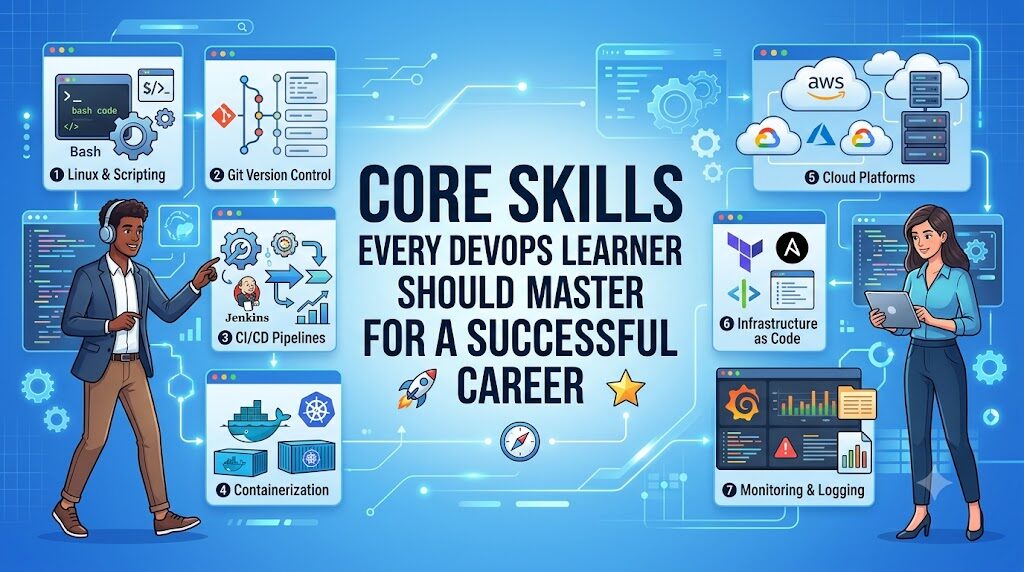
Mastering the Core Skills Every DevOps Learner Should Master is the true differentiator between a button-pusher and a true DevOps architect. Relying on tools alone leaves you vulnerable when technology shifts; building a strong foundation in core concepts ensures long-term employability and adaptability. Whether you are a student, a system administrator, or a developer, your journey should be guided by a structured, hands-on approach. For those looking for a clear path forward, DevOpsSchool provides comprehensive training and resources designed to help you navigate this complex field effectively. By focusing on practical application over theoretical memorization, you can build a sustainable and high-growth career.
What Are DevOps Skills?
DevOps skills are a blend of technical expertise, process-oriented thinking, and soft skills required to manage the software delivery lifecycle.
- Technical Skills: The ability to use specific software, languages, and infrastructure platforms to automate tasks.
- Process Knowledge: Understanding the methodology behind CI/CD, Agile, and Lean management.
- Collaboration: Working effectively across silos, specifically bridging the divide between software developers and IT operations staff.
- Automation Mindset: The consistent drive to replace manual, repetitive tasks with reliable, automated code or scripts.
At its heart, DevOps is about speed, reliability, and scale, and these skills are the tools you use to achieve those outcomes.
Why Core Skills Matter More Than Individual Tools
Technology changes rapidly. A specific tool you master today—like a particular CI/CD platform—might be superseded by a more efficient alternative within a few years. However, the core principles of networking, operating systems, and automation remain constant.
When you master core skills, you gain the ability to learn new tools quickly. If you understand how a packet traverses a network, you can troubleshoot a firewall issue regardless of the specific vendor. If you understand the fundamentals of version control, you can adapt to any repository system. Focusing on fundamentals creates a deeper sense of confidence and superior problem-solving capabilities in real-world production environments.
Complete DevOps Skills Roadmap
| Skill Area | Why It Matters | Difficulty Level |
| Linux | The foundation of almost all servers | Medium |
| Networking | Connects all distributed systems | High |
| Git | Essential for collaboration and versioning | Easy |
| Scripting | Necessary for automation | Medium |
| Cloud | Where modern infrastructure resides | High |
| CI/CD | The backbone of software delivery | Medium |
| Containers | Standardizes application deployment | Medium |
| Kubernetes | Orchestrates containerized workloads | Very High |
| IaC | Manages infrastructure as code | Medium |
| Monitoring | Ensures system health and visibility | Medium |
| Security | Protects the entire pipeline | High |
| Soft Skills | Bridges team communication | Easy |
Linux Skills
Linux is the operating system of the cloud. You must be proficient in:
- Command Line (CLI): Navigating the file system, editing files with Vim/Nano.
- File Systems: Permissions, ownership, and disk management.
- Process Management: Monitoring system resources and handling background jobs.
- Networking Basics: Configuring IP addresses, routing, and DNS.
Learning Tip: Stop using a GUI. Build a Linux virtual machine and force yourself to perform every administrative task exclusively through the terminal.
Networking Fundamentals
You cannot manage what you cannot connect. A DevOps engineer needs to understand:
- TCP/IP: The fundamental protocols of the internet.
- DNS: How domain names resolve to IP addresses.
- HTTP/HTTPS: How web traffic is handled.
- Load Balancing: Distributing traffic to ensure high availability.
Understanding how a request moves from a user’s browser, through a load balancer, to an application server, and back to a database is vital for troubleshooting.
Version Control With Git
Git is the language of collaboration. You must move beyond simple “git push” commands to understand:
- Branching & Merging: Handling parallel development features.
- Pull Requests: Peer review workflows.
- Git Workflows: Understanding Trunk-Based Development vs. GitFlow.
Git is how teams maintain the “source of truth” for both application code and configuration files.
Programming and Scripting
You don’t need to be a software developer, but you must be able to script.
- Bash: For simple, repetitive OS-level tasks.
- Python: For complex automation, API interactions, and data processing.
- PowerShell: Often required in Windows-centric corporate environments.
Scripting allows you to integrate different tools together into a cohesive pipeline.
Cloud Computing Skills
Cloud platforms like AWS, Azure, and Google Cloud provide the infrastructure. Focus on:
- Compute: Virtual machines and serverless functions.
- Storage: Object storage, block storage, and file systems.
- Networking: Virtual Private Clouds (VPC), security groups, and gateways.
- Identity Management: Managing users and permissions securely.
CI/CD Fundamentals
CI/CD is the heart of DevOps.
- Continuous Integration: Merging code changes frequently into a central repository.
- Continuous Delivery: Ensuring code is always in a deployable state.
- Continuous Deployment: Automating the release process to production.
Mastering tools like Jenkins, GitHub Actions, or GitLab CI is essential for creating automated workflows.
Docker and Containerization
Containers package an application and its dependencies into a single unit.
- Images: Creating lightweight, portable environments.
- Registries: Storing and retrieving container images.
- Networking/Volumes: Ensuring containers can communicate and persist data.
Docker allows you to eliminate the “it works on my machine” problem.
Kubernetes Skills
Kubernetes is the standard for container orchestration. Key concepts include:
- Pods: The smallest deployable unit.
- Deployments: Managing replicas and updates.
- Services: Exposing applications to internal or external traffic.
- Scaling: Adjusting resources based on demand.
Infrastructure as Code (IaC)
IaC allows you to provision infrastructure using human-readable configuration files rather than manual clicks in a console.
- Terraform: The industry standard for cloud-agnostic provisioning.
- Ansible: Excellent for configuration management and application deployment.
IaC enables version control, repeatability, and consistency across environments.
Monitoring and Observability
You cannot fix what you cannot see.
- Metrics: Tracking performance over time (e.g., Prometheus).
- Logging: Centralizing logs for analysis (e.g., ELK Stack).
- Alerting: Setting thresholds to notify teams when issues arise.
Observability provides the data necessary for informed incident response.
DevSecOps Fundamentals
Security is not an afterthought.
- Secure Coding: Scanning code for vulnerabilities.
- Secrets Management: Never hardcoding passwords in scripts.
- Shift-Left Security: Integrating security checks early in the pipeline.
Soft Skills Every DevOps Engineer Needs
- Communication: Clearly explaining technical issues to non-technical stakeholders.
- Problem-Solving: Remaining calm during outages and identifying root causes.
- Adaptability: Being willing to unlearn old methods when better ones emerge.
- Continuous Learning: The technology stack evolves weekly; your curiosity is your greatest asset.
How to Learn These Skills Step by Step
| Stage | Skills to Learn | Expected Outcome |
| 1 | Linux & Networking | Understanding the host environment |
| 2 | Git & Scripting | Automating basic tasks |
| 3 | Cloud & Containers | Deploying apps on modern infrastructure |
| 4 | CI/CD & IaC | Automating the full software delivery life cycle |
| 5 | Kubernetes & Monitoring | Managing production-scale systems |
Hands-On Projects to Build These Skills
| Project | Skills Covered | Difficulty |
| Web Server Setup | Linux, Networking | Easy |
| Git Workflow | Git | Easy |
| Dockerized App | Docker, Scripting | Medium |
| CI/CD Pipeline | Git, CI/CD, Docker | Medium |
| Cloud IaC Deployment | Terraform, Cloud | Hard |
| K8s Cluster Monitor | Kubernetes, Monitoring | Hard |
Common Learning Mistakes
- Skipping Fundamentals: Trying to learn Kubernetes before understanding Linux is like trying to build a roof without a foundation.
- Tool Hopping: Learning the interface of five different tools instead of the logic behind one.
- Passive Learning: Watching hours of video without ever opening a terminal.
- Ignoring Security: Believing that security is “someone else’s job.”
Measuring Your Progress
| Metric | Why It Matters | Career Benefit |
| GitHub Portfolio | Proves practical skills | Higher interview conversion |
| Automation Scripts | Shows efficiency | Demonstrates value |
| Certifications | Validates knowledge | HR gatekeeping pass |
| Projects Completed | Shows application | Technical confidence |
Real-World Example: Beginner to DevOps Engineer
Consider a Linux administrator who spends two hours daily learning Python and Docker. They build a personal project: a static website hosted on AWS. They use Terraform to provision the S3 bucket, a GitHub Action to trigger the deployment, and a monitoring script to alert them via email if the site goes down. By documenting this project on GitHub and explaining the why behind their choices in interviews, they shift from a “support” role to a “DevOps Engineer” role in less than a year.
Future Skills Every DevOps Professional Should Learn
- Platform Engineering: Building internal developer platforms to improve the developer experience.
- GitOps: Managing infrastructure via Git repository state.
- AI-assisted DevOps: Leveraging LLMs to write better scripts and analyze logs faster.
- FinOps: Managing and optimizing cloud costs.
Certifications & Learning Paths
| Certification | Best For | Skill Level | Focus Area |
| Linux+ | Linux Foundation | Beginner | OS Basics |
| AWS Solutions Architect | Cloud Beginners | Intermediate | Infrastructure |
| CKA | Kubernetes Experts | Advanced | Containers |
| Terraform Associate | IaC Beginners | Intermediate | Automation |
Explore structured paths at DevOpsSchool to find the right certification journey for your goals.
Best Practices Checklist
- [ ] Master Linux basics before touching cloud consoles.
- [ ] Automate any task you find yourself doing more than twice.
- [ ] Keep your Git commit history clean and meaningful.
- [ ] Always treat “Infrastructure as Code” as the source of truth.
- [ ] Document your failures and your learning process.
- [ ] Stay curious about the “how” and “why,” not just the “what.”
FAQs
- Which DevOps skill should I learn first? Start with Linux and basic networking. Everything else runs on top of these.
- Is Linux mandatory? Yes, it is the standard for most servers and container environments.
- Do I need programming knowledge? You need scripting knowledge. Deep software engineering isn’t required, but logic is.
- Which cloud platform is best? Start with AWS due to its market share and extensive documentation.
- How important is Kubernetes? It is essential for modern enterprise-scale applications.
- Can beginners learn DevOps? Yes, by following a structured roadmap and prioritizing hands-on practice.
- Are certifications enough? No, certifications validate knowledge, but projects prove competence.
- How long does it take to become job-ready? Depending on your background, 6 to 12 months of consistent study.
Final Thoughts
Becoming a DevOps engineer is not about memorizing a list of tools; it is about cultivating a mindset of continuous improvement and automation. The path can be challenging, but it is deeply rewarding for those who commit to mastering the core fundamentals. Do not be intimidated by the breadth of the field. Start small, build projects, document your progress, and stay consistent. Your ability to solve complex problems and automate away repetitive work will always be in high demand.