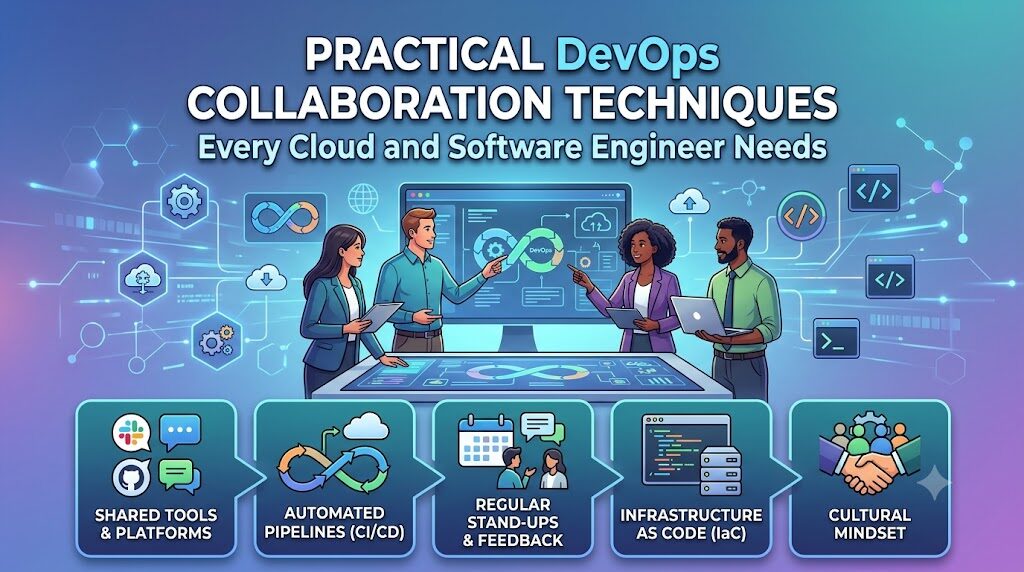
Introduction
In the world of software engineering, technical proficiency in writing code and configuring cloud infrastructure is only half the battle; modern software delivery is fundamentally a team sport. Historically, software development followed siloed models where developers, QA teams, and operations worked in isolation, leading to friction, slow release cycles, and finger-pointing. Today, DevOps bridges these gaps by ensuring all stakeholders share responsibility for the software lifecycle, making the early development of collaboration skills just as crucial as mastering CI/CD pipelines. As learners and junior engineers step into fast-paced technology environments, mastering team communication and shared workflows directly improves software quality, increases deployment speed, and drives long-term career success—principles emphasized within structured ecosystems like DevOpsSchool.
What Is DevOps Collaboration?
Definition
DevOps collaboration is the cultural and operational practice of bringing developers, operations personnel, quality assurance, security, and business stakeholders together throughout the entire software development lifecycle. It replaces traditional organizational silos with shared goals, transparent communication, and collective ownership of software products.
Shared Responsibility
In a collaborative DevOps environment, the phrase “it works on my machine” is replaced by “it works reliably in production.” Developers care about infrastructure and operational health, while operations engineers understand application architecture and code logic. Everyone shares the responsibility for building, testing, securing, and maintaining the software.
Cross-Functional Teams
Cross-functional teams include members with diverse skill sets working toward a common objective. Instead of passing tickets back and forth between departments, a single squad possesses all the capabilities required to design, build, test, and release features independently.
Continuous Communication
Collaboration is not an occasional meeting; it is a continuous dialogue enabled by chat platforms, transparent tracking boards, collaborative documentation, and shared feedback loops.
Why Collaboration Matters in DevOps
Faster Software Delivery
When teams communicate effectively, bottlenecks are identified and resolved quickly. Eliminating handoff delays allows features to move from code commit to production in minutes rather than weeks.
Better Quality
Peer reviews, shared test automation, and early security checks catch defects before they reach production. Quality becomes an inherent property of the codebase rather than a final gatekeeper check.
Reduced Deployment Failures
Transparent change management and collaborative deployment pipelines ensure that everyone understands what changes are entering an environment, drastically lowering rollback rates and production outages.
Knowledge Sharing
Collaboration breaks down information silos. When senior engineers mentor junior learners and cross-training occurs naturally, the entire team becomes more resilient and adaptable.
Continuous Improvement
Teams that collaborate openly discuss failures without fear, conducting honest post-mortems and applying lessons learned to future iterations.
Customer-Focused Development
Aligning technical goals with business objectives ensures that engineering efforts directly address user needs, improving overall satisfaction and business value.
Core Principles of DevOps Collaboration
| Principle | Why It Matters | Practical Example |
| Communication | Ensures alignment and prevents misunderstandings across disparate technical teams. | Using dedicated chat channels for active deployment updates and architectural discussions. |
| Transparency | Makes work visible to all stakeholders, reducing duplication and hidden roadblocks. | Maintaining public Kanban boards tracking feature progress from backlog to production. |
| Shared Ownership | Eliminates finger-pointing by making the entire team accountable for product success and failures. | Both developers and operations engineers participating in on-call rotations for services they build. |
| Continuous Feedback | Enables rapid course correction through frequent reviews and metric analysis. | Reviewing automated test results and user telemetry immediately after a release. |
| Automation | Replaces manual, error-prone human handoffs with reliable, repeatable workflows. | Triggering automated security scans and deployment scripts upon merging a pull request. |
| Trust | Fosters psychological safety, allowing team members to experiment and report errors honestly. | Encouraging engineers to flag deployment risks early without fear of punitive action. |
| Learning Culture | Promotes skill diversification and prevents stagnation within engineering groups. | Hosting weekly internal tech talks where team members share lessons from recent projects. |
| Accountability | Ensures commitments are honored and operational standards are consistently met. | Documenting service level objectives and reviewing adherence during sprint retrospectives. |
DevOps Collaboration Techniques Every Learner Should Try
Daily Stand-Up Meetings
Daily stand-ups are brief, 15-minute sync meetings where team members discuss what they accomplished yesterday, what they plan to do today, and any blockers they are facing. In a DevOps context, these meetings are not just status updates for managers; they are synchronization points where developers, QA, and operations align on active deployment pipelines, infrastructure changes, and active incidents.
Pair Programming
Pair programming involves two developers writing code at a single workstation—or via collaborative remote environments. One writes code (the driver) while the other reviews each line in real-time (the navigator). This technique accelerates skill transfer, reduces syntax errors, and spreads architectural knowledge across the team, ensuring no single person becomes a single point of failure.
Peer Code Reviews
Code reviews are a formal or informal process where peers examine source code before it is merged into the main branch. In a collaborative DevOps culture, code reviews go beyond checking syntax; they evaluate security posture, test coverage, readability, and operational readiness. Constructive code reviews foster mutual learning and maintain high code quality standards.
Shared Documentation
Documentation is the memory of a DevOps team. Relying on tribal knowledge creates bottlenecks when key personnel are absent. Collaborative documentation involves maintaining up-to-date runbooks, system architecture diagrams, API specifications, and troubleshooting guides in shared repositories (like Markdown files in Git or centralized wikis) that anyone can edit and improve.
Continuous Feedback
Feedback loops must be embedded into every stage of the development lifecycle. This includes automated feedback from CI/CD test suites, peer feedback during sprint reviews, and retrospective meetings where teams evaluate their collaborative processes and identify areas for improvement.
Collaborative CI/CD Pipelines
Pipelines should not be managed exclusively by a separate release engineering team. Instead, CI/CD pipeline definitions (such as GitHub Actions workflows or GitLab CI files) should live in version control alongside application code. Developers, testers, and operations engineers should be empowered to update, troubleshoot, and optimize the delivery pipeline together.
Cross-Functional Learning
Engineers grow faster when they step outside their primary domain. Developers can shadow operations engineers during server provisioning or incident response, while operations staff can learn basic application development and debugging. This cross-pollination builds empathy and breaks down traditional organizational barriers.
Incident Collaboration
When production incidents occur, effective teams respond as a unified unit rather than pointing fingers. Incident collaboration involves setting up dedicated bridge channels, assigning clear roles (such as incident commander, communicator, and investigator), and working systematically through root cause analysis (RCA) once stability is restored.
Communication Practices That Improve DevOps Teams
- Open Communication: Encourage transparent discussions across all channels, avoiding private silos or hidden decision-making.
- Active Listening: Prioritize understanding teammates’ perspectives before proposing technical solutions or counterarguments.
- Regular Updates: Share timely progress reports and potential roadmap roadblocks with cross-functional stakeholders.
- Clear Documentation: Write concise, actionable instructions and avoid overly complex jargon when explaining system architecture.
- Constructive Feedback: Frame code reviews and performance discussions around objective improvements rather than personal critiques.
- Meeting Effectiveness: Keep meetings focused with clear agendas, designated timeboxes, and actionable follow-up items.
Collaboration Tools Used in DevOps Teams
| Category | Purpose | Practical Example |
| Version Control | Managing source code changes, tracking history, and enabling parallel development. | Git, GitHub, GitLab, Bitbucket |
| Communication | Facilitating instant messaging, video conferencing, and team announcements. | Slack, Microsoft Teams, Zoom |
| Project Management | Tracking tasks, user stories, sprints, and overall workflow progress. | Jira, Trello, Linear, Asana |
| Documentation | Storing knowledge bases, runbooks, architecture diagrams, and meeting notes. | Confluence, Notion, Git-based Wikis |
| CI/CD | Automating building, testing, and deployment workflows across environments. | Jenkins, GitHub Actions, GitLab CI, ArgoCD |
| Monitoring | Providing real-time visibility into system health, performance metrics, and logs. | Prometheus, Grafana, Datadog |
| Knowledge Sharing | Hosting internal tech talks, recording training sessions, and sharing code snippets. | Loom, internal learning portals, GitHub Gists |
Common Collaboration Challenges and Solutions
Communication Gaps
- Challenge: Information remains trapped within specific departments, leading to misaligned expectations between business units and engineering teams.
- Solution: Establish cross-functional communication channels, schedule regular sync meetings, and maintain shared project boards accessible to all members.
Siloed Teams
- Challenge: Developers and operations engineers work independently, treating handoffs like transactional boundaries rather than collaborative milestones.
- Solution: Implement shared accountability metrics, joint on-call rotations, and cross-training initiatives to build mutual understanding.
Role Confusion
- Challenge: Team members are unclear about who owns specific tasks, resulting in duplicated effort or critical jobs being ignored.
- Solution: Define clear RACI matrices (Responsible, Accountable, Consulted, Informed) for projects, deployments, and incident management.
Poor Documentation
- Challenge: Critical operational knowledge exists only in individual team members’ heads, causing delays when staff transition.
- Solution: Adopt a “docs-as-code” approach, integrating documentation updates into the standard pull request review checklist.
Resistance to Change
- Challenge: Senior staff or traditional teams push back against new collaborative workflows and automation tools.
- Solution: Demonstrate value through small pilot projects, provide hands-on training, and celebrate early collaborative wins.
Best Practices for Building Strong DevOps Collaboration
Encourage Shared Responsibility
Ensure that success and failure belong to the entire team. When metrics improve, celebrate collectively; when outages occur, analyze the process and system vulnerabilities rather than blaming individuals.
Document Everything
Treat documentation as a first-class citizen. If a manual process is repeated more than twice, script it and document the steps so any team member can execute it safely.
Automate Repetitive Tasks
Manual toil drains team energy and increases the risk of human error. Automate testing, provisioning, building, and deployment to free up time for strategic collaboration and creative problem-solving.
Promote Continuous Learning
Provide time and resources for team members to explore new technologies, attend workshops, and acquire relevant industry certifications.
Celebrate Team Successes
Recognize milestones, successful product launches, and effective incident resolutions publicly to reinforce positive teamwork behaviors.
Improve Communication Skills
Invest in training that enhances written and verbal communication, ensuring technical staff can articulate complex ideas clearly to non-technical stakeholders.
Build Psychological Safety
Create an environment where team members feel safe admitting mistakes, asking questions, and proposing unconventional ideas without fear of negative consequences.
Real-World Example: Collaboration in a DevOps Team
Imagine an enterprise e-commerce organization preparing for a major holiday flash sale.
First, the software developers write a new high-throughput checkout service. Instead of writing code in isolation, they open a draft pull request early, inviting feedback from peers and operations engineers on architectural scalability.
Next, the QA engineers collaborate with developers during the design phase to define automated acceptance tests, ensuring test-driven development principles are integrated from day one.
Concurrently, the DevOps and platform engineers configure the CI/CD pipeline and Kubernetes cluster autoscaling parameters, ensuring the infrastructure can handle sudden traffic surges. They review the pipeline configuration file directly with the development team.
Meanwhile, the security team runs automated vulnerability and dependency scans within the pipeline, catching an outdated encryption library before code is merged.
On release day, the Site Reliability Engineering (SRE) team monitors production dashboards alongside developers. When a minor latency spike occurs, the team jumps onto a shared incident bridge, correlates application logs with infrastructure metrics, and rolls back the problematic configuration change within minutes.
Finally, the entire squad holds a blameless post-mortem retrospective to discuss what went well, identify monitoring improvements, and update shared runbooks for future events. This seamless coordination transforms potential disaster into a smooth, successful release.
Measuring Collaboration Success
| Metric | Why It Matters |
| Deployment Frequency | Measures how often code successfully reaches production, reflecting pipeline efficiency and teamwork smoothness. |
| Team Satisfaction | Evaluates employee engagement, morale, and perceived workplace friction through regular surveys. |
| Code Review Participation | Tracks how actively peers engage in reviewing pull requests and sharing constructive feedback. |
| Documentation Quality | Assesses whether runbooks and system wikis are actively maintained, accurate, and frequently updated. |
| Incident Resolution Time | Measures how quickly cross-functional teams diagnose and resolve production issues (Mean Time to Resolution). |
| Knowledge-Sharing Sessions | Counts internal tech talks, workshops, and cross-training events hosted by team members. |
| Customer Satisfaction | Reflects whether collaborative software delivery is effectively meeting end-user needs and expectations. |
| Change Failure Rate | Tracks the percentage of deployments that result in degraded service or require immediate remediation. |
Collaboration Skills That Improve DevOps Careers
Technical expertise is essential, but soft skills and collaborative capabilities dictate how far an engineer can advance in their career.
- Communication: The ability to explain complex technical concepts simply to developers, operations staff, managers, and clients.
- Leadership: Guiding initiatives, mentoring junior learners, and aligning team members toward shared goals without relying on formal authority.
- Problem-Solving: Approaching obstacles analytically and working collaboratively with cross-functional groups to find root causes.
- Time Management: Balancing project deliverables, operational maintenance, and continuous learning effectively.
- Adaptability: Embracing new tools, shifting project requirements, and evolving industry methodologies with a positive attitude.
- Conflict Resolution: Mediating technical disagreements constructively and finding compromises that benefit the product and team culture.
- Documentation: Translating intricate system designs and operational procedures into clear, accessible written guides.
- Continuous Learning: Cultivating curiosity and regularly updating knowledge to stay aligned with modern cloud-native standards.
How DevOpsSchool Helps Learners Build Collaboration Skills
Mastering technical concepts is only half the journey; developing the mindset and habits of a collaborative engineer requires practical guidance and real-world exposure.
DevOpsSchool provides comprehensive, industry-focused training programs designed to bridge the gap between theory and practice. Through hands-on team projects, collaborative CI/CD labs, cloud-native learning modules, and realistic DevOps scenarios, learners experience firsthand how multidisciplinary teams operate in enterprise settings.
Mentorship from seasoned practitioners ensures that students not only learn tools like Docker, Kubernetes, and Terraform, but also internalize the cultural principles, communication techniques, and collaborative workflows that define high-performing engineering teams.
Future of DevOps Collaboration
As software engineering continues to evolve, collaboration techniques are shifting to accommodate new technologies and distributed work models.
- AI-Assisted Collaboration: Generative AI tools and intelligent chat assistants are beginning to summarize incident threads, suggest code refactoring during pull requests, and draft initial runbook documentation automatically.
- Platform Engineering: Organizations are increasingly building internal developer platforms (IDPs) that foster collaboration by providing self-service infrastructure while maintaining centralized governance and guardrails.
- DevSecOps Teamwork: Security is no longer handed off to an external team; security checks are embedded directly into developer workflows and collaborative CI/CD pipelines from inception.
- GitOps: Infrastructure and application configurations are managed entirely through Git repositories, making infrastructure changes transparent, reviewable, and auditable by the entire team.
- Remote-First Engineering: Distributed global teams rely heavily on asynchronous communication tools, robust documentation standards, and collaborative digital workspaces to maintain high alignment.
- Intelligent Automation: Advanced monitoring and observability platforms provide shared telemetry data that helps multidisciplinary teams troubleshoot issues proactively before users are impacted.
FAQs
1. What is DevOps collaboration?
DevOps collaboration is the cultural and operational practice of uniting developers, operations, QA, security, and business teams throughout the software development lifecycle to achieve shared goals and improve software quality.
2. Why is collaboration important in DevOps?
Collaboration breaks down traditional silos, accelerates software delivery, reduces deployment failures, encourages knowledge sharing, and aligns technical output with business objectives.
3. How do beginners improve collaboration skills?
Beginners can improve collaboration by actively participating in code reviews, writing clear documentation, engaging in daily stand-ups, asking questions, and shadowing senior engineers across different domains.
4. What communication techniques help DevOps teams?
Effective techniques include transparent chat channels, active listening, structured daily stand-ups, clear status updates, and blameless post-mortem discussions during incidents.
5. What role does documentation play in DevOps?
Documentation acts as the team’s shared memory, preventing bottlenecks caused by tribal knowledge and ensuring that runbooks, architectures, and processes are accessible to everyone.
6. How does CI/CD improve collaboration?
CI/CD pipelines automate building, testing, and deployment workflows, replacing manual human handoffs with reliable, shared processes that all team members can monitor and contribute to.
7. How can cross-functional learning help engineers?
Cross-functional learning builds empathy between roles (such as developers understanding operations or vice versa), broadens technical capability, and prevents single points of failure within teams.
8. Which collaboration skills are most valuable for DevOps careers?
Key skills include clear communication, conflict resolution, active documentation, shared accountability, leadership, and a willingness to learn continuously from peers.
9. How do daily stand-ups support DevOps workflows?
Stand-ups provide a quick synchronization point where cross-functional team members align on active deployments, blockers, and infrastructure changes before starting daily work.
10. What is pair programming and why is it useful?
Pair programming involves two engineers working together at one workstation or shared session. It accelerates knowledge transfer, catches bugs early, and improves code quality.
11. How do teams handle production incidents collaboratively?
Teams use dedicated incident channels, assign clear roles, investigate root causes systematically, and conduct blameless retrospectives to prevent future occurrences.
12. What is a blameless post-mortem?
A blameless post-mortem is an analytical review of a production failure focused on identifying system and process vulnerabilities rather than blaming individual engineers.
13. How does psychological safety impact team performance?
Psychological safety encourages team members to report errors honestly, ask questions, and propose innovative ideas without fear of negative repercussions.
14. Can collaboration tools replace good team culture?
No. Tools facilitate communication and visibility, but a true collaborative culture requires trust, shared responsibility, and open dialogue among team members.
15. How can learners practice DevOps collaboration without a team?
Learners can practice by publishing open-source projects on GitHub, writing detailed README files, contributing to community discussions, and participating in team-based cohort training programs.
Final Thoughts
Mastering technical tools like containers, orchestrators, and cloud platforms is only part of becoming a successful DevOps professional. True engineering excellence relies equally on teamwork, communication, and shared ownership. When developers, operations staff, testers, and security engineers work together cohesively, software delivery becomes faster, more reliable, and immensely more rewarding.
Embracing collaboration techniques early in your learning journey prepares you to thrive in modern, high-performing engineering organizations and builds the foundation for a long-term, successful career in software and cloud engineering.