
This article is based on reporting originally published at searchcloudcomputing.techtarget.com in October 2019.
The Surprise Decision: Microsoft Takes JEDI
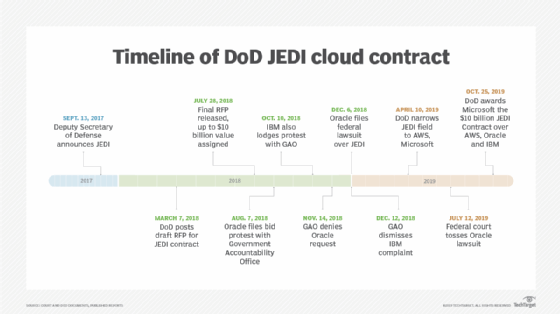
In late October 2019, the U.S. Department of Defense (DoD) awarded the Joint Enterprise Defense Infrastructure (JEDI) cloud computing contract to Microsoft Azure — a decision that caught much of the technology industry off guard. The single-vendor contract, valued at up to $10 billion over ten years, was widely expected to go to Amazon Web Services, which had long dominated the government cloud market.
“We’re surprised about this conclusion,” an AWS spokesperson said in a statement shortly after the award. “AWS is the clear leader in cloud computing, and a detailed assessment purely on the comparative offerings clearly led to a different conclusion.” The spokesperson declined to comment on the company’s next steps.
AWS’s Options for Challenging the Award
Following the announcement, industry observers outlined several avenues AWS could pursue to contest the decision:
- Government Accountability Office (GAO) appeal: Any party that participated in the procurement process may request that the GAO reconsider its decision. However, the request must be filed within 10 days of when the basis for reconsideration is known, and the petitioner must provide new information — simply restating prior objections or expressing disagreement with the outcome is not sufficient grounds for reconsideration.
- Enhanced debriefing: AWS could request a formal meeting with DoD officials to receive a detailed rationale for the contract decision. This process, sometimes called an “enhanced debriefing,” gives the losing bidder more transparency into the evaluation.
- Federal lawsuit: AWS could file a suit in the U.S. Court of Federal Claims challenging the legality of the procurement process or the evaluation criteria.
Importantly, a request for GAO reconsideration does not automatically suspend contract performance — Microsoft could begin work on JEDI while any appeal was pending.
Why Microsoft Won: Key Factors Behind the Decision
The DEOS Contract and Security Certifications
A pivotal stepping stone to Microsoft’s JEDI win was its inclusion in the Defense Enterprise Office Solutions (DEOS) Blanket Purchase Agreement (BPA), a $7.6 billion contract the DoD awarded to General Dynamics and partner companies earlier in 2019. Microsoft, Dell, and VMware were among the partners brought in under that deal, with the BPA built on Microsoft’s Office 365 platform.
Participation in DEOS required Microsoft to obtain the highest levels of U.S. government security certification. Once those certifications were in hand, Microsoft eliminated what had previously been a major competitive disadvantage versus AWS.
“The big differentiator between AWS and Microsoft on this bid was the security certifications AWS already had in its back pocket,” said one DoD consultant familiar with the matter, who requested anonymity to speak freely. “When Microsoft was granted the necessary certifications, it took that argument off the table.”
AWS had previously earned comparable government security certifications through its classified cloud work for the Central Intelligence Agency, giving it an early lead in credentialing. Microsoft’s attainment of similar certifications through DEOS effectively leveled the playing field.
GSA Schedule 70 and Procurement Efficiency
The Defense Information Systems Agency (DISA) and the General Services Administration (GSA) collaborated on the DEOS contract structure, leveraging the GSA’s IT Schedule 70 — a pre-vetted acquisition vehicle that gives federal and state agencies faster access to commercial technology products and services. By purchasing through Schedule 70, agencies can significantly shorten procurement timelines, ensure compliance, and obtain competitive pricing without going through a full open-market solicitation for every purchase.
“A key aspect here is the partnership with the GSA, because that is what opened up Schedule 70,” the DoD consultant noted. “What large government agencies like the Labor Department and others will do now is buy products that are on Schedule 70, which could be a nice business for Microsoft.”
Price, AI Capabilities, and Collaboration Tools
Beyond certifications and procurement positioning, Microsoft may have submitted a more aggressive bid price than its competitors, including AWS, IBM, and Oracle. Once security parity was established, cost became a decisive factor.
“Once [Microsoft] had the certifications, the Feds saw them as equal [with AWS] and so it became just an issue of price,” the consultant said.
Chris Smith, vice president of cloud architecture at Unitas Global — a hybrid cloud services provider that works with both AWS and Azure — suggested that the DoD may also have viewed Azure as having stronger artificial intelligence and machine learning capabilities. “Microsoft invests so much money in AI,” Smith said. He also noted that Microsoft Teams may have appealed to the DoD as a way to consolidate and standardize collaboration tooling across the department.
What This Means for Enterprise Cloud Competition
Ryan Marsh, a DevOps and serverless training expert at TheStack.io, offered a measured view of the outcome. While he acknowledged that AWS would have been a strong choice, he said Microsoft “will do a fine job” delivering on the JEDI contract. He also saw the decision as a signal of where the cloud market is heading.
“This is proof that long-term, the real competition will be between AWS and Azure. Google runs [Google Cloud Platform] like a hobby.”
— Ryan Marsh, DevOps coach, TheStack.io
Marsh also noted that Azure DevOps is a capable platform that could see meaningful adoption by DoD IT teams as a result of the contract.
Political Controversy Shadows the JEDI Award
The JEDI award did not occur in a political vacuum. President Donald Trump, a vocal critic of Amazon CEO Jeff Bezos (who also owns The Washington Post), publicly stated in July 2019 that his administration would scrutinize the JEDI procurement closely. A book about former Secretary of Defense James Mattis, written by Guy M. Snodgrass, reportedly claims Trump instructed Mattis to “screw Amazon” in relation to JEDI.
The DoD maintained that all bidders were treated fairly and that it consulted with its inspector general before making the award. Acting DoD Inspector General Glenn Fine’s office issued a statement indicating that, at the time of the award, no evidence had been found that would prevent the DoD from making its decision, while noting that the review was not yet complete and that a final report was expected by the end of November 2019.
“The DoD has consulted the DoD OIG, and we have shared our views on the JEDI acquisition and provided information on the status of our review,” the office said. “To date, we have not found evidence that we believe would prevent the DoD from making a decision about the award of the contract.”
The DoD consultant familiar with the deal was skeptical that politics had materially affected the outcome. “I don’t think politics entered into this much at all,” he said.
Others were less sanguine. Corey Quinn, cloud economist at the Duckbill Group — a firm that helps enterprises manage AWS spending — argued that the political context had obscured a genuinely important cloud industry story.
“Without that shadow looming over the contract award, the narrative would instead be about how Azure has really come into its own and can be taken incredibly seriously by enterprises. This is a great thing for the industry at large; nobody wants an Amazonian monoculture.”
— Corey Quinn, Cloud Economist, Duckbill Group
Key Takeaways for DevOps and Cloud Professionals
- Security certifications are a prerequisite, not a differentiator: In government cloud procurement, attaining the required compliance and security certifications is table stakes. Microsoft’s path through DEOS demonstrates how participation in one large government contract can unlock broader competitive opportunities.
- Price matters once capability parity is established: Technical leadership alone does not guarantee contract wins. When two vendors meet identical certification requirements, procurement decisions often hinge on price and total cost of ownership.
- Azure is a serious enterprise contender: Regardless of political controversy, the JEDI award reflects genuine maturation in Microsoft’s cloud platform, particularly in AI, compliance infrastructure, and enterprise collaboration tooling.
- Multi-cloud fluency is increasingly important: The JEDI outcome reinforces that DevOps teams cannot afford to be exclusively AWS-centric. Azure DevOps, Azure AI services, and Microsoft’s government cloud offerings are now firmly part of the enterprise landscape.
Note: This article reflects the state of the JEDI procurement as of late October 2019. AWS subsequently filed a legal challenge, and the JEDI contract faced a prolonged period of litigation and restructuring. Readers researching the current state of DoD cloud contracts should consult up-to-date sources.