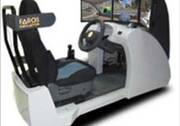
Automotive driving simulators have become critical tools for vehicle development, driver training, motorsport engineering, and road-safety research. This article provides an independent technical overview of the global automotive driving simulator landscape, including the major vendors active in the space, the main simulator categories, and the factors shaping market growth.
What Is an Automotive Driving Simulator?
An automotive driving simulator is a hardware-and-software system that replicates the dynamics of a real vehicle in a controlled, virtual environment. Engineers, researchers, and drivers use simulators to evaluate vehicle handling, test advanced driver-assistance systems (ADAS), validate control software, and train drivers — all without the cost, risk, or logistical overhead of on-road or on-track testing.
Modern simulators range from desktop software tools to large-scale motion platforms with multi-screen visual systems and force-feedback steering and pedal rigs. The fidelity required — and the budget available — determines which category of simulator is appropriate for a given application.
Key Vendors in the Automotive Driving Simulator Market
Several specialist companies and engineering firms compete in this space, each offering different combinations of motion platforms, visual systems, and vehicle-dynamics software:
- Mechanical Simulation — Best known for its CarSim, TruckSim, and BikeSim vehicle-dynamics software packages, widely used in both OEM and supplier engineering workflows.
- Ansible Motion — A UK-based specialist producing high-bandwidth, compact motion platforms (the Delta Series) targeted at automotive OEMs and motorsport teams that need high-fidelity dynamic response.
- Cruden — A Dutch company offering full-mission driving simulators for motorsport, OEM vehicle development, and driver training, including its Panthera simulator platform.
- Dallara — Primarily a racing car constructor, Dallara has invested in high-performance driving simulators used for Formula racing development and driver coaching.
- Moog — A diversified motion-control company whose simulation division supplies electric and hydraulic motion platforms used across automotive, aerospace, and defence simulators.
- Oktal — Part of the Sogeclair Group, Oktal provides SCANeR simulation software and integrated simulator systems for ADAS validation, autonomous-vehicle testing, and driver training.
Simulator Types and Categories
Automotive driving simulators are commonly segmented by their visual and motion capabilities:
Simple (Fixed-Base) Automotive Driving Simulators
Fixed-base simulators provide a vehicle cockpit, steering wheel, pedals, and a software-rendered driving environment but do not physically move the platform. They are the most affordable entry point and are widely used for driver training, HMI evaluation, and early-stage software testing where motion cues are not critical.
Single-Screen Active (Motion) Simulators
These systems add a motion platform — typically a Stewart platform or similar parallel kinematic mechanism — to a single forward-facing display. The motion system generates heave, pitch, roll, surge, sway, and yaw cues to supplement the visual scene, improving immersion and the realism of dynamic manoeuvres.
Multi-Screen (Three-Screen or Dome) Active Simulators
High-end simulators combine wide field-of-view visual systems — three or more screens, or curved projection domes — with high-bandwidth motion platforms. These configurations are used for advanced vehicle-dynamics research, ADAS/autonomous system validation, and professional motorsport development where peripheral vision and accurate motion fidelity are essential.
Primary Application Areas
- Vehicle dynamics development — Chassis, suspension, and powertrain engineers use simulators to evaluate handling behaviour and refine control parameters before physical prototypes are built.
- ADAS and autonomous vehicle validation — Safety-critical scenarios that are difficult or dangerous to reproduce on track (emergency braking, lane-departure events, sensor failure modes) can be run thousands of times in simulation.
- Driver training and assessment — Fleet operators, law-enforcement agencies, and motorsport academies use simulators to train drivers in hazardous conditions without risk.
- Ergonomics and HMI evaluation — Interior designers and UX teams use simulator environments to assess how drivers interact with infotainment, instrument clusters, and controls.
- Motorsport performance engineering — Racing teams use high-fidelity simulators for track familiarisation, setup optimisation, and driver-in-the-loop tyre and aerodynamic modelling.
Market Drivers and Restraints
Growth Drivers
- Rising investment in ADAS and autonomous driving technologies requires extensive simulation-based validation to satisfy safety standards such as ISO 26262 and UN ECE regulations.
- Electrification of vehicle powertrains creates new dynamics engineering challenges — simulators allow rapid iteration of motor calibration and regenerative braking strategies.
- Cost and time pressures in vehicle development programmes make simulator-based front-loading attractive compared with expensive physical prototype builds and track time.
- Growing adoption in driver-training applications across commercial vehicle fleets and public safety organisations.
Challenges and Restraints
- High capital cost of full-motion, high-fidelity systems limits adoption to well-funded OEMs, Tier 1 suppliers, and motorsport teams.
- Motion sickness and simulator adaptation effects can limit session durations and require careful platform tuning.
- Maintaining accurate, up-to-date vehicle and tyre models demands sustained investment in model development and correlation.
- Integration complexity when coupling simulator platforms with proprietary OEM software toolchains (e.g., MATLAB/Simulink-based control system models).
Geographic Landscape
Adoption is concentrated in regions with strong automotive OEM and motorsport ecosystems. Europe — particularly Germany, the UK, Italy, and the Netherlands — hosts both major simulator vendors and high-spending OEM customers. North America is a significant market driven by automotive R&D investment and defence/training simulation budgets. Asia-Pacific, particularly China, Japan, and South Korea, represents a growing segment as domestic OEMs increase investment in ADAS and EV development programmes.
Summary
The automotive driving simulator market spans a wide range of technologies — from low-cost fixed-base software tools to multi-million-dollar full-motion domes — serving use cases from driver training to autonomous-vehicle validation. Vendors such as Mechanical Simulation, Ansible Motion, Cruden, Dallara, Moog, and Oktal each occupy distinct niches within this ecosystem. As vehicle electrification, autonomy, and safety regulation continue to intensify, demand for high-fidelity simulation is likely to grow across the automotive value chain.