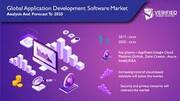
Note: This article is an independent editorial overview of the application development software market based on publicly available information about the platforms and categories mentioned. It is not a reproduction of any paid market research report, and no specific forecast figures, revenue values, or CAGR percentages are stated, as those originated in a third-party report that was not reproduced in full.
What Is Application Development Software?
Application development software encompasses the tools, platforms, and environments that developers — and increasingly non-developers — use to design, build, test, deploy, and maintain software applications. The category spans a wide spectrum: from traditional integrated development environments (IDEs) and source control platforms to low-code/no-code builders, cloud application platforms, mobile development tools, and API management services.
Demand for these tools has grown steadily as organizations of all sizes accelerate digital transformation initiatives, adopt DevOps practices, and shift workloads to cloud-native architectures. The market includes both web-based (SaaS) offerings and locally installed toolchains, serving developers targeting Android, iOS, and web platforms.
Key Platforms and Vendors in the Market
The competitive landscape is broad and spans several subcategories. Notable platforms commonly cited in this space include:
- AppSheet – A no-code application development platform (acquired by Google) that allows users to build mobile and web apps from spreadsheet or database data without writing code.
- Google Cloud Platform (GCP) – Google’s cloud infrastructure offering includes App Engine, Cloud Run, Firebase, and other services that support application development and deployment at scale.
- GitHub – The dominant source code hosting and collaboration platform, now a Microsoft subsidiary, also offering GitHub Actions for CI/CD automation.
- Zoho Creator – A low-code platform for building custom business applications, tightly integrated with the broader Zoho ecosystem.
- Microsoft Azure – Microsoft’s cloud platform provides a comprehensive set of application development services including Azure App Service, Azure DevOps, and Azure Functions.
- IntelliJ IDEA – JetBrains’ flagship IDE, widely used for Java and Kotlin development, with extensive plugin support for other languages and frameworks.
- Twilio – A cloud communications platform that provides APIs for SMS, voice, video, and authentication, commonly embedded into application workflows.
- Datadog – Primarily a monitoring and observability platform, Datadog integrates into development pipelines for performance tracking and alerting.
- Axure RP – A prototyping and wireframing tool used by UX/UI designers to create interactive application mockups.
- Joget Workflow – An open-source low-code/no-code platform for building enterprise web applications and automating workflows.
- GitLab – A complete DevOps platform offering source control, CI/CD, security scanning, and project management in a single application.
- SAP HANA Cloud Platform – SAP’s platform-as-a-service offering for building and extending enterprise applications, particularly those integrated with SAP’s ERP ecosystem.
- Snappii – A mobile business app builder targeting field operations and enterprise mobility use cases.
- King of App – A CMS-based mobile app builder platform.
Market Segments: Deployment Type and Target Platform
By Deployment Type
- Web-Based (SaaS) – Delivered via browser with no local installation. This model dominates new tool adoption due to lower friction, automatic updates, and easier collaboration across distributed teams.
- Installed (On-Premises or Desktop) – Traditional locally installed tools such as desktop IDEs. Still preferred in environments with strict data sovereignty or security requirements, or for performance-intensive workloads.
By Target Application Platform
- Android – Development tools targeting Google’s Android OS, including Android Studio, Kotlin/Java SDKs, and cross-platform frameworks such as Flutter and React Native.
- iOS – Development tools targeting Apple’s iOS platform, primarily Xcode, Swift, and Objective-C, alongside cross-platform options.
- Web – Browser-based application development covering front-end, back-end, and full-stack toolchains.
Regional Market Overview
Adoption of application development software varies by region, driven by differences in developer workforce size, enterprise IT maturity, cloud infrastructure investment, and regulatory environment:
- North America (led by the United States) – The largest single market, home to most of the major platform vendors and a mature enterprise software buyer base. Strong adoption of DevOps toolchains and cloud-native development practices.
- Europe (Germany, France, United Kingdom) – Significant enterprise demand, particularly for platforms that comply with GDPR. Growing investment in sovereign cloud and open-source tooling.
- Asia-Pacific (China, Japan, India) – Fast-growing developer population, especially in India. China’s domestic tooling ecosystem is increasingly distinct from Western platforms. Japan shows strong enterprise software adoption.
- Latin America (Brazil) – An emerging market with growing startup activity and increasing cloud platform adoption.
- Middle East and Africa – Developing market with government-led digitalization initiatives driving demand, though infrastructure maturity varies significantly by country.
Key Trends Shaping the Application Development Software Market
1. Low-Code and No-Code Acceleration
Platforms such as AppSheet, Zoho Creator, and Joget Workflow have reduced the barrier to application development. Business analysts and domain experts can now build functional applications without deep programming knowledge, which expands the total addressable market and shifts some development workloads away from traditional engineering teams.
2. DevOps and CI/CD Integration
Source control and collaboration tools like GitHub and GitLab have evolved into full DevOps platforms. Native CI/CD pipelines, container registry support, and security scanning are now expected features rather than add-ons. This has consolidated toolchain sprawl for many development teams.
3. Cloud-Native Development
Vendors like Google Cloud Platform, Microsoft Azure, and SAP HANA Cloud Platform are central to the shift toward containerized, microservices-based application architectures. Serverless computing, managed Kubernetes, and platform-as-a-service offerings reduce operational overhead and allow teams to focus on application logic.
4. AI-Assisted Development
Since the original market data was gathered (circa 2019), AI-assisted coding tools have become a significant new category within application development software. Tools offering code completion, generation, and review are now integrated into IDEs and cloud platforms, meaningfully changing developer productivity dynamics.
5. Observability as a Development Concern
The inclusion of Datadog in this market reflects a broader trend: monitoring and observability are no longer purely operational concerns. Development teams are expected to instrument applications from the start, integrating telemetry, logging, and alerting directly into the development lifecycle.
Evaluating Application Development Software: What to Look For
When assessing platforms for your team or organization, consider the following dimensions:
- Target user persona – Is the tool designed for professional developers, citizen developers, or both?
- Deployment model – SaaS, self-hosted, or hybrid? Does it meet your data residency requirements?
- Integration ecosystem – Does it connect with your existing CI/CD pipeline, cloud provider, and collaboration tools?
- Scalability – Can it support applications that grow from prototype to production workloads?
- Vendor lock-in risk – How portable are the applications and data you build on the platform?
- Security and compliance – Does it support your required compliance frameworks (SOC 2, ISO 27001, GDPR, etc.)?
- Total cost of ownership – Consider licensing, infrastructure, training, and migration costs together.
Summary
The application development software market is broad, competitive, and evolving rapidly. It encompasses everything from cloud platforms and IDEs to low-code builders and API toolkits. The vendors most relevant to any given organization depend heavily on team composition, target platform, cloud strategy, and compliance requirements. Understanding the major players and how they map to specific development use cases is a practical first step in toolchain evaluation.
For teams adopting DevOps practices, the strongest signal in this market is convergence: source control, CI/CD, security scanning, and deployment are increasingly available within single platforms like GitLab or GitHub, while hyperscaler platforms (Azure, GCP) continue to expand their developer tooling surface area.