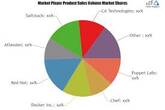
The DevOps platform market has grown from a niche discipline into a core pillar of enterprise IT strategy. Driven by the need for faster software delivery, greater reliability, and tighter collaboration between development and operations teams, organizations worldwide are investing heavily in DevOps tooling and platforms. This article examines who the major players are, how the market is segmented, which industries are adopting DevOps fastest, and what is fueling continued expansion.
What Is a DevOps Platform?
A DevOps platform is a suite of integrated tools and services that supports the principles and practices of DevOps across the full software delivery lifecycle. These platforms typically combine capabilities from several tooling categories:
- Source control and collaboration: version control, code review, and project tracking
- Build automation: continuous integration pipelines that compile, test, and package code automatically
- Configuration management: declarative infrastructure definition and drift remediation (e.g., Puppet, Chef, Ansible, SaltStack)
- Containerization and orchestration: packaging applications into portable units and managing their deployment at scale (e.g., Docker)
- Continuous delivery and release automation: safely promoting builds through staging and production environments
- Application and infrastructure monitoring: real-time visibility into system health and performance
- Security and compliance: embedding policy checks and audit trails throughout the pipeline
Organizations evaluate platforms on a maturity spectrum. Industry analysts commonly use three broad tiers: DevOps Ready (foundational tooling in place), DevOps Enabled (integrated pipelines with measurable automation), and DevOps Capable (fully optimized, culturally embedded practices with continuous feedback loops).
Major Vendors in the DevOps Platform Space
The market includes a mix of large enterprise software vendors, cloud providers, and specialist tooling companies. Vendors that have historically been prominent include:
- Puppet Labs – infrastructure automation and configuration management
- Chef (now Progress Chef) – infrastructure as code and compliance automation
- Docker Inc. – container runtime and image distribution
- Red Hat (Ansible) – agentless automation and OpenShift container platform
- Atlassian – collaboration tools including Jira, Bitbucket, and Bamboo
- SaltStack – event-driven infrastructure automation
- CA Technologies (now Broadcom) – enterprise release automation and value stream management
- Rackspace – managed cloud and DevOps-as-a-service
- XebiaLabs (now Digital.ai) – release orchestration and deployment automation
- VersionOne (now Digital.ai) – agile planning and value stream management
- Cisco – network automation and application performance management
- CollabNet (now Digital.ai) – agile lifecycle management
- IBM – DevOps toolchain integrated with hybrid cloud
- Microsoft – Azure DevOps and GitHub
- VMware – platform automation and Tanzu application platform
- DBmaestro – database DevOps and release automation
- Spirent Communications – network testing and validation
North America—particularly the United States—has historically been the largest concentration of DevOps platform vendors, though adoption is accelerating in Europe and Asia-Pacific as enterprises in those regions mature their software delivery practices.
Market Segments by Industry Vertical
DevOps platform adoption spans nearly every sector, but adoption rates and use cases vary significantly by vertical:
- Information Technology: The largest adopter. Software vendors and IT services firms were early movers and continue to drive tooling innovation.
- Banking, Financial Services, and Insurance (BFSI): Regulated but high-value adopter. DevOps accelerates feature delivery while compliance tooling addresses audit requirements.
- Retail and e-commerce: Continuous deployment of pricing, inventory, and customer experience features demands robust pipelines.
- Telecommunications: Network function virtualization and 5G rollouts are driving infrastructure automation investment.
- Education: Growing adoption of cloud-based learning platforms is increasing DevOps maturity in this sector.
- Other verticals: Healthcare, manufacturing, and government are all increasing DevOps investment, though often at an earlier maturity stage.
Regional Adoption
DevOps platform investment is global, with meaningful differences in adoption maturity and growth trajectory by region:
- North America (United States, Canada, Mexico): The most mature market. Large enterprises and cloud-native companies have driven significant tooling consolidation.
- Europe (Germany, France, UK, Russia, Italy): Strong growth, particularly in financial services and manufacturing, with GDPR compliance requirements adding demand for audit-ready pipelines.
- Asia-Pacific (China, Japan, South Korea, India, Southeast Asia): The fastest-growing region, fueled by large technology workforces, digital transformation initiatives, and rapid cloud adoption.
- South America (Brazil, Argentina, Colombia): An emerging market with growing adoption in fintech and e-commerce.
- Middle East and Africa (Saudi Arabia, UAE, Egypt, Nigeria, South Africa): Early-stage adoption, with government digitization programs and sovereign cloud initiatives beginning to create demand.
Key Growth Drivers
Several forces are accelerating DevOps platform investment across industries:
- Speed-to-market pressure: Competitive markets require faster feature delivery. DevOps practices reduce the time from code commit to production deployment.
- Cloud migration: Moving workloads to public and hybrid cloud environments creates natural demand for infrastructure automation and CI/CD tooling.
- Container and Kubernetes adoption: Containerization has made application packaging more portable, but managing container fleets at scale requires sophisticated platform tooling.
- Security integration (DevSecOps): Embedding security scanning and policy enforcement into pipelines reduces the cost and risk of vulnerabilities reaching production.
- Cultural and organizational change: Enterprises increasingly recognize that DevOps is as much a cultural transformation as a technical one, leading to broader organizational investment rather than point-tool purchasing.
- Mergers and acquisitions: Consolidation among vendors (e.g., multiple tools merging under the Digital.ai umbrella) is reshaping the competitive landscape and encouraging platform-level purchasing decisions.
Market Size and Growth Projections
According to market research cited in a 2019 industry report by HTF Market Intelligence, the global DevOps platform market was valued at approximately $2.59 billion USD in 2018 and was projected to reach approximately $7.12 billion USD by 2026, representing a compound annual growth rate (CAGR) of roughly 15.5% over that period.
These figures are from a third-party market research firm and reflect projections made in 2019. Actual market outcomes—particularly given the acceleration of cloud adoption and remote work following 2020—may differ materially from these forecasts. Readers should consult current analyst reports for updated figures.
Competitive Landscape
The DevOps platform market remains fragmented, with a mix of specialized vendors and large platform companies competing for enterprise budget. Key dynamics include:
- Point tools vs. integrated platforms: Smaller vendors offer best-in-class tools for specific pipeline stages, while larger vendors (Microsoft, IBM, Red Hat) offer broader platform coverage. Enterprises must weigh integration complexity against best-of-breed capability.
- Open source vs. commercial: Many foundational DevOps tools (Ansible, Kubernetes, Jenkins, Terraform) are open source, with vendors building commercial support and enterprise features on top. This raises the barrier for purely proprietary offerings.
- New entrants and startups: The low barrier to building SaaS tooling means new entrants continue to enter the market, particularly in areas like security scanning, observability, and AI-assisted development.
- Consolidation pressure: Enterprises dealing with toolchain sprawl are increasingly seeking fewer, better-integrated vendors—favoring established platforms with broad ecosystems.
What DevOps Maturity Means in Practice
Understanding where an organization sits on the DevOps maturity curve helps clarify which platform investments are most relevant:
- DevOps Ready: Teams have adopted source control, basic CI, and some scripted deployment. Manual steps still dominate releases.
- DevOps Enabled: Full CI/CD pipelines are in place. Infrastructure is defined as code. Automated testing gates deployments. Monitoring is integrated.
- DevOps Capable: Continuous deployment to production, feature flags, chaos engineering, and real-time feedback loops are standard practice. Security, compliance, and database changes are automated within the pipeline.
Most large enterprises in 2019 sat at the DevOps Ready or early DevOps Enabled stage. Platform vendors compete heavily to help organizations progress up this maturity curve, since higher-maturity customers typically purchase broader platform licenses and professional services.
Summary
The global DevOps platform market is large, fragmented, and growing steadily. Pressure to deliver software faster and more reliably—combined with cloud migration, containerization, and a maturing understanding of DevOps culture—continues to drive investment across industries and geographies. Vendors ranging from open-source-led specialists to large enterprise platform providers are competing for this spend, and ongoing M&A activity is reshaping which companies occupy which parts of the value chain.
For engineering and platform teams evaluating tooling, the most important consideration remains fit with your organization’s current maturity level and its realistic trajectory—not headline market size figures.
Market sizing data cited in this article is sourced from a 2019 HTF Market Intelligence report. Projections are inherently uncertain; consult current analyst research for updated figures.