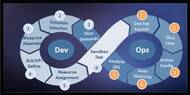
Source: financialplanning24.com (market research summary, originally published August 2019)
Global DevOps Market at a Glance
According to market research published in mid-2019, the global DevOps market was valued at approximately USD 3.62 billion in 2018 and was projected to reach USD 20.01 billion by 2026, growing at a compound annual growth rate (CAGR) of roughly 24.7% over the 2019–2026 forecast period. These figures reflect accelerating enterprise investment in continuous delivery pipelines, cloud-native infrastructure, and automation toolchains.
Even setting aside specific projections, the underlying drivers are clear: organisations across verticals were—and continue to be—under pressure to ship software faster, improve reliability, and reduce the cost of change. DevOps practices directly address all three pressures, which explains the sustained market growth.
Key Market Drivers
- Cloud adoption: Migration to public, private, and hybrid cloud environments creates a natural forcing function for DevOps tooling, particularly around infrastructure-as-code and automated provisioning.
- Agile transformation: Enterprises scaling Agile practices beyond individual teams need DevOps pipelines to prevent delivery bottlenecks.
- Microservices and containers: Container orchestration platforms (Kubernetes, ECS) require robust CI/CD pipelines and observability tooling to operate reliably at scale.
- Security and compliance pressure: The shift toward DevSecOps embeds security scanning, policy enforcement, and audit trails directly into delivery pipelines.
- Talent and toolchain consolidation: Platform engineering teams consolidating fragmented toolchains onto integrated DevOps platforms drive recurring software and SaaS spend.
Market Restraints
- Cultural resistance: Organisational silos between development, operations, and security teams remain the most cited barrier to DevOps adoption.
- Skill gaps: Demand for engineers fluent in both software development and infrastructure operations outpaces supply in most markets.
- Legacy infrastructure: Large enterprises with significant mainframe or on-premises estate face higher integration costs when adopting modern DevOps toolchains.
- Vendor lock-in concerns: Dependence on a single cloud provider’s DevOps services can constrain portability and negotiating leverage.
Leading Vendors in the DevOps Ecosystem
The 2019 research identified the following companies as leading players in the global DevOps market. The landscape has continued to evolve through acquisitions and product expansion since publication.
- Google – Cloud Build, Anthos, GKE; strong in Kubernetes-native DevOps
- Microsoft – Azure DevOps (formerly VSTS), GitHub Actions, extensive enterprise reach
- Amazon Web Services (AWS) – CodePipeline, CodeBuild, CodeDeploy; dominant cloud platform
- IBM – DevOps toolchains on IBM Cloud, integration with Red Hat OpenShift
- Red Hat – OpenShift, Ansible, acquired by IBM in 2019
- Atlassian – Jira, Bitbucket Pipelines, Confluence; strong in issue tracking and collaboration
- Oracle – Oracle Cloud Infrastructure DevOps service, Developer Cloud Service
- CA Technologies (now Broadcom) – Rally, Automic; enterprise Agile planning and release automation
- Micro Focus – ALM Octane, Fortify; testing and security integration
- Puppet – Infrastructure automation and configuration management
Regional Market Breakdown
The research segmented the market across five major regions. Understanding regional variation helps organisations and vendors prioritise investment and partnership strategies.
North America
North America represented the largest share of the DevOps market at the time of the report, driven by early enterprise cloud adoption, a mature Agile ecosystem, and concentration of major DevOps vendors (AWS, Microsoft, Google, Atlassian). The US, Canada, and Mexico were covered individually.
Europe
Europe showed strong growth, particularly in the UK, Germany, and France. GDPR compliance requirements created additional demand for DevSecOps tooling and auditable pipeline practices.
Asia-Pacific
Asia-Pacific was cited as the fastest-growing region, with China, Japan, and India as primary contributors. Rapid digital transformation initiatives and large developer communities in India and China drove adoption.
Middle East, Africa, and Latin America
These regions represented smaller but emerging opportunities, with growth tied to cloud infrastructure investment and government-backed digital transformation programmes.
Market Segmentation Dimensions
Analysts typically segment the DevOps market across three primary dimensions:
By Deployment Model
- Cloud (SaaS/PaaS): Hosted DevOps platforms managed by the vendor; lowest operational overhead
- On-premises: Self-hosted toolchains, preferred by regulated industries with strict data residency requirements
- Hybrid: Combination deployments bridging on-premises systems with cloud-native pipelines
By Solution Type
- Continuous Integration / Continuous Delivery (CI/CD)
- Configuration management and infrastructure automation
- Monitoring and observability
- Collaboration and planning (Agile boards, wikis)
- Security testing integration (SAST, DAST, SCA)
By Industry Vertical
- Banking, Financial Services, and Insurance (BFSI)
- IT and telecommunications
- Retail and e-commerce
- Healthcare and life sciences
- Government and public sector
- Manufacturing
Analytical Frameworks Used in DevOps Market Research
Comprehensive market reports in this space typically apply several standard analytical frameworks to assess the competitive environment and market attractiveness:
- Porter’s Five Forces: Evaluates competitive rivalry, threat of new entrants, supplier power, buyer power, and threat of substitutes within the DevOps tooling market.
- PEST Analysis: Assesses Political, Economic, Social, and Technological factors influencing DevOps adoption across regions.
- Value Chain Analysis: Maps how value is created and delivered across planning, development, testing, deployment, and monitoring stages.
- SWOT Analysis: Applied at the company level to profile strengths, weaknesses, opportunities, and threats for leading vendors.
Technology Trends Shaping the DevOps Market
Beyond the forecast period covered by the original report, several technology trends have reinforced or accelerated the growth trajectory identified in 2019:
- GitOps: Using Git repositories as the single source of truth for both application code and infrastructure state, enabling declarative and auditable deployments.
- Platform engineering: Dedicated internal developer platforms (IDPs) abstracting infrastructure complexity, reducing cognitive load on application teams.
- AI-assisted development and operations: Code completion, anomaly detection, and incident correlation tools integrating into DevOps pipelines.
- FinOps integration: Cost visibility and optimisation built into deployment pipelines to govern cloud spend alongside velocity.
- Supply chain security: SBOM generation, provenance attestation, and signing workflows becoming standard pipeline components post-SolarWinds and Log4Shell incidents.
What This Means for DevOps Practitioners
Market growth figures confirm what practitioners already observe on the ground: DevOps investment is not a passing trend. Engineering leaders can use this context to:
- Build business cases for internal platform teams and toolchain consolidation
- Anticipate continued vendor competition and evaluate multi-vendor or open-source strategies to avoid lock-in
- Identify skill development priorities (Kubernetes, security automation, observability) that align with where the market is heading
- Benchmark their organisation’s maturity against regional and vertical peers when assessing gaps
Note: The market size figures and CAGR cited in this article originate from a third-party research report published in 2019 via financialplanning24.com. Readers seeking current market data should consult up-to-date research from recognised analysts such as Gartner, IDC, or Forrester.