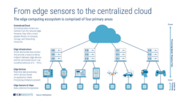
The Internet of Things (IoT) describes a vast, heterogeneous network of physical devices — from industrial sensors and connected vehicles to smart thermostats, smoke alarms, and household appliances — all transmitting data over the internet. The scale of this network is growing rapidly, and with it comes a set of engineering challenges around storing, processing, securing, and scaling the data those devices generate. Cloud computing has emerged as the primary infrastructure layer that makes large-scale IoT deployments practical.
The Scale of the IoT Data Problem
IoT devices sit at the edge of the network. They are purpose-built to sense and transmit — not to store or analyze. Most edge devices have constrained CPU, RAM, and storage because adding compute resources increases cost, power consumption, and physical size. Yet collectively, a large IoT deployment can generate data volumes that dwarf what any single on-device store could accommodate.
The logical answer is to offload storage and heavy computation to an external system — one that can scale independently of the devices themselves. That external system is, in almost every modern IoT architecture, the cloud.
Cloud Storage for IoT: Beyond Simple File Storage
Cloud providers offer object storage, time-series databases, data lakes, and managed streaming pipelines specifically designed to ingest high-velocity, high-volume IoT telemetry. Rather than provisioning physical storage inside each device — which would make devices larger, more expensive, and harder to maintain — engineers can stream raw telemetry directly to cloud endpoints and store it centrally.
This centralization has practical benefits beyond cost:
- Unified data access: All device data lands in one queryable location, making cross-device correlation straightforward.
- Retention flexibility: Retention policies can be adjusted without touching the devices themselves.
- Redundancy: Cloud storage is inherently replicated across availability zones, providing durability that no single edge device could offer.
Processing Power: Turning Raw Telemetry into Insight
Storage alone is not enough. Raw sensor readings — temperature values, GPS coordinates, vibration amplitudes — are meaningless in isolation. Value emerges when data from many devices, collected over time, is aggregated, correlated, and analyzed.
Cloud platforms provide the compute capacity to run these workloads at scale: stream processing pipelines can apply real-time transformations and anomaly detection as data arrives, while batch analytics jobs can identify longer-term trends across weeks or months of historical data. Machine learning models trained on this aggregated data can then be deployed back to the edge to improve device behavior — a pattern sometimes called the cloud-to-edge feedback loop.
A concrete example is IoT data used in CRM or customer analytics platforms. Individual device interactions — a user adjusting a thermostat, pausing a connected appliance — are low-signal on their own. Aggregated across thousands of users and devices in cloud infrastructure, these interactions can reveal behavioral patterns, inform product decisions, and drive personalized experiences.
Latency: When Cloud Isn’t Fast Enough
Sending data to a remote cloud data center and waiting for a response introduces latency — typically measured in tens of milliseconds over a well-connected link, but potentially much higher under congested or unreliable network conditions. For many IoT use cases, this is perfectly acceptable. A connected fridge reporting its temperature inventory has no need for millisecond response times.
However, there are categories of IoT application where this latency is unacceptable:
- Autonomous and assisted driving: Collision avoidance decisions must be made in microseconds to milliseconds. A round-trip to a cloud data center is far too slow.
- Medical devices: An implantable cardiac monitor detecting an arrhythmia needs to trigger a local alert immediately, without waiting for cloud acknowledgment.
- Industrial safety systems: A sensor detecting dangerous pressure buildup in a pipeline must trigger a valve closure locally and instantly.
This latency constraint is the primary driver behind edge computing — deploying compute resources physically close to the devices, on-premises or at network edge nodes, so that time-critical decisions can be made locally. The cloud then handles less time-sensitive tasks: long-term storage, model training, analytics, and dashboard reporting. A well-designed IoT architecture typically uses both tiers: edge compute for real-time response, cloud for scale and intelligence.
Security: Centralization as Both Shield and Target
IoT security is a well-documented challenge. Devices are often deployed in physically accessible locations, may run firmware that is difficult to update, and frequently connect over untrusted networks. A cloud-based security layer addresses some of these weaknesses:
- Centralized threat detection: Anomalous behavior on one device — unusual data volumes, unexpected connection attempts — can be detected centrally and used to trigger protective actions across the entire fleet.
- Certificate and identity management: Cloud IoT platforms provide device identity services that issue and rotate cryptographic credentials, reducing the risk of credential compromise.
- Firmware update delivery: Over-the-air (OTA) update infrastructure, typically cloud-hosted, is essential for patching vulnerabilities across large device fleets.
At the same time, centralizing data in the cloud creates a high-value target. A breach of the cloud backend can expose data from every device in the network simultaneously. This tension — centralization as both enabler and risk — is one of the core security engineering challenges in IoT architecture. Defense-in-depth strategies, including network segmentation, end-to-end encryption of device telemetry, and strict access control on cloud APIs, are essential mitigations.
Financial Scalability: Pay for What You Use
IoT workloads are rarely uniform. A retail chain’s sensor network may generate orders of magnitude more data during peak shopping seasons than in slow periods. An agricultural monitoring platform may have high data ingestion during growing seasons and near-zero traffic in winter. Pre-provisioning fixed on-premises infrastructure to handle peak load means paying for idle capacity the rest of the time.
Cloud infrastructure’s pay-as-you-go model maps well to these variable demand patterns. Storage and compute can scale up automatically when device data volumes increase and scale back down when they fall — without requiring manual intervention or capital expenditure. This elasticity is particularly valuable for IoT startups and teams running pilot deployments who cannot accurately forecast their eventual data volumes.
Architectural Patterns: Cloud-Only vs. Hybrid Edge-Cloud
Understanding when to use cloud-only versus a hybrid edge-cloud architecture is a key design decision in any IoT project. The following table summarizes common considerations:
| Requirement | Cloud-only | Edge + Cloud |
|---|---|---|
| Response latency | Tens of milliseconds and above | Sub-millisecond to low millisecond |
| Network reliability | Requires stable connectivity | Can operate offline locally |
| Data volume management | All raw data sent to cloud | Filtering and aggregation at edge reduces egress |
| Operational complexity | Lower — no edge infrastructure to manage | Higher — edge nodes require provisioning and updates |
| Cost at scale | Data egress costs can be significant | Edge filtering reduces cloud ingestion and egress costs |
Key Takeaways
- IoT devices generate large data volumes but have limited onboard compute and storage. Cloud infrastructure fills this gap.
- Cloud platforms provide not just storage but also the processing pipelines, analytics engines, and ML infrastructure needed to derive value from raw telemetry.
- Latency constraints in safety-critical IoT applications require edge compute alongside cloud backends — not instead of them.
- Cloud-based security tooling helps manage large device fleets, but centralization also increases the consequence of a backend breach. Security must be layered.
- Cloud’s elastic cost model suits the variable, hard-to-forecast data volumes typical of IoT deployments.
As IoT device fleets continue to grow, the cloud remains the most practical and scalable backend infrastructure available. The engineering challenge is not whether to use cloud, but how to architect the boundary between edge and cloud to meet the specific latency, reliability, and cost requirements of each application.