Source: dbta.com (original announcement, October 2019)
Overview
Talend, a provider of cloud data integration and data integrity solutions, announced the general availability of Talend Cloud on Microsoft Azure. The release delivers a secure, scalable Integration Platform-as-a-Service (iPaaS) designed to help organizations collect, transform, and clean data at cloud scale.
By pairing embedded data quality with native Azure performance, the offering aims to give enterprises the trusted, timely data they need to support real-time business decisions, advanced analytics workloads, and regulatory compliance requirements.
Why Azure?
As enterprise data volumes grow and more workloads migrate to the cloud, organizations increasingly need integration tooling that is co-located with—and optimized for—their cloud provider of choice. Running Talend Cloud natively on Azure reduces data movement latency, simplifies identity and security management, and lets teams take advantage of Azure-native services without additional configuration overhead.
Talend Cloud on Azure is also designed to support multi-cloud and hybrid environments, meaning teams are not locked into a single deployment model. Organizations already running on-premises infrastructure, or splitting workloads across cloud providers, can connect those environments through the same platform.
Key Features and Capabilities
The Azure release of Talend Cloud introduces or expands the following capabilities:
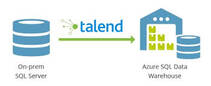
- Broad Azure connectivity: Native connectors and optimized performance for Azure SQL Data Warehouse, Azure Databricks, Azure Data Lake Store, Azure HDInsight, and additional Azure services, alongside support for on-premises and third-party cloud sources.
- Built-in pervasive data quality: Data quality checks are embedded throughout the pipeline rather than applied as a post-processing step, helping teams enforce data standards and meet compliance requirements continuously.
- Azure DevOps integration with CI/CD and serverless support: Teams can incorporate Talend pipelines into existing Azure DevOps workflows, enabling automated testing, deployment pipelines, and serverless execution models for easier scaling without infrastructure management.
- Governed self-service applications: Tools such as Pipeline Designer, Data Preparation, and Data Stewardship allow data analysts and business users to participate in data workflows without requiring deep engineering involvement, while maintaining governance controls.
- Predictable, user-based pricing with pay-as-you-go options: The licensing model is designed to give organizations cost predictability, with flexibility to scale consumption up or down based on actual usage.
Use Cases
Talend positions the Azure offering as suitable for several common enterprise scenarios:
- Customer segmentation: Ingesting and cleansing customer data at scale to produce higher-quality segmentation models.
- Data science operationalization: Integrating data pipelines with machine learning workflows so that trained models can act on reliable, up-to-date data.
- Historical and streaming data integration: Combining batch historical data with real-time event streams to enable faster responses to market changes or operational events.
- Cloud data warehouse acceleration: Streamlining the movement and transformation of data into Azure Synapse Analytics (formerly SQL Data Warehouse) for business intelligence workloads.
What Talend Says
“Our strong relationship with Microsoft on Analytics and Azure led to combining our technologies to provide an easier, faster, and seamless experience for companies that want to accelerate their cloud data warehousing and advanced analytics projects. We’ve built Talend Cloud on Microsoft Azure to meet growing demand from companies wanting to process data faster for better insight and customer experiences, using the same budget and skill sets. We are thrilled to work closely with the Azure team to make this offering possible.”
— Ciaran Dynes, Senior Vice President of Product, Talend
Context for DevOps and Data Engineering Teams
For DevOps engineers working alongside data engineering teams, the most immediately relevant aspect of this release is the Azure DevOps integration and CI/CD support. The ability to version-control, test, and deploy Talend pipelines through the same toolchain used for application code reduces the gap between application delivery practices and data pipeline delivery practices—a gap that historically has caused reliability and governance problems in data platforms.
Serverless execution support also reduces the operational burden of managing Talend job infrastructure, shifting responsibility for scaling and availability to the platform rather than requiring dedicated cluster management.
Organizations evaluating Talend Cloud on Azure should assess connector coverage for their specific source systems, review how data quality rules are authored and maintained, and confirm that the CI/CD integration meets their existing pipeline governance requirements before committing to a migration or greenfield deployment.