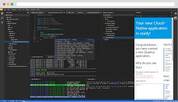
Originally announced at Oracle Code One, San Francisco, September 17, 2019. Source: globenewswire.com
Eclipse Che 7: A Kubernetes-Native IDE Built for Cloud Native Teams
The Eclipse Foundation announced Eclipse Che 7 at the Oracle Code One conference in San Francisco, positioning it as the first developer workspace server and Integrated Development Environment (IDE) purpose-built for creating cloud native, enterprise applications on Kubernetes. The release represents more than six years of community development, with contributions from over 20 vendors.
“Eclipse Che 7 is the culmination of more than six years of community contributions, including more than 20 vendors, delivering a tremendous boost to the productivity of cloud native development on Kubernetes,” said Mike Milinkovich, executive director of the Eclipse Foundation. “As the world’s first Kubernetes-native IDE, Che 7 makes the developer and production environments the same on a scalable, collaborative, and secure platform specifically designed for building containerized applications.”
The Problem Che 7 Solves
Kubernetes is powerful for running applications at scale, but its operational complexity creates a significant barrier for many developers. Most application developers are not Kubernetes specialists, yet they are increasingly expected to build applications that run on Kubernetes clusters. This creates friction: environment setup is time-consuming, onboarding new team members is slow, and local development environments rarely match production configurations.
Che 7 addresses this by abstracting away Kubernetes complexity. Developers get a fully configured, centrally hosted workspace that handles building and packaging applications for Kubernetes automatically. The result is a dramatically shorter path from writing code to running it in a production-like environment.
Key Features of Eclipse Che 7
- Kubernetes-native workspaces: Every component of the development environment — the IDE, its plugins, and their dependencies — runs as a Kubernetes application. This makes environments repeatable and reproducible across the entire team.
- Browser-based IDE powered by Eclipse Theia: Che 7 ships with a pre-packaged web-based IDE built on an extended version of Eclipse Theia, delivering a Visual Studio Code-compatible experience entirely in the browser. No local software installation is required.
- Devfiles: A new Devfile specification allows teams to define workspace configurations as code, enabling any developer to spin up a pre-configured environment from a single file checked into source control.
- Centrally hosted workspaces: Developer workspaces are hosted centrally, making it easy to share projects, enforce consistent tooling, and apply enterprise-grade security policies from a single control plane.
- Flexible deployment: Che 7 supports deployment on public Kubernetes clusters as well as on-premises data centers, giving organizations the flexibility to meet their own compliance and infrastructure requirements.
- Faster onboarding: New team members can begin contributing to a project immediately without spending time configuring local development environments, since all workspace definitions are shared and version-controlled.
Closing the Gap Between Development and Production
One of the persistent challenges in Kubernetes-based development is environment drift — the subtle differences between how an application runs on a developer’s laptop versus how it behaves in a production cluster. Che 7 eliminates this gap by running the development environment itself inside Kubernetes, using the same runtime stacks, container images, and orchestration infrastructure that production workloads use.
“With Che 7, everything a cloud native developer needs — including the IDE, its plugins, and their dependencies — is running as a Kubernetes application, so everything becomes repeatable and reproducible,” said Brad Micklea, Vice President, Developer Tools and Programs at Red Hat. “Now, developers can more quickly spin up a development environment in Kubernetes that mirrors a production application and Che will take care of adding the development, build and debugging tools needed for them. Anyone, anytime, can contribute to a project without installing software, thus enabling faster application development from a more secure, centrally hosted environment.”
Ecosystem Adoption and Vendor Integration
Eclipse Che and Eclipse Theia were already integrated into cloud native offerings from vendors including Google, IBM, and Broadcom at the time of the Che 7 release. Most notably, Che 7 forms the core of Red Hat CodeReady Workspaces, Red Hat’s developer environment solution for OpenShift.
Broadcom highlighted Che’s role in enabling mainframe developers to adopt modern DevOps workflows. “We’re delighted to be part of the Eclipse Che community bringing a modern, open approach to the mainframe platform,” said Jean-Louis Vignaud, Director, Product Management, DevOps and Open Mainframe at Broadcom. “Empowering developers with open source tools that deploy easily, facilitate on-boarding, and drive frictionless DevOps workflows across platforms is a cornerstone of our mainframe strategy.”
Nuxeo shared a practical migration story. “At Nuxeo, we have been using Eclipse Che 5 since its first days as our Developer Certification Platform,” said Arnaud Kervern, developer advocate at Nuxeo. “We’re currently migrating all of our internal services to Kubernetes. We’re seeing more and more activity spikes on our Developer Certification Platform so it seemed natural to move forward with Che 7 over Kubernetes to react faster to those scalability issues. With all the great new Che 7 features like Devfiles and Eclipse Theia IDE with Java Support, we’re already planning to create new improvements for our online customer experience on top of Che 7.”
Why This Matters for DevOps Teams
For DevOps teams managing Kubernetes-based CI/CD pipelines, Eclipse Che 7 addresses a common pain point: the development environment itself is often the least automated part of the software delivery chain. Che 7 brings the same infrastructure-as-code principles that govern production deployments to developer workspaces, making them version-controlled, auditable, and reproducible.
The security implications are also significant. Centrally hosted workspaces mean that source code and credentials need not leave the cluster. Developers work through a browser, reducing the risk of sensitive data being stored on personal devices. Access controls, workspace policies, and audit logs can be managed centrally by platform or security teams.
About the Eclipse Foundation
The Eclipse Foundation is a not-for-profit organization that provides a mature, scalable, and commercially focused environment for open source software collaboration. It is home to the Eclipse IDE, Jakarta EE, and over 375 open source projects spanning IoT, automotive, geospatial, systems engineering, and other technology domains. The Foundation is supported by over 275 member organizations.
Red Hat and OpenShift are trademarks or registered trademarks of Red Hat, Inc. or its subsidiaries in the U.S. and other countries. All other third-party trademarks are the property of their respective owners.