At a time when variations on DevOps continue to multiply, GitOps has emerged as one of the most substantive. Rather than a buzzword, GitOps represents a concrete operational model: it applies the workflows developers already trust—pull requests, code review, version control, CI/CD pipelines—to infrastructure management and deployment operations. This article breaks down what GitOps means in practice, what tooling it depends on, what teams stand to gain, and where adoption tends to get difficult.
What Is GitOps?
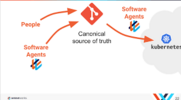
At its core, GitOps is the practice of defining infrastructure and operational procedures as code, stored and managed in a Git repository. Git becomes the single source of truth for everything running in production—and in staging and development environments as well.
Declarative tools such as Terraform, AWS CloudFormation, and Kubernetes make this practical. Because these tools describe the desired state of a system rather than a sequence of imperative commands, the state of your infrastructure can be expressed in files that live in source control just like application code.
However, GitOps is more than Infrastructure as Code. True operational practice also requires a structured process for planning, reviewing, approving, and releasing changes—whether those changes are to application deployments or to foundational infrastructure such as networking and security controls. GitOps covers that full lifecycle. When implemented well, every change to infrastructure follows the same pull-request-based workflow used for application code: propose, review, approve, merge, and deploy.
The practical results of this model are significant:
- Full audit trail: Every change is recorded in Git history, making compliance and forensic investigation straightforward.
- Easy rollback: Reverting a problematic change is as simple as reverting a commit or merge request.
- Repeatability: Infrastructure defined in code can be reliably reproduced across environments.
- Visibility: The Git repository answers the “what changed and when?” question without requiring anyone to hunt through change logs or ask colleagues.
What Technology Does GitOps Require?
Adopting GitOps requires assembling a toolchain that spans version control, declarative infrastructure provisioning, Kubernetes orchestration, and a CI/CD platform to tie them together.
Version Control
A Git-based repository is the non-negotiable foundation. All infrastructure definitions, runbooks, and configuration live here. GitHub, GitLab, Bitbucket, and self-hosted Gitea are all viable options, though the surrounding workflow tooling matters as much as the repository itself.
Declarative Infrastructure Tools
Terraform is widely used for provisioning cloud infrastructure (compute, networking, databases, DNS, and so on) across providers. Because Terraform state is declarative, diffs between the current state and desired state can be reviewed before applying changes—a natural fit for pull-request-based workflows.
Kubernetes manages containerized application workloads declaratively using YAML manifests. Tools such as Helm (for packaging Kubernetes manifests as versioned charts) and Flux or Argo CD (for continuous reconciliation of the cluster state against a Git repository) extend Kubernetes into a full GitOps delivery platform.
CI/CD and Workflow Platform
A platform that integrates issue tracking, merge requests, and CI/CD pipelines is what wraps the operational process around the infrastructure tooling. GitLab is one example of an end-to-end solution that can manage the backlog of infrastructure requests, route them to the appropriate engineer, facilitate review and approval, and trigger automated execution of changes through its built-in CI/CD system. Other teams assemble equivalent workflows from separate tools—GitHub Actions for CI/CD, Jira for issue tracking, and dedicated GitOps controllers such as Flux or Argo CD for Kubernetes reconciliation.
The key requirement is not a specific product but a coherent workflow: every change should originate as an issue or request, be implemented as a code change in Git, pass through peer review, and be deployed automatically or semi-automatically by the pipeline—never applied manually in production.
What Are the Benefits of GitOps?
GitOps is one of the few DevOps practices that delivers concrete improvements for both developers and operations engineers simultaneously.
Collaboration Replaces Isolation
Traditional operations work is often performed by a single engineer working in isolation—making changes directly on servers or in cloud consoles that nobody else can see. GitOps makes every infrastructure change visible and collaborative. Pull requests invite review from peers, architects, and security teams before anything reaches production.
Consistency and Repeatability
Because all infrastructure is defined in code, environments can be reproduced reliably. The “it works on my machine” or “I set that up manually six months ago” problems are eliminated. New environments—for testing, disaster recovery, or regional expansion—can be spun up from the same Git repository that drives production.
Faster Recovery
When something goes wrong, GitOps shortens the mean time to recovery. The Git history shows exactly what changed and when. Rolling back is a revert commit away. And because the desired state is always expressed in code, automated reconciliation tools can detect and correct drift from that state.
Built-in Compliance and Auditability
Regulated industries that require change-management documentation benefit directly from GitOps. Every merge request serves as an auditable record of who proposed a change, who reviewed it, who approved it, and when it was deployed. This can satisfy audit requirements that previously demanded separate change-management systems.
Continuous Delivery for Infrastructure
GitOps enables teams to apply infrastructure updates continuously—at the cadence of application delivery rather than in infrequent, high-risk maintenance windows. Smaller, more frequent changes are easier to test, easier to review, and much easier to roll back.
Possible Challenges
GitOps is not without friction, and organisations that underestimate the cultural and process changes involved often struggle with adoption.
Discipline Is Non-Negotiable
GitOps only works if the team commits to using it for every change. The temptation to make a quick manual fix directly in production—”cowboy engineering”—is real, especially under time pressure. Every manual change that bypasses Git undermines the audit trail, creates configuration drift, and erodes the trust that the repository is actually the source of truth. Teams adopting GitOps need explicit agreement and cultural reinforcement that the Git workflow is the only path to production.
Documentation and Written Communication
GitOps requires engineers to write things down: in merge request descriptions, in issue comments, in runbooks stored alongside the infrastructure code. For teams with a strong oral or ad-hoc culture, this is a genuine adjustment. The value of the audit trail is directly proportional to the quality of the written context surrounding each change.
Toolchain Complexity
Assembling and maintaining a GitOps toolchain—Git repository, Terraform, Kubernetes, Helm, a GitOps controller such as Flux or Argo CD, and a CI/CD platform—introduces its own operational overhead. Teams without existing Kubernetes expertise may find the learning curve steep. Starting with a smaller scope (see below) helps manage this complexity.
Secret Management
Storing everything in Git creates an obvious tension with secrets management. Credentials, API keys, and certificates must never be committed to a repository in plain text. GitOps workflows require a complementary secrets management strategy—using tools such as HashiCorp Vault, AWS Secrets Manager, or Kubernetes-native solutions like Sealed Secrets or External Secrets Operator—to keep sensitive values out of Git while still enabling automated deployments.
Getting Started: Start Small and Iterate
If GitOps sounds like a fit for your organisation, the practical advice is to resist the urge to roll it out everywhere at once. Pick a small, well-defined area—a single service, a single environment, or a single piece of infrastructure—and implement the full GitOps workflow there first. Get a working example that the team can learn from, demonstrate the value, and then expand from that foundation.
This iterative approach reduces risk, builds the team’s confidence and skills with the toolchain, and surfaces process problems at a manageable scale before they affect critical systems.
Summary
| GitOps Dimension | Key Points |
|---|---|
| Definition | Infrastructure and ops procedures defined as code in Git; Git is the single source of truth |
| Core tooling | Git, Terraform, Kubernetes, Helm, Flux or Argo CD, CI/CD platform |
| Primary benefits | Auditability, repeatability, faster recovery, continuous delivery, cross-team collaboration |
| Main challenges | Cultural discipline, written documentation, toolchain complexity, secrets management |
| Adoption advice | Start with a small scope, prove value, then expand iteratively |
GitOps is not a silver bullet, but for teams already comfortable with Git-based workflows for application development, extending those same habits to infrastructure management offers a coherent, auditable, and repeatable approach to operations that scales with organisational complexity.