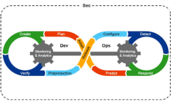
Organizations of all sizes and across all industries have embraced DevOps culture and practices. DevOps accelerates the development and deployment of applications, but velocity without security discipline creates significant risk. DevSecOps emerged directly from that tension: it is the practice of integrating security into every stage of the DevOps lifecycle rather than treating it as a gate at the end of the pipeline.
Why Security Cannot Be an Afterthought in DevOps
In traditional software delivery, security reviews happened late in the cycle—often just before a production release. DevOps compressed delivery cycles dramatically, which meant that a late-stage security review either became a bottleneck or was skipped entirely. DevSecOps resolves this by shifting security left: making it a shared responsibility of developers, operations engineers, and security teams from the very beginning of a project.
Despite the logic of this approach, many organizations still struggle to treat security as an inherent property of their systems rather than an add-on. The reasons are partly cultural, partly skills-based, and partly structural.
The Two Foundational Pillars of DevSecOps
According to security practitioners, successful DevSecOps implementation rests on two core elements: training and automation.
1. Training: Building a Security-Aware Engineering Culture
Secure coding is not an innate skill. Developers entering the workforce—regardless of the quality of their academic training—rarely arrive with deep knowledge of secure coding practices, threat modeling, or common vulnerability patterns such as those documented in the OWASP Top 10. Organizations cannot assume that skill exists; they must build it deliberately.
Effective security training for engineering teams typically includes:
- Secure coding guidelines specific to the languages and frameworks the team uses
- Threat modeling workshops that teach developers to think like attackers when designing features
- Hands-on exercises using intentionally vulnerable applications (such as OWASP WebGoat or similar platforms) to practice identifying and fixing real vulnerabilities
- Regular refreshers as new vulnerability classes and attack techniques emerge
Critically, security skill development is iterative. A developer who receives consistent feedback from automated scanning tools over months will internalize patterns, write fewer vulnerable code paths, and require less remediation over time. Training and tooling therefore reinforce each other.
2. Automation: Removing Security as a Bottleneck
One of the most common points of friction between development and security teams is time. Manual security reviews introduce delays that conflict directly with the fast-iteration ethos of DevOps. The solution is not to skip security reviews—it is to automate as many of them as possible and integrate them into the existing CI/CD pipeline so they run without requiring human scheduling.
A mature DevSecOps pipeline typically incorporates several layers of automated security tooling:
- Static Application Security Testing (SAST): Scans source code for known vulnerability patterns at check-in time, before code is compiled or deployed.
- Software Composition Analysis (SCA): Identifies known vulnerabilities in open-source dependencies and third-party libraries.
- Dynamic Application Security Testing (DAST): Runs automated attack simulations against a running application in a staging environment.
- Infrastructure-as-Code (IaC) scanning: Checks Terraform, CloudFormation, Kubernetes manifests, and similar configuration files for security misconfigurations before they reach production.
- Secrets detection: Prevents API keys, passwords, and certificates from being committed to source control.
When these tools are integrated into a CI platform such as Jenkins, GitHub Actions, GitLab CI, or similar, a developer receives security feedback in the same workflow as build failures and test results. The result is faster remediation—the developer is still in context when the issue is flagged—and a tighter feedback loop that accelerates skill development.
The Legacy Infrastructure Problem
Secure code does not exist in isolation. The operations environment it runs in has its own security posture, and many organizations carry significant technical debt in the form of outdated hardware, unsupported operating systems, and deprecated network protocols. This creates a compounding problem for DevSecOps:
- Developers may be required to write code that targets legacy runtime environments where modern security controls are unavailable or incompatible.
- Backward-compatibility requirements with older systems can force the use of weak cryptographic protocols or insecure API patterns even when the new code itself is written correctly.
- Unpatched infrastructure introduces vulnerabilities that no amount of secure coding can mitigate at the application layer.
Addressing legacy infrastructure is not purely a security problem—it is a business and architecture problem that requires executive support, dedicated investment, and a roadmap for modernization. DevSecOps programs that ignore this dimension will hit a ceiling regardless of how strong their training and automation practices are.
Measuring DevSecOps Maturity
Progress in DevSecOps is measurable. Teams that have invested in training and automation should expect to see improvement in metrics such as:
- Mean time to remediate (MTTR) security findings: As developers become more skilled and tooling provides faster feedback, the time between vulnerability discovery and fix should decrease.
- Vulnerability density: The number of security findings per thousand lines of code should decline over time as developers internalize secure coding patterns.
- Percentage of pipeline stages with security gates: A mature DevSecOps program integrates security checks at multiple stages of the pipeline, not just at the end.
- Reduction in critical and high findings reaching production: The ultimate measure of whether shift-left security is working.
The Goal: Security as a Default, Not a Discipline
The long-term vision for DevSecOps is a state where security is so deeply embedded in development culture and tooling that a separate “DevSecOps initiative” is no longer necessary. Security becomes a property of the system—like reliability or performance—rather than a compliance exercise bolted on at the end.
Getting there requires sustained investment in the two pillars described above: equipping engineers with the knowledge to write secure code, and building the automation infrastructure that catches issues when humans inevitably miss them. Organizations that treat both as ongoing, iterative programs rather than one-time projects are the ones most likely to close the gap between DevOps velocity and security assurance.