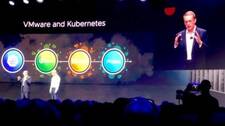
This article is based on announcements made at VMworld 2019 in San Francisco and reporting originally published by SiliconAngle. Analyst commentary is attributed to Wikibon.
VMware’s Strategic Pivot: Kubernetes Meets vSphere
VMware used VMworld 2019 in San Francisco to make a sweeping set of announcements aimed at strengthening its position in multicloud computing. At the centre of those announcements was a move that analysts have characterised as a classic “bet the business” gambit: Project Pacific, the architectural core of the forthcoming VMware Tanzu Portfolio.
Announced during the Day One keynote, Project Pacific will embed Kubernetes directly into the control plane of a future release of vSphere, VMware’s flagship server virtualisation platform. Beyond a simple integration, the project adds a container runtime into the vSphere hypervisor itself. A new construct called ESXi native pods combines the properties of Kubernetes pods and traditional virtual machines (VMs), with the stated goal of improving security and performance for mission-critical workloads — without forcing teams to choose between one runtime model and the other.
What Is the VMware Tanzu Portfolio?
At the time of VMworld 2019, the Tanzu Portfolio was available only in limited preview. Its core promise is a single control plane from which platform and DevOps teams can monitor, manage, and enforce policies across all Kubernetes clusters — regardless of which cloud or on-premises environment those clusters run in.
Key capabilities described at launch include:
- Tanzu Mission Control: A centralised console allowing developers to use familiar vSphere tooling to deliver applications to Kubernetes clusters, while also exposing Kubernetes API constructs inside vSphere.
- Kubernetes API access to VMware SDDC infrastructure: The tooling exposes VMware’s software-defined data centre (SDDC) virtualisation infrastructure via standard Kubernetes APIs, enabling consistent operations across hybrid and multicloud environments.
- Unified DevOps view: Operators see Kubernetes constructs rendered consistently within vSphere’s interface, reducing the cognitive overhead of managing two distinct runtime environments.
VMware did not announce a general availability date for Tanzu at VMworld 2019, leaving customers reliant on the limited preview to assess real-world readiness.
The Business Logic: Why Kubernetes Migration Is Central to VMware’s Growth
Kubernetes alone is not a differentiator for any vendor — it is open-source infrastructure available to everyone. VMware’s wager is more nuanced: if it can make migration from VM-based workloads to Kubernetes-backed, multicloud-ready architectures fast and low-risk for its enormous enterprise customer base, it creates significant cross-sell opportunities for premium services built on top of that Kubernetes backplane.
At the time of the announcements, VMware reported that more than 70 million workloads ran on VMware infrastructure, with approximately 10 million already in the cloud. VMware Cloud provided a consistent hybrid cloud platform spanning AWS, Microsoft Azure, Google Cloud, and IBM Cloud, along with more than 60 VMware Cloud Verified partners worldwide.
The competitive urgency is real. Rival VM/container convergence approaches were already emerging, including:
- AWS Firecracker and Fargate: Lightweight micro-VM runtimes from Amazon Web Services.
- CNCF KubeVirt: An open-source project enabling traditional VM workloads to run alongside container workloads on Kubernetes.
- Google gVisor: A user-space kernel providing container isolation with VM-like security boundaries.
- Intel Kata Containers: Containers that run inside lightweight VMs to provide stronger isolation.
Each of these approaches addresses the same fundamental tension: containers offer density and speed, while VMs offer stronger isolation. VMware’s answer with Project Pacific is to converge the two at the hypervisor level rather than at the orchestration layer.
Key Kubernetes-Related Announcements at VMworld 2019
Project Pacific and Tanzu were not VMware’s only Kubernetes moves at VMworld 2019. The following announcements collectively show a strategy to make every layer of the VMware stack Kubernetes-aware:
- Pivotal Acquisition: VMware’s agreement to acquire Pivotal deepened its stake in VMware Enterprise PKS (now VMware Tanzu Kubernetes Grid), the Kubernetes platform the two companies co-developed. The acquisition gave VMware direct control over a commercially supported Kubernetes distribution with an existing enterprise customer base.
- Cloud Migration Services: A new console experience designed to simplify migration of VM workloads to hybrid clouds, initially focusing on VMware Cloud on AWS. Future support for VMware Cloud on AWS Outposts and VMware Cloud on Dell EMC was indicated. The new VMware CloudHealth Hybrid tool added per-workload optimisation for Kubernetes migrations, factoring in cost, performance, and security requirements.
- Bitnami Acquisition and Project Galleon: VMware’s acquisition of Bitnami brought a large catalog of pre-built, scanned, and maintained application content for Kubernetes clusters, serving a developer community reported at 2.5 million users. Building on that, VMware launched Project Galleon (in beta), enabling enterprise IT departments to deliver pre-validated, multicloud-ready Kubernetes application stacks to their developers. ISV partners building on the Bitnami Community Catalog were also highlighted.
- vSphere 6.7 Update 3: This release added support for high-performance containerised AI workloads powered by multiple NVIDIA GRID virtual GPUs per VM, acknowledging that a significant share of new containerised workloads are AI and machine learning applications.
- vSAN 6.7 Update 3: Updated to provide container-ready storage infrastructure, enabling AI and next-generation containerised applications to operate consistently across multiclouds.
- VMware Hybrid Cloud Operations Enhancements (AIOps): New AI-driven capabilities for deploying and managing containerised Kubernetes applications across multiclouds, covering cost management, resource governance, security, performance monitoring, and closed-loop remediation.
- Wavefront Enhancements: Updates to Wavefront by VMware added automatic service discovery and monitoring for Kubernetes environments, including the ability to track health and performance of workloads running across more than 200,000 concurrent containers.
The Strategic Risk: VMs May Have a Longer Shelf Life Than Expected
VMware’s Tanzu strategy contains a structural tension worth understanding. By enabling VMs and containers to coexist indefinitely through ESXi native pods and Project Pacific, VMware may inadvertently reduce its customers’ urgency to migrate fully to a Kubernetes-native application backplane — which is the very outcome its cross-sell strategy depends on.
Evidence from VMworld suggested this tension is already playing out. Mark Lohmeyer, then Senior Vice President of VMware’s Cloud Platform Business Unit, noted in a theCUBE interview that customer adoption of VMware Cloud on AWS had grown sharply: a 4x increase in customers on the service and a 9x increase in VM count. That growth was being driven by lift-and-shift migrations — moving existing VMs to the cloud without re-architecting them — rather than by Kubernetes-native deployments.
Lohmeyer framed this as a feature, not a bug: “We could help them migrate to the public cloud very quickly without requiring any changes if they don’t want to. And then when they’re there, they can modernise at their own pace based on the needs of the business.”
For DevOps teams, this is a practical operating reality. Organisations with large VM footprints are unlikely to perform a “big bang” migration to containers. A platform that supports both — and allows phased modernisation — is more likely to see adoption than one that demands immediate re-architecture.
The risk for VMware is the inverse: if VM workloads remain economically and operationally viable for years, the incentive to purchase Kubernetes-native premium services from VMware is reduced. KubeVirt and similar projects further complicate the picture by offering open-source paths to VM/container coexistence that do not require VMware’s commercial stack.
What This Means for Enterprise DevOps and Platform Teams
The Wikibon analyst team offered the following guidance for VMware customers at the time of the VMworld 2019 announcements:
- Evaluate Project Pacific through the limited preview: The primary criterion should be whether ESXi native pods genuinely improve security and performance for workloads that mix containers and VMs — not just whether the integration is technically functional.
- Assess the broader Tanzu announcement set together: The individual announcements — Pivotal, Bitnami, Wavefront, vSAN, CloudHealth Hybrid — are designed to work as a suite. Evaluating them in isolation misses the strategic intent.
- Do not assume full Kubernetes migration is imminent: VMware’s own data suggests that VM lift-and-shift remains the dominant motion for most enterprise customers. Plan for a multi-year coexistence phase rather than a near-term cutover.
- Track competing convergence approaches: KubeVirt, Firecracker, Kata Containers, and gVisor are all maturing rapidly. Organisations with the engineering capacity to evaluate open-source alternatives should do so before committing to a proprietary convergence platform.
Summary
VMworld 2019 marked a clear inflection point in VMware’s positioning. By embedding Kubernetes into vSphere’s hypervisor through Project Pacific, acquiring Pivotal and Bitnami, and extending Kubernetes-awareness across its storage, monitoring, and cloud management portfolio, VMware made a co-ordinated bet that the enterprise path to Kubernetes would run through its existing infrastructure — not around it.
Whether that bet pays off depends on two variables: how quickly VMware can demonstrate that the Tanzu platform genuinely simplifies VM-to-Kubernetes migration at scale, and how long enterprise customers continue to invest in their existing VM-based workloads. As of VMworld 2019, both variables were moving in VMware’s favour — but the competitive landscape, from AWS to the CNCF ecosystem, was narrowing the window.