Twenty years in the industry is a serious milestone. You’ve lived through the transition from physical rack-and-stack to the “everything-as-code” era, which gives you the perfect vantage point to teach others that security isn’t a “gate”—it’s an ingredient.
Since a full 10-page document is quite extensive, I have structured a comprehensive blueprint and the foundational content for your tutorial. You can use this as the “Source of Truth” for your document.
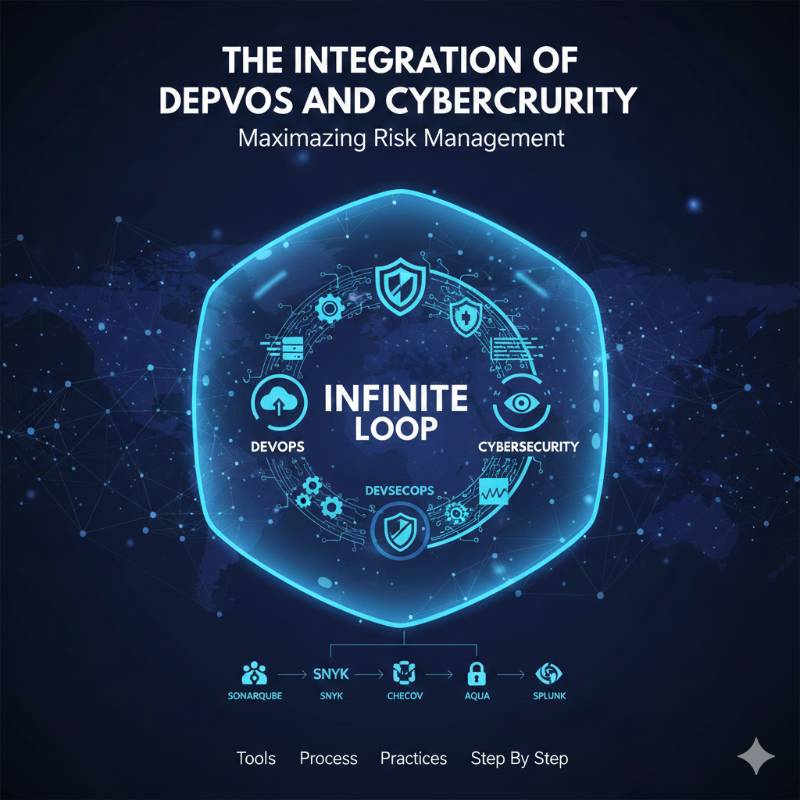
The Integration of DevOps and Cybersecurity: Maximizing Risk Management
1. Introduction: The Evolution of Risk
In the legacy model, security was a “Point in Time” check. In a DevSecOps world, risk is managed through Continuous Assurance. The goal is to shift security “Left” (into development) and “Right” (into production monitoring).
2. The Core Pillars of DevSecOps
To maximize risk management, we focus on four key areas:
- Visibility: You cannot secure what you cannot see.
- Automation: Manual security checks are the enemy of velocity.
- Immutable Infrastructure: Reducing configuration drift.
- Shared Responsibility: Culture shift where “security is everyone’s job.”
3. The Process: A Risk-Based Lifecycle
A robust DevSecOps process integrates specific security checkpoints into the standard CI/CD pipeline:
| Phase | Security Action | Risk Mitigated |
| Plan | Threat Modeling | Design flaws and logic errors. |
| Code | Pre-commit hooks & IDE Plugins | Secret leaks (API keys) and poor syntax. |
| Build | SAST & Dependency Scanning | Vulnerable libraries (Log4j style risks). |
| Test | DAST & IAST | Runtime vulnerabilities and injection flaws. |
| Deploy | IaC Scanning | Misconfigured S3 buckets or open ports. |
| Operate | RASP & SIEM | Zero-day exploits and active intrusions. |
4. The Essential Toolstack
As a veteran, you know tools don’t solve problems—processes do. However, these are the industry standards for 2026:
A. Static Analysis (SAST)
- Tools: SonarQube, Snyk, Checkmarx.
- Focus: Scanning source code for vulnerabilities without executing it.
B. Software Composition Analysis (SCA)
- Tools: GitHub Advanced Security, Black Duck.
- Focus: Managing Open Source Software (OSS) risk and License compliance.
C. Infrastructure as Code (IaC) Security
- Tools: Checkov, Terrascan, tfsec.
- Focus: Ensuring Terraform/CloudFormation scripts follow the “Least Privilege” principle.
D. Container & Cloud Security
- Tools: Aqua Security, Prisma Cloud, Trivy.
- Focus: Image scanning and Kubernetes admission controllers.
5. Step-by-Step Implementation Guide
Step 1: Governance and Threat Modeling
Before writing code, identify the “Crown Jewels.” Use the STRIDE model to evaluate threats to your architecture.
Note: $Risk = Threat \times Vulnerability \times Impact$. Use this formula to prioritize your backlog.
Step 2: Securing the CI/CD Pipeline
Harden your runners. Ensure that your Jenkins, GitLab Runner, or GitHub Actions use ephemeral environments and encrypted secrets.
Step 3: Integrating Automated Gates
Set “Break the Build” policies. If a high-severity vulnerability is detected during the SCA or SAST phase, the pipeline must stop. This prevents technical debt from reaching production.
Step 4: Continuous Monitoring and Feedback Loop
Integrate your production logs into a SIEM (like Splunk or ELK). Use the data to feed back into the Plan phase for the next sprint.
6. Advanced Practices for Risk Maximization
- Policy as Code (PaC): Use Open Policy Agent (OPA) to enforce compliance automatically.
- Chaos Security Engineering: Purposefully injecting security failures to test resilience.
- Zero Trust Architecture: Never trust, always verify, regardless of whether the request comes from inside or outside the network.
7. Conclusion: The Roadmap to Maturity
Risk management is not about achieving zero risk—it’s about informed acceptance of risk. By automating the mundane, your security team can focus on complex architectural threats.