Introduction
Imagine an engineering team finishing a three-month development sprint. All features are locked, code is merged, and the application is handed over to the QA team for the very first time. Within hours, testers find critical database integration failures, broken authentication pathways, and severe performance bottlenecks. Fixing these architectural flaws now requires rewriting core modules, delaying release by weeks, frustrating stakeholders, and introducing immense release uncertainty.
This scenario illustrates the traditional bottleneck of treating testing as a final checkpoint. Continuous Testing in DevOps solves this by embedding validation throughout the software delivery lifecycle. Rather than waiting until development is complete, testing runs continuously alongside development, providing rapid feedback on every code commit.
What Is Continuous Testing?
Continuous Testing is the process of executing automated software tests as an integrated part of the software delivery pipeline to obtain immediate feedback on business risks associated with a software release.
Key pillars of Continuous Testing include:
- Testing throughout the delivery lifecycle: Moving validation from an isolated end-phase into every stage of development.
- Early defect detection: Catching syntax, logic, and integration bugs when code is written.
- Automated validation: Executing test scripts without manual intervention.
- Continuous feedback: Informing developers instantly if a change breaks existing functionality.
- Integration with CI/CD: Triggering tests automatically upon code commits or builds.
- Quality gates: Establishing automated criteria that code must pass before moving downstream.
- Risk-based testing: Focusing test efforts on areas with the highest probability of failure or business impact.
Continuous Testing shifts testing from a manual roadblock into an automated feedback loop.
Continuous Testing vs Traditional Testing
While traditional testing relies heavily on manual handoffs at the end of a release cycle, Continuous Testing integrates quality checks directly into the delivery pipeline.
| Area | Traditional Testing | Continuous Testing |
| Testing stage | Performed late, usually after code freeze | Integrated across all lifecycle stages |
| Feedback | Delayed by days, weeks, or months | Immediate (minutes after code commit) |
| Automation | Largely manual with selective scripting | Highly automated across multiple layers |
| CI/CD integration | Minimal or non-existent | Deeply integrated into automated pipelines |
| Regression testing | Manual and time-consuming | Automated and executed frequently |
| Security testing | Performed right before production release | Shift-left via automated scans early on |
| Performance testing | Executed once right before deployment | Baseline performance checked continuously |
| Release validation | High uncertainty and high stress | Managed through objective quality gates |
| Collaboration | Siloed between Dev, QA, and Ops | Shared responsibility across cross-functional teams |
Traditional testing practices—such as exploratory testing and user acceptance testing—remain valuable, but Continuous Testing builds upon these foundations to match modern delivery speeds.
Why Continuous Testing Matters in DevOps
Integrating testing into DevOps yields profound advantages for engineering organizations:
- Faster feedback: Developers learn within minutes if their code changes break core functions.
- Earlier defect detection: Fixing bugs during the coding phase is significantly cheaper than post-release patching.
- Reduced regression risk: Automated test suites catch unintended side effects instantly.
- Better release confidence: Every deployment is vetted against standardized quality criteria.
- Improved collaboration: Developers, testers, and operations teams share accountability for software quality.
- Repeatable testing: Automated scripts execute identically across different environments.
Continuous Testing does not guarantee zero bugs or instant releases; rather, it provides transparency and control over software quality.
Continuous Testing in the DevOps Lifecycle
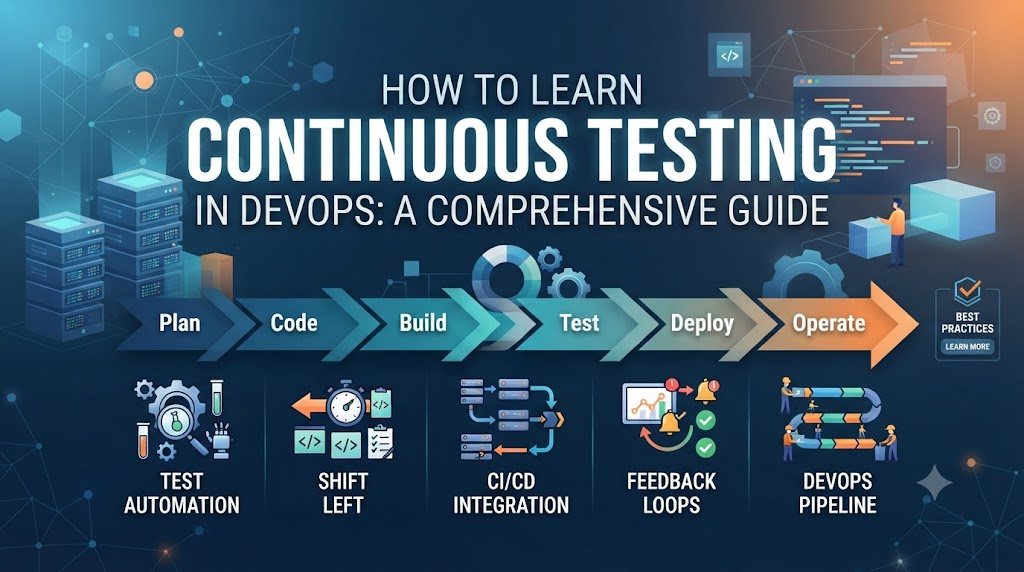
Continuous Testing is not a single tool or phase; it spans the entire DevOps workflow:
$$\text{Plan} \rightarrow \text{Code} \rightarrow \text{Build} \rightarrow \text{Test} \rightarrow \text{Security} \rightarrow \text{Release} \rightarrow \text{Deploy} \rightarrow \text{Operate} \rightarrow \text{Monitor} \rightarrow \text{Feedback}$$
- Plan & Code: Static code analysis and unit testing validate code quality as it is written.
- Build & Test: Integration, API, and functional tests run automatically inside CI/CD pipelines.
- Security & Release: Vulnerability scanning, container checks, and staging validations ensure compliance.
- Deploy, Operate & Monitor: Synthetic transactions, real-user monitoring, and error tracking validate production behavior.
Types of Testing in Continuous Testing
A robust testing strategy employs multiple layers of validation. Not every test needs to run at every pipeline stage.
- Unit Testing: Validates individual functions or components in isolation, usually written by developers using frameworks like JUnit or PyTest.
- Integration Testing: Verifies how different modules, databases, and external services interact.
- API Testing: Tests service interfaces and data payloads via HTTP methods for fast and reliable backend validation.
- Functional Testing: Evaluates application features against business requirements.
- Regression Testing: Ensures that new code changes do not break existing features.
- End-to-End (E2E) Testing: Simulates complete user journeys across the entire system stack.
- Performance Testing: Assesses system behavior under load, stress, and scalability constraints.
- Security Testing: Uncovers vulnerabilities using static analysis, dependency scanning, and dynamic checks.
- Infrastructure Testing: Validates infrastructure-as-code scripts and server configurations.
What Should Beginners Learn First?
Before diving into advanced test automation frameworks, beginners must master foundational skills:
- Software Testing Fundamentals: Understand test cases, scenarios, defect lifecycles, test plans, and coverage metrics.
- Programming Basics: Learn a versatile language like Python, JavaScript, or Java to read and write test scripts.
- Linux Basics: Master navigation commands, file permissions, processes, and basic networking.
- Git: Learn repository management, branching strategies, commits, and pull requests.
Learn Test Automation
Test automation replaces repetitive manual validation with executable scripts. It involves creating test frameworks, assertions, reporting mechanisms, and test data management.
While automation handles repetitive regression and data-driven checks efficiently, it does not replace exploratory or usability testing performed by humans.
Learn API and UI Testing
- API Testing: Focuses on HTTP methods, status codes, payload structures (JSON/XML), and authentication tokens. APIs provide rapid feedback and high stability compared to UI tests.
- UI Testing: Focuses on browser automation, user workflows, and visual assertions. UI tests should be kept lean and targeted toward critical business paths to avoid high maintenance overhead.
Learn CI/CD for Continuous Testing
Continuous Testing relies on CI/CD pipelines to automate execution. A standard pipeline flows from code commit and unit tests through integration checks, security reviews, artifact packaging, test environment deployment, and quality gate approval prior to production release.
Test Automation in CI/CD
Automated tests are triggered by events such as pull requests, code merges, or scheduled cron jobs. To keep pipelines efficient, teams separate tests into fast tiers (unit and API tests) and slower tiers (comprehensive E2E and performance suites), avoiding heavy test executions on every minor code change.
Continuous Testing and Shift-Left Testing
Shift-Left Testing moves quality checks earlier in the delivery lifecycle. Instead of testing after code completion, teams introduce unit tests, static code analysis, and dependency vulnerability scans during the coding and pull-request stages. Shift-Left does not mean testing stops before deployment; it simply ensures defects are intercepted early.
Continuous Testing and Shift-Right Testing
Shift-Right Testing extends validation into production environments. Utilizing production monitoring, synthetic transactions, canary releases, and real-user feedback, teams observe how applications perform under real-world conditions, feeding operational insights back into development cycles.
Continuous Security Testing
Embedded security (DevSecOps) safeguards applications against vulnerabilities through static application security testing (SAST), software composition analysis (SCA) for dependencies, container image scanning, and dynamic testing (DAST). Secrets—such as passwords or API keys—should never be stored in source code repositories.
Continuous Performance Testing
Performance testing integrates baseline load, stress, and scalability checks into release pipelines. By tracking response times, throughput, and resource utilization automatically, teams catch performance degradation before code reaches staging or production.
Infrastructure and Configuration Testing
In cloud-native environments, infrastructure is defined as code. Validating configuration scripts, policy compliance, and environment consistency prevents deployment drift and environment-specific failures.
Test Environments and Test Data
Managing environments (development, test, staging, production) and data privacy is a core challenge. Teams must utilize controlled, sanitized test data that mirrors production scenarios while protecting sensitive user information.
Test Reporting and Quality Gates
Metrics should drive decisions rather than serve as vanity numbers. Tracking pass/fail rates, test coverage, execution duration, and flaky test frequencies enables teams to enforce strict, objective quality gates.
Handling Flaky Tests
Flaky tests pass intermittently without code changes, eroding trust in automation. Common causes include environmental instability, race conditions, timing issues, and shared test data. Solutions include root-cause analysis, better test isolation, explicit wait synchronization, and dedicated flaky test monitoring rather than simply ignoring them.
How to Build a Continuous Testing Project
To solidify your skills, build a practical end-to-end pipeline project:
- Write a simple web application and push it to a Git Repository.
- Configure a CI pipeline to execute Unit Tests on every commit.
- Add API Tests and Security Scans to the build stage.
- Package the app into a container and deploy it to a test environment.
- Execute automated functional tests and generate pipeline test reports.
Step-by-Step Continuous Testing Learning Roadmap
- Step 1: Learn testing fundamentals and terminology.
- Step 2: Learn programming basics (Python, Java, or JavaScript).
- Step 3: Master Git version control.
- Step 4: Learn Linux command-line essentials.
- Step 5: Learn test automation principles and frameworks.
- Step 6: Master API testing techniques.
- Step 7: Learn UI automation fundamentals.
- Step 8: Understand CI/CD pipeline concepts.
- Step 9: Integrate automated tests into pipeline stages.
- Step 10: Learn continuous security testing (DevSecOps).
- Step 11: Implement performance testing fundamentals.
- Step 12: Explore infrastructure and configuration testing.
- Step 13: Build a hands-on continuous testing project.
- Step 14: Analyze test metrics and reports.
- Step 15: Continuously refine and optimize your testing strategy.
Common Beginner Mistakes
- Automating everything without understanding testing fundamentals.
- Building brittle UI tests instead of relying on fast API and unit tests.
- Ignoring security and performance validation.
- Running slow test suites at the wrong stage of the pipeline.
- Ignoring flaky tests instead of fixing their root causes.
- Treating code coverage as the sole indicator of quality.
Skills Needed for a Continuous Testing Career
- Testing Skills: Test design, regression strategy, API testing, automation.
- DevOps Skills: Git, CI/CD pipelines, Linux, containers, cloud infrastructure.
- Programming Skills: Scripting, debugging, test framework creation.
- Quality Skills: Risk analysis, root-cause investigation, defect analytics.
Career Paths Related to Continuous Testing
Professionals skilled in Continuous Testing pursue roles such as QA Automation Engineer, Test Automation Engineer, SDET, DevOps Engineer, DevSecOps Engineer, and Site Reliability Engineer (SRE), depending on their focus areas.
How DevOpsSchool Can Help Learners
Mastering the blend of testing methodologies, automation tools, and CI/CD workflows requires structured guidance and hands-on practice. DevOpsSchool provides comprehensive training programs and certification paths designed to help engineering professionals and students master modern DevOps practices, automation frameworks, CI/CD integration, containerization, and infrastructure testing. Explore structured courses and learning modules directly at DevOpsSchool.
Future of Continuous Testing
The landscape of Continuous Testing continues to evolve through AI-assisted test generation, self-healing automation scripts, intelligent test selection, continuous security validation, and observability-driven quality checks. While artificial intelligence accelerates test creation and maintenance, human judgment, critical thinking, and exploratory testing remain irreplaceable.
Frequently Asked Questions
- What is Continuous Testing in DevOps?It is the practice of executing automated tests throughout the software delivery pipeline to gain immediate feedback on business risks.
- How is Continuous Testing different from traditional testing?Traditional testing happens at the end of development as a separate phase, whereas Continuous Testing is integrated into every stage of the CI/CD lifecycle.
- What should I learn first to start Continuous Testing?Start with software testing fundamentals, basic programming, Git version control, and Linux commands.
- Is programming required for Continuous Testing?Yes, basic programming is necessary to write maintainable automated test scripts and interact with test frameworks.
- How does CI/CD support Continuous Testing?CI/CD pipelines automatically trigger test execution upon code commits, ensuring rapid feedback loops.
- What types of testing are used in Continuous Testing?It includes unit, integration, API, functional, regression, performance, and security testing.
- Is Continuous Testing only automated testing?No, while automation is critical for speed, continuous testing also involves exploratory testing, risk assessment, and quality gate governance.
- Can a manual tester move into Continuous Testing?Yes, manual testers can transition successfully by learning programming basics, automation tools, and CI/CD fundamentals.
Final Thoughts
Continuous Testing is much more than running automated scripts; it is a cultural and technical shift that embeds quality checks into every stage of software delivery. By combining solid testing fundamentals, smart automation, CI/CD integration, and continuous feedback, teams can release software with greater confidence and lower risk.
Continuous Testing is not about testing everything everywhere. It is about placing the right quality checks at the right stages of the software delivery process and continuously learning from the results.