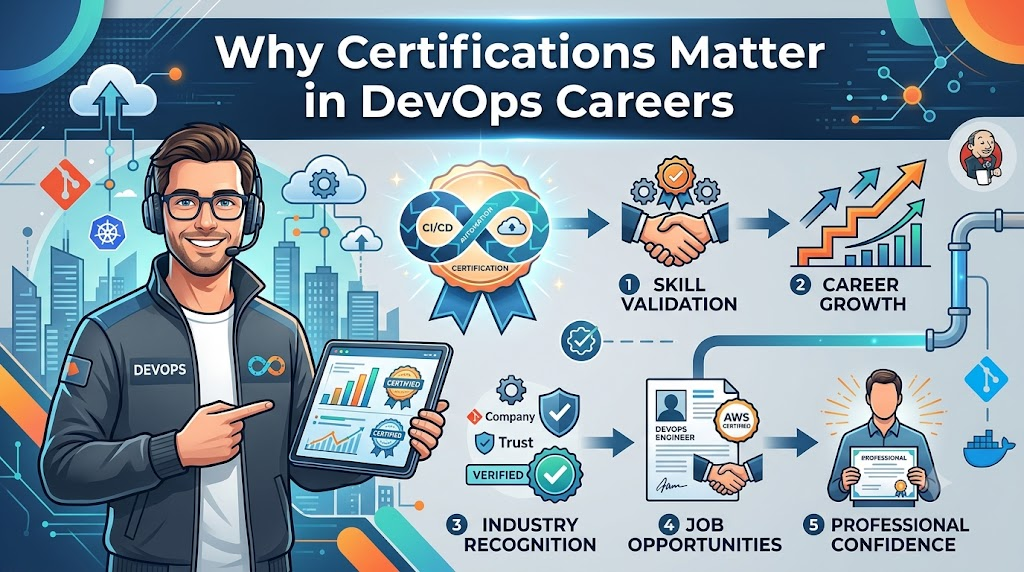
Introduction
Imagine an engineer who has spent months watching video tutorials, reading documentation, and spinning up local test environments. They understand how continuous integration pipelines work, can write basic configuration scripts, and know their way around container tools. Yet, when they apply for roles or try to explain their capabilities to a hiring manager, their resume fails to catch attention, and they struggle to prove their baseline technical competence. This is a common hurdle in the technology sector. Self-taught knowledge is powerful, but communicating that knowledge objectively can be difficult. A structured certification can act as a bridge, providing formal validation of skills while keeping expectations grounded. Certification alone does not replace actual engineering ability, but it serves as a recognized milestone in a broader professional journey.
What Is a DevOps Certification?
A DevOps certification represents formal recognition issued by a certifying body, vendor, or professional training organization after a candidate passes an evaluation. It typically encompasses:
- Structured curriculum: A defined scope of learning objectives.
- Knowledge assessment: Standardized testing of technical concepts.
- Skill validation: Objective measurement of specific competencies.
Certifications vary widely in focus. Some target foundational operations and culture, while others dive deep into cloud platforms, container orchestration, infrastructure automation, security, or reliability engineering. Recognizing that not all credentials hold equal weight for every role is essential for effective career planning.
Why Certifications Matter in DevOps Careers
Certifications offer several distinct advantages for professionals navigating technical industries. They provide an objective framework for learning and help establish professional credibility in competitive job markets.
Structured Learning
Self-directed learning often leads to fragmented knowledge, where engineers master individual tools without understanding how they integrate into an enterprise architecture. Certification roadmaps provide:
- Defined learning objectives and scope.
- A logical progression from basic to advanced topics.
- Clear milestones to measure educational progress.
Certifications Help Validate Knowledge
There is a distinct difference between stating, “I have read about container management,” and passing a rigorous, scenario-based evaluation that tests actual understanding. While exams cannot replicate every production crisis, they do confirm that a candidate has mastered the core principles required to pass a standardized assessment.
Certifications Can Help Career Changers
Transitioning from system administration, development, quality assurance, or IT support into a specialized domain requires demonstrable competence. Certifications help bridge the gap for career changers by signaling to employers that the candidate has invested time in learning modern tooling and methodologies. A successful transition typically combines certification with practical projects, hands-on labs, and transferable career experience.
Certifications Can Strengthen a Resume
A well-chosen credential highlights a candidate’s commitment to continuous learning. It shows recruiters and engineering managers that the individual proactively updates their skill set to keep pace with evolving industry standards, making their resume stand out among applicants with similar backgrounds.
Certifications and Recruiter Screening
Initial resume screening often involves navigating automated applicant tracking systems or high-volume reviews. When an organization explicitly lists specific technical credentials as preferred requirements, relevant certifications can help a candidate pass through initial filters. However, requirements vary widely across companies, industries, and seniority levels, meaning certifications are merely one data point in a broader evaluation.
Certifications Can Improve Interview Preparation
Studying for an exam forces engineers to revisit core principles they might otherwise overlook in daily work. Exam preparation requires deep review of continuous integration, cloud architecture, container runtimes, infrastructure automation, and security best practices, resulting in sharper technical recall during live interviews.
Certifications Encourage Continuous Learning
Technology stacks evolve rapidly. Cloud-native architectures, platform engineering paradigms, and automated security practices require continuous adaptation. Setting certification goals provides structured motivation to explore emerging technologies rather than remaining stagnant in daily routines.
Certification vs. Hands-On Experience
| Certification | Hands-On Experience |
| Validates theoretical and applied knowledge | Demonstrates real-world execution |
| Provides structured learning pathways | Solves unpredictable production issues |
| Highlights professional commitment | Proves day-to-day operational capability |
| Useful for career positioning and resume visibility | Essential for production readiness |
Can Certifications Get You a DevOps Job?
A certification can improve career positioning, but it cannot guarantee employment. Securing a role depends heavily on practical troubleshooting skills, communication ability, project portfolios, interview performance, and relevant past experience. Certifications open doors, but technical execution seals the deal.
Certification vs. Experience vs. Projects
- Certification: Validates foundational and specialized knowledge through formal assessment.
- Projects: Demonstrates practical application by building working systems from scratch.
- Experience: Proves real-world responsibility, incident management, and collaboration in production environments.
Building all three over time creates a resilient and highly marketable professional profile.
DevOps Certification Categories
- DevOps Fundamentals: Ideal for beginners establishing core cultural and technical concepts.
- Cloud Certifications: Focused on specific cloud provider ecosystems and infrastructure management.
- Kubernetes Certifications: Targeted at container orchestration and cloud-native application deployment.
- Infrastructure as Code Certifications: Centered on automated provisioning and configuration management.
- DevSecOps Certifications: Emphasizing security integration throughout the software delivery lifecycle.
- SRE-Oriented Learning: Focused on system reliability, observability, and incident response.
How Beginners Should Choose a Certification
Beginners should evaluate several practical factors before committing time and money to a specific exam:
- Current technical background and baseline knowledge.
- Specific career goals and desired job titles.
- Required study time and financial cost.
- Relevance and recognition within the target job market.
Avoid choosing credentials purely based on popularity or social media hype.
Certification Learning Roadmap
Stage 1: Fundamentals ---> Linux, Git, Networking, CI/CD Basics
Stage 2: Infrastructure --> Cloud Computing, Identity, Storage, Networking
Stage 3: Containers ------> Docker, Image Building, Registries
Stage 4: Kubernetes ------> Pods, Deployments, Services, Ingress
Stage 5: Advanced --------> IaC, Observability, DevSecOps, SRE
Certification Preparation Should Include Hands-On Practice
Reading books and watching videos is not enough. Effective preparation requires building practice labs, deploying local test clusters, configuring continuous integration pipelines, and debugging broken automation scripts. Hands-on practice turns abstract exam theory into permanent muscle memory.
How to Build a DevOps Portfolio Alongside Certification
To make certification efforts tangible, candidates should back up their studies with a personal portfolio. This can include:
- Writing declarative infrastructure code to provision test environments.
- Setting up automated testing and deployment pipelines for sample applications.
- Containerizing legacy applications and deploying them to orchestration clusters.
- Implementing monitoring dashboards and alerting rules.
Certifications for Experienced Engineers
Even seasoned engineers benefit from targeted certifications. Experienced professionals use advanced credentials to validate niche specializations, pivot into architecture or platform engineering roles, or demonstrate formal mastery of modern cloud-native ecosystems.
DevOps Career Progression
- Beginner: Focuses on core tools, Linux, scripting, and CI/CD fundamentals.
- Intermediate: Expands into cloud infrastructure, containerization, and automation frameworks.
- Advanced: Focuses on Kubernetes orchestration, infrastructure as code, and observability.
- Senior/Leadership: Centers on system architecture, reliability engineering, security governance, and business impact.
Salary Expectations
Certifications can improve a professional’s negotiating position, but compensation depends on a wide range of factors, including geographic location, years of experience, technical depth, interview performance, and company size. Credentials alone do not dictate salary tiers.
Common Certification Mistakes
- Memorizing answers: Relying on brain dumps instead of understanding underlying concepts.
- Collecting certificates: Accumulating numerous credentials without practical project experience.
- Ignoring fundamentals: Jumping straight into advanced container exams without understanding Linux or networking basics.
- Treating exams as job guarantees: Expecting an employer to hire solely based on a PDF certificate.
How to Study for a Certification
- Understand exam objectives: Review the official blueprint thoroughly.
- Identify knowledge gaps: Pinpoint weak technical areas before scheduling study blocks.
- Learn the concepts: Study documentation, guides, and structured training materials.
- Practice hands-on: Build labs and test environments for every objective.
- Take practice assessments: Use mock exams to test time management and knowledge retention.
- Review mistakes: Analyze incorrect answers to solidify understanding before test day.
Avoiding Certificate Collection
Collecting certificates without applying the knowledge yields diminishing returns. A sustainable professional model follows this progression:
$$\text{Learn} \rightarrow \text{Practice} \rightarrow \text{Build} \rightarrow \text{Document} \rightarrow \text{Validate} \rightarrow \text{Apply}$$
Certifications and Open-Source Projects
Reinforcing certification study by exploring open-source repositories provides immense practical value. Reading production-grade configuration files, contributing to documentation, or testing automation scripts in community projects bridges the gap between exam theory and real-world engineering.
Certifications and Real-World DevOps Skills
A well-rounded engineer combines certification knowledge with practical mastery of Linux administration, networking protocols, version control workflows, scripting languages, cloud services, container runtimes, monitoring tools, and systematic troubleshooting methodologies.
Employer Evaluation
Hiring managers look past credentials to evaluate how a candidate thinks. During technical evaluations, employers test problem-solving approaches, production troubleshooting instincts, collaboration skills, and the ability to reason through architectural trade-offs under pressure.
Mentioning Certifications on a Resume
Keep certification listings concise and relevant. Include the official credential name, the issuing organization, and the date earned if applicable. Avoid cluttering a resume with outdated or unrelated certificates that dilute your core professional narrative.
Discussing Certifications in Interviews
When interviewers ask about certifications, avoid reciting memorized textbook definitions. Instead, discuss what challenges you faced during preparation, how those studies improved your understanding of system behavior, and how you applied those concepts to solve actual engineering problems.
Role of DevOpsSchool
Structured guidance plays a critical role in mastering complex engineering domains. Programs offered through DevOpsSchool help professionals navigate core DevOps principles, continuous integration workflows, cloud automation, containerization, Kubernetes, infrastructure as code, monitoring, and security practices. Structured training environments provide the clarity, mentorship, and practical exposure needed to build confident, career-ready engineering skills.
Future of DevOps Certifications
As the technology landscape shifts toward platform engineering, automated security, and advanced observability, certification programs are evolving. Future evaluations increasingly emphasize practical, scenario-based problem-solving over simple multiple-choice recall, ensuring that certified professionals remain adaptable to modern production environments.
Frequently Asked Questions
Are DevOps certifications worth it? Yes, when used to structure learning, validate knowledge, and strengthen a resume. They are most effective when paired with hands-on project experience.
Can a certification help me get a DevOps job? A certification can help pass initial recruiter screenings and demonstrate commitment, but landing a job ultimately requires practical troubleshooting, portfolio projects, and strong interview performance.
Is certification enough to become a DevOps engineer? No. Certification validates theoretical and structured knowledge, but actual engineering roles require hands-on experience with production systems, CI/CD pipelines, and infrastructure management.
Which DevOps certification should beginners choose? Beginners should start with foundational credentials that cover Linux, basic cloud concepts, Git, and introductory CI/CD principles before moving on to advanced tools.
Do experienced DevOps engineers need certifications? Experienced engineers do not strictly need certifications, but they often use them to validate new skill sets, support career transitions into architecture, or demonstrate mastery of cloud-native ecosystems.
How should I prepare for a DevOps certification? Combine official study guides with dedicated lab practice, small personal projects, mock exams, and deep reviews of underlying architectural concepts.
Should I build projects while studying for certification? Building practical projects alongside exam preparation is essential to ensure that theoretical knowledge translates into real-world capability.
Can certifications help with career growth? Yes, they provide structured milestones for continuous learning and help signal technical specialization during internal mobility or promotion reviews.
Final Thoughts
Certifications offer valuable structure, knowledge validation, and resume visibility, particularly for career changers and professionals seeking focused learning paths. However, they do not replace hands-on experience, real-world troubleshooting, or practical project execution. The right credential should align with your specific career goals while serving as a stepping stone toward deeper technical competence. Combine certification preparation with active lab work, portfolio building, and continuous engineering practice to turn validated knowledge into a successful, long-term career.