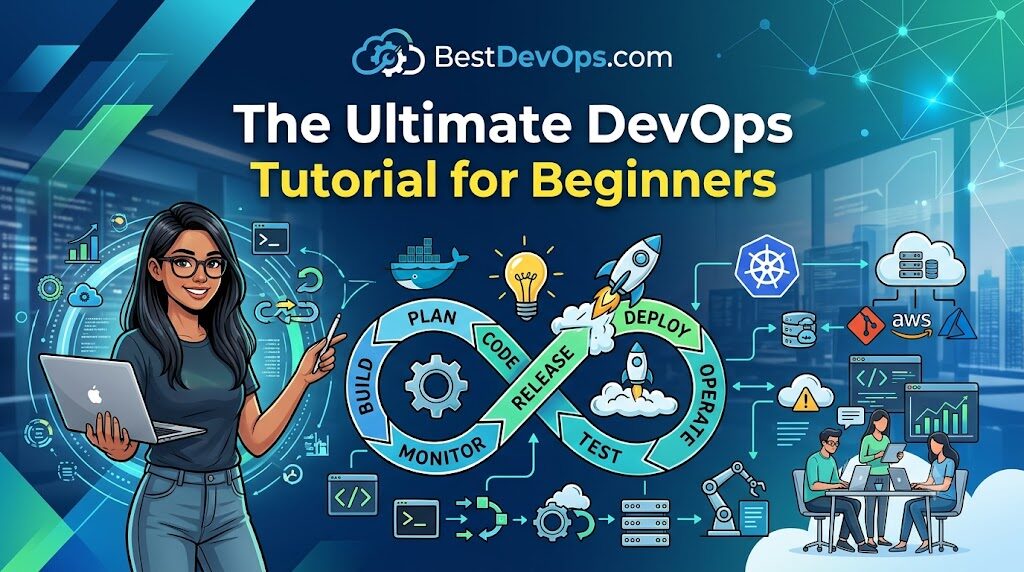
The tech landscape is shifting rapidly, and organizations are under immense pressure to ship software faster without sacrificing stability. If you are looking to break into this dynamic field or level up your engineering career, understanding how to implement continuous delivery is essential. Finding a definitive DevOps tutorial for beginners that bridges the gap between raw theory and production-grade reality can be challenging.
This guide breaks down everything you need to know about navigating the modern ecosystem, implementing the best DevOps tools, and building the technical expertise required to thrive in the industry today.
Why DevOps Matters in Modern Software Development
In the traditional software model, development and operations teams worked in isolated silos. Developers threw code “over the wall,” leaving operations teams to handle deployment issues, configuration drift, and system crashes. This friction delayed releases and increased system downtime.
DevOps eliminates these barriers by fostering a culture of shared responsibility, automation, and continuous feedback. By unifying workflows, businesses can accelerate release cycles, improve software quality, and respond to customer needs in real time.
The Evolution: From DevOps to Platform Engineering and SRE
As systems grow more complex, the industry has evolved. While DevOps focuses on the cultural and process integration of development and operations, Site Reliability Engineering (SRE) applies software engineering principles to infrastructure and uptime problems. Meanwhile, Platform Engineering has emerged to create Internal Developer Platforms (IDPs), reducing cognitive load for developers by providing self-service infrastructure templates.
The Modern DevOps Lifecycle: Core Concepts
To successfully deliver high-quality software, teams rely on a continuous loop of planning, building, testing, deploying, and monitoring.
 [ Plan ] ➔ [ Code ] ➔ [ Build ] ➔ [ Test ]
    ▲                                    │
    │                                    ▼
 [ Optimize ] 🔀 [ Monitor ] ◀ [ Deploy & Release ]
Code language: CSS (css)
1. Continuous Integration and Continuous Delivery (CI/CD)
CI/CD is the backbone of automated software delivery. Continuous Integration ensures that code changes from multiple developers are automatically built, validated, and merged into a shared repository. Continuous Delivery automates the release of that validated code to environments like staging or production.
2. Infrastructure as Code (IaC)
Gone are the days of manually configuring servers via a cloud console or command line. Infrastructure as Code treats infrastructure setup exactly like application source code. It allows teams to provision, version control, and tear down environments programmatically, ensuring consistency across development, staging, and production.
3. Microservices and Containerization
Modern applications are rarely built as monolithic giants. Instead, they are broken down into small, loosely coupled microservices that communicate via APIs. Containers package these microservices along with their specific dependencies, ensuring that an application runs identically whether it is on a local laptop or a massive cloud cluster.
Essential DevOps Engineer Skills
Becoming a proficient engineer requires a blend of soft skills, systems thinking, and deep technical capabilities. If you are looking to build a structured learning path to master these competencies, reviewing a comprehensive DevOps roadmap can help you prioritize which technologies to learn first.
Foundational Capabilities
- Linux Fundamentals & Scripting: You must be comfortable navigating the command line, managing permissions, and writing automation scripts in Bash or Python.
- Cloud Computing Platforms: Deep familiarity with at least one major cloud provider—such as AWS, Azure, or GCP—is non-negotiable for modern infrastructure roles.
- Version Control: Git mastery is mandatory. You need to understand branching strategies, pull requests, and merge conflict resolution.
Advanced Capabilities
- Container Orchestration: Managing production-scale containers requires specialized tools to handle scaling, self-healing, and networking.
- Observability and Monitoring: You cannot fix what you cannot measure. Understanding how to collect metrics, logs, and traces is vital for maintaining system health.
- DevSecOps (Security Integration): Security must be integrated directly into the automated pipeline—from static code analysis to container vulnerability scanning—rather than treated as an afterthought.
The Best DevOps Tools Checklist
No single tool solves every operational bottleneck. A robust software supply chain relies on an integrated stack of specialized technologies. Choosing the best DevOps tools depends heavily on your team’s specific architectural needs and scaling challenges.
| Lifecycle Phase | Industry Standard Tools | Core Purpose |
| Source Control | Git, GitHub, GitLab | Code versioning, collaboration, and peer review tracking. |
| CI/CD Automation | Jenkins, GitHub Actions, GitLab CI | Automating builds, running automated tests, and orchestrating deployments. |
| Containerization | Docker | Packaging applications into lightweight, isolated, portable containers. |
| Orchestration | Kubernetes | Managing container lifecycles, autoscaling, load balancing, and self-healing. |
| Infrastructure as Code | Terraform, OpenTofu, Ansible | Declarative cloud provisioning and automated configuration management. |
| Monitoring & Logs | Prometheus, Grafana, ELK Stack | Real-time metric gathering, log aggregation, and system observability. |
Practical Examples and Real-World Use Cases
Scenario A: Eliminating “Works on My Machine” Syndromes
A development team frequently faces bugs where code works perfectly on a local computer but fails immediately upon reaching the staging server due to mismatched Node.js runtime versions.
- The Solution: The team introduces Docker. By defining a standard environment inside a
Dockerfile, every developer runs the exact same container version locally that runs in production, wiping out environment drift entirely.
Scenario B: Recovering From a Cloud Data Center Outage
An entire cloud availability zone goes offline, taking down a critical web application and causing hours of expensive business downtime.
- The Solution: By maintaining their infrastructure setups inside Terraform configuration files, the operations team executes a single command to spin up an identical copy of their entire network, server clusters, and databases in an entirely separate, healthy geographic region within minutes.
Common Challenges and Best Practices
Transitioning to automated delivery workflows comes with cultural and technical speed bumps. Avoiding these common mistakes keeps your engineering velocity high.
Avoid These Common Mistakes
- Automating Bad Processes: If your deployment workflow is messy, unorganized, and error-prone, automating it will only allow you to make mistakes faster. Fix the underlying process workflow before writing automation code.
- Neglecting Security in the Pipeline: Waiting until the week before a production launch to run security audits creates massive development bottlenecks.
- Tool Fatigue: Introducing too many shiny new technologies at once overwhelms development teams and creates unmaintainable operational complexity.
Proven Industry Best Practices
- Keep Infrastructure Code Dry and Modular: Write reusable IaC modules to prevent copying and pasting server configurations across projects.
- Implement Small, Incremental Changes: Deploying tiny code updates frequently reduces the risk profile of each individual release and makes troubleshooting straightforward if something breaks.
- Shift Security Left: Use automated tools within your CI/CD pipelines to scan code libraries for vulnerabilities the moment a developer opens a pull request.
Evaluating Performance: DORA Metrics Tools
To understand whether your operational workflows are genuinely improving, engineering leaders rely on data. The DevOps Research and Assessment (DORA) group identifies four key metrics that differentiate high-performing engineering organizations from low-performing ones:
- Deployment Frequency: How often does your team successfully release code to production?
- Lead Time for Changes: How long does it take for a commit to go from code check-in to running in production?
- Change Failure Rate: What percentage of deployments lead to a failure or require immediate rollback?
- Time to Restore Service: How long does it take to recover from a production failure or outage?
To track these indicators accurately, engineering teams leverage specialized DORA metrics tools like Apache DevLake, LinearB, or integrated dashboards inside GitLab and GitHub Enterprise. Measuring these data points provides objective clarity on where delivery pipelines face bottlenecks.
Career Opportunities and Industry Insights
The demand for skilled infrastructure professionals remains exceptionally strong as organizations across healthcare, finance, and e-commerce migrate workloads to cloud environments.
DevOps Engineer Salary Trends
Because this role requires a cross-functional mix of software engineering expertise and systems administration knowledge, compensation scales quickly with hands-on experience.
- Junior Engineer: $80,000 – $105,000 per year
- Mid-Level Engineer: $110,000 – $145,000 per year
- Senior / Principal Consultant: $155,000 – $210,000+ per year
Note: Actual earnings vary based on geographic location, remote work options, and specific domain expertise like advanced Kubernetes security or cloud financial optimization (FinOps).
Elevating Your Career with Professional Certifications
Earning industry-recognized validations can make your resume stand out to recruiters and hiring managers. Depending on your chosen cloud ecosystem, targeting the best DevOps certifications can accelerate your career progression:
- AWS Certified DevOps Engineer – Professional: Validates advanced skills in provisioning, operating, and managing AWS environments.
- Certified Kubernetes Administrator (CKA): A highly respected, hands-on exam demonstrating real-world ability to manage container clusters.
- Microsoft Certified: DevOps Engineer Expert: Focuses heavily on Azure DevOps practices, version control, and continuous delivery strategies.
Step-by-Step Learning Strategy
If you are wondering how to transition from theory to actual implementation, here is a practical approach to building your expertise:
- Master the Command Line: Spend time configuring local environments exclusively using the Linux terminal. Learn to write small automation scripts.
- Build Hands-On Portfolio Projects: Reading documentation is a start, but building actual DevOps projects—such as configuring a multi-stage Jenkins pipeline or deploying a load-balanced web app using Terraform—builds real troubleshooting skills.
- Enroll in Structured Learning: To save time and avoid getting overwhelmed by thousands of disconnected video tutorials, invest in a structured, comprehensive curriculum. Enrolling in the best DevOps course that fits your current skill level provides clear direction and mentorship.
- Prepare Intensely for Tech Interviews: Coding algorithms are only half the battle. You must be ready to explain system architecture design, container networking, and disaster recovery strategies clearly. Reviewing a vetted list of DevOps interview questions helps you articulate your technical experience confidently under pressure.
Frequently Asked Questions
1. What is the difference between DevOps and Agile?
Agile is a software development methodology focused on iterative project management, collaboration, and breaking down software development into smaller sprints. DevOps extends this philosophy past the code phase, focusing on automated deployment, testing, cloud infrastructure, and operational reliability.
2. Do I need to be an expert programmer to work in DevOps?
No, you do not need to write complex application code or build user interfaces. However, you do need a solid grasp of programming and scripting logic (such as Python, Go, or Bash) to write automation scripts, configure pipelines, and manage cloud infrastructure files.
3. Which cloud platform should a beginner learn first?
AWS remains the dominant market share leader globally, making it an excellent starting choice for career opportunities. However, Azure is widely adopted in large enterprise environments, and GCP is highly favored by container-native engineering teams. Focus on mastering one platform deeply, as cloud concepts transfer easily.
4. What exactly is a CI/CD pipeline?
A CI/CD pipeline is an automated workflow that handles software delivery steps. When a developer submits code, the pipeline automatically triggers tasks to compile the application, run automated tests, check for security bugs, and deploy the application to servers without manual intervention.
5. Why is Kubernetes considered difficult to learn?
Kubernetes handles complex infrastructure challenges, including internal networking, storage allocation, service discovery, and automated horizontal scaling. Because it introduces many unique concepts and abstraction layers, it has a steep learning curve for developers unfamiliar with systems networking.
6. How does DevSecOps change traditional software security?
In traditional workflows, security audits happen at the very end of the delivery cycle, often delaying releases. DevSecOps builds security tools directly into the automated CI/CD pipeline, checking every code commit for vulnerabilities automatically.
7. What are the key indicators used to track engineering velocity?
Engineering teams track deployment frequency, lead time for changes, change failure rate, and mean time to restore service (MTTR). These indicators provide data on development speed and system stability.
8. How can I gain practical experience if my current job doesn’t use DevOps?
You can build open-source infrastructure projects in your spare time. Try creating an automated deployment pipeline for a personal web application, configure cloud environments using free tier accounts, and host your infrastructure configuration code publicly on GitHub to showcase your practical skills.
Key Takeaways
- DevOps is a Culture, Not Just a Job Title: True success lies in breaking down institutional communication silos and embracing shared operational responsibility.
- Prioritize Automation Wisely: Focus on automating high-frequency, error-prone tasks like software testing and production deployments first.
- Keep Learning Continuously: The infrastructure landscape changes quickly. Keeping your skills updated requires continuous curiosity and hands-on experimentation.
Conclusion
Succeeding in the cloud computing space requires a balance of cultural collaboration, practical system design knowledge, and automation experience. By focusing your time on mastering the core principles of continuous delivery, containerization, and infrastructure automation, you can build reliable software environments.
As you navigate your educational journey, having trusted resources by your side makes a significant difference. If you want to access comprehensive learning resources, explore structured career guides, read curated tech tutorials, or brush up on your core engineering fundamentals, check out BestDevOps.com to discover actionable insights and take your engineering career to the next level.