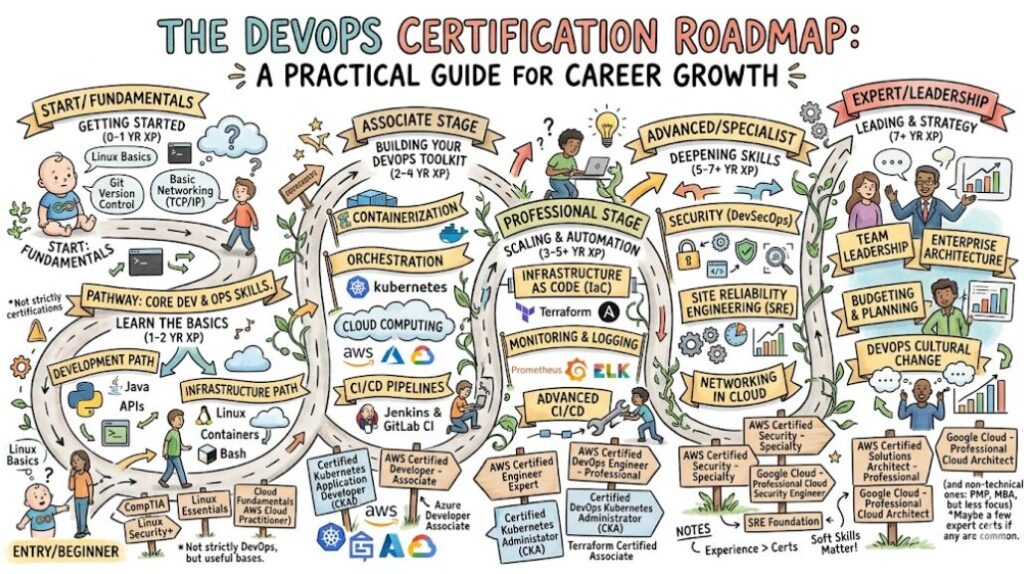
The world of DevOps can feel overwhelming. With so many tools, methodologies, and professional certifications available, it is easy for engineers to get lost in the noise. Many learners pick certifications based on buzzwords rather than career goals, often ending up with credentials that do not align with their daily work or future aspirations.
Choosing the right certification is not about collecting badges; it is about building a structured roadmap that bridges the gap between what you know today and where you want to be tomorrow. Whether you are a system administrator looking to automate your environment, a developer seeking a deeper understanding of operations, or an SRE aiming for higher reliability, this guide helps you filter the noise and focus on paths that provide tangible, long-term value.
Why DevOps Certifications Matter
Certifications serve as a roadmap for your learning journey. They provide:
- Skill Validation: Proven mastery of tools like Kubernetes, Terraform, and cloud-native practices.
- Structured Learning: A focused curriculum that prevents “tutorial hell” by providing a clear path from A to Z.
- Industry Demand: Employers prioritize candidates who can demonstrate proficiency in standard industry frameworks.
- Career Confidence: Moving from “I think I know this” to “I am certified in this” changes your approach to complex system troubleshooting.
- Hands-on Focus: Many certifications require solving real-world infrastructure problems, which is critical for operational excellence.
Who Should Read This Guide
This guide is designed for anyone ready to standardize their DevOps knowledge:
- Freshers: Building an initial career foundation.
- Developers: Transitioning into infrastructure-focused roles.
- Linux Administrators: Scaling your management skills to the cloud.
- Cloud & Kubernetes Engineers: Specializing in modern orchestration.
- SRE & Platform Engineers: Focusing on high-availability systems.
- DevSecOps Professionals: Integrating security into the CI/CD pipeline.
DevOps Certification Categories
To make the right choice, categorize your goals:
- Foundation Certifications: Build the basics of DevOps principles and culture.
- Tool-Based Certifications: Master specific technologies like Docker, Kubernetes, or Terraform.
- Cloud DevOps Certifications: Focus on cloud-native delivery within platforms like AWS, Azure, or Google Cloud.
- DevSecOps Certifications: Learn to embed security into the development lifecycle.
- SRE and Platform Engineering Certifications: Focus on reliability, scalability, and system architecture.
- Advanced and Specialized Certifications: High-level mastery for MLOps, AIOps, and GitOps roles.
Best DevOps Certifications at a Glance
| Certification Name | Best For | Level | Main Skills | Career Scope |
| DevOps Certified Professional (DCP) | All Levels | Foundation | CI/CD, Automation | DevOps Engineer |
| DevSecOps Certified Professional (DSOCP) | Security Teams | Advanced | Pipeline Security | DevSecOps Engineer |
| SRE Certified Professional | Ops Engineers | Advanced | Reliability, Latency | SRE Engineer |
| Master in DevOps Engineering (MDE) | Professionals | Advanced | Scaling, Architecture | DevOps Architect |
| Master in Azure DevOps | Azure Users | Intermediate | Azure Pipelines | Cloud Engineer |
| AWS Certified DevOps Professional | AWS Users | Advanced | AWS Cloud Ops | Cloud Architect |
| Master in Python Programming | Developers | Foundation | Scripting, Automation | Automation Engineer |
| Hashicorp Certified Terraform Associate | Infrastructure | Intermediate | IaC, Provisioning | Platform Engineer |
| Certified Kubernetes Administrator (CKA) | Cloud Engineers | Intermediate | Clusters, Storage | K8s Administrator |
| Docker Certified Associate (DCA) | Beginners | Foundation | Containers, Images | DevOps Engineer |
| Envoy ISTIO Certification Training | Net Engineers | Advanced | Service Mesh | Network Engineer |
| MLOps Certification Training Course | Data Teams | Advanced | Model Lifecycle | MLOps Engineer |
| Google Cloud Professional Cloud DevOps Engineer | GCP Users | Advanced | GCP Pipelines | Cloud Engineer |
| Master in Machine Learning | Data Analysts | Intermediate | Algorithms, Data | ML Engineer |
| Master in Artificial Intelligence | AI Aspirants | Advanced | NLP, Automation | AI Engineer |
| Master in AppDynamics | SREs | Intermediate | Monitoring | SRE/Monitoring |
| Master in Data Science | Developers | Foundation | Data Analysis | Data Scientist |
| Master in Deep Learning | Researchers | Advanced | Neural Networks | AI Specialist |
| Prometheus with Grafana | Operations | Intermediate | Monitoring, Metrics | DevOps Engineer |
| GitOps Certified Professional (GOCP) | SRE/Platform | Intermediate | GitOps, Workflows | Platform Engineer |
Certification Deep Dive (Select Examples)
DevOps Certified Professional (DCP)
- What It Is: A foundational course covering CI/CD pipelines, automated testing, and basic DevOps culture.
- Best Career Fit: DevOps Engineer, System Administrator.
- Difficulty: Foundation.
- Skills You Will Learn: CI/CD implementation, version control integration, and collaborative workflows.
- Tools: Git, Jenkins, basic Linux.
Certified Kubernetes Administrator (CKA)
- What It Is: An intensive program focused on container orchestration, cluster management, and troubleshooting.
- Best Career Fit: Kubernetes Engineer, Platform Engineer.
- Difficulty: Intermediate.
- Skills You Will Learn: Cluster architecture, workload management, and storage configuration.
- Tools: Kubernetes, etcd, kubectl.
DevSecOps Certified Professional (DSOCP)
- What It Is: Teaches security integration at every stage of the software lifecycle (Shift Left).
- Best Career Fit: DevSecOps Engineer, Security Architect.
- Difficulty: Advanced.
- Skills You Will Learn: Vulnerability scanning, secure pipelines, and compliance as code.
Certification Comparison Table
| Certification | Best For | Difficulty | Main Focus | Career Scope |
| DCP | Beginners | Low | DevOps Basics | Junior DevOps |
| CKA | Ops Engineers | High | Kubernetes | K8s Engineer |
| Terraform Associate | Infra Engineers | Medium | IaC | Platform Engineer |
| AWS DevOps Pro | Cloud Admins | High | Cloud Ops | Cloud Architect |
| DSOCP | Security Teams | High | Security Integration | DevSecOps Lead |
DevOps Certification Roadmap
Beginner Roadmap
- Linux fundamentals.
- Version control with Git.
- Basic containerization (Docker).
- Foundation of CI/CD concepts.
Intermediate Roadmap
- Terraform for infrastructure automation.
- Jenkins or GitLab CI configuration.
- Kubernetes administration (CKA).
- Cloud fundamentals (AWS/Azure/GCP).
Advanced Roadmap
- Kubernetes professional certifications.
- Service Mesh (Istio).
- DevSecOps integration.
- Advanced Monitoring (Prometheus/Grafana).
Specialized Roadmap
- GitOps workflows.
- MLOps pipelines.
- AIOps and Observability.
- Platform Engineering.
Recommended Certification Path by Role
| Role | Suggested Path |
| DevOps Beginner | DCP -> Docker -> Jenkins |
| Cloud Engineer | AWS/Azure/GCP DevOps -> Terraform |
| Kubernetes Engineer | CKA -> Kubernetes Security |
| SRE Engineer | SRE Professional -> Prometheus -> AppDynamics |
| DevSecOps Engineer | DSOCP -> Security Tools |
| Platform Engineer | Terraform -> Kubernetes -> GitOps |
Real-World Career Scenarios
- Fresher: Start with the DevOps Certified Professional (DCP). This builds the broad knowledge base you need to understand how development and operations teams connect.
- Cloud Engineer to DevOps: If you are already managing cloud resources, focus on Terraform and Kubernetes to move from managing UI-based cloud services to automated, code-based infrastructure.
- Operations to SRE: Focus on SRE Certified Professional and Prometheus/Grafana. Your operational background is the perfect foundation for mastering system reliability and observability.
- Developer to Platform Engineering: You already know the code; now learn the infrastructure. Start with Docker and Kubernetes to understand how your code lives in production.
Common Mistakes to Avoid
- Skipping Linux Fundamentals: DevOps is built on Linux. If you do not know the command line, no certification can fix that.
- Ignoring Networking: Understanding DNS, Load Balancing, and Firewalls is essential for cloud orchestration.
- Starting Kubernetes Too Early: Learn Docker first. Trying to run a cluster without understanding containers is like trying to drive a car without knowing how an engine works.
- Certification Collecting: Having ten certificates means nothing if you have zero projects. Balance your study with building.
- Avoiding the “Why”: Focus on the philosophy of DevOps (collaboration, culture) as much as the tools (Jenkins, Terraform).
Hands-On Projects to Build
- Build a CI/CD Pipeline: Automate a simple web application deployment using a tool like Jenkins or GitHub Actions.
- Containerize an App: Take a local application and convert it into a Docker image.
- Kubernetes Deployment: Deploy a multi-tier application to a local K8s cluster (Minikube).
- Terraform Automation: Provision a simple virtual machine on a cloud provider using Infrastructure as Code.
- Observability: Set up a monitoring dashboard using Prometheus and Grafana for your application.
- GitOps Workflow: Automate your infrastructure changes using a Git repository as the single source of truth.
How to Choose the Right DevOps Certification
- Assess Your Current Skill Level: Are you comfortable with the terminal? If not, start with Linux/Docker foundations.
- Define Your Career Goal: Are you aiming for Cloud, Security, or Reliability? Let that dictate your path.
- Cloud Preference: If your company uses Azure, get Azure DevOps certified. Do not waste time on AWS-specific certs if you don’t use the platform.
- Hands-On vs. Theory: Look for certifications that emphasize lab-based exams (like CKA) over purely theoretical quizzes.
- Long-term Growth: Pick a path that builds upon itself. A logical progression is the fastest way to get promoted.
FAQs
- Which certification is best for beginners?The DevOps Certified Professional (DCP) is the most effective starting point as it covers all foundational pillars.
- Is Docker certification necessary?It is highly recommended for building a strong understanding of containerization, which is the core of modern DevOps.
- Should I learn Kubernetes or Terraform first?Terraform is often better for beginners to understand how to provision resources, while Kubernetes is better once you understand how to run applications.
- Are DevOps certifications enough to get a job?Certifications validate knowledge, but employers prioritize candidates with hands-on projects and the ability to demonstrate their skills.
- What is the best path for an SRE role?Focus on SRE Certified Professional, followed by Prometheus and Grafana monitoring tools.
- Can I do DevOps without coding?You need to understand scripting (Python/Bash) and automation workflows. “No code” DevOps is a myth.
- How long does it take to get certified?It depends on your current experience, but a consistent study plan can lead to certification in 3–6 months.
- Is the CKA exam hard?It is performance-based and challenging, requiring practical experience. It is highly respected in the industry.
- Should I get an AWS or Azure certification?Choose the one that matches your current workplace environment or your target industry.
- How do I maintain my certification value?Keep building projects and stay updated on the latest tooling changes, as the DevOps ecosystem evolves rapidly.
- Do I need to be a developer first?No, but having basic development knowledge helps you understand the code you are deploying.
- What is the difference between DevOps and SRE?DevOps is the culture of collaboration; SRE is a specific engineering implementation of those principles focused on reliability.
Final Recommendation
There is no single “perfect” certification. The best roadmap is the one that forces you to build things. If you are just starting, prioritize the DevOps Certified Professional to grasp the full scope. As you progress, specialize in a tool-based certification like CKA or Terraform Associate.
Remember, certificates open the door, but your practical project portfolio keeps the room open. Focus on building real pipelines, automating real infrastructure, and solving real problems. The path to DevOps mastery is a marathon, not a sprint—start by building one project today.