Introduction
In the current era of digital transformation, software delivery expectations have shifted dramatically. Users no longer wait months for a major feature update; they expect continuous improvements, rapid bug fixes, and seamless performance around the clock. This pressure forces engineering teams to re-evaluate how they plan, write, test, and release code.
Traditionally, development and operations teams worked in silos. Developers would write code and “throw it over the wall” to operations, creating bottlenecks, finger-pointing, and slow release cycles. Agile introduced iterative development to solve the “what to build” problem, but it did not fully solve the “how to deliver” challenge. This is where DevOps bridges the gap.
When you integrate Agile and DevOps, you combine the flexibility of iterative planning with the stability of automated delivery. Many organizations struggle with this integration, often treating them as competing philosophies rather than complementary ones. If you are looking to master these concepts, resources at DevOpsSchool provide structured learning paths to help you navigate this transition.
In this guide, we will break down exactly how these two methodologies work together to create a streamlined, efficient, and high-quality software delivery engine.
What Is Agile?
Agile is a mindset and a framework focused on iterative development. Instead of planning a project in its entirety for six months, Agile breaks work into smaller, manageable chunks. This allows teams to respond to change rather than following a rigid, linear plan.
At its core, Agile prioritizes customer feedback and frequent delivery of working software. By working in short iterations—often called Sprints—teams can pivot quickly if user needs change.
Key Agile frameworks include:
- Scrum: A framework where teams work in fixed-length iterations (usually two weeks) to deliver incremental value.
- Kanban: A method focused on continuous flow, visual management, and limiting work-in-progress to reduce bottlenecks.
For example, an Agile team building an e-commerce checkout page would not wait three months to launch the entire system. Instead, they would release the “Add to Cart” functionality first, gather user feedback, and then move to the “Payment Gateway” in the next sprint.
What Is DevOps?
DevOps is a set of practices that combines software development (Dev) and IT operations (Ops). Its primary goal is to shorten the systems development life cycle and provide continuous delivery with high software quality. DevOps is not just a tool; it is a cultural shift that emphasizes shared responsibility, automation, and transparency.
While Agile focuses on the process of building software, DevOps focuses on the process of delivering and maintaining it. It leverages automation to eliminate manual tasks, ensuring that code is always in a deployable state.
Core pillars of DevOps include:
- Collaboration: Removing the wall between developers and system administrators.
- Automation: Using pipelines to test, build, and deploy code without manual intervention.
- Continuous Improvement: Using monitoring and telemetry to learn from production data.
For example, in a DevOps environment, a developer does not just write code and commit it. They ensure the code passes automated tests and is automatically packaged into a container, ready for deployment to a cloud environment without an operations engineer needing to manually configure the server.
Agile vs DevOps: Understanding the Difference
While they overlap in many areas, their primary focus differs. The following table highlights the distinctions.
| Area | Agile | DevOps |
| Primary Focus | Software development lifecycle & project management | Infrastructure, deployment, and operations |
| Teams Involved | Devs, Product Owners, Scrum Masters | Devs, Ops, QA, Security, SREs |
| Core Goal | Faster delivery of features based on customer needs | Faster, more reliable, and stable releases |
| Feedback Loop | Feedback on product functionality | Feedback on system performance and stability |
| Automation | Important, but secondary to the planning process | Critical and mandatory for every stage |
| Delivery Process | Iterative cycles (Sprints) | Continuous integration and continuous delivery (CI/CD) |
Why Agile and DevOps Work Better Together
Agile without DevOps often leads to a bottleneck where developers build features quickly, but operations cannot deploy them at the same speed. Conversely, DevOps without Agile often leads to automated deployments of features that the customer may not actually need.
When combined, they create a powerful loop:
- Faster Delivery: Agile gives you the roadmap, and DevOps builds the high-speed highway to get there.
- Continuous Feedback: You get feedback on both the product (Agile) and the infrastructure (DevOps).
- Better Collaboration: Teams move from being “developers” and “operators” to being a unified product team.
- Improved Quality: Automated testing (DevOps) catches bugs early, and frequent releases (Agile) ensure that issues are small and easy to fix.
How Agile and DevOps Work Together in Modern Teams
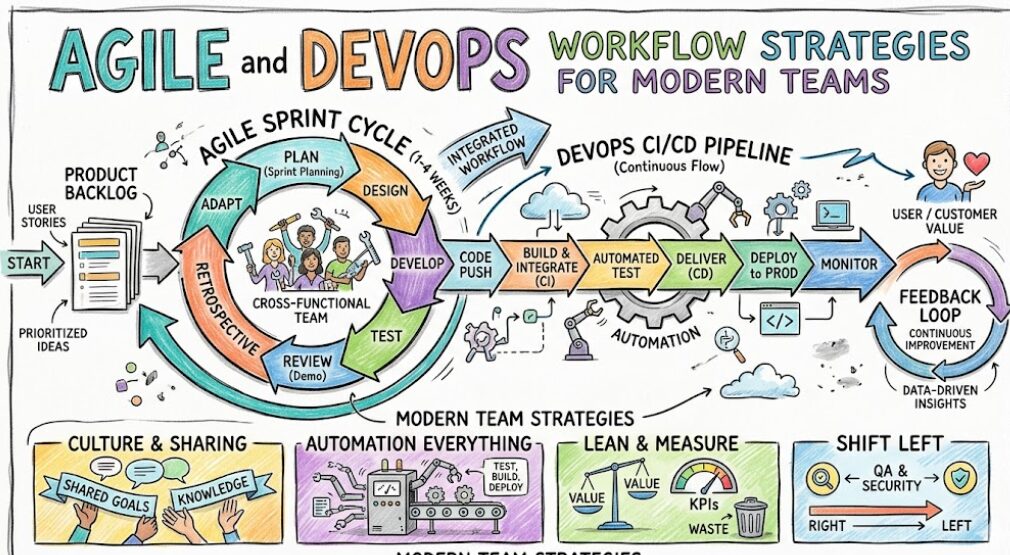
In a high-performing team, the two methodologies form a continuous cycle. The Agile process handles the “what” and “when,” while the DevOps pipeline handles the “how.”
The integrated workflow looks like this:
- Agile Planning: The team prioritizes features based on business value.
- Sprint Development: Developers build the features in short, focused increments.
- CI/CD Pipeline Execution: As soon as code is committed, automated pipelines build and test the software.
- Automated Testing: Code is verified for quality and security automatically.
- Continuous Deployment: If tests pass, the code is moved to staging or production automatically.
- Monitoring and Feedback: Once in production, monitoring tools track performance and user behavior.
- Next Sprint: Data from the monitoring phase informs the next round of Agile planning.
Agile + DevOps Workflow Explained
To visualize how this works, consider the lifecycle of a single feature request:
- Backlog: The Product Owner creates a user story: “User should be able to log in with Google.”
- Sprint Planning: The team commits to this story for the current sprint.
- Development: The developer writes code and creates a Pull Request.
- Automated Testing: The CI pipeline runs unit tests. If they fail, the build stops.
- CI/CD Pipeline: If tests pass, the artifact is created and pushed to a container registry.
- Deployment: The infrastructure (using IaC) spins up the environment and deploys the new login feature.
- Monitoring: The team monitors the login success rate in real-time.
- Feedback: If users struggle, the team addresses it in the next sprint planning session.
Role of CI/CD in Agile and DevOps
CI/CD (Continuous Integration/Continuous Delivery) is the technical glue that binds Agile and DevOps.
- Continuous Integration (CI): This is the practice of merging code changes into a central repository frequently. It prevents “integration hell” where code conflicts arise because developers haven’t merged their work for weeks.
- Continuous Delivery (CD): This ensures that code is always in a releaseable state.
In an Agile world, you might have a Sprint review every two weeks. With CI/CD, you can technically release at the end of every day, giving your Product Owner the ability to demonstrate new features to stakeholders immediately.
Automation as the Bridge Between Agile and DevOps
Automation removes the “toil” that prevents Agile teams from moving fast.
- Test Automation: Ensures that new features do not break existing functionality.
- Infrastructure as Code (IaC): Allows you to treat infrastructure like software, version-controlling it so that your environment is reproducible.
- Release Automation: Eliminates the need for manual checklists during deployment nights.
- Monitoring Automation: Proactively alerts the team before a user reports a bug.
Without automation, Agile teams are held back by the manual speed of the operations team.
Benefits of Combining Agile and DevOps
- Faster Time to Market: You go from idea to production in hours, not weeks.
- Reduced Risk: Smaller, more frequent releases are easier to troubleshoot than massive “Big Bang” releases.
- High Product Quality: Automation ensures consistency and reduces human error.
- Happier Teams: Developers spend less time fixing deployment issues and more time writing features.
- Customer Satisfaction: Users get the features they ask for almost immediately.
Agile and DevOps in Cloud-Native Development
Modern architecture, specifically cloud-native development, relies heavily on this combination.
- Containers: (e.g., Docker) ensure code runs the same in a developer’s laptop as it does in production.
- Kubernetes: Orchestrates these containers, allowing teams to scale services up or down automatically.
- Microservices: Allow Agile teams to own specific, small parts of the application, deploying them independently without waiting for the whole application to be ready.
This setup is the standard for modern SaaS platforms.
Team Collaboration in Agile and DevOps
The cultural shift is the hardest part. You must break down silos.
- Developers take ownership of the code beyond just writing it; they care about how it performs in production.
- Operations engineers move upstream, helping write deployment scripts and monitoring configurations during the development phase.
- QA engineers focus on writing automated test scripts rather than manual testing.
- Product Owners learn that while they drive the roadmap, they must respect the operational requirements (like technical debt) needed to keep the platform stable.
Real-World Example of Agile and DevOps Working Together
Imagine a banking mobile app team.
- Product Team: Defines a new feature: “Instant Money Transfer.”
- Agile Sprint: The team breaks this down into tasks: UI changes, API logic, database updates.
- Development: Developers write the code.
- CI/CD Pipeline: The pipeline runs unit tests, integration tests, and security scans.
- Deployment: The code is deployed to a staging environment for the Product Owner to review.
- Monitoring: Once pushed to production, the team uses monitoring tools to ensure transfer latency is low.
- Feedback: The team sees that users are using the feature heavily, so they plan an “Update Limits” feature for the next sprint.
Common Challenges When Combining Agile and DevOps
- Cultural Resistance: “We have always done it this way” is the biggest killer of progress.
- Tool Complexity: Teams sometimes buy every tool in the market without knowing how to integrate them.
- Skill Gaps: Developers may not know how to handle infrastructure, and Operations may not know how to code.
- Legacy Systems: Some older applications were not designed for automated deployment.
- Weak Automation: If you automate a bad process, you just get a bad result faster.
Common Beginner Misunderstandings
- “Agile and DevOps are the same.” No. Agile is the process; DevOps is the delivery mechanism.
- “DevOps replaces Agile.” No. DevOps makes Agile effective.
- “Agile means no documentation.” Agile promotes valuable documentation, not useless documentation.
- “DevOps is only tools.” DevOps is 80% culture and 20% tools.
Best Practices for Agile + DevOps Success
- Start Small: Automate one part of the pipeline before trying to automate everything.
- Cross-Functional Teams: Put developers and ops in the same “squad.”
- Invest in Automation: Treat your pipeline code with the same care as your production code.
- Shared KPIs: Measure the team based on business outcomes, not individual tasks.
- Practice Continuous Learning: Technology changes fast; encourage your team to upskill.
Role of Leadership in Agile and DevOps Adoption
Management must provide the space for change. Leaders should:
- Remove Silos: Stop measuring teams by individual departmental performance (e.g., stop measuring Ops only on uptime and Dev only on velocity).
- Support Experimentation: Allow teams to fail fast and learn.
- Invest in Training: Upskilling is the best way to handle the talent gap.
- Encourage Collaboration: Create environments where developers and operations engineers speak the same language.
Role of DevOpsSchool in Learning Agile and DevOps
To truly succeed, you need a structured learning path. DevOpsSchool provides hands-on exposure to the tools and practices that bridge these two worlds. Rather than reading theory, the focus here is on:
- Real-world scenarios: Applying concepts to actual codebases.
- CI/CD exposure: Learning how to build pipelines that actually work.
- Cloud-native practices: Mastering containers and orchestration.
- Mentoring: Learning from experts who have navigated the challenges of enterprise modernization.
Industries Benefiting from Agile and DevOps
- Banking & Finance: Needs high security and stability, but also needs to release features faster to stay competitive with Fintech.
- Healthcare: Requires rigorous testing (compliance) combined with the need to update patient systems quickly.
- E-Commerce: Needs 100% uptime and the ability to release features for sales and promotions instantly.
- SaaS Platforms: The very definition of continuous delivery.
- Telecom: Needs to manage massive scale while rolling out new network capabilities.
- Enterprise IT: Breaking down massive, slow-moving legacy structures into agile, modular parts.
Career Opportunities Related to Agile and DevOps
The demand for professionals who understand both sides is at an all-time high.
- DevOps Engineer: Focuses on the automation and infrastructure.
- Scrum Master/Agile Coach: Focuses on the process and team health.
- Cloud Engineer: Focuses on AWS/Azure/GCP architecture.
- Platform Engineer: Builds internal tools for developers.
- SRE (Site Reliability Engineer): Bridges the gap between development and operations with a heavy focus on stability.
Skills Required: Linux, Cloud Platforms, CI/CD tools, Infrastructure as Code, Agile frameworks, and strong communication skills.
Certifications & Learning Paths
| Certification | Best For | Skill Level | Focus Area |
| Certified ScrumMaster | Scrum Masters/Managers | Beginner | Agile Process |
| AWS Certified DevOps Engineer | Cloud Engineers | Advanced | Cloud & CI/CD |
| CKA (Certified Kubernetes Admin) | Platform/DevOps Engineers | Advanced | Container Orchestration |
| DevOps Foundation | Beginners | Beginner | DevOps Culture |
Future of Agile and DevOps
The future is heading toward autonomous operations.
- AI-assisted Development: AI will help write and test code, accelerating Agile sprints.
- Platform Engineering: Creating internal developer platforms (IDP) so developers can self-serve infrastructure.
- DevSecOps: Security is shifting even further left, becoming an automated part of the CI/CD pipeline.
- GitOps: Managing infrastructure entirely through Git repositories.
FAQs
- What is the core difference between Agile and DevOps?Agile is about how you manage the work (planning and iterations), while DevOps is about how you execute and deploy the work (automation and infrastructure).
- Can Agile exist without DevOps?Yes, but it will be slow. Without DevOps, Agile teams often struggle to deploy their work, leading to a build-up of unreleased features.
- Does DevOps replace Agile?No. They are complementary. DevOps enhances the effectiveness of Agile.
- Why do companies combine Agile and DevOps?To achieve the speed of Agile with the stability of DevOps, resulting in faster and more reliable software releases.
- Is CI/CD necessary for Agile?While you can do Agile without CI/CD, you will struggle to meet the “continuous” part of Agile delivery without it.
- Is Kubernetes important for this integration?Yes, because it provides a standard environment for deployment, which is a key requirement for modern DevOps.
- Can beginners learn Agile and DevOps together?Yes, but it is better to learn the fundamentals of the development lifecycle first.
- Is DevOps a good career?It is one of the most in-demand and highest-paying career paths in IT today.
- What is the “shift-left” approach?It means moving testing and security earlier into the development process, rather than leaving it for the end.
- How does DevOps help with technical debt?By automating testing and infrastructure, teams have more time to pay down technical debt rather than just fighting deployment fires.
- Do I need to be a programmer to do DevOps?You need to understand code and scripting, even if you are not a software developer by trade.
- What is the hardest part of adopting these methodologies?The cultural change—getting people to work together and share responsibility.
- Can Agile and DevOps work in a waterfall project?It is very difficult. They are designed for iterative, not sequential, development.
- How long does it take to implement these practices?It is a journey, not a project. It usually takes months to years to see full enterprise-wide maturity.
- What is the role of monitoring in this relationship?Monitoring provides the feedback loop that drives the next Agile sprint planning.
Final Thoughts
Combining Agile and DevOps is not just about adopting new tools; it is about changing how your team thinks. It is about moving from “my code” to “our product.” When you remove the barriers between the people who build software and the people who run it, you unlock a level of velocity that is impossible to achieve otherwise.
If you are just starting, do not try to overhaul everything overnight. Start by automating one manual process, or by holding one collaborative sprint planning session that includes your operations team. Success in this field comes from consistent, incremental improvement—which, ironically, is the very essence of both Agile and DevOps.