Introduction
In the current landscape of rapid software delivery, the demand for robust, scalable, and automated infrastructure has never been higher. As teams move toward cloud-native architectures, the traditional divide between developers and system administrators has become a bottleneck. This is where the cultural and technical framework of DevOps bridges the gap.
For those starting their journey, the initial instinct is often to jump straight into learning complex tools like Kubernetes or Terraform. However, tools are transient; principles are enduring. Understanding these core concepts is the single most effective way to accelerate your career. By mastering the fundamentals, you gain the ability to adapt to new technologies as they emerge.
At DevOpsSchool, we emphasize that successful engineering careers are built on a solid understanding of these core tenets. Whether you are a student or an IT professional shifting your career path, grasping these concepts is your first step toward true technical proficiency.
What Are DevOps Principles?
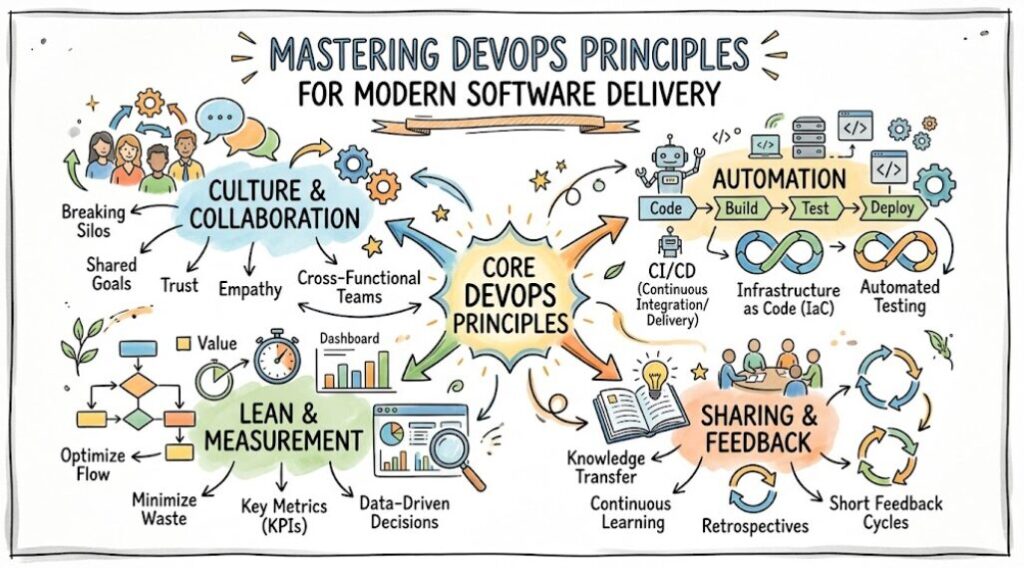
At its heart, DevOps is not a single product or a specific toolset. It is a philosophy that combines practices, cultural philosophies, and tools to increase an organization’s ability to deliver applications and services at high velocity.
DevOps principles focus on breaking down the barriers between siloed teams. Instead of “throwing code over the wall” from development to operations, DevOps encourages shared ownership throughout the entire lifecycle of an application—from design and development to production support and maintenance. It is an automation-first mindset that champions continuous improvement and radical transparency.
Why DevOps Principles Matter for Beginners
For a beginner, the tech world can feel overwhelming due to the sheer volume of available tools. Learning principles provides a compass.
- Faster Software Delivery: Principles teach you how to remove manual bottlenecks.
- Better Collaboration: You learn how to communicate effectively between development and operations teams.
- Improved Scalability: You gain an understanding of how to build systems that grow with user demand.
- Reduced Operational Friction: By automating mundane tasks, you focus on solving complex problems rather than fighting fires.
- Cloud-Native Fluency: These principles are the backbone of modern cloud computing, making them essential for working with AWS, Azure, or GCP.
Evolution of DevOps Principles
The industry moved toward DevOps as a reaction to the limitations of the Waterfall model, where development and operations worked in isolation. In the past, changes were infrequent, manual, and high-risk.
As Agile methodology gained traction, development teams began moving faster. Operations teams, however, were still tasked with maintaining stability, creating a clash of objectives. DevOps emerged as the solution—a way to marry the speed of Agile development with the stability of robust operations. This evolution birthed the concepts of CI/CD, Infrastructure as Code, and the modern cloud-native ecosystem.
Overview of Core DevOps Principles
| Principle | Purpose | Technical Benefit | Business Benefit |
| Collaboration | Unify teams | Reduced silos | Faster time-to-market |
| Automation | Remove manual work | Consistency | Reduced human error |
| Continuous Integration | Merge code frequently | Early bug detection | Stable codebases |
| Continuous Delivery | Release ready code | Reliable releases | Rapid feature rollout |
| Monitoring | Observe performance | Proactive fixing | Higher uptime |
| IaC | Version infrastructure | Reproducibility | Scalable environments |
| Feedback Loops | Iterate faster | Data-driven growth | Customer satisfaction |
| Shared Responsibility | Collective ownership | Higher quality code | Better security posture |
Principle 1: Collaboration and Communication
DevOps is 50% culture and 50% technology. Breaking down “silos”—the pockets of information held by specific teams—is the most critical first step. When developers understand how their code performs in production, and operators understand the application’s design, the entire organization becomes more productive.
Principle 2: Automation
Automation is the engine of DevOps. If a task is performed more than once, it should be automated. This applies to testing code, provisioning servers, or configuring network policies. Automation ensures that the process is repeatable, predictable, and free from human error.
Principle 3: Continuous Integration (CI)
Continuous Integration is the practice of merging all developers’ working copies to a shared mainline several times a day. Each integration is verified by an automated build and automated tests.
- Tools: Jenkins, GitHub Actions, GitLab CI/CD.
- Example: When a developer pushes code, an automated script runs unit tests to ensure the new changes do not break existing functionality.
Principle 4: Continuous Delivery & Continuous Deployment
These concepts focus on moving code from development to production as efficiently as possible.
| Continuous Delivery | Continuous Deployment |
| Code is always deployable. | Code is automatically deployed to production. |
| Requires manual approval. | No manual intervention. |
| Business controls release timing. | Continuous, automatic release flow. |
Principle 5: Infrastructure as Code (IaC)
IaC is the practice of managing and provisioning computing infrastructure through machine-readable definition files, rather than physical hardware configuration or interactive configuration tools.
- Tools: Terraform, Ansible, CloudFormation.
- Benefit: You can spin up an entire server environment in seconds by running a script, ensuring that your development, staging, and production environments are identical.
Principle 6: Monitoring and Observability
You cannot fix what you cannot see. Monitoring involves tracking metrics, logs, and traces to understand the health of your system.
- Tools: Prometheus for metrics, Grafana for visualization, ELK Stack for logging.
- Example: Setting up alerts to notify the team if CPU usage exceeds 80% on a server.
Principle 7: Continuous Feedback
Feedback loops are essential for improvement. By collecting data from production and user behavior, teams can make informed decisions about the next set of features or performance optimizations required.
Principle 8: Shared Responsibility
In a DevOps model, there is no “it works on my machine” excuse. Both developers and operations share the responsibility for the application’s uptime, security, and performance. This fosters a sense of pride and ownership.
Principle 9: Customer-Centric Thinking
All automation and infrastructure work should ultimately serve the user. By delivering features faster and maintaining high reliability, DevOps practices directly improve the user experience.
Principle 10: Continuous Learning
The DevOps field changes rapidly. An engineer must be comfortable with constant learning, analyzing failures without blame, and sharing knowledge across the team.
DevOps Principles in Cloud-Native Environments
Cloud-native environments, powered by technologies like Kubernetes and microservices, rely heavily on DevOps principles. Because infrastructure is dynamic, you cannot manage it manually. You must use CI/CD pipelines to manage containerized applications and Platform Engineering to provide self-service infrastructure for developers.
Popular Tools Supporting DevOps Principles
| Tool | Purpose | Beginner Difficulty | Industry Demand |
| Jenkins | CI/CD | Medium | High |
| Terraform | IaC | Medium | Very High |
| Prometheus | Monitoring | High | High |
| Docker | Containers | Low-Medium | Very High |
| Git | Version Control | Low | Essential |
Real-World DevOps Workflow Example
- Code: Developer writes code on their local machine.
- Commit: Code is pushed to a repository like GitHub.
- CI: Pipeline triggers; code is compiled and tested automatically.
- Artifact: A Docker image is created and stored in a registry.
- Deploy: The pipeline updates the Kubernetes cluster with the new image.
- Monitor: Tools track the new deployment to ensure no errors occur.
Benefits of Understanding DevOps Principles Early
By focusing on these principles, you avoid the “tool-trap.” When a new tool arrives in the market, you will already understand why it exists and what problem it aims to solve. This perspective makes you an architect, not just a tool operator.
Common Challenges Beginners Face
- Information Overload: Focus on one principle at a time.
- Ignoring Fundamentals: Do not skip learning Linux and networking.
- Lack of Hands-on Practice: Build small projects; do not just read blogs.
Best Practices for Learning DevOps Principles
- Start with Linux: It is the backbone of almost all cloud infrastructure.
- Learn Git: Version control is the foundation of collaboration.
- Build a Project: Deploy a simple web application using a basic CI/CD pipeline.
- Embrace Failure: Use it as a learning opportunity.
DevOps Principles vs Traditional IT Practices
| Feature | Traditional IT | DevOps Principles |
| Collaboration | Siloed teams | Cross-functional teams |
| Deployment | Infrequent/Manual | Frequent/Automated |
| Infrastructure | Manual configuration | Infrastructure as Code |
| Monitoring | Reactive | Proactive/Observability |
Certifications & Learning Paths
While hands-on experience is paramount, certifications can validate your knowledge. Consider exploring the structured learning paths provided at DevOpsSchool.
| Certification | Best For | Skill Level | Focus Area |
| CKA | Kubernetes | Advanced | Container Orchestration |
| AWS/Azure/GCP | Cloud Fundamentals | Beginner | Cloud Infrastructure |
| Terraform Associate | IaC | Intermediate | Infrastructure Automation |
Common Beginner Mistakes
- Focusing on tools over principles: Remember, tools change, but principles remain.
- Skipping Networking: You must understand how computers talk to each other.
- Avoiding Monitoring: Assuming the application will run perfectly without oversight.
Career Opportunities
The roles in this domain are diverse and high-paying:
- DevOps Engineer: Focuses on the intersection of code and infrastructure.
- Site Reliability Engineer (SRE): Focuses on system reliability and uptime.
- Platform Engineer: Builds internal tools for other developers to use.
Future of DevOps Principles
The future lies in AI-assisted operations (AIOps), where machine learning helps identify issues before they happen, and GitOps, where the entire state of the infrastructure is managed directly through a Git repository.
FAQs
- What are DevOps principles?
They are a set of cultural and technical practices aimed at improving software delivery speed and quality. - Why are DevOps principles important?
They reduce operational complexity and increase team collaboration. - Is automation the main DevOps principle?
It is a core pillar, but it must be supported by culture and feedback. - What is CI/CD in DevOps?
It is the practice of automatically testing and deploying code changes. - Is Linux mandatory?
Yes, it is the standard environment for servers and cloud-native tools. - What is Infrastructure as Code?
Managing infrastructure settings via code files. - Is Kubernetes required for beginners?
Learn the basics of containers first, then move to orchestration. - How long does it take to learn?
It is a continuous journey, but basic proficiency can be built in 6 months of consistent practice. - Can I learn DevOps without a developer background?
Yes, but basic scripting knowledge is highly recommended. - Does DevOps replace System Administrators?
It evolves the role into a more automated and strategic function. - What is the difference between DevOps and SRE?
SRE is a specific implementation of DevOps principles. - Are there jobs for DevOps beginners?
Yes, roles like Junior DevOps Engineer or Cloud Associate are common. - Is networking important?
Essential. Understanding HTTP, DNS, and Firewalls is critical. - Where can I practice?
Use free tiers from cloud providers and local virtual machines. - What is the best way to start?
Focus on learning Git and Linux, then build a CI/CD pipeline for a static website.
Final Thoughts
The journey into DevOps is one of the most rewarding paths in the modern IT landscape. However, it requires a mindset shift. Do not be in a rush to master every tool; instead, focus on the “why” behind the principles. Understand the value of automation, the importance of failing fast, and the necessity of shared responsibility.
The most successful engineers are those who view technology as a way to solve business and human problems, not just as a collection of features. Stay curious, practice continuously, and never lose your drive to improve the systems you manage.