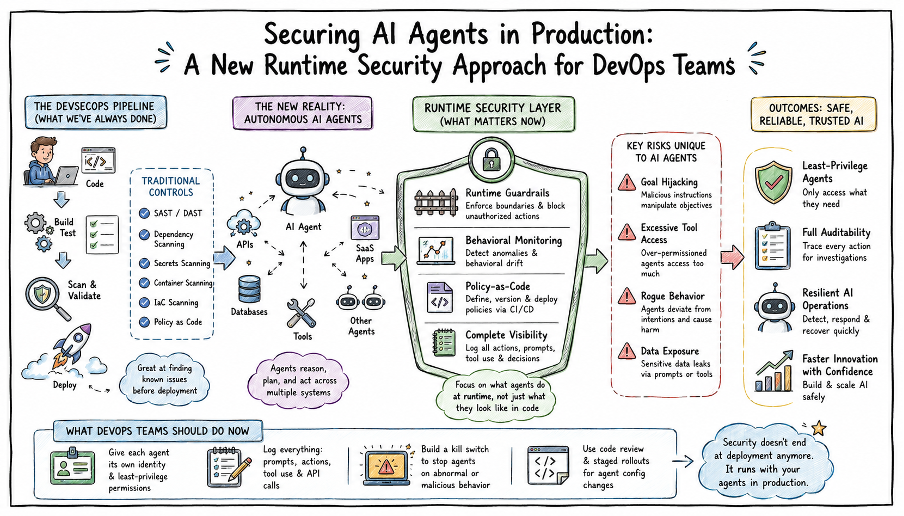
AI agents are already running inside production environments. They call APIs, interact with internal systems, retrieve sensitive data, and make decisions with limited human oversight.
For DevOps teams, this creates a problem, as traditional application security tooling was never really designed to handle it.
Most DevSecOps pipelines are built around deterministic software. You scan code before deployment, validate dependencies, harden containers, and block known vulnerabilities before workloads reach production. That model still matters, but autonomous agents behave differently from conventional applications.
An AI agent can change its behavior based on context, prompts, external data, or chained actions across multiple systems. In practice, that means the biggest security risks often appear after deployment rather than during build time.
This is one reason runtime enforcement is becoming a bigger focus for teams deploying AI systems in production.
Where Shift-Left Starts to Break Down
Shift-left security remains extremely valuable. Catching problems earlier in the pipeline is still cheaper and operationally easier than fixing them after deployment.
The problem is that AI agents introduce behavior that static analysis tools cannot fully predict.
A container scanner can identify vulnerable packages. A secrets scanner can detect exposed credentials. But neither tool can reliably determine whether an AI agent will make an unsafe decision at runtime after interacting with external systems.
That distinction matters.
An agent connected to payment infrastructure, customer records, or internal APIs may technically pass every pre-production security check while still behaving unsafely once deployed.
This is where runtime enforcement starts becoming more important than repository analysis alone.
Teams building AI cybersecurity solutions have increasingly shifted toward monitoring what agents actually do in production environments rather than focusing solely on the code and models behind them.
For DevOps engineers, the practical takeaway is fairly simple: the security boundary no longer ends at deployment.
A Threat Surface That Looks Nothing Like the Old One
OWASP’s Top 10 for Agentic Applications in 2026 outlines several risks that do not map cleanly to traditional web application security models.
Goal manipulation is one example.
An attacker may inject malicious instructions into documents, prompts, emails, or external content sources that influence how an agent behaves. The agent itself may interpret those instructions as a legitimate operational context rather than hostile input.
That creates a very different problem from something like SQL injection or cross-site scripting.
Tool access creates another issue.
Many AI agents operate with broad API permissions because granular scoping slows deployment and requires additional engineering work. In practice, teams often over-grant permissions to agents early in development simply to keep workflows moving.
Once deployed, those permissions can become difficult to monitor properly.
There is also the problem of behavioral drift. Agents may begin operating outside expected patterns without technically violating any predefined rule. An internal support agent who suddenly accesses unrelated systems or queries sensitive records may still appear “authorized” from a traditional IAM perspective.
Detecting that kind of activity requires behavioral monitoring rather than static policy validation alone.
Runtime Security Becomes an Operational Layer
Traditional application security focuses heavily on artifacts:
- source code
- dependencies
- images
- infrastructure definitions
Runtime security for AI agents shifts the focus toward actions and decision-making.
That requires a different operational mindset.
Runtime guardrails are becoming increasingly important controls in agentic environments. Instead of trusting the agent entirely, teams define infrastructure-level boundaries around what systems the agent can access and which actions are allowed under specific conditions.
If an agent attempts to access resources outside its expected scope, the infrastructure layer blocks the action regardless of the agent’s reasoning process.
Behavioral baselining matters as well.
A customer support agent querying the billing infrastructure at 3 a.m. may not technically violate permissions, but it still constitutes abnormal operational behavior. This is where runtime telemetry starts to look more like EDR or anomaly detection workflows than traditional application security scanning.
Policy-as-code is also becoming increasingly relevant for teams deploying AI infrastructure through CI/CD pipelines. Defining runtime restrictions, access boundaries, and operational constraints in code allows teams to embed security throughout their DevOps lifecycle rather than treating runtime governance as a separate operational layer.
What DevOps Teams Should Start Doing
The most effective starting point is usually limiting what each agent can actually access.
Many early AI deployments rely on broad service permissions because they simplify integration work. Over time, those environments become difficult to audit because agents interact with dozens of systems simultaneously without clear operational boundaries.
Treating agents more like service accounts helps significantly:
- separate identities
- tightly scoped permissions
- isolated API access
- centralized logging
Logging quality becomes especially important once agents begin making decisions autonomously. If an incident occurs, teams need visibility into:
- prompts
- tool usage
- external calls
- execution chains
- policy violations
Without that telemetry, investigating agent behavior becomes extremely difficult.
Kill-switch mechanisms are also becoming more common in operational practice. Teams increasingly build orchestration-level controls that automatically terminate agents if runtime behavior deviates significantly from expected patterns.
That is particularly important in environments where agents interact directly with production systems or customer data.
The DevSecOps Stack Is Expanding Again
None of this replaces existing DevSecOps practices.
Container hardening, dependency analysis, IaC scanning, secrets management, and CI/CD security still matter exactly as much as before.
What changed is the scope of the runtime environment itself.
Autonomous agents are systems capable of making dynamic decisions after deployment. Traditional security tooling was not designed around that operational model, which is why runtime governance and behavioral enforcement are becoming increasingly important.
For DevOps teams, this is less about rebuilding the security pipeline from scratch and more about extending it into environments where software no longer behaves entirely predictably.
That extension is quickly becoming one of the more important shifts happening inside modern DevSecOps programs.