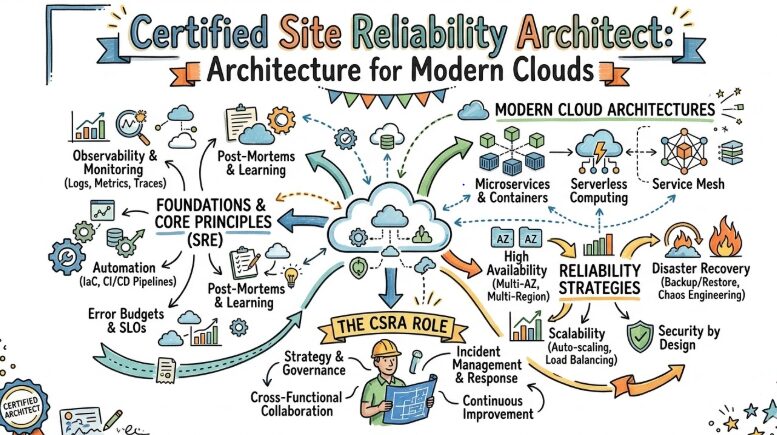
In the modern landscape of cloud-native ecosystems and distributed systems, the role of an architect has shifted from drawing diagrams to engineering resilience. This guide explores the Certified Site Reliability Architect program, a comprehensive framework designed for professionals navigating the complexities of DevOps, SRE, and platform engineering. Whether you are a system engineer looking to scale or a technical leader aiming to reduce operational toil, understanding this path is essential for making informed career decisions. You can find the full curriculum at the Certified Site Reliability Architect page on SREschool, which serves as a central hub for high-availability engineering standards.
What is the Certified Site Reliability Architect?
The Certified Site Reliability Architect represents the pinnacle of operational excellence, focusing on the intersection of software engineering and systems architecture. It is a credential designed to validate an engineer’s ability to design systems that are not only functional but inherently reliable, scalable, and maintainable under heavy production loads. Unlike theoretical frameworks, this certification emphasizes real-world application, requiring practitioners to understand how code behaves in a distributed environment. It aligns perfectly with modern enterprise practices where “shipping fast” must be balanced with “staying up,” ensuring that architectural decisions support long-term stability and performance.
Who Should Pursue Certified Site Reliability Architect?
This certification is specifically crafted for mid-to-senior level engineers who have moved beyond basic automation and are now responsible for the structural integrity of entire platforms. It is ideal for SREs, DevOps leads, Cloud Architects, and even Data Engineers who need to ensure their pipelines meet strict Service Level Objectives. While experienced engineers will find the advanced architectural patterns highly relevant, technical managers and engineering leaders also benefit by gaining the vocabulary and strategic insight needed to guide their teams. In the competitive markets of India and the global tech hubs, this certification distinguishes a “tool operator” from a “system designer.”
Why Certified Site Reliability Architect is Valuable and Beyond
The demand for architectural reliability has never been higher as enterprises move toward microservices and serverless infrastructures. As tools and cloud providers change, the fundamental principles of reliability—such as error budgets, toil reduction, and incident management—remain constant, ensuring long-term career longevity. Pursuing this path offers a significant return on time because it teaches you how to think about systems holistically rather than focusing on ephemeral command-line syntax. Investing in these architectural skills ensures you remain an indispensable asset to any organization that views downtime as a threat to its core business.
Certified Site Reliability Architect Certification Overview
The program is delivered through the official portal and is hosted on the SREschool.com platform. It utilizes a practical, assessment-based approach that moves away from simple multiple-choice questions in favor of validating deep conceptual understanding and architectural logic. The certification is structured to cover the entire lifecycle of a reliable system, from initial design and capacity planning to post-mortem analysis and continuous improvement. By focusing on ownership and end-to-end accountability, the program ensures that certified architects can lead reliability initiatives across diverse technical departments.
Certified Site Reliability Architect Certification Tracks & Levels
The certification is organized into distinct levels to mirror the natural progression of an engineering career. The Foundation level introduces the core vocabulary and philosophy of SRE, ensuring everyone on a team starts with a shared understanding of reliability. As professionals move into more specialized roles, the tracks expand into Advanced and Architectural levels, focusing on complex topics like multi-region failover, automated remediation, and financial operations. These levels allow engineers to map their learning journey to their specific career goals, whether they aim to remain individual contributors or transition into technical leadership.
Complete Certified Site Reliability Architect Certification Table
| Track | Level | Who it’s for | Prerequisites | Skills Covered | Recommended Order |
| Core SRE | Foundation | Junior Engineers | Basic Linux/Cloud | SLIs/SLOs, Toil, Error Budgets | 1 |
| Engineering | Professional | SREs / DevOps | 2+ Years Experience | Observability, Automation, CI/CD | 2 |
| Architecture | Expert | Senior Architects | 5+ Years Experience | Distributed Systems, Scalability | 3 |
| Management | Leadership | Team Leads | Management Interest | Cultural Change, Hiring for SRE | 4 |
Detailed Guide for Each Certified Site Reliability Architect Certification
What it is
This certification validates a foundational understanding of the SRE principles originally pioneered by major tech giants. it confirms the candidate’s ability to speak the language of reliability and understand the core metrics that drive production decisions.
Who should take it
It is designed for software developers, system administrators, and fresh graduates who want to enter the world of DevOps and SRE. It is also highly recommended for project managers who work alongside technical teams.
Skills you’ll gain
- Defining and measuring SLIs and SLOs.
- Understanding the concept of Error Budgets.
- Identifying and eliminating operational Toil.
- Implementing basic monitoring and alerting strategies.
Real-world projects you should be able to do
- Create a basic dashboard that tracks service availability.
- Draft an incident response document for a small-scale application.
- Automate a repetitive manual task using scripting.
Preparation plan
- 7-14 Days: Focus on core SRE definitions and the Google SRE handbook summaries.
- 30 Days: Implement basic monitoring tools on a personal project to see metrics in action.
- 60 Days: Review case studies of system failures and practice writing basic post-mortems.
Common mistakes
- Focusing too much on specific tools instead of the underlying SRE philosophy.
- Overcomplicating SLIs by trying to measure everything at once.
- Ignoring the cultural aspect of “blame-free” post-mortems.
Best next certification after this
- Same-track option: Certified Site Reliability Professional
- Cross-track option: Certified DevOps Professional
- Leadership option: SRE Team Lead Certification
Choose Your Learning Path
DevOps Path
The DevOps path focuses on the seamless integration of development and operations through automation and cultural alignment. Professionals on this path prioritize CI/CD pipelines, configuration management, and infrastructure as code to increase velocity without sacrificing quality. It is the ideal starting point for those who enjoy building the bridge between writing code and deploying it. This path eventually leads into platform engineering where the focus shifts to internal developer portals.
DevSecOps Path
The DevSecOps path emphasizes that security is a shared responsibility that must be integrated into every stage of the software lifecycle. Practitioners learn to automate security scanning, manage secrets securely, and implement compliance as code. This path is vital for industries with high regulatory requirements, such as finance and healthcare. It transforms security from a bottleneck into a continuous, automated process.
SRE Path
The SRE path is for those who treat operations as a software engineering problem. It focuses heavily on the stability, performance, and latency of distributed systems in production environments. SREs spend their time building tools to manage large-scale fleets of servers and refining the metrics that define user happiness. This path is highly analytical and requires a deep love for troubleshooting complex system behaviors.
1. AIOps / MLOps Path
This path merges the worlds of artificial intelligence and machine learning with traditional operations. AIOps practitioners use machine learning to analyze vast amounts of log data to predict and prevent outages before they happen. MLOps focuses on the lifecycle of machine learning models, ensuring they are deployed and monitored with the same rigor as traditional software. It is a cutting-edge field for those looking to work at the intersection of data science and systems engineering.
DataOps Path
DataOps is centered on the automated, policy-based management of data throughout its lifecycle. This path is for engineers who manage large-scale data lakes, warehouses, and real-time streaming platforms. It ensures that data is high-quality, accessible, and delivered with low latency to the applications that need it. Professionals here focus on the reliability of the data pipeline itself, treating data as a first-class citizen.
FinOps Path
FinOps is the practice of bringing financial accountability to the variable spend model of the cloud. This path teaches engineers how to optimize cloud costs through better architectural choices and resource management. It involves a collaborative culture where engineering, finance, and business teams work together to get the most value out of every dollar spent on infrastructure. It is increasingly important as cloud budgets become a major portion of enterprise expenses.
Role → Recommended Certified Site Reliability Architect Certifications
| Role | Recommended Certifications |
| DevOps Engineer | SRE Foundation, Certified DevOps Professional |
| SRE | SRE Foundation, Site Reliability Architect |
| Platform Engineer | SRE Foundation, Cloud Architect |
| Cloud Engineer | SRE Foundation, Certified Cloud Specialist |
| Security Engineer | SRE Foundation, DevSecOps Expert |
| Data Engineer | SRE Foundation, DataOps Specialist |
| FinOps Practitioner | SRE Foundation, FinOps Practitioner |
| Engineering Manager | SRE Foundation, SRE Leadership |
Next Certifications to Take After Certified Site Reliability Architect
Same Track Progression
Once you have mastered the architectural level, the next step is deep specialization. This involves diving into advanced topics like global traffic management, multi-cloud resilience, and chaos engineering. Deep specialization allows you to become the “go-to” expert for the most critical systems in an organization, often moving into a Principal or Staff Engineer role.
Cross-Track Expansion
Broadening your skills into adjacent tracks like FinOps or DevSecOps makes you a much more versatile architect. For example, an SRE who understands cloud economics (FinOps) can design systems that are both reliable and cost-effective. This cross-pollination of skills is what defines the most successful technical leaders in the industry today.
Leadership & Management Track
For those looking to move away from day-to-day coding, the leadership track focuses on building and scaling high-performing SRE teams. This involves learning how to hire the right talent, managing organizational change, and communicating the value of reliability to non-technical stakeholders. It is a transition from managing systems to managing the people who build them.
Training & Certification Support Providers for Certified Site Reliability Architect
DevOpsSchool
As a premier institution in the DevOps space, DevOpsSchool provides extensive hands-on training tailored for the Certified Site Reliability Architect. They focus on providing a lab-heavy environment where students can practice real-world scenarios, ensuring that they are prepared for the rigors of production environments. Their curriculum is constantly updated to reflect the latest industry trends and toolsets, making them a reliable partner for career growth.
Cotocus
Cotocus specializes in high-end consulting and training for modern engineering practices. Their approach to the Certified Site Reliability Architect program is deeply rooted in enterprise-grade architecture. They provide mentorship from experts who have worked on large-scale distributed systems, offering insights that go beyond standard textbooks. Their training is designed for professionals who need to solve complex problems in real-time.
Scmgalaxy
Scmgalaxy has long been a community hub for configuration management and DevOps enthusiasts. For those pursuing the Certified Site Reliability Architect, they offer a wealth of resources, including community-driven tutorials and documentation. Their support system is built on a foundation of collaborative learning, making it an excellent choice for engineers who value community feedback and peer-to-peer knowledge sharing.
BestDevOps
BestDevOps focuses on providing streamlined, efficient paths to certification. Their training modules for the Site Reliability Architect are designed to be concise yet comprehensive, focusing on the most impactful skills. They are an ideal choice for busy professionals who need to maximize their learning outcomes in a limited timeframe without sacrificing the quality of the education they receive.
devsecopsschool.com
While specializing in security, devsecopsschool.com provides essential context for the Site Reliability Architect, particularly regarding the “Security as Code” philosophy. They ensure that architects understand how to build resilient systems that are also secure by design. Their integration of security into the SRE lifecycle is a critical component for any modern architectural certification.
sreschool.com
As the primary host for the certification, sreschool.com is the definitive source for all related curriculum and assessment standards. They provide the core framework that defines what it means to be a Site Reliability Architect. Their platform is built specifically for reliability engineers, offering a specialized environment that caters to the unique needs of the SRE community.
aiopsschool.com
Aiopsschool.com provides the necessary training for architects looking to integrate machine learning into their operational workflows. As the Certified Site Reliability Architect program evolves to include more automated decision-making, the resources provided here become increasingly vital. They bridge the gap between traditional monitoring and intelligent, predictive operations.
dataopsschool.com
Dataopsschool.com offers specialized support for architects who deal with massive datasets and complex data pipelines. They ensure that the principles of reliability are applied to data integrity and availability. For an architect, understanding the nuances of data flow is essential for building a truly resilient enterprise platform.
finopsschool.com
Finopsschool.com focuses on the critical intersection of architecture and cloud economics. They provide the tools and training necessary for a Site Reliability Architect to design systems that are financially sustainable. In a world where cloud costs can spiral out of control, their contribution to an architect’s skillset is indispensable.
Frequently Asked Questions
- How difficult is the Certified Site Reliability Architect exam?
The exam is designed to be challenging as it tests architectural thinking rather than just memorization. Candidates with solid hands-on experience in production environments generally find it manageable but rigorous. - How much time is required to prepare for this certification?
For an experienced engineer, a dedicated study period of 30 to 60 days is usually sufficient to cover the curriculum and complete the practical exercises. - Are there any prerequisites for the Foundation level?
There are no formal prerequisites, but a basic understanding of Linux, networking, and at least one cloud provider is highly recommended. - What is the return on investment (ROI) for this certification?
The ROI is high, often manifesting as increased salary potential, access to senior-level roles, and the ability to lead high-impact projects within an organization. - Should I take the DevOps or SRE certification first?
It depends on your goals, but many professionals start with DevOps to understand the delivery pipeline and then move into SRE to master production reliability. - Does this certification cover specific tools like Kubernetes or Terraform?
While it mentions specific tools as examples, the focus remains on the architectural principles that apply across all tools and platforms. - Is the certification recognized globally?
Yes, the standards taught in the program are based on global industry best practices used by top-tier technology companies worldwide. - How often do I need to renew the certification?
Typically, certifications are valid for two to three years, after which a refresher or a higher-level exam is required to stay current with evolving technology. - Can this certification help me move into a management role?
Absolutely. It provides the strategic overview of operations that is essential for any engineering manager or technical lead. - Is there a community or forum for candidates?
Yes, platforms like Scmgalaxy and SREschool.com offer forums where candidates can discuss topics and share study tips. - Are the assessments multiple-choice or lab-based?
The assessments are designed to be practical, often involving scenario-based questions that require you to apply architectural logic to solve a problem. - How does this certification compare to cloud-provider specific architect exams?
Cloud-provider exams focus on “how” to use their specific services, while this certification focuses on the “why” and “how” of reliability across any infrastructure.
FAQs on Certified Site Reliability Architect
- What makes a Site Reliability Architect different from a traditional System Architect?
A Site Reliability Architect specifically focuses on the operational health and longevity of a system. While a traditional architect might focus on features and initial design, the SRE Architect ensures the system can survive real-world traffic and failures over time. - How does this certification address multi-cloud strategies?
The curriculum includes sections on designing for cloud neutrality and implementing reliability patterns that work across AWS, Azure, and Google Cloud, which is vital for modern enterprise resilience. - Can a Software Developer benefit from this architectural certification?
Yes, developers gain a deep understanding of how their code impacts the production environment, leading to better-written, more stable software and fewer emergency calls. - What is the role of automation in this certification?
Automation is a core pillar. The certification teaches you how to design systems where manual intervention is the exception rather than the rule, focusing on self-healing architectures. - Does the program cover incident management and post- mortems?
Yes, these are critical components. You will learn how to lead a team through a crisis and, more importantly, how to extract valuable lessons to prevent recurrence. - How are SLIs and SLOs treated in the architectural curriculum?
They are treated as the primary “contract” between the business and engineering. The certification teaches you how to design systems that can actually meet these targets. - Is chaos engineering part of the architect’s toolkit?
Advanced levels of the certification do introduce chaos engineering as a method for validating the resilience of the architectural designs you create. - How does this certification help with career progression in India?
With the massive growth of tech hubs in India, there is a shortage of qualified architects who can handle global-scale traffic. This certification provides the verified proof of skill needed for these high-level roles.
Final Thoughts: Is Certified Site Reliability Architect Worth It?
In my two decades of navigating the shifts from physical data centers to ephemeral cloud clusters, I have seen many certifications come and go. However, the principles of site reliability are not a trend; they are a fundamental requirement for the modern internet. Choosing to become a Certified Site Reliability Architect is an investment in your ability to handle the “messy” reality of production. It moves you away from being a fire-fighter and toward being a designer of systems that don’t catch fire in the first place. If you are serious about a long-term career in high-end engineering, this path offers the clarity and authority you need to succeed.