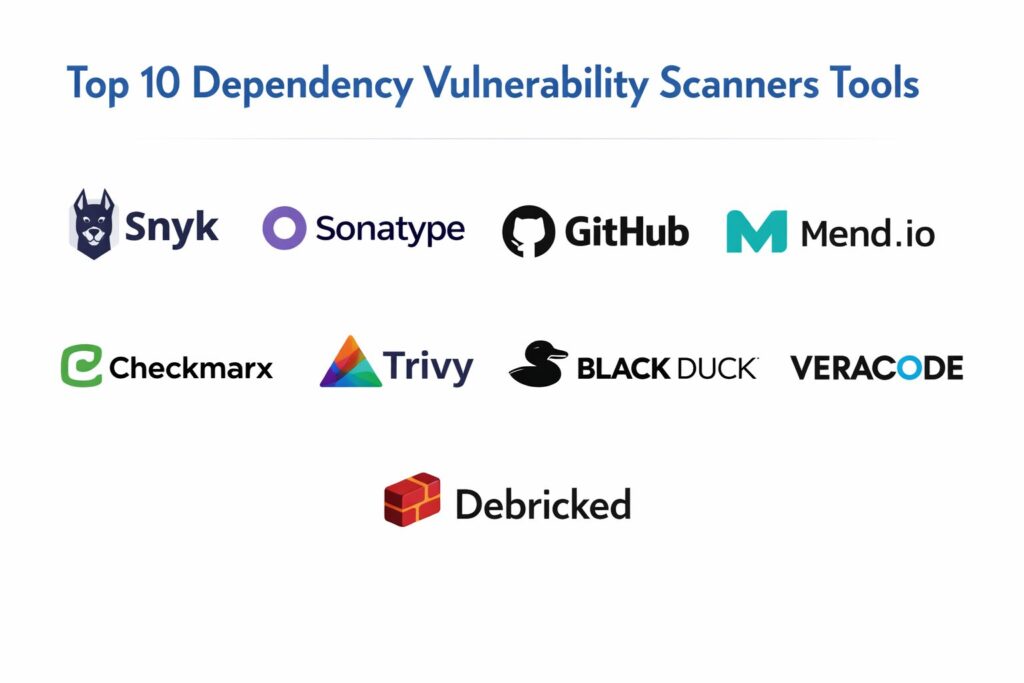
Introduction
Dependency vulnerability scanners are specialized security tools designed to identify, track, and remediate security flaws within third-party libraries and open-source components. In modern software engineering, approximately 80% to 90% of a typical application’s code consists of external dependencies. While these libraries accelerate development, they also introduce significant “inherited” risk. These scanners function by analyzing a project’s manifest files or binary signatures against a comprehensive database of known vulnerabilities, such as the Common Vulnerabilities and Exposures (CVE) list. By automating this inspection, organizations can ensure that their software supply chain remains secure without manually auditing thousands of lines of external code.
The necessity of these tools has escalated as software supply chain attacks become a primary vector for data breaches. Modern development practices, characterized by rapid deployment cycles and complex microservices, require security to be “shifted left”—integrated directly into the developer workflow. A robust vulnerability scanner does more than just flag risks; it provides actionable intelligence, such as reachability analysis and automated pull requests for patches. When evaluating these platforms, technical leaders must look beyond simple detection rates. Critical criteria include the accuracy of the vulnerability database, the “false positive” rate, seamless integration with continuous integration pipelines, and the ability to visualize the transitive dependency graph.
Best for: DevSecOps engineers, security architects, software developers, and compliance officers who need to secure open-source usage across enterprise applications and containerized environments.
Not ideal for: Organizations building purely proprietary, “air-gapped” software with zero external library usage, or basic static websites that do not utilize package managers or complex backend logic.
Key Trends in Dependency Vulnerability Scanners
The industry is moving rapidly toward Software Bill of Materials (SBOM) standardization, where scanners automatically generate and verify a comprehensive inventory of every component within a software package. There is also a significant shift toward “Reachability Analysis,” a sophisticated feature that determines if a vulnerable function within a library is actually being called by the application, helping teams prioritize fixes that matter. Artificial intelligence is now being utilized to suggest code-compatible patches and to predict the exploitability of newly discovered flaws before they are officially categorized in public databases.
Another dominant trend is the consolidation of Software Composition Analysis (SCA) with container and infrastructure-as-code scanning, providing a single pane of glass for all cloud-native risks. We are also seeing a move toward “Policy as Code,” where security teams can define automated guardrails that break a build if a dependency fails to meet specific license or security criteria. Furthermore, the focus has expanded from just finding vulnerabilities to managing “Dependency Health,” which includes tracking abandoned projects, stagnant update cycles, and potential “typosquatting” attacks in public registries.
How We Selected These Tools
The selection of these top ten scanners was based on a rigorous evaluation of their detection capabilities and their friction-less integration into the modern developer experience. We prioritized tools that maintain their own proprietary vulnerability intelligence feeds in addition to public databases, as this often results in faster discovery of zero-day flaws. Market adoption among enterprise-scale organizations was a key signal, as it indicates a tool’s ability to handle massive, multi-language codebases without significant performance degradation.
Technical performance was measured by the depth of the “dependency tree” analysis—specifically the ability to identify transitive dependencies that are hidden multiple layers deep. We also scrutinized the remediation guidance provided by each tool, favoring those that offer automated fix suggestions and compatibility testing. Security posture signals, such as the tool’s own compliance certifications and its ability to enforce complex organizational policies, were also heavily weighted. Finally, we looked for a balance between developer-friendly command-line interfaces and executive-level reporting dashboards to ensure value across the entire organization.
1. Snyk
Snyk has established itself as a developer-first security platform that focuses on seamless integration into the coding workflow. It is widely recognized for its proprietary vulnerability database, which often captures threats before they appear in public registries. The tool is designed to not only find vulnerabilities but to provide one-click remediation through automated fix pull requests.
Key Features
The platform offers deep integration with integrated development environments and source control managers. It provides a unique reachability analysis feature to see if vulnerable code is actually executed. The tool supports a vast range of languages and package managers, from JavaScript and Python to Go and Java. It also includes container and infrastructure-as-code scanning within the same interface. Users benefit from automated fix suggestions that include version upgrades and backported patches. The system allows for the enforcement of custom security and license policies across the entire organization.
Pros
Exceptional developer experience with high-quality, actionable remediation advice. Its proprietary database provides superior coverage and faster alerts than tools relying solely on public feeds.
Cons
The enterprise pricing tiers can be significant for smaller teams. Some users find the high frequency of alerts requires careful policy tuning to avoid “alert fatigue.”
Platforms and Deployment
Cloud-native SaaS, with options for self-hosted agents and CLI-based local scanning.
Security and Compliance
SOC 2 Type II compliant, ISO 27001 certified, and offers robust role-based access control.
Integrations and Ecosystem
Extensive ecosystem including GitHub, GitLab, Bitbucket, AWS, Azure, and most major CI/CD pipelines.
Support and Community
Strong professional support tiers complemented by a massive community of developers and free educational resources.
2. Sonatype Lifecycle
Sonatype Lifecycle is an enterprise-grade Software Composition Analysis tool built by the pioneers of the Maven Central repository. It focuses on providing a “Nexus Intelligence” feed that tracks the quality and security of open-source components from the moment they are created. It is particularly strong in complex enterprise environments that require strict policy enforcement.
Key Features
The tool utilizes a highly accurate intelligence engine that tracks millions of components across multiple ecosystems. it features advanced “InnerSource” tracking to manage proprietary components alongside open-source ones. The platform allows for highly granular policy creation based on security, license, and architectural age. It provides deep integration with repository managers to block “bad” components at the front door. The system generates detailed Software Bill of Materials reports for compliance requirements. It also offers automated migration paths for moving from vulnerable versions to secure ones.
Pros
Extremely low false-positive rate due to the depth of their component research. It is arguably the most powerful tool for large-scale architectural and policy governance.
Cons
The user interface can be more complex and “enterprise-heavy” compared to more modern, lightweight scanners. Setup and initial configuration require a more significant time investment.
Platforms and Deployment
Available as a SaaS offering or a self-hosted on-premises installation.
Security and Compliance
Maintains high enterprise security standards, including SAML/SSO support and detailed audit logging.
Integrations and Ecosystem
Deeply integrated with the Nexus Repository Manager, as well as Jenkins, Bamboo, and Azure DevOps.
Support and Community
Enterprise-grade 24/7 support and a long-standing reputation in the Java and Maven communities.
3. GitHub Advanced Security (Dependency Graph)
GitHub has integrated vulnerability scanning directly into its platform, making it a natural choice for teams already hosting their code there. This tool includes Dependabot, which automatically monitors dependencies and opens pull requests to update vulnerable libraries to secure versions.
Key Features
The service provides a comprehensive dependency graph for every repository. Dependabot alerts notify developers of new vulnerabilities in real-time. It features automated version updates that can be configured to keep dependencies current even when no vulnerability is present. The system includes “Dependency Review” in pull requests to stop new vulnerabilities from being merged. It utilizes the GitHub Advisory Database, which is curated from a mix of public and private sources. The tool is natively integrated into the GitHub UI, requiring no external dashboard for basic use.
Pros
Zero-friction setup for teams already using GitHub. The automated pull requests for updates significantly reduce the manual effort of remediation.
Cons
Full “Advanced Security” features are only available to Enterprise customers. It is less effective for organizations that utilize a mix of different source control providers.
Platforms and Deployment
Cloud-hosted via GitHub.com or available via GitHub Enterprise Server.
Security and Compliance
Inherits GitHub’s enterprise security posture, including SOC 1, SOC 2, and ISO certifications.
Integrations and Ecosystem
Natively integrated with the GitHub Actions CI/CD system and the wider GitHub marketplace.
Support and Community
Strong community support through GitHub Discussions and professional support for Enterprise account holders.
4. Mend.io (formerly WhiteSource)
Mend.io is a comprehensive security platform that specializes in both Software Composition Analysis and static application security testing. It is known for its ability to handle very large and diverse codebases while providing automated remediation for both security flaws and license compliance issues.
Key Features
The platform features “Mend Renovate,” a leading tool for automated dependency updates. It provides a unique reachability analysis called “Prioritize” to help focus on vulnerabilities that are actually accessible in code. The tool supports over 200 programming languages and a wide array of package managers. It includes automated license discovery and policy enforcement. The system provides real-time alerts within the developer’s workflow. It also offers a centralized dashboard for managing risk across thousands of applications and microservices.
Pros
Exceptional at automated dependency management through the Renovate engine. It provides very high-quality reachability data to help prioritize the most critical fixes.
Cons
The breadth of features can lead to a complex configuration process for new users. Some reporting features are perceived as less intuitive than specialized competitors.
Platforms and Deployment
Primarily SaaS-based with support for hybrid and on-premises deployments.
Security and Compliance
SOC 2 compliant and ISO 27001 certified; supports enterprise SSO and complex RBAC.
Integrations and Ecosystem
Integrates with all major SCMs and CI/CD tools, including specialized support for container registries.
Support and Community
Offers professional services, 24/7 technical support, and a wealth of documentation.
5. JFrog Xray
JFrog Xray is a universal binary analysis tool that integrates deeply with the JFrog Artifactory repository manager. It provides a “bottom-up” view of security by scanning components at the binary level, ensuring that what you actually deploy is secure, regardless of where the source code came from.
Key Features
The tool performs recursive scanning of binaries and container images to find hidden vulnerabilities. It features a unique “Impact Analysis” that shows how a single vulnerable component affects every project in the organization. The platform provides deep integration with Artifactory to block the download of non-compliant libraries. It supports automated policy enforcement based on security severity or license type. The system generates high-fidelity SBOMs for all managed artifacts. It also includes “Contextual Analysis” to determine if a vulnerability is truly exploitable in your specific environment.
Pros
Unrivaled visibility for organizations that rely on binary repository management. Its ability to map a vulnerability from a production binary back to the source is a major differentiator.
Cons
Its full value is only realized when used in conjunction with JFrog Artifactory. It can be more expensive than standalone source-code scanners.
Platforms and Deployment
Available as a SaaS, self-hosted, or multi-cloud deployment.
Security and Compliance
Highly compliant with enterprise standards, offering FIPS 140-2 support in specific configurations.
Integrations and Ecosystem
Native integration with the JFrog Platform and strong support for Jenkins, GitLab, and Kubernetes.
Support and Community
Professional global support and a highly active community centered around the “Liquid Software” philosophy.
6. Checkmarx One (SCA)
Checkmarx is a veteran in the application security space, and its Software Composition Analysis tool is a core part of its “Checkmarx One” platform. It is designed for enterprises that want to consolidate their static, dynamic, and dependency scanning into a single, unified developer experience.
Key Features
The tool offers “Supply Chain Security” features that detect malicious packages and typosquatting. It provides a unified view of risk that correlates findings between source code and third-party libraries. The platform features automated remediation through integration with code repositories. It includes a powerful policy engine for automated governance. The system provides detailed “Exploitable Path” analysis to help developers prioritize fixes. It also supports scanning of container images and infrastructure-as-code templates within the same workflow.
Pros
Excellent for large organizations looking for a “single platform” approach to application security. Its focus on the broader supply chain security helps detect emerging threats like malicious package injections.
Cons
The platform can feel heavy for small teams that only need dependency scanning. Integration with specialized developer tools can sometimes lag behind developer-first competitors.
Platforms and Deployment
Cloud-native SaaS with support for hybrid environments.
Security and Compliance
SOC 2 compliant and ISO certified; designed for high-security enterprise requirements.
Integrations and Ecosystem
Strong integrations with AWS, Azure, and Google Cloud, along with most major CI/CD providers.
Support and Community
Extensive global support and a professional services division for large-scale enterprise rollouts.
7. Aqua Security (Trivy)
While Aqua Security is a broad cloud-native security platform, its open-source tool Trivy has become the industry standard for lightweight, fast dependency and container scanning. It is the preferred choice for engineers who need a scanner that can be integrated into a pipeline in seconds.
Key Features
The tool scans container images, file systems, and remote git repositories for vulnerabilities. It also detects misconfigurations in infrastructure-as-code files like Terraform and Kubernetes manifests. The scanner is incredibly fast and has no external dependencies for its basic operation. It supports a wide range of OS packages and application-level dependencies. It provides high-quality SBOM generation in standard formats like CycloneDX and SPDX. The system can be run as a standalone CLI tool or integrated as a server for centralized scanning.
Pros
Completely free and open-source, making it accessible to everyone from hobbyists to enterprises. It is exceptionally fast and easy to use within automated scripts and CI pipelines.
Cons
The open-source version lacks the centralized reporting and policy management found in the commercial Aqua platform. It does not provide the same level of reachability analysis as some premium competitors.
Platforms and Deployment
Local CLI, Container, or as part of the Aqua Cloud-Native Security Platform.
Security and Compliance
The commercial version offers full enterprise compliance; the open-source version is community-validated.
Integrations and Ecosystem
Natively integrated into many popular platforms like Harbor, GitLab, and various Kubernetes distributions.
Support and Community
Vast community support on GitHub and Slack, with professional support available through Aqua Security.
8. Black Duck (Synopsys)
Black Duck is one of the most established names in Software Composition Analysis. It is particularly renowned for its massive database of open-source projects and its ability to identify “snippet-level” code reuse, making it a favorite for legal and compliance teams during mergers and acquisitions.
Key Features
The tool identifies open-source components even if they have been modified or don’t have a manifest file. it features an extensive license compliance engine with a database of over 2,500 licenses. The platform provides automated alerts for new vulnerabilities in projects that have already been scanned. It includes deep container scanning and “binary-to-source” matching. The system provides a centralized dashboard for tracking security and license risk across the enterprise. It also offers automated policy management to block the use of problematic libraries based on age or security score.
Pros
Unrivaled for license compliance and legal due diligence. Its ability to find “hidden” open-source code within proprietary files is the best in the market.
Cons
The scan times can be significantly longer than modern, manifest-only scanners. The user interface is often viewed as more formal and less developer-centric.
Platforms and Deployment
SaaS and on-premises deployment options are available.
Security and Compliance
Extremely robust compliance features, tailored for highly regulated industries like finance and healthcare.
Integrations and Ecosystem
Supports all major CI/CD pipelines, build tools, and container orchestration platforms.
Support and Community
Extensive professional support, training, and a global presence for large-scale enterprise deployments.
9. Veracode (SCA)
Veracode is a leader in the “Security as a Service” market, providing a cloud-native platform that covers the entire application security lifecycle. Its Software Composition Analysis tool focuses on providing high-accuracy results through a mix of automated scanning and human-backed intelligence.
Key Features
The platform offers “Agentless” scanning that analyzes code directly from the repository. It features an “Auto-Fix” capability that suggests the minimal version change required to resolve a vulnerability. The tool provides clear visibility into the transitive dependency tree. It includes a policy engine that allows for global security standards to be applied across all teams. The system generates high-level risk reports for executive leadership. It also supports “Vulnerability Prioritization” by checking if the vulnerable code is actually called by the application.
Pros
The cloud-native approach makes it very easy to scale across thousands of applications without managing infrastructure. The automated fix suggestions are highly accurate and help reduce developer workload.
Cons
The pricing is geared toward large enterprises, making it less accessible for startups. Some developers find the reporting style more focused on compliance than on day-to-day coding.
Platforms and Deployment
100% Cloud-based SaaS.
Security and Compliance
Certified to the highest enterprise standards, including FedRAMP authorization for government work.
Integrations and Ecosystem
Strong integrations with Azure DevOps, Jenkins, and major IDEs like IntelliJ and Visual Studio.
Support and Community
Dedicated customer success managers and 24/7 technical support for enterprise clients.
10. Debricked
Debricked is a modern, agile SCA tool that prioritizes high-quality data and developer productivity. It focuses heavily on “Community Health” and the long-term sustainability of the open-source projects you choose to include in your software.
Key Features
The tool provides a “Health Score” for every dependency, factoring in maintainer activity and update frequency. It features an automated “Select” tool that helps developers choose the best library before they even add it to their project. The platform uses machine learning to clean and verify vulnerability data from multiple sources. It includes automated pull requests for vulnerability fixes. The system offers a highly visual dependency graph and easy-to-use policy builders. It also supports license compliance and generates audit-ready reports.
Pros
The focus on “Project Health” helps prevent technical debt and future security issues by discouraging the use of abandoned libraries. The UI is very clean and modern, making it a favorite for fast-moving startups.
Cons
As a newer player, the depth of its “snippet” scanning is not as extensive as veterans like Black Duck. Its language support, while broad, is still expanding in some niche areas.
Platforms and Deployment
SaaS-based platform with easy-to-use CLI tools.
Security and Compliance
SOC 2 Type II compliant and adheres to GDPR data privacy requirements.
Integrations and Ecosystem
Native support for GitHub, GitLab, and Bitbucket, with easy integration into any CI/CD pipeline.
Support and Community
Responsive customer support and a growing community of security-conscious developers.
Comparison Table
| Tool Name | Best For | Platform(s) Supported | Deployment | Standout Feature | Public Rating |
| 1. Snyk | Developer-first DevSecOps | Win, Mac, Linux | Hybrid | Reachability Analysis | 4.8/5 |
| 2. Sonatype Lifecycle | Enterprise Governance | Win, Mac, Linux | Hybrid | Nexus Intelligence Feed | 4.6/5 |
| 3. GitHub Security | Teams already on GitHub | Web-based | Cloud | Native Dependabot Fixes | 4.7/5 |
| 4. Mend.io | Automated Remediation | Win, Mac, Linux | Hybrid | Renovate Engine | 4.5/5 |
| 5. JFrog Xray | Binary/Artifact Security | Win, Mac, Linux | Multi-cloud | Universal Binary Mapping | 4.6/5 |
| 6. Checkmarx One | Unified AppSec Platform | Win, Mac, Linux | Cloud | Malicious Package Detect | 4.4/5 |
| 7. Trivy (Aqua) | Fast/Open-source Scan | Win, Mac, Linux | CLI/Cloud | Lightweight Iac Scanning | 4.9/5 |
| 8. Black Duck | License Compliance/M&A | Win, Mac, Linux | Hybrid | Snippet-level Matching | 4.5/5 |
| 9. Veracode | SaaS-native Enterprise | Web-based | Cloud | Minimal-change Auto-fix | 4.3/5 |
| 10. Debricked | Dependency Health/Startups | Web-based | Cloud | Project Health Scoring | 4.7/5 |
Evaluation & Scoring of Dependency Vulnerability Scanners
The scoring below is a comparative model intended to help shortlisting. Each criterion is scored from 1–10, then a weighted total from 0–10 is calculated using the weights listed. These are analyst estimates based on typical fit and common workflow requirements, not public ratings.
Weights:
- Core features – 25%
- Ease of use – 15%
- Integrations & ecosystem – 15%
- Security & compliance – 10%
- Performance & reliability – 10%
- Support & community – 10%
- Price / value – 15%
| Tool Name | Core (25%) | Ease (15%) | Integrations (15%) | Security (10%) | Performance (10%) | Support (10%) | Value (15%) | Weighted Total |
| 1. Snyk | 10 | 10 | 10 | 9 | 9 | 9 | 8 | 9.45 |
| 2. Sonatype | 10 | 6 | 9 | 10 | 8 | 9 | 7 | 8.45 |
| 3. GitHub | 8 | 10 | 8 | 9 | 10 | 8 | 10 | 8.85 |
| 4. Mend.io | 9 | 8 | 9 | 9 | 8 | 9 | 8 | 8.65 |
| 5. JFrog Xray | 9 | 7 | 10 | 9 | 9 | 9 | 7 | 8.55 |
| 6. Checkmarx | 9 | 7 | 9 | 9 | 7 | 9 | 7 | 8.15 |
| 7. Trivy | 8 | 10 | 9 | 7 | 10 | 7 | 10 | 8.70 |
| 8. Black Duck | 10 | 5 | 8 | 10 | 6 | 9 | 7 | 7.95 |
| 9. Veracode | 9 | 7 | 8 | 9 | 8 | 9 | 7 | 8.15 |
| 10. Debricked | 8 | 9 | 9 | 8 | 9 | 8 | 9 | 8.55 |
How to interpret the scores:
- Use the weighted total to shortlist candidates, then validate with a pilot.
- A lower score can mean specialization, not weakness.
- Security and compliance scores reflect controllability and governance fit, because certifications are often not publicly stated.
- Actual outcomes vary with assembly size, team skills, templates, and process maturity.
Which Dependency Vulnerability Scanner Tool Is Right for You?
Solo / Freelancer
For individuals, the priority is zero cost and immediate utility. The open-source version of Trivy or the free tier of GitHub Security provides professional-grade detection without any financial overhead. These tools ensure your personal projects are secure with minimal maintenance.
SMB
Small businesses need a tool that offers automated remediation to compensate for a smaller security team. Snyk or Debricked are excellent choices here because they focus on developer productivity and offer automated pull requests that make patching a one-click process.
Mid-Market
Organizations in the mid-market range often have a mix of proprietary code and diverse cloud-native infrastructure. Mend.io or Veracode provide the breadth of coverage needed to secure multiple languages and deployment models while offering more advanced reporting for management.
Enterprise
Large-scale enterprises require deep governance, license compliance, and binary management. Sonatype Lifecycle, Black Duck, and JFrog Xray are the market leaders in this category, offering the robustness needed to manage risk across thousands of developers and multi-cloud environments.
Budget vs Premium
If budget is the primary constraint, Trivy is the clear winner for its powerful open-source capabilities. For organizations where security and speed take priority over cost, “Premium” options like Snyk or Checkmarx offer advanced intelligence and reachability analysis that drastically reduce manual work.
Feature Depth vs Ease of Use
Black Duck offers the greatest depth for legal and compliance needs but is more complex to operate. Conversely, GitHub Security is the easiest to use but may lack the specialized “deep-dive” features required for hyper-technical security research.
Integrations & Scalability
If your entire infrastructure is built on a specific repository manager like Artifactory, JFrog Xray is the most scalable choice. For teams with a highly fragmented toolchain, a standalone provider like Snyk or Mend.io offers the best cross-platform integration.
Security & Compliance Needs
For highly regulated industries like finance or defense, Sonatype and Veracode offer the most specialized compliance reporting and government-grade security certifications. These tools provide the audit trails necessary for passing rigorous external security checks.
Frequently Asked Questions (FAQs)
1. What is Software Composition Analysis (SCA)?
SCA is a security methodology that identifies the open-source components used in an application. It analyzes these libraries for known vulnerabilities and license compliance issues, helping teams manage the risks of the software supply chain.
2. How often should I scan my dependencies?
Scanning should be continuous. Ideally, a scan should trigger every time code is committed and periodically on your production branch to catch new vulnerabilities discovered in libraries you have already deployed.
3. What is a transitive dependency?
A transitive dependency is a library that is not directly used by your application but is required by one of your direct dependencies. These “hidden” libraries are a major source of security risk if not properly tracked.
4. Can a scanner automatically fix my vulnerabilities?
Many modern scanners can open pull requests that update a vulnerable library to a secure version. However, these still require a human to review the change and run automated tests to ensure the update doesn’t break the application.
5. What is reachability analysis?
Reachability is an advanced scanning feature that checks if the specific vulnerable function of a library is actually being called by your code. If the code isn’t reachable, the vulnerability might be a lower priority to fix.
6. Why is license compliance important in 3D animation or software dev?
Many open-source libraries have “copyleft” licenses that could legally force you to release your proprietary source code. Scanners identify these licenses so you can avoid using libraries that put your intellectual property at risk.
7. Is a high number of “False Positives” common?
Historically, yes. However, modern tools have greatly improved accuracy. A “false positive” often happens when a scanner flags a library as vulnerable, but the specific vulnerability doesn’t apply to the way you are using the software.
8. Do scanners work with containerized applications?
Yes, most top-tier scanners can inspect container images (like Docker) to find vulnerabilities in both the application libraries and the underlying operating system packages.
9. What is an SBOM?
A Software Bill of Materials is a formal, machine-readable inventory of every component in your software. It is becoming a standard requirement for selling software to governments and large enterprises.
10. How do scanners impact build speed?
Manifest-based scanners are very fast and usually add only seconds to a build. Deep binary or snippet scanners can take longer, which is why they are often scheduled to run daily rather than on every commit.
Conclusion
Securing the modern software supply chain is an ongoing effort that requires more than just reactive patching. The selection of a dependency vulnerability scanner is a pivotal decision for any organization aiming to mature its DevSecOps practice. As we move further into a landscape defined by cloud-native complexity and automated attacks, the ability to clearly visualize and govern third-party risk is no longer optional. The “best” tool is the one that bridges the gap between the security team’s need for control and the developer’s need for speed. By choosing a platform that prioritizes high-fidelity data and automated remediation, technical leaders can empower their teams to build more resilient software while maintaining a rapid pace of innovation.
I find that this expert review of Dependency Vulnerability Scanners perfectly captures the “inherited” risk that I see as a DevSecOps Lead managing a modern software supply chain. I learned from this blog that since approximately 80% to 90% of a typical application’s code consists of external libraries, tools like Snyk and Sonatype Lifecycle are no longer just optional scanners—they are essential gatekeepers for our Software Bill of Materials (SBOM). In my real-world work, implementing these platforms helps me move beyond a simple list of CVEs to a world of Reachability Analysis, where I can prioritize fixes based on whether a vulnerable function is actually being called by our code. For others, the transition toward automated fix pull requests and Policy as Code means that security is baked into the developer’s IDE, allowing us to neutralize “typosquatting” and stagnant project risks before they ever reach production. My advice for anyone looking to master this space is to focus on the transitive dependency tree; a vulnerability hidden three layers deep is just as dangerous as one in a direct import, and choosing a scanner with high precision and automated remediation is the only way to keep your release velocity high while maintaining a secure perimeter.