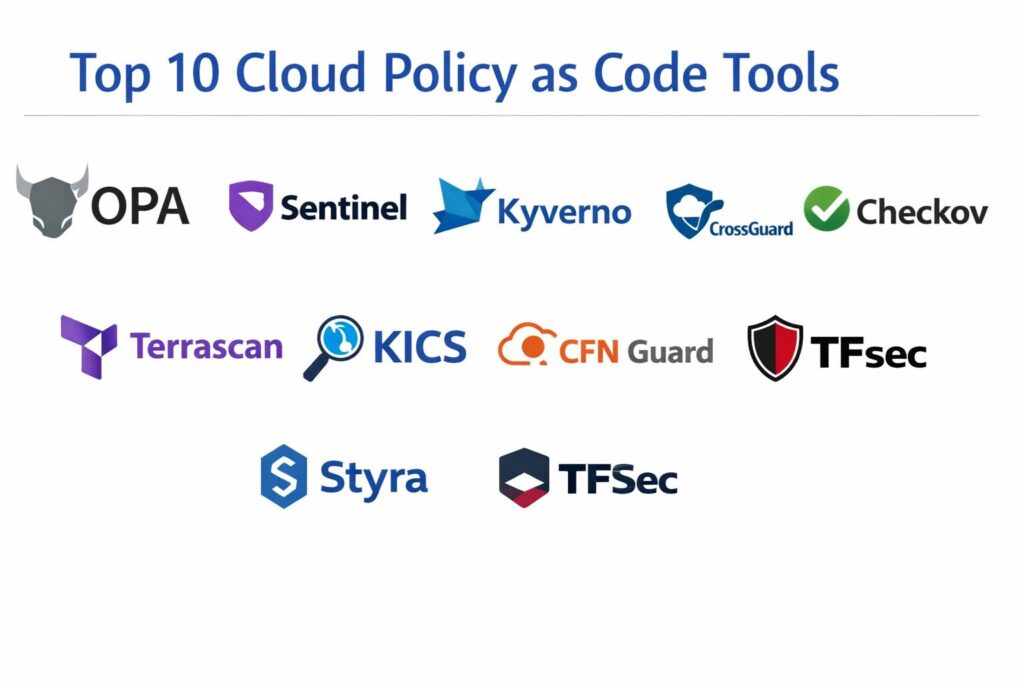
Introduction
Cloud Policy as Code (PaC) represents the maturation of governance in the era of automated infrastructure. As organizations scale their cloud presence across multiple providers and thousands of resources, manual compliance checks and “point-and-click” security configurations become mathematically impossible to maintain. Policy as Code solves this by codifying security requirements, operational guardrails, and compliance standards into machine-readable files. These files are integrated directly into the Continuous Integration and Continuous Deployment (CI/CD) pipeline, allowing for automated enforcement of rules before a single resource is ever provisioned. This shift from reactive “firefighting” to proactive governance is a fundamental requirement for any organization operating at a professional scale.
The necessity of PaC is driven by the speed of modern DevOps cycles and the increasing complexity of regulatory environments. Without automated policy enforcement, the risk of misconfigurations—such as exposed storage buckets or unencrypted databases—increases exponentially with every deployment. Policy as Code provides a “single source of truth” for what constitutes a safe and compliant environment, enabling developers to move fast without breaking organizational guardrails. When evaluating these tools, architectural leaders must consider the flexibility of the policy language, the depth of integration with existing infrastructure-as-code frameworks, the performance overhead of the evaluation engine, and the ability to provide clear, actionable feedback to engineering teams during the development process.
Best for: Cloud engineers, security architects, SRE teams, and compliance officers who need to enforce consistent governance across hybrid and multi-cloud environments through automation.
Not ideal for: Small, static environments with very few resources or organizations that do not use Infrastructure as Code (IaC) for provisioning, as the value of automated policy enforcement relies on a programmatic delivery model.
Key Trends in Cloud Policy as Code Tools
The industry is seeing a significant shift toward “Shift-Left” governance, where policies are evaluated during the local development phase rather than waiting for a centralized security scan. This developer-centric approach reduces friction by providing immediate feedback within the IDE or the pull request. We are also witnessing the rise of “Self-Healing Infrastructure,” where Policy as Code tools work in tandem with automated remediation systems to not only detect violations but also revert them to a compliant state in real-time. Artificial Intelligence is increasingly being used to “suggest” policies based on an organization’s historical risk profile and industry benchmarks, lowering the barrier to entry for complex rule creation.
Multi-cloud interoperability has moved from a feature to a core requirement, with tools now offering a unified policy language that can evaluate resources across various cloud providers simultaneously. There is also a move toward “Identity-Aware” policies, where the governance engine considers who is making a change and the context of the request before granting permission. Furthermore, the integration of compliance frameworks like SOC 2 and HIPAA directly into policy libraries allows organizations to demonstrate “compliance by design.” As organizations adopt serverless and containerized architectures, Policy as Code is expanding to cover fine-grained application-level permissions and service mesh configurations.
How We Selected These Tools
Our selection process involved a rigorous evaluation of the tool’s ability to integrate with modern DevOps workflows and the robustness of its policy evaluation engine. We prioritized tools that support open standards and offer high levels of community or commercial stability. A critical criterion was the “expressiveness” of the policy language, assessing how easily a tool can handle complex, multi-variable logic without becoming unreadable. We looked for a balance between specialized security tools and general-purpose governance frameworks that can handle cost management, operational tagging, and resource optimization.
Scalability was a major factor; we selected tools that can handle the high-velocity evaluation requirements of large-scale, automated pipelines. We scrutinized the quality of the reporting and alerting mechanisms, favoring tools that provide clear “why” and “how to fix” explanations for policy violations. Security of the policy engine itself was also considered, ensuring that the tool follows the principle of least privilege and maintains an audit log of all evaluations. Finally, we assessed the ecosystem value, looking at the availability of pre-built policy libraries that allow organizations to implement standard benchmarks—like the CIS Foundations Benchmark—with minimal manual effort.
1. Open Policy Agent (OPA)
Open Policy Agent is the industry-standard, general-purpose policy engine that has decoupled policy decision-making from policy enforcement. It uses a high-level declarative language called Rego to define rules across the entire cloud-native stack, from Kubernetes admission control to microservices authorization.
Key Features
The platform features the Rego language, which is designed to handle complex data structures like JSON and YAML found in cloud configurations. It includes a powerful command-line interface for testing and evaluating policies locally. The system can be deployed as a sidecar, a standalone service, or an embedded library. It offers “Conftest,” a specialized utility for testing configuration files against OPA policies. It also provides a robust set of toolings for auditing and logging policy decisions to ensure full transparency of the governance process.
Pros
It is incredibly versatile and can be used for everything from cloud infrastructure to application-level authorization. As a CNCF graduated project, it has a massive ecosystem and support community.
Cons
The Rego language has a notable learning curve for those not familiar with Datalog or functional programming. Managing large sets of complex policies can become difficult without a management plane.
Platforms and Deployment
Linux, Windows, macOS, and containerized as a sidecar or service.
Security and Compliance
Highly secure architecture with support for signed policies and granular audit logs.
Integrations and Ecosystem
Integrates with Kubernetes, Terraform, Envoy, Kafka, and hundreds of other cloud-native technologies.
Support and Community
Supported by a massive open-source community and several commercial vendors providing enterprise-grade management platforms.
2. HashiCorp Sentinel
Sentinel is an embedded policy-as-code framework used across the HashiCorp enterprise product suite. It is designed to provide fine-grained, logic-based policy enforcement that is deeply integrated with the workflows of Terraform, Vault, and Nomad.
Key Features
The platform features “Advisory,” “Soft-Mandatory,” and “Hard-Mandatory” enforcement levels, allowing organizations to grade their response to policy violations. It includes a specialized simulator for testing policies against mock data before deployment. The system offers “Policy Sets” for organizing rules by team or environment. It features a high-level, human-readable language that is easier to learn than OPA’s Rego. It also provides deep integration with Terraform Cloud to block non-compliant infrastructure changes before they are applied.
Pros
The integration with Terraform is seamless, providing the most robust way to govern HashiCorp-managed infrastructure. The language is designed to be readable by both developers and compliance officers.
Cons
It is a proprietary tool and is only available in the Enterprise versions of HashiCorp products. It is not a general-purpose engine and cannot be easily used outside the HashiCorp ecosystem.
Platforms and Deployment
Embedded within HashiCorp Enterprise products (Cloud or Self-hosted).
Security and Compliance
Adheres to strict enterprise standards with full auditability and integration with Vault for secrets management.
Integrations and Ecosystem
Deeply integrated with Terraform, Vault, Nomad, and Consul.
Support and Community
Backed by HashiCorp’s professional support and an extensive library of pre-built “Foundation” policies.
3. Kyverno
Kyverno is a policy engine designed specifically for Kubernetes. Unlike other engines that require a new language, Kyverno allows policies to be managed as Kubernetes resources using standard YAML, making it exceptionally accessible for Kubernetes administrators.
Key Features
The platform features the ability to validate, mutate, and generate Kubernetes resources based on policy definitions. It includes a “Policy Reporter” that provides a visual dashboard of compliance across the cluster. The system can automatically sign and verify container images to ensure only trusted code is running. It features “Clean-up” policies that automatically remove stale or non-compliant resources. It also provides a CLI for testing policies in CI/CD pipelines before they reach the cluster.
Pros
The use of YAML for policy definition removes the barrier of learning a new programming language. It is native to Kubernetes, meaning it follows the same patterns as the rest of the cluster management.
Cons
It is strictly limited to Kubernetes and cannot be used for broader cloud infrastructure governance outside of a cluster. It may struggle with extremely complex logic that requires a full programming language.
Platforms and Deployment
Kubernetes-native deployment.
Security and Compliance
Supports image verification and integrates with Kubernetes RBAC for secure policy management.
Integrations and Ecosystem
Integrates with GitOps tools like ArgoCD and Flux, and various Kubernetes monitoring solutions.
Support and Community
Growing rapidly as a CNCF project with a strong community and increasing enterprise adoption.
4. Pulumi CrossGuard
CrossGuard is the policy-as-code framework for the Pulumi Infrastructure as Code platform. It allows users to write policies using familiar general-purpose programming languages like TypeScript, JavaScript, Python, and Go.
Key Features
The platform features the ability to write policies in the same language as the infrastructure code, reducing context switching for developers. It includes support for “Enforcement Levels” to distinguish between warnings and mandatory blocks. The system offers “Policy Packs” which can be versioned and shared across multiple projects. It features the ability to evaluate policies during the “preview” stage of a deployment. It also provides a centralized management console for viewing compliance results across the organization.
Pros
Using general-purpose languages allows for extremely complex logic and the use of existing testing frameworks. It is highly accessible for developers who are already using Pulumi for IaC.
Cons
It is primarily tied to the Pulumi ecosystem. Organizations using Terraform or other IaC tools will not be able to leverage CrossGuard for their governance needs.
Platforms and Deployment
Managed via the Pulumi CLI and Pulumi Cloud.
Security and Compliance
Supports secure policy distribution and provides detailed audit logs of all policy evaluations.
Integrations and Ecosystem
Deeply integrated with the Pulumi IaC platform and its supported cloud providers.
Support and Community
Backed by Pulumi’s professional support team and a growing community of infrastructure-as-code practitioners.
5. Checkov (by Bridgecrew/Prisma Cloud)
Checkov is a static code analysis tool for infrastructure-as-code. It scans cloud configurations—including Terraform, CloudFormation, and Kubernetes—to find security and compliance misconfigurations before they are deployed.
Key Features
The platform features over 1,000 built-in policies covering industry benchmarks like CIS and NIST. It includes “Graph-based” analysis that understands the relationships between different cloud resources. The system offers a “Visual Editor” for creating policies without writing code. It features “Automatic Remediation” suggestions that provide the exact code needed to fix a violation. It also provides a specialized IDE extension to give developers real-time feedback while they are writing infrastructure code.
Pros
It is incredibly easy to set up and provides immediate value with its extensive library of pre-built checks. The graph-based analysis is superior at finding complex, multi-resource vulnerabilities.
Cons
While it has a custom logic builder, creating highly unique or complex organizational policies can be more difficult than with OPA. The free version has some limitations in reporting.
Platforms and Deployment
CLI-based, containerized, and integrated into CI/CD pipelines.
Security and Compliance
Adheres to global security standards and is part of the broader Prisma Cloud security suite.
Integrations and Ecosystem
Integrates with GitHub, GitLab, Jenkins, Terraform, and all major cloud providers.
Support and Community
Maintains a very active open-source community and is supported by Palo Alto Networks’ enterprise services.
6. Terrascan (by Tenable)
Terrascan is an open-source static code analyzer for Infrastructure as Code. It uses the Open Policy Agent (OPA) engine under the hood to provide high-performance security scanning across various IaC formats.
Key Features
The platform features over 500 out-of-the-box policies based on common security best practices. It includes support for Terraform, Kubernetes, Helm, and Kustomize. The system can be used to scan both static code and live cloud environments to find “drift” from policies. It features a “Server Mode” for providing policy evaluation as an API. It also provides a detailed JSON output that can be easily integrated into custom reporting and dashboarding tools.
Pros
It combines the power of OPA with a much easier setup process for infrastructure scanning. It is completely free and open-source, making it accessible for any budget.
Cons
The reporting features are primarily text-based and may require additional tools for visualization. It is less comprehensive in its “remediation” capabilities compared to Checkov.
Platforms and Deployment
CLI, Docker, and integrated into GitHub Actions and other CI tools.
Security and Compliance
Leverages the secure OPA engine and supports standard security auditing practices.
Integrations and Ecosystem
Works with all major cloud providers and IaC tools, benefiting from the broader OPA ecosystem.
Support and Community
Supported by Tenable and a community of security-focused developers.
7. KICS (Keeping Infrastructure as Code Secure)
KICS is an open-source tool designed to find security vulnerabilities, compliance issues, and infrastructure misconfigurations early in the development cycle. It supports a massive range of IaC languages and cloud-native technologies.
Key Features
The platform features support for more than 2,000 queries, making it one of the most comprehensive scanning tools available. It includes support for Docker, Ansible, Terraform, and AWS CloudFormation. The system offers “Result Redaction” to ensure sensitive information doesn’t end up in logs. It features a “Query Builder” for creating custom policies using the Rego language. It also provides a variety of output formats, including HTML, JSON, and SARIF, for easy integration with security dashboards.
Pros
The breadth of supported languages is its biggest strength, covering almost every modern cloud configuration format. It is very fast and can be easily automated within a CI pipeline.
Cons
Since it uses Rego for custom queries, it shares the same learning curve as OPA. Some users find the sheer volume of results can be overwhelming without careful filtering.
Platforms and Deployment
CLI, Docker, and CI/CD integration.
Security and Compliance
Follows best practices for secure scanning and is regularly updated with the latest security benchmarks.
Integrations and Ecosystem
Integrates with GitLab, GitHub, Bitbucket, and various security orchestration platforms.
Support and Community
Maintained by Checkmarx and supported by a strong community of security researchers.
8. AWS CloudFormation Guard
CloudFormation Guard (cfn-guard) is a high-speed, open-source CLI tool that provides a domain-specific language to define and enforce policy compliance for AWS CloudFormation templates and other JSON/YAML data.
Key Features
The platform features a “Rule” language that is much simpler and more concise than Rego or general-purpose languages. It includes a “Validation” mode that provides instant pass/fail results for templates. The system can be used to generate rules from existing “known-good” templates, speeding up the creation process. It features a “Unit Testing” framework to ensure policies work as expected before being deployed. It also provides detailed error messages that point directly to the line of code causing a violation.
Pros
It is extremely fast and has a very small footprint. The domain-specific language is tailored for infrastructure, making it very easy for AWS engineers to adopt.
Cons
It is primarily focused on the AWS ecosystem and CloudFormation. While it can scan generic JSON/YAML, it lacks the broader multi-cloud context of OPA or Checkov.
Platforms and Deployment
CLI tool for Linux, Windows, and macOS.
Security and Compliance
Adheres to AWS security standards and is used internally by AWS for many of its managed services.
Integrations and Ecosystem
Deeply integrated with AWS CloudFormation and AWS CodePipeline.
Support and Community
Backed by AWS and an active community of AWS-focused developers.
9. TFSec (now part of Trivy)
TFSec is a static analysis security tool for Terraform code. It has recently been integrated into the Trivy project to provide a unified security scanner for containers, filesystems, and infrastructure code.
Key Features
The platform features a massive library of pre-built checks for AWS, Azure, and GCP. It includes “Link-based” documentation for every violation, providing deep context on why a rule exists. The system offers “Ignore” tags that can be placed directly in the Terraform code for granular control. It features an extremely fast execution engine that can scan thousands of lines of code in seconds. It also provides a specialized “Pro” version for enterprise reporting and advanced visualization.
Pros
The documentation provided for each violation is some of the best in the industry, making it an excellent learning tool for developers. The integration into Trivy makes it part of a powerful, all-in-one security suite.
Cons
As a standalone tool, it is strictly limited to Terraform. Some of the more advanced multi-resource logic can be harder to implement than with graph-based tools.
Platforms and Deployment
CLI, Docker, and integrated into most modern CI/CD platforms.
Security and Compliance
Part of the Aqua Security ecosystem, adhering to high enterprise security standards.
Integrations and Ecosystem
Integrates with Terraform, GitHub, GitLab, and various security management consoles.
Support and Community
Supported by Aqua Security and a large, active open-source community.
10. Styra Declarative Entitlements
Styra, the creators of OPA, provides a specialized platform for managing Policy as Code at scale. It offers a sophisticated control plane that simplifies the lifecycle of OPA policies across complex enterprise environments.
Key Features
The platform features a “Policy Authoring” interface that provides drag-and-drop rule creation and real-time validation. It includes “Impact Analysis” to show how a new policy would affect existing traffic before it is turned on. The system offers centralized management for OPA agents distributed across multiple clusters. It features a “Compliance Dashboard” that provides a high-level view of governance status across the entire organization. It also provides automated “Decision Logging” for meeting strict regulatory audit requirements.
Pros
It is the most advanced management plane for OPA, making large-scale deployments manageable for enterprise teams. The impact analysis feature is a critical “safety net” for high-stakes environments.
Cons
It is a premium, commercial product with a significant cost compared to standalone open-source tools. It may be “overkill” for smaller organizations or single-cluster environments.
Platforms and Deployment
SaaS or self-hosted management plane with OPA agents deployed locally.
Security and Compliance
SOC 2 Type II compliant and designed to handle the most sensitive enterprise governance requirements.
Integrations and Ecosystem
Deeply integrated with the OPA ecosystem and all major cloud-native platforms.
Support and Community
Provides professional enterprise support from the original creators of the Open Policy Agent.
Comparison Table
| Tool Name | Best For | Platform(s) Supported | Deployment | Standout Feature | Public Rating |
| 1. OPA | General-purpose PaC | Win, Mac, Linux | Sidecar/Service | Rego Language | 4.8/5 |
| 2. Sentinel | HashiCorp Ecosystem | Win, Mac, Linux | Embedded | Mandatory Levels | 4.5/5 |
| 3. Kyverno | Kubernetes Native | Kubernetes | Cluster Native | YAML Based | 4.7/5 |
| 4. CrossGuard | Pulumi Users | Win, Mac, Linux | CLI / Cloud | General Languages | 4.6/5 |
| 5. Checkov | Pre-deployment Scan | Win, Mac, Linux | CLI / CI/CD | Graph-based Analysis | 4.8/5 |
| 6. Terrascan | OPA-based IaC Scan | Win, Mac, Linux | CLI / Server | Server Mode API | 4.4/5 |
| 7. KICS | Multi-language IaC | Win, Mac, Linux | CLI / Docker | 2000+ Queries | 4.7/5 |
| 8. CFN Guard | AWS Infrastructure | Win, Mac, Linux | CLI | Rule Generator | 4.3/5 |
| 9. TFSec | Terraform Security | Win, Mac, Linux | CLI / Docker | Deep Documentation | 4.7/5 |
| 10. Styra | Enterprise OPA Mgmt | Web / Hybrid | SaaS / Hybrid | Impact Analysis | 4.9/5 |
Evaluation & Scoring of Cloud Policy as Code Tools
The scoring below is a comparative model intended to help shortlisting. Each criterion is scored from 1–10, then a weighted total from 0–10 is calculated using the weights listed. These are analyst estimates based on typical fit and common workflow requirements, not public ratings.
Weights:
- Core features – 25%
- Ease of use – 15%
- Integrations & ecosystem – 15%
- Security & compliance – 10%
- Performance & reliability – 10%
- Support & community – 10%
- Price / value – 15%
| Tool Name | Core (25%) | Ease (15%) | Integrations (15%) | Security (10%) | Performance (10%) | Support (10%) | Value (15%) | Weighted Total |
| 1. OPA | 10 | 4 | 10 | 9 | 9 | 9 | 10 | 8.85 |
| 2. Sentinel | 8 | 7 | 8 | 10 | 9 | 9 | 6 | 7.95 |
| 3. Kyverno | 9 | 9 | 8 | 8 | 8 | 8 | 9 | 8.50 |
| 4. CrossGuard | 8 | 8 | 8 | 9 | 8 | 8 | 7 | 7.95 |
| 5. Checkov | 9 | 9 | 9 | 9 | 8 | 8 | 8 | 8.70 |
| 6. Terrascan | 8 | 7 | 8 | 8 | 9 | 7 | 9 | 7.95 |
| 7. KICS | 8 | 7 | 9 | 8 | 9 | 7 | 9 | 8.10 |
| 8. CFN Guard | 7 | 8 | 7 | 8 | 10 | 7 | 8 | 7.65 |
| 9. TFSec | 8 | 8 | 8 | 9 | 9 | 7 | 9 | 8.20 |
| 10. Styra | 10 | 6 | 10 | 10 | 9 | 10 | 7 | 8.85 |
How to interpret the scores:
- Use the weighted total to shortlist candidates, then validate with a pilot.
- A lower score can mean specialization, not weakness.
- Security and compliance scores reflect controllability and governance fit, because certifications are often not publicly stated.
- Actual outcomes vary with assembly size, team skills, templates, and process maturity.
Which Cloud Policy as Code Tool Is Right for You?
Solo / Freelancer
For a solo founder or a very small team, the priority is immediate security coverage with zero cost. You should look for tools that offer a massive library of pre-built checks so you don’t have to write your own policies from scratch. A CLI tool that can be added to a basic GitHub Action in minutes is the best way to ensure your early infrastructure is following best practices without slowing you down.
SMB
Organizations with limited technical resources should prioritize ease of use and tools that use familiar languages. If you are already using Kubernetes, a tool that uses YAML for policy definition will be much easier to manage than one requiring a specialized programming language. Your goal is to achieve “good enough” governance that protects sensitive donor data without requiring a dedicated security engineer.
Mid-Market
Mid-sized companies should focus on integrating policy evaluation across the entire lifecycle, from the developer’s workstation to the production environment. You need a tool that can provide clear, actionable feedback to your engineers so they can fix their own violations. At this stage, the ability to generate compliance reports for auditors is also a major consideration for meeting new regulatory requirements.
Enterprise
For large, complex organizations, the focus is on centralized visibility and impact analysis. You need a management plane that can handle thousands of policies across hundreds of teams. The ability to “test” a policy change against historical data to see what it would break is a critical requirement for maintaining uptime while increasing security. Security certifications and dedicated professional support are non-negotiable at this level.
Budget vs Premium
If budget is the primary concern, open-source engines like OPA or Kyverno provide world-class power for free, provided you have the in-house talent to manage them. Premium platforms, however, offer the “safety net” of impact analysis, visual editors, and enterprise-grade reporting that can save thousands of hours in manual governance and auditing costs.
Feature Depth vs Ease of Use
General-purpose engines offer the most depth but require the most time to master. Domain-specific tools or YAML-based engines are much easier to adopt but may eventually hit a “ceiling” when you need to implement highly complex, multi-variable logic. Most mature organizations eventually use a combination of a deep engine for complex logic and a simpler scanner for standard checks.
Integrations & Scalability
Your policy tool must be a first-class citizen in your CI/CD pipeline. It must be able to evaluate changes in seconds to avoid becoming a bottleneck. As your infrastructure grows, the ability to distribute policy enforcement to the “edge”—within individual clusters or accounts—while maintaining centralized visibility is vital for long-term scalability.
Security & Compliance Needs
If you operate in a highly regulated industry, your tool must do more than just find bugs; it must prove compliance. You should prioritize tools that map their checks directly to frameworks like PCI DSS, HIPAA, or SOC 2. The ability to maintain an immutable log of every policy decision is often a legal requirement for demonstrating “due diligence” to regulators.
Frequently Asked Questions (FAQs)
1. What is the difference between static and dynamic policy evaluation?
Static evaluation scans the code itself (the Terraform or YAML file) before it is deployed. Dynamic evaluation checks the live environment to ensure resources haven’t changed or “drifted” from their intended state after they were provisioned.
2. Does Policy as Code replace traditional cloud security tools?
It doesn’t replace them, but it shifts the focus. Traditional tools find problems in production (reactive), while Policy as Code finds them during the development phase (proactive). Both are necessary for a “defense-in-depth” strategy.
3. Is the OPA Rego language really that hard to learn?
It follows a different logic than standard languages like Python or Java, which can be frustrating at first. However, for those comfortable with data-driven logic or SQL, the core concepts are very powerful and allow for extremely concise policy definitions.
4. Can Policy as Code help with cloud cost management?
Yes, you can write policies that block the creation of expensive resource types, ensure every resource has a “cost-center” tag, or prevent the deployment of oversized instances in development environments.
5. How do I handle policy “exceptions” without breaking the system?
Most professional tools allow for “annotations” or “ignore” tags that can be applied to specific resources. This should be managed through a formal approval process to ensure that exceptions are documented and audited.
6. Can I use multiple Policy as Code tools at the same time?
Yes, many organizations use a static scanner like Checkov for broad security checks and a deeper engine like OPA for complex, organization-specific business logic. The key is ensuring they don’t provide conflicting feedback to developers.
7. Does Policy as Code slow down the CI/CD pipeline?
If configured correctly, policy evaluation takes only a few seconds. For very large environments, you can optimize performance by scanning only the changed parts of the code rather than the entire infrastructure repository.
8. Is “Self-Healing” infrastructure the same as Policy as Code?
Policy as Code is the “brain” that makes the decision, while Self-Healing is the “action” that fixes the problem. Policy as Code tells the system what is wrong, and remediation scripts or controllers bring it back into compliance.
9. Can these tools scan Docker containers?
Some tools, like KICS and Trivy (which includes TFSec), can scan Dockerfiles and container images for vulnerabilities. Others are strictly focused on the infrastructure layer that the containers run on.
10. How do I get developers to adopt Policy as Code?
The key is to provide feedback where they already work—in the IDE or the Pull Request. If a policy violation comes with a clear explanation and the code needed to fix it, developers are much more likely to see it as a helpful tool rather than a roadblock.
Conclusion
In a modern, automated cloud environment, Policy as Code is the only viable path toward sustainable governance and security. By treating policies as software, organizations can achieve a level of consistency and auditability that manual processes simply cannot provide. The transition to this model requires a shift in culture as much as a shift in technology, moving toward a “shared responsibility” where security is integrated into every stage of the engineering lifecycle. Choosing the right toolset is about finding the balance between the expressive power needed for complex logic and the simplicity required for rapid adoption across the engineering organization.
I find that this deep dive into Cloud Policy as Code (PaC) Tools perfectly captures the “shift-left” governance mindset that is essential as a Cloud Governance Architect. I learned from this blog that the transition from manual compliance checks to machine-readable rules in tools like Open Policy Agent (OPA) and HashiCorp Sentinel is the only way to manage security at scale in our modern, automated deployment pipelines. In my real-world work, implementing these platforms helps me move beyond reactive “firefighting,” using automated guardrails to block non-compliant infrastructure—like unencrypted databases or exposed buckets—before a single resource is ever provisioned. For others, the transition toward YAML-native policies in Kyverno or using general-purpose languages in Pulumi CrossGuard means building a “single source of truth” that empowers developers to move fast while maintaining strict organizational standards. My advice for anyone looking to excel in PaC is to prioritize the expressiveness and readability of your policy language; a rule is only as effective as the feedback it provides to your engineering team, and choosing a tool that offers clear “how-to-fix” guidance is the best way to turn security into a collaborative partner in innovation.