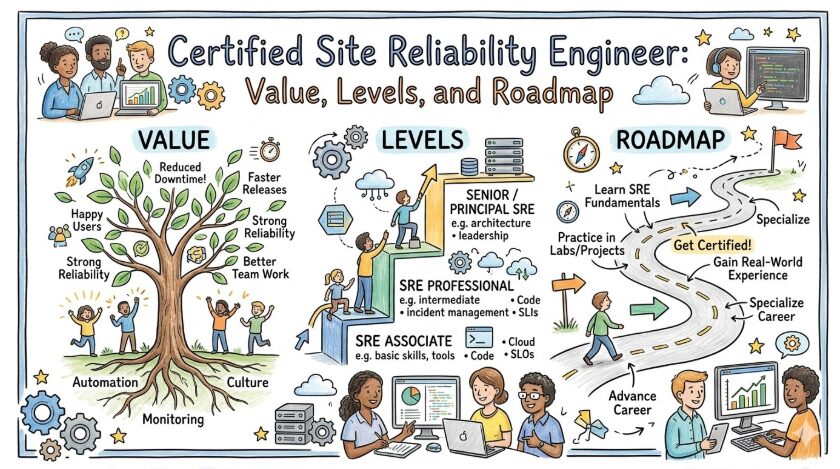
Introduction
In the current landscape of cloud-native architecture, the role of a Certified Site Reliability Engineer has transitioned from a niche specialty to a core requirement for any organization operating at scale. This guide is designed for software engineers, platform architects, and technical managers who recognize that modern systems require more than just deployment—they require sustainable, automated, and reliable operations. As we move deeper into the era of complex distributed systems, understanding the balance between feature velocity and system stability is the primary differentiator for high-performing engineering teams. This comprehensive review will help you navigate the certification landscape, evaluate the career impact of this credential, and determine how to integrate these practices into your professional growth within the DevOps and platform engineering domains.
What is the Certified Site Reliability Engineer?
The Certified Site Reliability Engineer designation represents a commitment to the “operations as a software problem” philosophy originally pioneered at Google. It is not merely a theoretical framework but a production-focused credential that validates an engineer’s ability to apply software engineering principles to infrastructure and operations tasks. This certification exists to bridge the gap between traditional IT operations and modern development, focusing heavily on measurable reliability through code rather than manual intervention. It aligns with enterprise practices by emphasizing error budgets, service level objectives, and the reduction of toil, ensuring that practitioners can handle the rigors of 24/7 high-traffic environments.
Who Should Pursue Certified Site Reliability Engineer?
This certification is highly beneficial for mid-level and senior software engineers who want to specialize in the operational health of their applications. Systems administrators and cloud engineers looking to transition into SRE roles will find this path essential for learning the necessary automation and monitoring patterns. Furthermore, engineering managers and technical leaders should pursue this knowledge to better understand how to structure their teams and set realistic performance targets for their products. In the global market, including the rapidly evolving tech hubs in India, the demand for certified professionals who can guarantee system uptime while maintaining development speed is at an all-time high across finance, e-commerce, and SaaS sectors.
Why Certified Site Reliability Engineer is Valuable and Beyond
The longevity of the Site Reliability Engineering discipline is rooted in the fact that as long as there is software, there is a need for that software to be reliable. Tooling may change—moving from VMs to containers to serverless—but the fundamental principles of monitoring, incident response, and capacity planning remain constant. This certification provides a return on investment by making an engineer “tool-agnostic,” focusing on the architectural patterns and cultural shifts required to maintain complex systems. Enterprises are increasingly adopting SRE models to replace traditional siloed operations, ensuring that those with these certified skills remain at the forefront of the industry regardless of which cloud provider or orchestration platform becomes the next standard.
Certified Site Reliability Engineer Certification Overview
The program is delivered via the official course portal and is hosted on the sreschool.com platform. It is structured as a rigorous assessment of both technical proficiency and the ability to implement SRE cultural patterns within an organization. Unlike general DevOps certifications that may focus heavily on CI/CD pipelines, this program hones in on the “Run” phase of the software lifecycle, examining how systems behave under load and how they recover from failure. The certification ownership ensures that the curriculum stays updated with the latest industry standards, providing a practical framework that can be immediately applied to production environments to improve stability and performance.
Certified Site Reliability Engineer Certification Tracks & Levels
The certification is structured to support professionals at various stages of their career journey, beginning with the foundation level and moving toward expert-tier specializations. The foundation level establishes a common language around reliability, while professional and advanced tracks dive deep into complex topics like distributed system design, advanced observability, and disaster recovery orchestration. These levels are designed to align with career progression, allowing a junior engineer to move from a generalist role into a dedicated SRE position, and eventually into a Principal or Architect role. This tiered approach ensures that learning is incremental and that each certification validates a specific, higher degree of operational responsibility.
Complete Certified Site Reliability Engineer Certification Table
| Track | Level | Who it’s for | Prerequisites | Skills Covered | Recommended Order |
| SRE Core | Foundation | Aspiring SREs, Developers | Basic Linux/Cloud knowledge | SLIs/SLOs, Toil Reduction, Monitoring | 1 |
| SRE Core | Professional | Active SREs, Cloud Engineers | 2+ years ops experience | Incident Management, Error Budgets | 2 |
| SRE Core | Advanced | SRE Architects, Leads | 5+ years experience | Distributed Systems, Capacity Planning | 3 |
| Management | Leadership | Engineering Managers | Management experience | SRE Culture, Team Structure, Metrics | 1 |
Detailed Guide for Each Certified Site Reliability Engineer Certification
What it is
This certification validates a candidate’s fundamental understanding of SRE principles and their ability to differentiate between DevOps and SRE. It ensures the practitioner understands how to define and measure reliability using industry-standard metrics.
Who should take it
This is suitable for software developers, junior systems administrators, and recent graduates who want to enter the reliability engineering field. It is also ideal for stakeholders who need to speak the language of SRE.
Skills you’ll gain
- Ability to define Service Level Indicators (SLIs) and Service Level Objectives (SLOs).
- Understanding of the concept of “Toil” and how to identify it.
- Basic knowledge of monitoring and alerting strategies.
- Familiarity with the SRE Golden Signals: Latency, Traffic, Errors, and Saturation.
Real-world projects you should be able to do
- Draft a basic Service Level Agreement (SLA) document for a web service.
- Identify three manual tasks in a deployment workflow that can be automated.
- Configure a basic dashboard to track system health metrics.
Preparation plan
- 7–14 days: Focus on core vocabulary, reading the original SRE handbook chapters on SLOs and error budgets.
- 30 days: Engage with lab environments to configure basic Prometheus or similar monitoring tools.
- 60 days: Complete a full mock project involving the transition of a legacy app to an SRE-managed model.
Common mistakes
- Confusing SLOs with SLAs, which are legal rather than technical targets.
- Underestimating the cultural shift required to implement error budgets.
- Focusing too much on specific tools rather than the underlying principles.
Best next certification after this
- Same-track option: Certified Site Reliability Engineer – Professional
- Cross-track option: Certified DevOps Engineer
- Leadership option: SRE Team Lead Certification
Choose Your Learning Path
DevOps Path
The DevOps path focuses on the entire software delivery lifecycle, where SRE practices serve as the operational pillar. Engineers on this path learn how to integrate reliability checks directly into the CI/CD pipeline, ensuring that performance testing and stability gates are automated. This path is ideal for those who want to maintain a balance between writing feature code and managing the infrastructure that runs it. By combining SRE with DevOps, professionals can create a “You Build It, You Run It” culture that significantly reduces the friction between development and operations teams.
DevSecOps Path
In the DevSecOps path, the focus shifts to integrating security as a core component of system reliability. Practitioners learn that a system cannot be reliable if it is not secure, treating security vulnerabilities as a form of operational debt that can cause catastrophic downtime. This path involves automating security scanning and compliance checks within the SRE framework, ensuring that the infrastructure is resilient against both accidental failures and malicious attacks. It is a critical path for engineers working in highly regulated industries like banking or healthcare.
SRE Path
The pure SRE path is for those who wish to become specialists in high-scale system architecture and stability. This involves a deep dive into distributed systems, complex networking, and advanced automation to handle massive traffic volumes without human intervention. Engineers on this path often work on building internal platforms and tools that other developers use, effectively acting as the architects of the organization’s reliability. It requires a strong programming background and a passion for finding and fixing the most complex bottlenecks in a system.
AIOps Path
The AIOps path explores the intersection of artificial intelligence and IT operations to handle the massive amounts of telemetry data generated by modern systems. Practitioners learn how to use machine learning models to predict potential outages before they happen and to automate the root cause analysis of incidents. This path is essential for organizations where the scale of infrastructure has surpassed the ability of humans to monitor it manually. It focuses on reducing “alert fatigue” by using intelligent filtering and automated remediation.
MLOps Path
The MLOps path is a specialized track for those managing the reliability of machine learning models in production. Unlike traditional software, ML models require monitoring for “data drift” and “model decay,” which are unique forms of reliability challenges. This path applies SRE principles—like SLOs and automated testing—to the ML pipeline, ensuring that models remain accurate and performant over time. It is a bridge between data science and platform engineering, focusing on the industrialization of artificial intelligence.
DataOps Path
DataOps focuses on the reliability and agility of data pipelines, ensuring that data flows from sources to consumers without interruption or corruption. Practitioners apply SRE concepts to data engineering, creating automated tests for data quality and building resilient data architectures. This path is vital for companies that rely on real-time analytics and big data to make business decisions. It treats data pipelines as production systems that require the same level of monitoring and incident response as a core web application.
FinOps Path
The FinOps path integrates financial accountability into the SRE and cloud architecture workflow. As infrastructure becomes more elastic, costs can spiral out of control; this path teaches engineers how to optimize cloud spend as a technical metric alongside latency and uptime. It involves creating “Cost SLOs” and ensuring that the organization gets the most value out of its cloud investment. This path is increasingly popular among senior engineers and managers who need to balance technical excellence with budget constraints.
Role → Recommended Certified Site Reliability Engineer Certifications
| Role | Recommended Certifications |
| DevOps Engineer | Certified Site Reliability Engineer – Foundation, Certified DevOps Professional |
| SRE | Certified Site Reliability Engineer – Foundation & Professional |
| Platform Engineer | Certified Site Reliability Engineer – Advanced, Kubernetes Certification |
| Cloud Engineer | Certified Site Reliability Engineer – Foundation, Cloud Architect Level |
| Security Engineer | Certified Site Reliability Engineer – Foundation, DevSecOps Professional |
| Data Engineer | Certified Site Reliability Engineer – Foundation, DataOps Specialist |
| FinOps Practitioner | Certified Site Reliability Engineer – Foundation, FinOps Certified Practitioner |
| Engineering Manager | Certified Site Reliability Engineer – Foundation, SRE Leadership |
Next Certifications to Take After Certified Site Reliability Engineer
Same Track Progression
For those who have completed the foundation level, the natural progression is to move into the Professional and Advanced tiers. These certifications challenge you to solve more complex scenarios, such as managing multi-region failovers and designing high-availability architectures for global traffic. Deep specialization in SRE makes you an invaluable asset for large-scale tech companies that require specialized “Reliability Architects” to oversee their most critical services.
Cross-Track Expansion
If you have mastered the core SRE principles, expanding into DevSecOps or MLOps can significantly broaden your career prospects. Understanding how reliability interacts with security or data science allows you to take on “Full-Stack Ops” roles, where you can oversee the entire technical ecosystem of a product. This cross-training makes you a more versatile engineer who can solve problems that span multiple departments, often leading to roles like Staff Engineer or Technical Lead.
Leadership & Management Track
Transitioning into leadership requires moving away from the command line and focusing on team dynamics, organizational culture, and business alignment. Certifications in SRE Management or Technical Leadership focus on how to hire SREs, how to negotiate SLOs with business stakeholders, and how to foster a “blameless” culture during incident post-mortems. This is the ideal path for those who want to influence the engineering strategy of an entire company.
Training & Certification Support Providers for Certified Site Reliability Engineer
DevOpsSchool
DevOpsSchool provides a robust ecosystem for professionals seeking to master site reliability. Their approach is heavily grounded in hands-on labs and real-world scenarios that mirror the challenges faced in high-pressure production environments. They offer extensive resources, including recorded sessions and live mentorship, which are tailored to help engineers understand the practical application of SRE principles rather than just passing an exam. Their curriculum is frequently updated to reflect the latest trends in the DevOps and SRE communities globally.
Cotocus
Cotocus is known for its intensive training programs that cater to both individual learners and corporate teams. They focus on delivering high-quality, instructor-led sessions that dive deep into the technical nuances of cloud-native reliability. Their trainers are often industry practitioners who bring a wealth of field experience into the classroom, ensuring that students learn how to solve real problems. Cotocus emphasizes the integration of SRE with modern container orchestration tools, making it a great choice for platform engineers.
Scmgalaxy
Scmgalaxy acts as a community-driven knowledge hub that offers a wide array of tutorials, blogs, and certification guides. They are particularly strong in providing technical documentation and step-by-step guides for various DevOps and SRE tools. Their platform serves as a valuable support system for candidates who prefer a self-paced learning style or who need a quick reference for specific technical challenges during their certification journey.
BestDevOps
BestDevOps focuses on providing curated content and training tracks that highlight the best practices in the industry. They offer specialized courses that help bridge the gap between development and operations, with a strong emphasis on automation and reliability. Their training modules are designed to be concise and impactful, making them suitable for busy professionals who want to gain specific skills quickly without sacrificing depth of knowledge.
devsecopsschool.com
This provider specializes in the intersection of security and operations, offering a dedicated path for those who want to master DevSecOps. Their training programs emphasize the “Shift Left” philosophy, teaching engineers how to integrate security into every stage of the SRE lifecycle. They provide comprehensive labs on automated security testing and vulnerability management, which are essential skills for any modern reliability engineer.
sreschool.com
As the primary host for the Certified Site Reliability Engineer program, sreschool.com offers the most direct and comprehensive path to achieving this credential. Their platform is dedicated entirely to the SRE discipline, providing deep-dive courses on everything from monitoring to incident response. By focusing exclusively on reliability, they ensure that their content is of the highest quality and fully aligned with the certification requirements.
aiopsschool.com
Aiopsschool.com is at the forefront of teaching how artificial intelligence can be leveraged to enhance IT operations. Their curriculum covers the use of machine learning for predictive maintenance, anomaly detection, and automated incident resolution. For SREs looking to future-proof their careers, this provider offers the essential knowledge needed to manage next-generation, AI-driven infrastructure.
dataopsschool.com
Dataopsschool.com addresses the growing need for reliability in data engineering and analytics pipelines. They provide specialized training on how to apply SRE principles to data workflows, ensuring data integrity and availability. Their courses are ideal for data engineers who want to bring a higher level of operational discipline to their data platforms and move away from reactive troubleshooting.
finopsschool.com
Finopsschool.com provides the necessary training to align technical operations with financial business goals. They teach the frameworks and tools needed to monitor cloud costs and implement optimization strategies effectively. This is a critical resource for SREs and managers who are responsible for the financial sustainability of their cloud environments.
Frequently Asked Questions (General)
- How difficult is the Certified Site Reliability Engineer exam?
The exam is designed to be challenging but fair, focusing on practical application rather than rote memorization. If you have a solid understanding of Linux and basic cloud concepts, the foundation level is very achievable with a few weeks of study. - How long does it take to prepare for this certification?
For a working professional, 30 to 45 days is usually sufficient to cover the foundation materials and complete the necessary labs. More advanced levels may require several months of hands-on experience in a production setting. - Are there any prerequisites for the foundation level?
There are no formal prerequisites, but having a basic understanding of software development and how servers work is highly recommended. - What is the return on investment for this certification?
Professionals with SRE certifications often command higher salaries and have access to more senior roles at top-tier tech companies. The investment in time is balanced by the long-term career stability the role provides. - Is this certification recognized globally?
Yes, SRE is a global standard for operations, and this certification is recognized by enterprises and startups alike across the world, including major tech hubs in India, Europe, and North America. - Can I take the exam online?
Yes, the certification process is designed to be accessible globally via online proctored platforms provided by the hosting site. - How often do I need to recertify?
Typically, certifications are valid for two to three years, after which you may need to pass an update exam or demonstrate continuing education in the field. - Is there a coding requirement for SRE?
While you don’t need to be a senior developer, a basic proficiency in a scripting language like Python or Go is essential for the automation tasks covered in the certification. - How does SRE differ from traditional DevOps?
While DevOps is a broad philosophy of collaboration, SRE is a specific implementation of that philosophy with a defined set of roles and metrics. - Will this certification help me move into a management role?
Yes, understanding the metrics and cultural aspects of SRE is excellent preparation for managing modern engineering teams. - Do I need to be an expert in Kubernetes to pass?
While Kubernetes is a common tool used in SRE, the certification focuses more on the principles of reliability which can be applied to any orchestration platform. - Are there practice exams available?
Yes, most training providers listed offer mock exams and practice questions to help you gauge your readiness.
FAQs on Certified Site Reliability Engineer
- What are the primary skills tested in the Certified Site Reliability Engineer program?
The program tests your ability to define and monitor SLOs, manage incident response, perform root cause analysis, and automate repetitive tasks to reduce toil. - How does the certification handle modern observability?
It moves beyond simple monitoring to teach deep observability, including tracing, logging, and metrics, to understand the “why” behind system failures. - Is the focus more on tools or culture?
It is a balanced approach. While you will learn about tools, the certification places a heavy emphasis on the SRE culture and the mindset required for reliability. - Does this certification cover cloud-specific tools?
The principles taught are cloud-agnostic, meaning they apply whether you are using AWS, Azure, Google Cloud, or an on-premise data center. - What is the passing score for the foundation exam?
Typically, a score of 70% or higher is required, though this can vary slightly depending on the specific version of the exam. - Are there any hands-on lab requirements?
Yes, the professional and advanced levels often include lab-based assessments where you must solve real infrastructure problems in a live environment. - How is the curriculum updated?
The certification board reviews the curriculum annually to ensure it reflects the latest industry shifts, such as the rise of AIOps and serverless technologies. - Can teams take this certification together?
Many organizations use this program to get their entire engineering staff on the same page regarding reliability standards and language.
Conclusion: Is Certified Site Reliability Engineer Worth It?
As someone who has navigated the evolution of operations from manual rack-and-stack to fully automated cloud environments, I can tell you that the principles of Site Reliability Engineering are the most stable foundation you can build a career on. The Certified Site Reliability Engineer credential is not just a badge for your resume; it is a structured way to internalize the discipline required to run modern, high-scale software. If you are looking to move away from firefighting and toward building resilient, self-healing systems, this path is worth every hour of study. It provides the clarity and technical depth needed to lead in an industry where reliability is the ultimate competitive advantage. Whether you stay in a technical role or move into leadership, these skills will remain relevant for the next decade of your career.