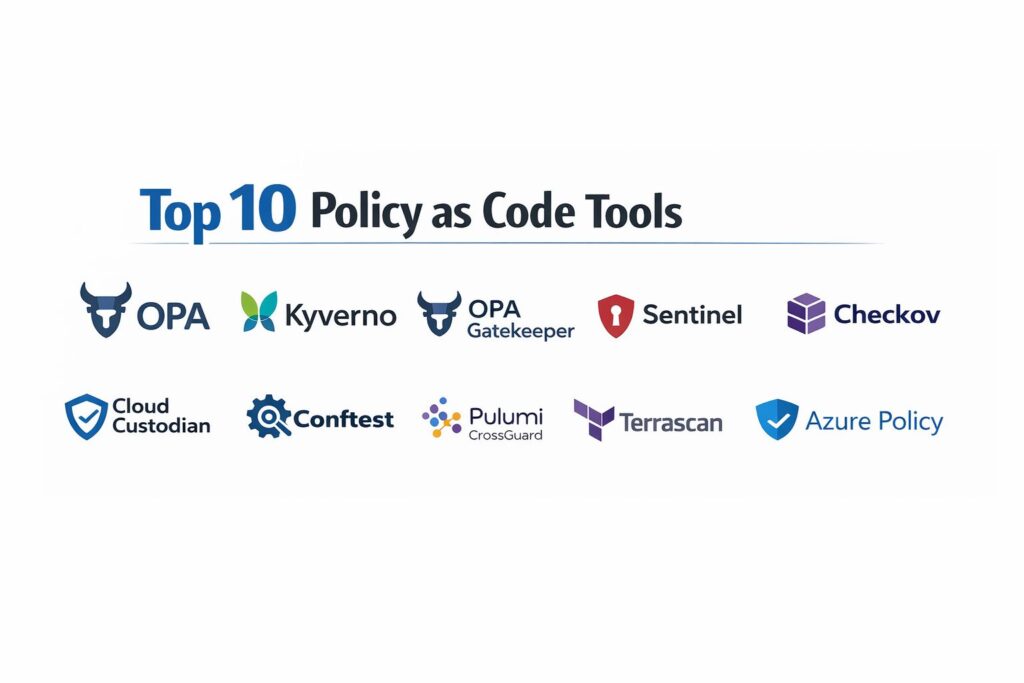
Introduction
Policy as Code (PaC) represents the evolution of governance from manual, document-heavy checklists to automated, version-controlled logic. In the modern cloud-native ecosystem, infrastructure is provisioned through code, making it essential that the guardrails governing that infrastructure are also codified. At its core, PaC involves writing rules in a high-level declarative language that can be tested, shared, and enforced across the entire software development lifecycle. By decoupling policy decisions from the underlying application or infrastructure logic, organizations can achieve a level of consistency and security that was previously impossible. This approach allows security and compliance teams to define “golden paths” for developers, ensuring that every deployment adheres to organizational standards without requiring manual intervention.
The strategic implementation of PaC is a critical component of a mature DevSecOps practice. It enables a “shift-left” security model where misconfigurations—such as unencrypted storage buckets or overly permissive network rules—are caught in the IDE or CI/CD pipeline before they ever reach production. Beyond security, PaC streamlines operational efficiency by providing instant feedback to engineers, reducing the friction between development and compliance departments. As environments scale to thousands of resources across multi-cloud and hybrid architectures, PaC serves as the automated referee that maintains order, ensuring that velocity does not come at the expense of safety. Selecting the right tool requires an understanding of the specific domain—whether it is Kubernetes admission control, infrastructure scanning, or fine-grained application authorization.
Best for: DevOps and Platform engineers, Security Architects, and Compliance officers who need to enforce rigorous governance across automated deployment pipelines and cloud-native environments.
Not ideal for: Small, static environments with minimal automation or organizations where infrastructure is still managed through manual “click-ops” in cloud consoles, as the overhead of codifying policies may exceed the immediate benefits.
Key Trends in Policy as Code Tools
The most significant trend is the rise of “Agentic Governance,” where AI-driven agents assist in the generation and refinement of policies based on natural language requirements. This move toward intent-based governance allows teams to describe a security outcome—such as “Ensure no public database access”—and have the tool automatically generate the corresponding Rego or YAML logic. Furthermore, there is a visible convergence between Infrastructure as Code (IaC) scanning and runtime policy enforcement. Modern tools are increasingly unified, providing a single policy engine that validates a Terraform plan in a pull request and simultaneously monitors for drift or unauthorized changes in the live environment.
Sustainability and FinOps are also becoming integrated into the PaC landscape. Policies are no longer just about security; they are being used to enforce cost-management rules, such as preventing the use of expensive GPU instances outside of production or ensuring that all resources are tagged with a specific “cost center” ID. Additionally, the move toward Kubernetes Validating Admission Policy (VAP) using the Common Expression Language (CEL) is gaining traction, offering a built-in alternative to external webhooks. This represents a broader shift toward making policy enforcement a native capability of the platforms themselves rather than a separate, external layer.
How We Selected These Tools
Our selection process for the top Policy as Code tools focused on technical versatility and ecosystem maturity. We prioritized tools that support open standards, such as the Open Policy Agent (OPA) framework, which has become the de facto industry standard. Another key criterion was the ability of the tool to integrate across multiple stages of the pipeline—from local pre-commit hooks to production admission controllers. This “end-to-end” visibility is crucial for maintaining a consistent security posture. We also evaluated the learning curve of the underlying policy languages, balancing the power of Domain Specific Languages (DSLs) like Rego against the simplicity of YAML-based configurations.
The robustness of the built-in policy libraries was a major factor in our scoring. Tools that provide out-of-the-box mappings for compliance frameworks like SOC2, HIPAA, and CIS Benchmarks offer immediate value to enterprise users. We also examined the performance overhead of each engine, as policy evaluation must be fast enough to avoid slowing down CI/CD pipelines or introducing latency into Kubernetes API requests. Finally, we looked for tools that offer strong community support and active maintenance, ensuring that the tool will remain relevant as new cloud services and security threats emerge.
1. Open Policy Agent (OPA)
Open Policy Agent is the industry-standard, general-purpose policy engine that decouples policy decision-making from the services themselves. It uses a declarative language called Rego, which is designed to express complex logic over structured data. OPA is incredibly versatile, used for everything from authorizing microservice API calls to enforcing rules in CI/CD pipelines and Kubernetes.
Key Features
The platform is built around the Rego language, which allows for sophisticated data manipulation and logic checks. It operates as a lightweight sidecar or a standalone service that responds to policy queries with JSON decisions. OPA provides a powerful set of unit testing tools for policies, ensuring that rules behave as expected before they are deployed. It includes a “discovery” feature that allows OPA instances to pull updated policies and data from a centralized server dynamically. The engine is highly optimized for performance, capable of making thousands of decisions per second with minimal latency.
Pros
Extremely flexible and can be used across the entire stack, from applications to infrastructure. It has a massive community and the most extensive ecosystem of integrations in the industry.
Cons
Rego has a significant learning curve and can be difficult for beginners to master. Managing a large-scale deployment of OPA sidecars requires significant operational maturity.
Platforms and Deployment
Available as a binary for Windows, macOS, and Linux; typically deployed as a sidecar or a central service in cloud-native environments.
Security and Compliance
Supports signed policy bundles and secure communication via TLS. It provides detailed audit logs of every decision made by the engine.
Integrations and Ecosystem
Integrates with almost everything including Kubernetes, Terraform, Envoy, Kafka, and various CI/CD tools.
Support and Community
Maintained by the CNCF with a very active Slack community, extensive documentation, and numerous third-party training resources.
2. Kyverno
Kyverno is a policy engine designed specifically for Kubernetes. Unlike OPA, which uses a custom language, Kyverno policies are written in standard Kubernetes YAML. This makes it highly accessible to Kubernetes operators who are already familiar with the platform’s native manifest structure.
Key Features
The tool allows for validation, mutation, and generation of Kubernetes resources. It can automatically “mutate” resources to inject sidecars or labels, ensuring that all pods meet security standards. It features a unique “generate” capability that can create new resources, such as a default NetworkPolicy, whenever a new namespace is created. Kyverno provides a “background scanning” mode that audits existing resources against new policies. It also includes a CLI for testing policies locally against resource manifests before applying them to a cluster.
Pros
Zero learning curve for those already familiar with Kubernetes YAML. It offers native mutation and generation features that are more complex to implement in OPA.
Cons
It is strictly limited to the Kubernetes ecosystem and cannot be used for general-purpose application or cloud-level policies.
Platforms and Deployment
Native Kubernetes controller deployed via Helm chart.
Security and Compliance
Integrates with Kubernetes RBAC and supports image signature verification through Cosign.
Integrations and Ecosystem
Deeply integrated with the Kubernetes API and GitOps tools like Argo CD and Flux.
Support and Community
A CNCF incubating project with a rapidly growing community and strong focus on Kubernetes-native workflows.
3. OPA Gatekeeper
OPA Gatekeeper is a specialized project that brings the power of Open Policy Agent to Kubernetes in a more manageable, native way. It provides a bridge between OPA’s Rego language and the Kubernetes Custom Resource Definition (CRD) model, allowing policies to be managed like any other cluster resource.
Key Features
The platform uses “ConstraintTemplates” to define reusable policy logic and “Constraints” to apply that logic to specific resources. It includes a powerful “audit” functionality that periodically scans the cluster for resources that violate current policies. Gatekeeper supports “dry-run” and “warn” modes, allowing teams to test new policies without breaking existing deployments. It integrates with the Kubernetes ValidatingAdmissionWebhook to intercept and evaluate API requests. The system also supports data replication, allowing policies to make decisions based on other resources in the cluster.
Pros
Provides a structured, scalable way to manage OPA policies across multiple Kubernetes clusters. It offers better auditing and reporting than raw OPA deployments.
Cons
Still requires knowledge of Rego for creating templates. The architecture is more complex than Kyverno, involving multiple components and webhooks.
Platforms and Deployment
Deployed as a controller within Kubernetes clusters.
Security and Compliance
Enforces strict admission control and provides detailed compliance reports for audit purposes.
Integrations and Ecosystem
Specifically built for Kubernetes but shares the wider OPA ecosystem for policy libraries.
Support and Community
Jointly maintained by the OPA community and major cloud providers like Google and Microsoft.
4. HashiCorp Sentinel
Sentinel is an embedded policy as code framework used across the HashiCorp product suite, including Terraform, Vault, and Consul. It is designed for fine-grained, logic-based policy enforcement that goes beyond simple static analysis.
Key Features
The tool uses the Sentinel language, which is designed to be readable and expressive for non-programmers. It supports different “enforcement levels,” such as “advisory” (warn only), “soft-mandatory” (can be overridden), and “hard-mandatory” (cannot be bypassed). Sentinel has a “Simulator” that allows developers to test policies against mock data without needing a live environment. It integrates deeply into the Terraform workflow, evaluating policies during the “plan” and “apply” phases. It also provides built-in functions for handling complex data types and CIDR blocks common in infrastructure management.
Pros
Exceptional integration with the HashiCorp stack, particularly for enterprise governance in Terraform Cloud. The enforcement levels offer great flexibility for organizational rollouts.
Cons
It is a proprietary tool and requires a paid enterprise license for many production features. It is not as general-purpose as OPA.
Platforms and Deployment
Integrated into HashiCorp Cloud Platform (HCP) and enterprise self-hosted versions.
Security and Compliance
Provides enterprise-grade governance with full audit trails and integration with identity providers for overrides.
Integrations and Ecosystem
Works exclusively within the HashiCorp ecosystem (Terraform, Vault, Consul, Nomad).
Support and Community
Supported by HashiCorp’s professional support teams with extensive enterprise documentation.
5. Checkov
Checkov is a static code analysis tool for infrastructure as code. It scans cloud infrastructure configurations created in Terraform, CloudFormation, Kubernetes, and more to detect security and compliance misconfigurations.
Key Features
The platform includes over 1,000 built-in policies covering major security standards like CIS and SOC2. It uses a “graph-based” engine that allows it to understand relationships between resources, such as verifying if an S3 bucket is truly private by checking the attached IAM policies. Checkov allows for custom policies to be written in either Python or YAML. It provides “inline suppression” capabilities, allowing developers to acknowledge and bypass specific checks at the code level. It also integrates directly with Bridgecrew (Prisma Cloud) for a unified view of code and runtime security.
Pros
Very easy to set up and provides immediate value with its vast library of built-in checks. The graph-based analysis catches complex errors that simple scanners miss.
Cons
Primarily focused on static analysis; it cannot act as a runtime admission controller like OPA or Kyverno.
Platforms and Deployment
Python-based CLI tool; runs on Windows, macOS, and Linux. Easily integrated into CI/CD pipelines.
Security and Compliance
Maps all findings to industry compliance standards and provides remediation instructions.
Integrations and Ecosystem
Supports Terraform, Helm, Kubernetes, Serverless, and all major CI/CD providers.
Support and Community
Open-source with strong backing from Palo Alto Networks and a very active GitHub community.
6. Cloud Custodian
Cloud Custodian is a rules engine for managing public cloud accounts. It allows users to define policies for a well-managed cloud infrastructure that are both secure and cost-optimized, using a simple YAML configuration.
Key Features
The tool uses a “stateless” execution model, typically running as a Lambda function or a scheduled container. It can perform “auto-remediation,” such as automatically stopping unencrypted databases or deleting untagged resources. It supports all three major cloud providers (AWS, Azure, GCP) through a single unified language. Cloud Custodian features an extensive library of filters and actions that allow for very granular resource selection. It also provides a robust reporting mechanism that can output findings to S3, CloudWatch, or specialized security dashboards.
Pros
Excellent for multi-cloud governance and remediation. It is highly efficient and costs very little to run due to its serverless-first architecture.
Cons
The YAML DSL can become very complex and difficult to debug for large, multi-step policies.
Platforms and Deployment
Python-based tool; deployed as serverless functions or local CLI.
Security and Compliance
Ideal for enforcing compliance at scale across thousands of cloud accounts.
Integrations and Ecosystem
Integrates natively with cloud-native monitoring and alerting tools like AWS Security Hub and Slack.
Support and Community
An open-source project with a strong community of enterprise users and regular updates.
7. Conftest
Conftest is a utility to help you write tests against structured configuration data. It uses OPA’s Rego language and is specifically designed to be used in CI/CD pipelines to “test” your code before it is deployed.
Key Features
The tool is built to work with any configuration file that can be converted to JSON, including YAML, HCL, and Dockerfiles. It allows teams to treat policy as a “unit test” for their infrastructure. Conftest provides a “verify” command that tests the policies themselves, ensuring they are logically sound. It supports “policy pulling” from remote OCI registries, making it easy to share policies across different teams. The CLI output is designed to be human-readable and can be easily parsed by other automation tools.
Pros
Perfect for “shifting left” by bringing OPA-based policy enforcement directly into the developer’s local environment and CI pipeline.
Cons
Like OPA, it requires learning Rego. It is a testing tool, not a continuous enforcement or admission control tool.
Platforms and Deployment
Standalone binary for Windows, macOS, and Linux; Docker images available.
Security and Compliance
Enforces security standards at the earliest possible stage of the development lifecycle.
Integrations and Ecosystem
Part of the OPA ecosystem; works seamlessly with GitHub Actions, GitLab CI, and Jenkins.
Support and Community
Maintained as part of the Open Policy Agent project with a strong developer following.
8. Pulumi Policy as Code (CrossGuard)
CrossGuard is Pulumi’s Policy as Code framework. It allows you to write policies in familiar programming languages like TypeScript, JavaScript, Python, or Go, and apply them to your Pulumi stacks.
Key Features
The platform allows policies to be run during the “preview” and “update” phases of infrastructure deployment. Because it uses general-purpose languages, you can use standard libraries, loops, and conditional logic that are more powerful than limited DSLs. It supports “remediation” hints that tell developers exactly how to fix a violation. CrossGuard can enforce policies across multiple cloud providers simultaneously. It also offers a “Policy Pack” system that allows for the versioning and distribution of policy sets across an entire organization.
Pros
Highly attractive for developer-centric teams who prefer using their existing coding skills rather than learning a new policy language like Rego or Sentinel.
Cons
It is strictly tied to the Pulumi IaC ecosystem and cannot be used with Terraform or CloudFormation.
Platforms and Deployment
Integrated into the Pulumi CLI and Pulumi Cloud.
Security and Compliance
Supports mandatory and advisory enforcement levels for rigorous compliance management.
Integrations and Ecosystem
Works natively with Pulumi and integrates into standard CI/CD workflows.
Support and Community
Backed by Pulumi’s corporate support with a strong community of modern IaC practitioners.
9. Terrascan
Terrascan is an open-source static code analyzer for Infrastructure as Code. It helps in detecting security vulnerabilities and compliance violations across various IaC tools using the Open Policy Agent (OPA) engine under the hood.
Key Features
The tool comes with over 500 out-of-the-box policies based on the CIS Benchmark. It supports multiple IaC providers including Terraform, Kubernetes, Helm, and Kustomize. Terrascan can be run as an admission controller in Kubernetes to prevent the deployment of insecure resources. It features a unique “template” system that allows users to create their own custom Rego policies easily. It also provides a “scan” command that is highly optimized for speed, making it suitable for pre-commit hooks.
Pros
Combines the power of OPA with the ease of a specialized IaC scanner. It offers a very broad range of supported IaC formats.
Cons
Maintenance has fluctuated; some users prefer more actively updated tools like Checkov for the latest cloud resource support.
Platforms and Deployment
CLI-based tool for all major operating systems; Docker images and admission controller options.
Security and Compliance
Deeply aligned with CIS and other standard security frameworks for infrastructure.
Integrations and Ecosystem
Integrates with popular CI/CD platforms and serves as a Kubernetes admission controller.
Support and Community
Open-source project with a focus on simple, OPA-based infrastructure security.
10. Azure Policy
Azure Policy is a native service in Microsoft Azure that helps you manage and prevent non-compliant resources. It provides a centralized dashboard to enforce different rules and effects over your entire Azure environment.
Key Features
The platform uses a declarative JSON-based language to define policies. It features “Policy Initiatives,” which are groups of policies that can be assigned to a management group or subscription to meet specific compliance goals (e.g., ISO 27001). Azure Policy provides “auto-remediation” capabilities through “deployIfNotExists” or “modify” effects. It integrates with Azure Resource Graph to provide fast, complex querying of compliance states. The system also supports “guest configuration” policies that can audit and enforce settings inside virtual machines.
Pros
Completely free for Azure resources and requires no infrastructure to manage. It is incredibly powerful for maintaining governance across large, complex Azure estates.
Cons
Locked entirely to the Azure ecosystem. The JSON syntax can be verbose and difficult to manage for very complex logic.
Platforms and Deployment
Managed cloud service accessible via the Azure Portal, CLI, and PowerShell.
Security and Compliance
Built-in compliance dashboards for major global standards and tight integration with Microsoft Defender for Cloud.
Integrations and Ecosystem
Deeply integrated with all Azure services, DevOps, and Lighthouse for multi-tenant management.
Support and Community
Fully supported by Microsoft with a vast library of community-contributed policy samples.
Comparison Table
| Tool Name | Best For | Platform(s) Supported | Deployment | Standout Feature | Public Rating |
| 1. OPA | General Purpose | Cross-platform | Hybrid | Rego Language | 4.8/5 |
| 2. Kyverno | Kubernetes Native | Linux (K8s) | Self-hosted | YAML-based Policies | 4.7/5 |
| 3. OPA Gatekeeper | K8s Enterprise | Linux (K8s) | Self-hosted | Constraint Templates | 4.6/5 |
| 4. Sentinel | HashiCorp Stack | Web / Enterprise | Cloud/Hybrid | Enforcement Levels | 4.5/5 |
| 5. Checkov | Static IaC Scan | Cross-platform | Local/CI | Graph-based Analysis | 4.7/5 |
| 6. Cloud Custodian | Multi-Cloud Gov | AWS/Azure/GCP | Serverless | Auto-Remediation | 4.4/5 |
| 7. Conftest | Shift-Left Testing | Cross-platform | Local/CI | Config Unit Testing | 4.5/5 |
| 8. Pulumi CrossGuard | Developer-First IaC | Cross-platform | Cloud/Hybrid | Logic in TS/Python/Go | 4.6/5 |
| 9. Terrascan | OPA-based IaC | Cross-platform | Local/K8s | 500+ Built-in Rules | 4.3/5 |
| 10. Azure Policy | Azure Governance | Azure Cloud | Cloud | Native Cloud Integration | 4.8/5 |
Evaluation & Scoring of Policy as Code Tools
The scoring below is a comparative model intended to help shortlisting. Each criterion is scored from 1–10, then a weighted total from 0–10 is calculated using the weights listed. These are analyst estimates based on typical fit and common workflow requirements, not public ratings.
Weights:
- Core features – 25%
- Ease of use – 15%
- Integrations & ecosystem – 15%
- Security & compliance – 10%
- Performance & reliability – 10%
- Support & community – 10%
- Price / value – 15%
| Tool Name | Core (25%) | Ease (15%) | Integrations (15%) | Security (10%) | Performance (10%) | Support (10%) | Value (15%) | Weighted Total |
| 1. OPA | 10 | 6 | 10 | 10 | 10 | 9 | 9 | 9.15 |
| 2. Kyverno | 9 | 10 | 8 | 9 | 9 | 8 | 10 | 9.05 |
| 3. OPA Gatekeeper | 9 | 7 | 9 | 10 | 8 | 9 | 9 | 8.70 |
| 4. Sentinel | 8 | 8 | 7 | 9 | 9 | 9 | 7 | 8.05 |
| 5. Checkov | 9 | 9 | 9 | 9 | 8 | 8 | 10 | 8.95 |
| 6. Cloud Custodian | 8 | 7 | 9 | 9 | 9 | 8 | 10 | 8.45 |
| 7. Conftest | 8 | 8 | 9 | 9 | 10 | 8 | 10 | 8.75 |
| 8. Pulumi CrossGuard | 9 | 9 | 7 | 9 | 9 | 8 | 8 | 8.45 |
| 9. Terrascan | 8 | 8 | 8 | 8 | 9 | 7 | 10 | 8.25 |
| 10. Azure Policy | 10 | 8 | 6 | 10 | 10 | 10 | 10 | 9.20 |
How to interpret the scores:
- Use the weighted total to shortlist candidates, then validate with a pilot.
- A lower score can mean specialization, not weakness.
- Security and compliance scores reflect controllability and governance fit, because certifications are often not publicly stated.
- Actual outcomes vary with assembly size, team skills, templates, and process maturity.
Which Policy as Code Tool Is Right for You?
Solo / Freelancer
If you are working alone or in a small team, Checkov is the most logical starting point. It requires almost no setup and provides immediate feedback on your Terraform or Kubernetes files, helping you avoid common security pitfalls from day one.
SMB
For small to medium businesses focused primarily on Kubernetes, Kyverno is the winner. Its use of YAML ensures that your existing team can manage security policies without having to learn complex new programming languages, keeping operational overhead low.
Mid-Market
Organizations with a mix of infrastructure and application needs should invest in Open Policy Agent (OPA). While the learning curve is steeper, the ability to use a single policy engine for everything—from API authorization to CI/CD gates—provides a cohesive governance strategy.
Enterprise
Large enterprises already using the HashiCorp or Azure ecosystems should prioritize Sentinel or Azure Policy. These tools offer the “hard-mandatory” enforcement levels and centralized management dashboards required for global compliance and auditing.
Budget vs Premium
Open-source tools like OPA, Kyverno, and Cloud Custodian offer world-class power for free. However, if you need professional support and advanced features like centralized “policy sets” and visual audit dashboards, the premium offerings from HashiCorp or Prisma Cloud (for Checkov) are justified investments.
Feature Depth vs Ease of Use
OPA offers the most depth but is the hardest to use. Kyverno and Azure Policy are far easier to get started with but are limited to their respective platforms. Determine if you need a “swiss army knife” (OPA) or a “specialized scalpel” (Kyverno).
Integrations & Scalability
If your roadmap includes complex multi-cloud and multi-tenant architectures, OPA and OPA Gatekeeper are the only tools with the necessary scalability and integration depth to handle those requirements without becoming a bottleneck.
Security & Compliance Needs
For teams under strict regulatory pressure (SOC2, HIPAA), Checkov and Terrascan are invaluable due to their built-in compliance mappings, which allow you to generate audit-ready reports directly from your code.
Frequently Asked Questions (FAQs)
1. What is the difference between Policy as Code and Infrastructure as Code?
Infrastructure as Code (IaC) defines what resources you want to create (e.g., an S3 bucket), while Policy as Code (PaC) defines the rules those resources must follow (e.g., the bucket must be encrypted). PaC acts as the “referee” for your IaC.
2. Is Rego the only language for Policy as Code?
No. While Rego (used by OPA) is very popular, other tools use YAML (Kyverno), JSON (Azure Policy), or even general-purpose languages like TypeScript and Python (Pulumi CrossGuard).
3. Will Policy as Code slow down my development team?
Initially, there is a small overhead, but in the long run, it speeds up development. By providing instant feedback in the IDE or CI pipeline, developers spend less time waiting for security reviews and fixing bugs later in the cycle.
4. Can I use Policy as Code for non-security rules?
Yes. PaC is frequently used for FinOps (cost control) and operational standards (naming conventions, mandatory tagging), ensuring that the cloud environment remains organized and cost-effective.
5. Do I need a specialized tool for Kubernetes policies?
While you can use general tools, specialized controllers like Kyverno or OPA Gatekeeper are recommended because they integrate directly with the Kubernetes admission process to block non-compliant resources in real-time.
6. Can Policy as Code fix issues automatically?
Some tools, like Kyverno and Cloud Custodian, support “mutation” or “auto-remediation,” meaning they can automatically modify a resource to make it compliant rather than just blocking it.
7. How do I test my policies?
Most modern PaC tools include a “unit test” framework. For example, OPA and Conftest allow you to write tests in Rego to verify that your policies correctly permit or deny specific mock data.
8. Can I run these tools locally?
Yes. Tools like Checkov, Conftest, and Terrascan are designed to be run as CLI tools on a developer’s workstation or as part of a pre-commit hook.
9. What happens if a policy needs to be bypassed?
Most enterprise tools support “enforcement levels” or “exceptions.” This allows authorized users to temporarily bypass a rule for a specific reason while still logging the event for audit purposes.
10. Is Policy as Code only for cloud resources?
No. OPA, for example, is widely used for fine-grained authorization in custom applications, controlling which users can access specific API endpoints or data within a software system.
Conclusion
The transition to Policy as Code is no longer a luxury for elite engineering teams; it is a fundamental requirement for any organization operating in the cloud-native era. As we navigate the complexities of 2026, the ability to automate governance ensures that security is a continuous process rather than a final hurdle. By codifying policies, organizations transform their compliance departments from gatekeepers into enablers, providing developers with the clear, automated boundaries they need to move fast without breaking things. Whether you choose a platform-specific tool like Kyverno or a universal engine like OPA, the goal remains the same: to create a resilient, self-healing infrastructure where security is inherent in every line of code. Implementing these tools is the most effective way to protect your brand, maintain regulatory compliance, and ensure that your automated systems remain within your control.
As a Compliance Lead overseeing governance across multiple cloud environments, I find this deep dive into Policy as Code (PaC) tools essential for modernizing our audit readiness. I learned from this comparison that the shift from manual “checklist” compliance to automated, code-based enforcement is the only way to maintain a consistent security posture at scale. In my real-world role, these tools allow me to sleep better knowing that our infrastructure won’t even deploy if it violates our encryption or tagging standards. For other teams, adopting PaC means moving from being the “department of No” to providing “guardrails” that empower developers to move fast without breaking compliance. My advice for anyone exploring this list is to look closely at the “as-code” language used; mastering something like Rego for OPA might have a steeper learning curve initially, but the universal applicability across Kubernetes, Terraform, and APIs is what will ultimately future-proof your career in governance. How do you all handle the balance between strict policy enforcement and the need for occasional emergency exceptions in production?